Agile vs Waterfall: Which One Fits Your Project?
A practical comparison of agile and waterfall, covering the real difference between predictive and adaptive delivery, four questions that decide the choice, where each approach genuinely fits, and the mistakes teams make deciding.


The debate is usually conducted as though one approach is modern and the other obsolete.
That framing is unhelpful and produces bad decisions in both directions: iterative delivery
applied to a regulatory submission, and detailed up-front specification applied to a product nobody has validated.
This guide covers the actual difference, four questions that settle the choice, and where each genuinely fits.
Quick answer: Waterfall defines the full scope up front and delivers through sequential phases; agile defines a little, builds, gathers feedback and adjusts. The choice comes down to whether you can know the requirements in advance and how expensive it is to change your mind later.
Neither is universally better — they make different bets about what you know at the start.
The Actual Difference
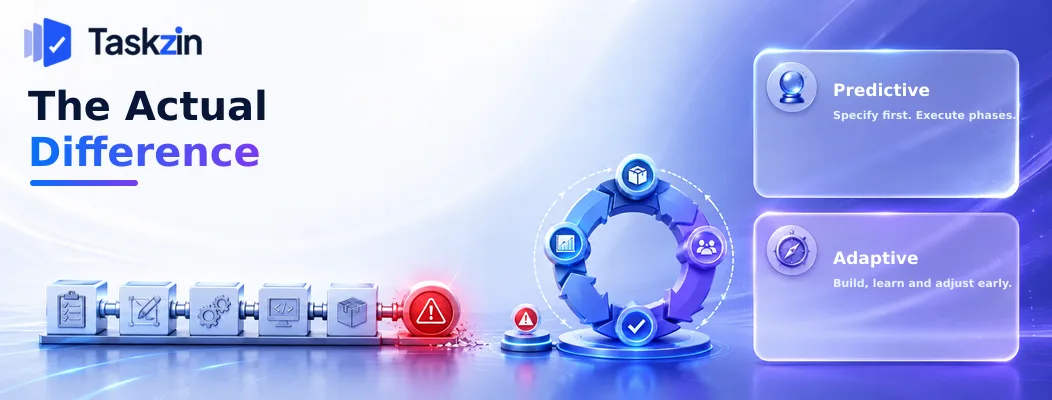
Waterfall assumes requirements are knowable in advance and optimises for efficient execution; agile assumes they are not and optimises for discovering errors early.
Predictive versus adaptive
Waterfall is predictive: specify, design, build, test, deploy, with each phase completing before the next begins and change managed formally.
Agile is adaptive: build a small piece, put it in front of someone who will use it, learn, adjust the plan. The scope evolves as understanding improves.
When you discover you were wrong
This is the practical difference that matters most.
Under waterfall, a mistake in the initial specification surfaces at testing or deployment — the point at which correcting it is most expensive. Under agile, the same mistake surfaces after the first iteration, when correction is cheap.
Waterfall is not worse at getting things right. It is worse at finding out that it got them wrong, which only matters if getting them wrong is likely.
What each assumes about requirements
Waterfall assumes you can specify the outcome accurately before building. For a bridge, a payroll migration or a regulatory filing, that assumption largely holds.
Agile assumes you cannot — that requirements will be revealed by contact with users and reality. For a new product feature or a process redesign, that assumption largely holds instead.
Agile and Waterfall Side by Side
Waterfall Agile Scope Fixed at the start Evolves Sequence Phases in order Iterations, all activities in each
Change Formal change control Expected and absorbed Delivery One release at the end Frequent usable increments Feedback Late, at testing Early, each iteration Planning Detailed, up front Continuous, rolling Documentation Comprehensive Sufficient Best when Requirements stable, change
How expensive is change?
Requirements uncertain, change cheap Main risk Wrong specification found late Drift without a clear end state
Four Questions That Decide It
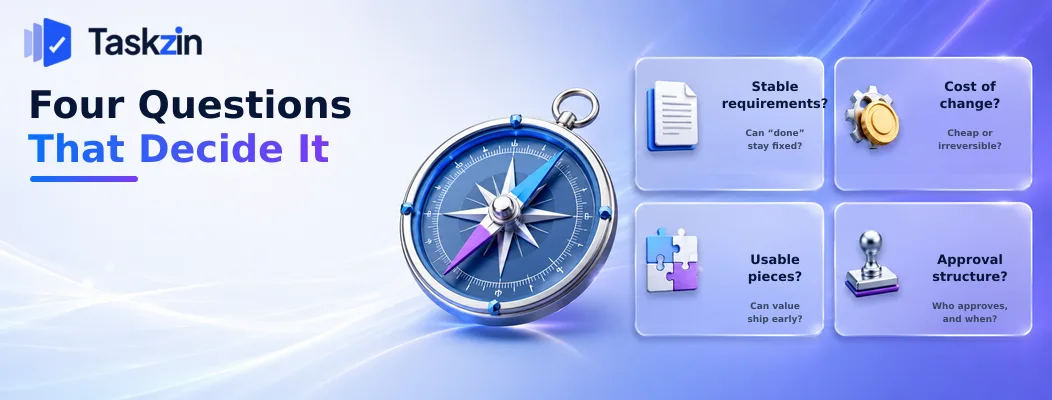
Requirement stability, cost of change, whether you can deliver in usable pieces, and how approvals work will settle the choice for almost any project.
How stable are the requirements?
Can you write down what "done" looks like now, with confidence it will still be right in six months?
If yes, predictive planning is efficient — you avoid the overhead of continuous replanning. If no, specifying in detail produces a document that will be wrong and expensive to correct.
How expensive is change?
Changing a line of code is cheap. Changing a poured foundation is not. Changing a submitted regulatory filing may be impossible.
Where change is expensive or irreversible, the value of deciding correctly up front outweighs the value of learning as you go. Where it is cheap, the reverse.
Can you deliver in usable pieces?
Agile depends on producing something usable each iteration. Some work genuinely cannot be delivered incrementally — half a bridge is not a bridge.
If there is no meaningful partial deliverable, the feedback loop agile relies on does not exist, and you get the ceremony without the mechanism.
Who needs to approve what, and when?
If a governance body must approve the full scope before funding is released, that is a structural constraint on how iteratively you can work.
You may still deliver iteratively within the approved scope — that is a hybrid approach — but pretending the constraint is absent produces conflict rather than agility.
When Waterfall Is the Right Answer
Waterfall fits fixed-scope regulated delivery, physical and irreversible work, and situations where contract or procurement structure fixes the outcome in advance.
Fixed scope and regulated delivery
Where documented traceability from requirement to delivery is mandatory, and where an auditor will examine the specification against the outcome, the artefacts waterfall produces are the evidence you need.
Iterating on the requirement in these environments is not a philosophical stance — it is a compliance problem.
Physical and irreversible work
Construction, manufacturing, infrastructure, event delivery. Materials are ordered, foundations are poured, venues are booked.
The cost of change rises steeply once commitments are made, which is exactly the condition under which up-front planning pays for itself.
Contractual and procurement constraints
A fixed-price fixed-scope contract specifies deliverables in advance. Adapting scope in response to learning is a contractual variation rather than a normal event.
You can still deliver iteratively inside the agreed scope, which is often the sensible compromise, but the commercial structure sets the outer boundary.
When Agile Is the Right Answer
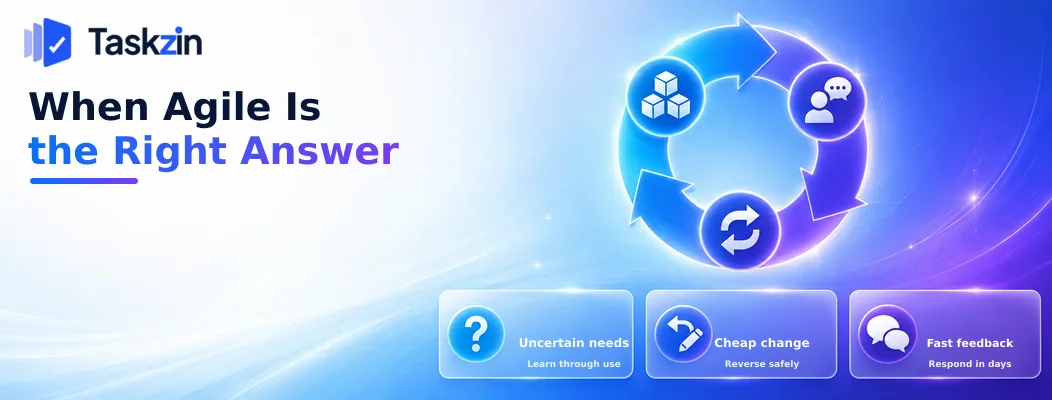
Agile fits work where the requirement is genuinely uncertain, change is cheap and reversible, and real feedback is available quickly.
Uncertain requirements
Product features, process redesign, anything user-facing where the honest answer to "what should this do" is that nobody is certain until people try it.
Specifying this work in detail up front produces confident documentation of a guess.
Cheap, reversible change
Software, digital content, internal processes. Changing direction costs rework rather than materials, and the rework is bounded.
Under those conditions, the option to change your mind is worth more than the efficiency of not having to.
Available feedback
Agile depends on someone responding to what you built. If your users are accessible and can react within days, the loop works.
If feedback takes three months to obtain — a seasonal business, an annual process, a long regulatory cycle — the iteration is theoretical. You are running ceremonies without the learning they exist to produce.
Common Mistakes in This Decision
The three errors are choosing based on what the approach signals, assuming one answer for an entire project, and adopting agile without the organisational authority to change direction.
Choosing by identity
Teams sometimes adopt agile because it signals being modern, or defend waterfall because it signals rigour.
The question is not what the choice says about you. It is whether your requirements are stable and your change is expensive.
Assuming one answer for the whole project
Most substantial projects contain both kinds of work. The infrastructure has fixed lead times; the user-facing features do not.
Splitting deliberately — planning the constrained elements traditionally and delivering the uncertain elements iteratively — is a hybrid approach and it is frequently the correct answer rather than a compromise.
Adopting agile without the authority to change direction
Agile assumes someone can decide to do something different next month. If priorities are fixed annually by a body that meets twice a year, the team's adaptability is theoretical.
This is the most common structural failure. The ceremonies run, the plan does not change, and the organisation concludes agile does not work — when what actually happened is that nothing was allowed to adapt. Whichever approach you choose, the tooling should support both patterns, so a change of method is a process decision rather than a migration.
Frequently asked
What is the difference between agile and waterfall?
Waterfall fixes scope up front and delivers in sequential phases. Agile defines a little, builds, gathers feedback and adjusts. The core difference is when you find out the specification was wrong.
Is waterfall still used?
Widely and appropriately. Construction, regulated manufacturing, infrastructure and fixed-price contracted work all suit sequential delivery where change is expensive and requirements are stable.
Which is better, agile or waterfall?
Neither universally. Agile suits uncertain requirements and cheap change; waterfall suits stable requirements and expensive change. Choosing without assessing those factors is how projects end up mismatched to their method.
Can you use both on one project?
Yes, and it is often correct. Plan fixed-constraint elements traditionally and deliver uncertain elements iteratively, with an explicit interface between the two halves.
Is agile faster than waterfall?
Not inherently. Agile delivers usable output sooner and finds errors earlier, which reduces rework. Total time to a fully defined scope is not necessarily shorter.
Which is better for fixed-price contracts?
Waterfall aligns more naturally, since the contract fixes scope. Agile can operate within a fixed scope, but the commercial structure limits the adaptation that gives agile its main advantage.
How do you switch from waterfall to agile?
Gradually, and only where the work suits it. Start with one team, shorten the feedback loop first, and confirm the organisation can actually redirect priorities — without that, the change is cosmetic.
Binita Ray is a content writer at Taskzin, creating insightful and practical content on task management, team collaboration, productivity, workflow optimization, and SaaS solutions. She focuses on helping businesses, teams, and professionals simplify their work processes, improve efficiency, and make better use of modern productivity tools.
All posts by Binita Ray

Comments