What Is a Work Breakdown Structure (WBS)?
A clear explanation of the work breakdown structure, covering why it is deliverable-based, the 100 percent rule, how to decompose a project into work packages, the available formats, and how the WBS is used after planning.

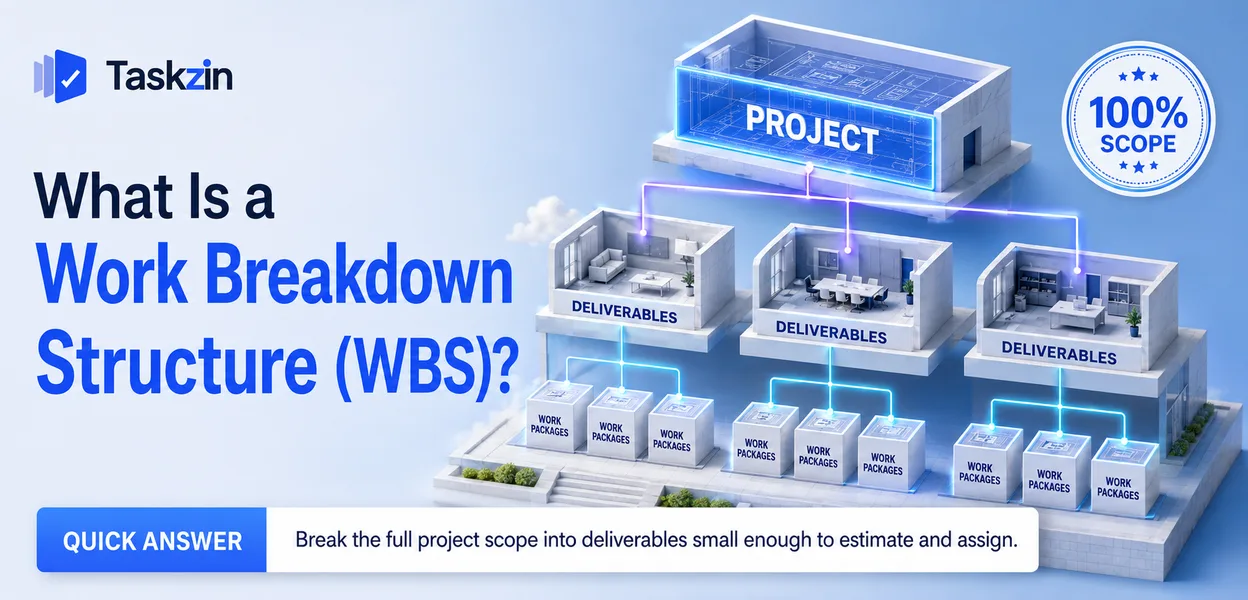
The WBS is one of the older project management tools and remains among the most useful, because it forces you to identify the whole scope before estimating any of it. Most schedule overruns trace back to work that was never in the plan.
This guide covers what a WBS is, how to build one, the formats available, and how it is used after planning.
Quick answer: A work breakdown structure is a hierarchical decomposition of everything a project must deliver, broken down level by level until each piece is small enough to estimate and assign. It is organised around deliverables rather than activities, and it follows the 100 percent rule: the breakdown must account for all the work in scope, and nothing outside it.
What a WBS Is and Why It Exists [IMG]
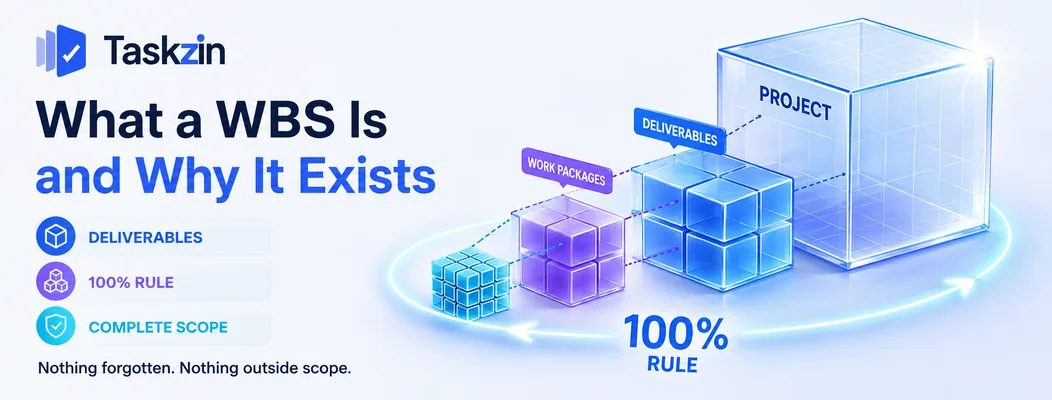
A WBS decomposes the project's total scope into progressively smaller deliverables, so that nothing is forgotten and each piece can be estimated with confidence.
Deliverables, not activities
A WBS describes what the project will produce, not the actions taken to produce it. "User authentication module" rather than "build authentication".
This orientation matters because deliverables are easier to verify and harder to forget. Activity lists tend to describe the work someone imagined; deliverable lists describe what must exist at the end, which is a more reliable way to find omissions.
The 100 percent rule
The rule states that a WBS must include 100 percent of the work defined by the project scope, and no more. Each level of decomposition must fully represent the level above it.
If a parent element breaks into four children, those four must add up to the parent completely.
This is the discipline that catches missing work — the moment you cannot make the children sum to the parent, you have found something you had not planned for.
What it gives you that a task list does not
A flat task list has no way of telling you it is incomplete. A hierarchy does, because each branch must be checked against its parent.
The WBS is also the basis for estimating, scheduling and costing. You estimate the lowest-level packages and roll them up, which is more accurate than estimating the project as a whole.
The Levels of a WBS
Level Contains Example (website project) 1 The project New customer website 2 Major deliverables or phases Design, Build, Content, Launch 3 Sub-deliverables Build → Frontend, Backend, Integrations 4 Work packages Frontend → Navigation, Checkout, Account pages
5 Tasks (optional) Checkout → Cart page, Payment form, Confirmation
Most projects need three to four levels. Five is common only on large programmes.
How to Build a WBS [IMG]
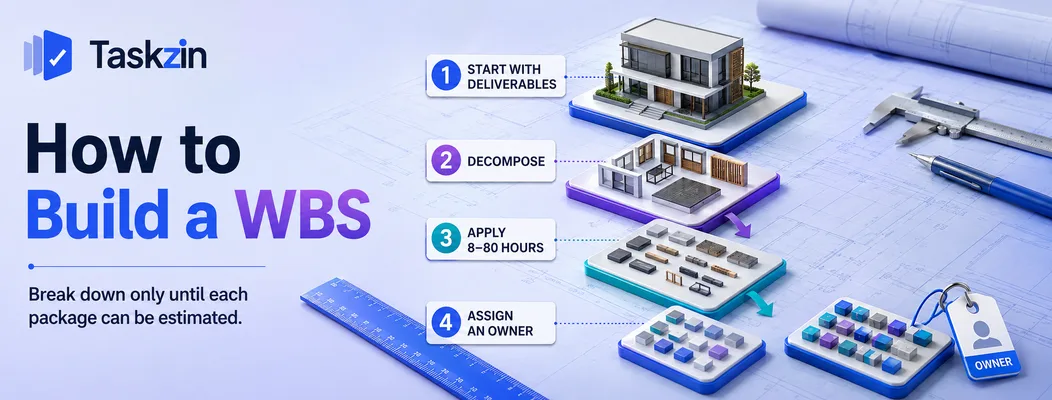
Start from the final deliverables, decompose each until you can estimate it confidently, keep work packages between eight and eighty hours, and give each one an owner.
Start from the deliverables
Ask what must exist when the project is complete. Those are your level-two elements.
Working from the end backwards is more reliable than working forwards from what you plan to do first. Forward planning tends to produce a detailed beginning and a vague end, which is exactly the wrong shape.
Decompose until you can estimate
Break each element down until someone can look at a piece and give an estimate they would defend.
That is the stopping condition. Further decomposition adds administration without improving accuracy, and stopping too early leaves estimates that are guesses about large, poorly understood chunks.
Apply the eight-eighty rule
A common guideline is that work packages should take between eight and eighty hours — roughly one day to two weeks of effort.
Below that, you are tracking at a level that costs more to manage than it returns. Above it, the package is too large to estimate reliably or to detect slippage within.
Assign a work package owner
Each lowest-level package gets one named owner responsible for delivering it.
This is where the WBS connects to execution. Once packages have owners and estimates, they can be sequenced into a schedule and tracked. Modern tools represent this as nested tasks — in Taskzin, projects containing subtasks with owners and dates — which is the same hierarchy in a working form rather than a static diagram.
WBS Formats and When to Use Each
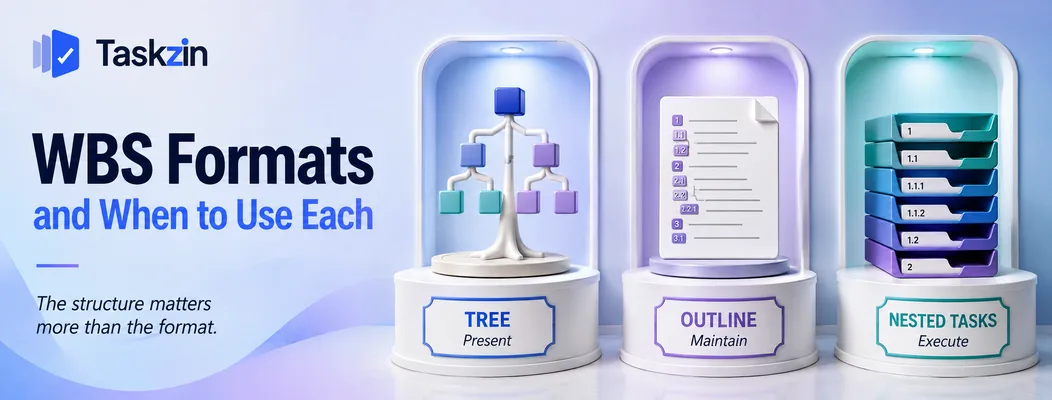
A WBS can be drawn as a tree, written as an indented outline, or built directly as nested tasks in a project tool — the structure matters more than the format.
Hierarchical tree
The classic diagram, useful for presenting scope to stakeholders because the shape communicates completeness at a glance.
Less useful as a working document, since it is awkward to update.
Indented outline
A numbered indented list — 1, 1.1, 1.1.1 — is easier to maintain and prints well.
This is the most practical format for most projects, and it maps directly into a spreadsheet or document.
Nested tasks in a project tool
Building the WBS directly as projects, tasks and subtasks means the breakdown becomes the plan rather than a separate artefact that goes stale.
The trade-off is that the hierarchy is less visible as a whole. Many teams draw the tree once for stakeholders and maintain the working version in their tool.
Using the WBS After Planning [IMG]
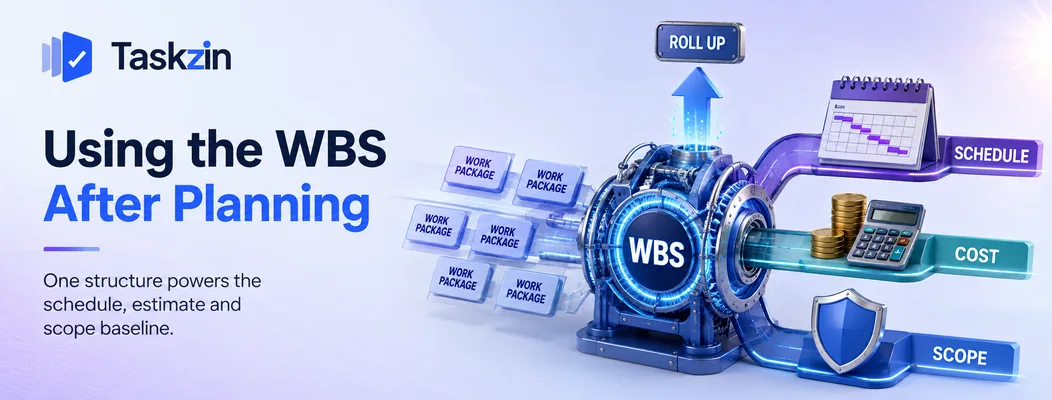
The WBS becomes the foundation of the schedule, the basis for estimating and cost tracking, and the reference for what is out of scope.
It becomes the basis of the schedule
Once you have work packages, you sequence them by dependency, apply durations, and the schedule emerges.
Building a schedule without a WBS means inventing tasks as you go, which is how projects end up with plans that look complete and are missing a third of the work.
It supports estimating and costing
Estimating small packages and rolling up is more accurate than estimating large chunks, because errors in both directions partially offset.
It also gives you the cost baseline. Costs attached to packages roll up through the hierarchy, so you can see spend by deliverable rather than only in total.
It defines what is out of scope
Because the 100 percent rule means the WBS contains all the work and nothing else, anything not in it is out of scope by definition.
This makes scope conversations concrete. "Where does this sit in the WBS?" is a better question than "is this in scope?", because the answer is checkable.
Common WBS Mistakes
The three errors that undermine a WBS are listing activities instead of deliverables, decomposing far past the point of usefulness, and building it without the people doing the work.
Listing activities instead of deliverables
An activity-based breakdown tends to mirror how someone imagines the work proceeding, which means it inherits their blind spots. Deliverable-based breakdowns are checkable against the finished product.
Decomposing too far
A WBS with two-hour work packages produces a plan with hundreds of items, none of which anyone updates. The administrative cost exceeds the planning benefit.
Stop when you can estimate confidently.
Building it alone
A project manager producing a WBS in isolation produces a document reflecting their understanding, complete with its gaps.
Build it with the people who will do the work. They identify the missing pieces, and the resulting estimates are ones they own rather than ones they were given.
Frequently asked
What is a work breakdown structure?
A hierarchical decomposition of all the work in a project's scope, organised by deliverable and broken down until each piece is small enough to estimate and assign to an owner.
What is the 100 percent rule in a WBS?
The principle that the breakdown must account for all the work in scope and nothing outside it, with each level fully representing the level above. It is what catches missing work during planning.
What is a work package?
The lowest-level element of a WBS — a deliverable small enough to estimate, schedule and assign to one owner, commonly representing between eight and eighty hours of effort.
How detailed should a WBS be?
Decompose until someone can estimate a package confidently, typically three to four levels. Further detail adds administration without improving accuracy.
What is the difference between a WBS and a task list?
A task list is flat and cannot indicate its own completeness. A WBS is hierarchical, so each branch can be checked against its parent, which is what reveals work you forgot to plan.
Does agile use a work breakdown structure?
Not formally. Agile uses a product backlog with epics decomposed into stories, which is a similar hierarchical idea applied continuously rather than as an up-front planning exercise.
Who should create the WBS?
The project manager facilitating, with the people who will do the work contributing. A WBS built alone reflects one person's understanding and inherits their gaps.
Binita Ray is a content writer at Taskzin, creating insightful and practical content on task management, team collaboration, productivity, workflow optimization, and SaaS solutions. She focuses on helping businesses, teams, and professionals simplify their work processes, improve efficiency, and make better use of modern productivity tools.
All posts by Binita Ray

Comments