Stakeholder Management: Mapping, Communicating, Escalating
A practical guide to stakeholder management, covering how to identify who genuinely matters, mapping by power and interest, building a communication plan that people read, handling difficult stakeholders, and escalating cleanly.

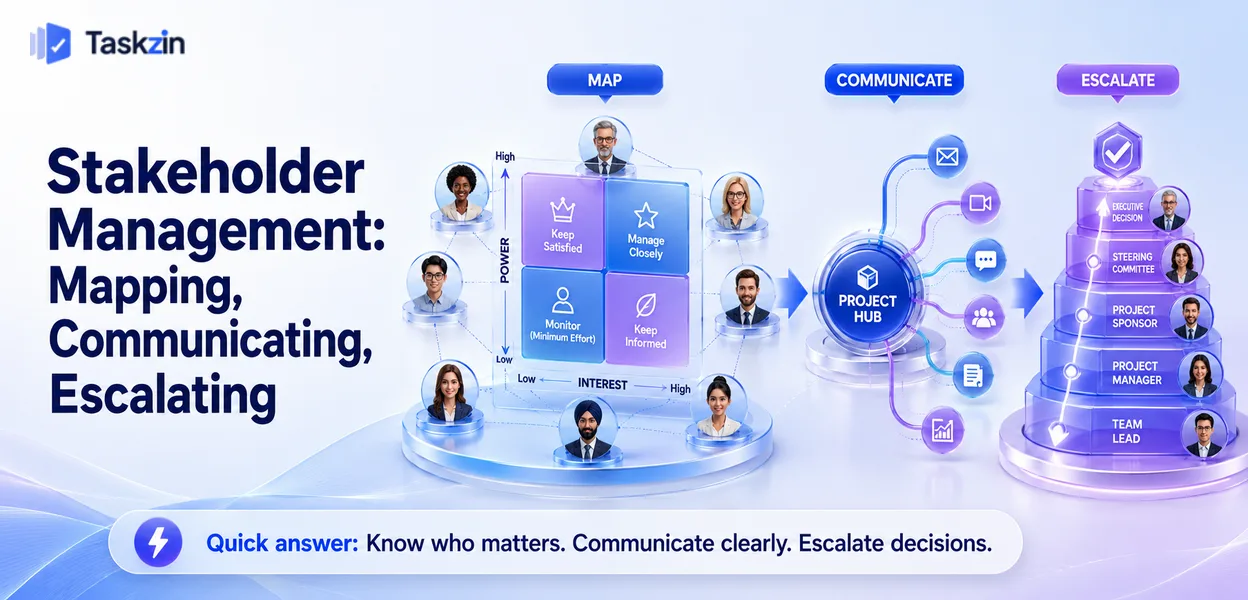
The discipline fails quietly. Nobody reports a stakeholder management problem — they report that a decision took six weeks, or that a department blocked the rollout, or that the sponsor was surprised.
Quick answer: Stakeholder management means identifying everyone who can affect or is affected by the project, understanding what each needs, communicating at the right depth and
frequency, and escalating decisions cleanly when they cannot be resolved at your level. It is mostly unglamorous preparation, and it is the difference between a project that has support when it needs it and one that discovers opposition too late.
What Stakeholder Management Actually Involves
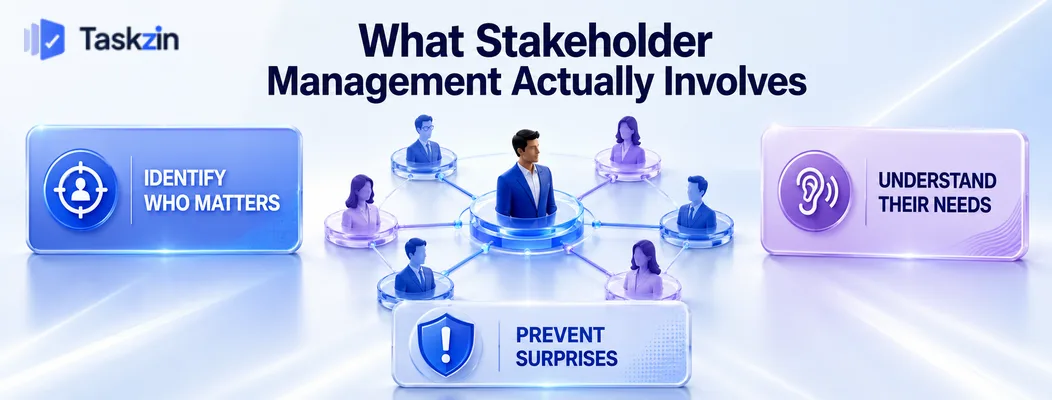
It involves identifying who matters, understanding what each of them needs from the project, and maintaining enough contact that nobody is surprised.
More than keeping people informed
Sending updates is the visible part and the smallest part. The substance is understanding what each stakeholder wants, what they are worried about, and what would make them oppose the project.
That knowledge is what lets you address concerns before they become objections, and it comes from conversations rather than from distribution lists.
Identifying who genuinely matters
Stakeholders are anyone who can affect the project or is affected by it. That includes people with no formal role — the operations manager whose team inherits the result, the compliance lead whose approval you will eventually need.
The ones most often missed are those whose involvement comes late but whose objection is fatal. Identifying them at the start costs an hour; discovering them at month five costs considerably more.
Why it fails quietly
Stakeholder problems present as other problems: slow decisions, late-surfacing requirements, resistance at rollout.
Because the symptom appears elsewhere, the cause is rarely diagnosed. A project manager who cannot name their stakeholders and what each wants is carrying a risk nobody has written down.
Mapping Stakeholders by Power and Interest
Quadrant Power Interest Approach Typical examples Manage closely High High Regular direct contact, involve in decisions Sponsor, key business owner Keep satisfied High Low Brief, infrequent, exception-based Senior executives, finance Keep informed Low High Regular updates, consult on detail End users, delivery teams
Monitor Low Low Minimal, periodic Peripheral departments
Position is not fixed. A low-interest executive becomes high-interest the moment the project affects their area.
Building the Communication Plan
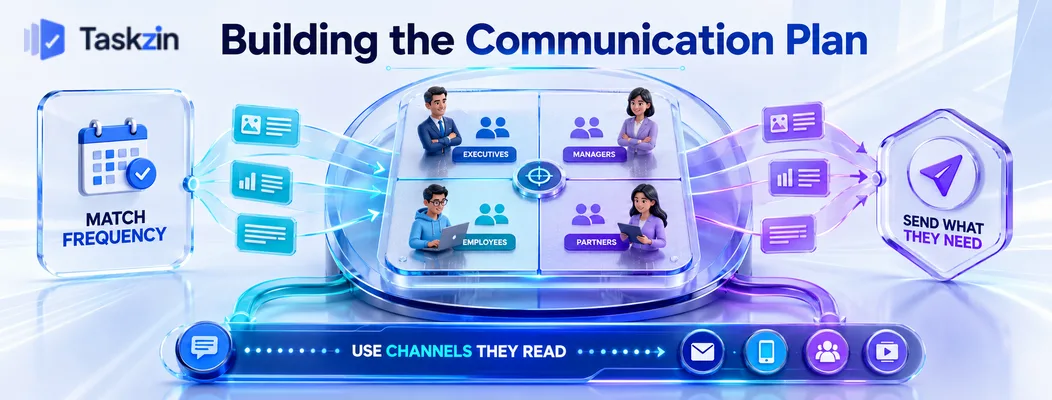
Match communication frequency and depth to each stakeholder's quadrant, work out what each actually needs rather than what is convenient to send, and use channels they already read.
Match frequency and depth to the quadrant
Manage closely: weekly or fortnightly, direct, two-way, involved in decisions.
Keep satisfied: monthly or at milestones, short, exception-focused. These people do not want detail; they want to know whether to worry.
Keep informed: regular updates with enough detail to act on, plus consultation when their area is affected.
Monitor: periodic, minimal.
Decide what each person actually needs
Ask them. "What do you need to know about this project, and how often?" takes two minutes and prevents months of sending the wrong thing.
Most stakeholder communication fails because the sender decided what to send. Executives generally want the exception and the decision required; delivery teams want the detail and the dependencies. Sending both groups the same document means one of them stops reading.
Choose channels people already use
An update posted somewhere a stakeholder never visits has not been communicated.
Use the channel they already read. Where the project data itself can be shared — a read-only project view or dashboard rather than a manually written summary — the update stays current without anyone writing it, and free guest access in tools like Taskzin makes that practical for external stakeholders too.
Managing Difficult Stakeholders
Three common difficulties — disengagement, changing requirements, and bypassing the project manager — each have a specific response.
The one who will not engage
A stakeholder whose input you need who does not respond, does not attend, and does not review.
Try three things in order: make engagement cheaper (five minutes rather than an hour, a decision rather than a review), find out whether they consider the project a priority at all, and if neither works, escalate the absence of a decision rather than complaining about the person. A documented "we could not obtain a decision on X by Y date" is a factual escalation.
The one who changes their mind
Frequently changing requirements usually means the requirement was never properly understood, not that the person is difficult.
Record decisions in writing at the time, with the reasoning. When the position changes, that record turns a disagreement into a change request with a visible cost — which is a much easier conversation than one about who said what.
The one who goes around you
A stakeholder who takes requests directly to a team member, bypassing prioritisation.
Address it with the team first: agree that requests get logged rather than actioned directly. Then address it with the stakeholder, framed as ensuring their request is properly tracked rather than as a complaint about process.
Escalating Without Damage
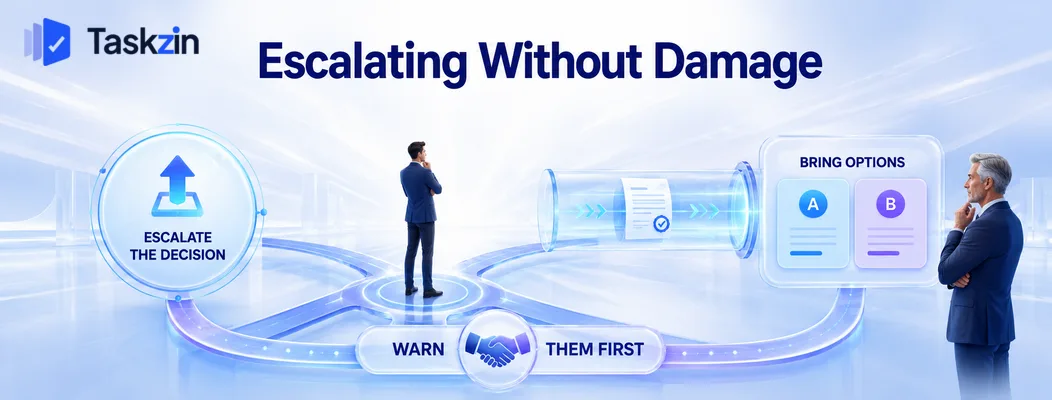
Escalate decisions rather than people, bring options rather than problems, and tell the person before you escalate above them.
Escalate the decision, not the person
"I need a decision on X and cannot obtain one" is a factual escalation. "Y is being difficult" is a complaint, and it damages the relationship permanently.
Frame every escalation around the decision required and its consequence. This keeps it professional and makes it far more likely to be acted on.
Bring options, not just the problem
An escalation presenting a problem asks the recipient to do your analysis. An escalation presenting two or three options with a recommendation asks them to decide, which is what they are for.
This distinction determines whether escalating you is experienced as helpful or as an interruption.
Tell them before you escalate
Tell the person you are about to go above them, and why. "I need this resolved by Thursday, so if we cannot agree I will take it to the sponsor" is fair warning.
Escalating without warning creates an enemy. Escalating with warning frequently makes escalation unnecessary — the warning itself often produces the decision.
Common Stakeholder Management Mistakes
The three recurring failures are sending everyone the same update, communicating only when something is wrong, and mapping stakeholders once at the start.
One update sent to everyone
A single status report distributed widely satisfies nobody. Executives find it too detailed, delivery teams find it too shallow, and both stop reading.
Two versions — a short exception-based summary and a detailed operational update — cover almost every audience.
Only communicating when something is wrong
If your stakeholders only hear from you when there is a problem, your name becomes associated with bad news and contact becomes something they avoid.
Regular contact when things are fine builds the credibility you need when they are not.
Mapping once and never revisiting
Stakeholder positions change. People move roles, a project starts affecting a department it did not before, and a previously indifferent executive becomes highly interested.
Revisit the map at each major milestone. It takes ten minutes and catches the shift that would otherwise surface as unexpected resistance.
Frequently asked
What is stakeholder management?
Identifying everyone who can affect or is affected by the project, understanding what each needs, communicating at appropriate depth and frequency, and escalating decisions cleanly when they cannot be resolved locally.
How do you map stakeholders?
List everyone with influence over or interest in the project, then position each by power and interest to determine the engagement approach. Revisit at milestones, since positions change.
What is a power interest grid?
A four-quadrant map placing stakeholders by how much power they hold and how much interest they have, producing four approaches: manage closely, keep satisfied, keep informed, and monitor.
How often should you communicate with stakeholders?
By quadrant: weekly or fortnightly for high power and high interest, monthly or at milestones for high power and low interest, regularly for high interest and low power, periodically for the rest.
How do you handle a stakeholder who will not engage?
Make engagement cheaper, check whether the project is a priority for them at all, and if neither works, escalate the absence of a decision as a factual issue rather than raising it as a complaint about the person.
When should you escalate?
When a decision is required, cannot be obtained at your level, and delay has a consequence. Bring options with a recommendation, and tell the person you are escalating before you do it.
What is the difference between a stakeholder and a sponsor?
A stakeholder is anyone affected by or able to affect the project. The sponsor is the specific stakeholder who funds it and holds ultimate accountability for the benefits.
Sanju Shrestha is a SaaS content writer at Taskzin who explores smarter ways to manage work, organize priorities, and improve team performance. Her content covers productivity strategies, digital workflows, collaboration, and task management, with a focus on helping modern teams work more efficiently and stay aligned.
All posts by Sanju Shrestha
Comments