Sprint Review vs Retrospective: What's the Difference?
A clear explanation of sprint review versus retrospective, covering what each event inspects, who attends, what each produces, how to run both efficiently, and the mistakes that collapse them into one ineffective meeting.

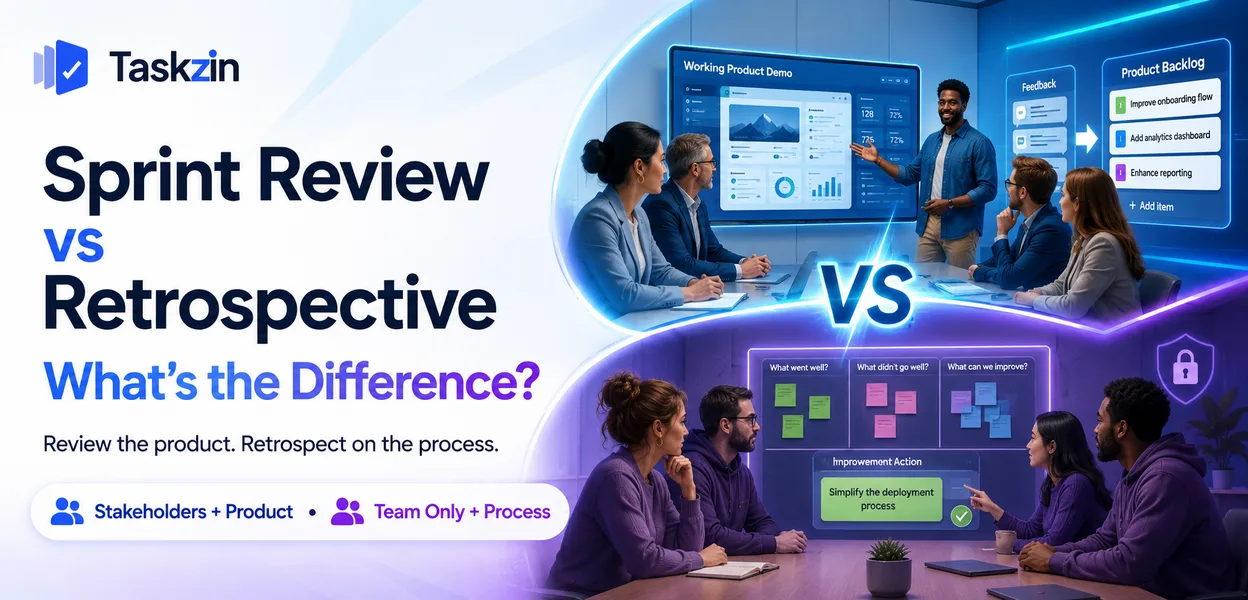
Teams confuse them constantly, and the usual result is a single meeting that does neither job.
Stakeholders sit through a discussion of the team's internal frictions, or the team spends its improvement time walking through completed tickets.
This guide covers the distinction precisely, what happens in each, how to run both without losing an afternoon, and the mistakes that collapse them into one ineffective session.
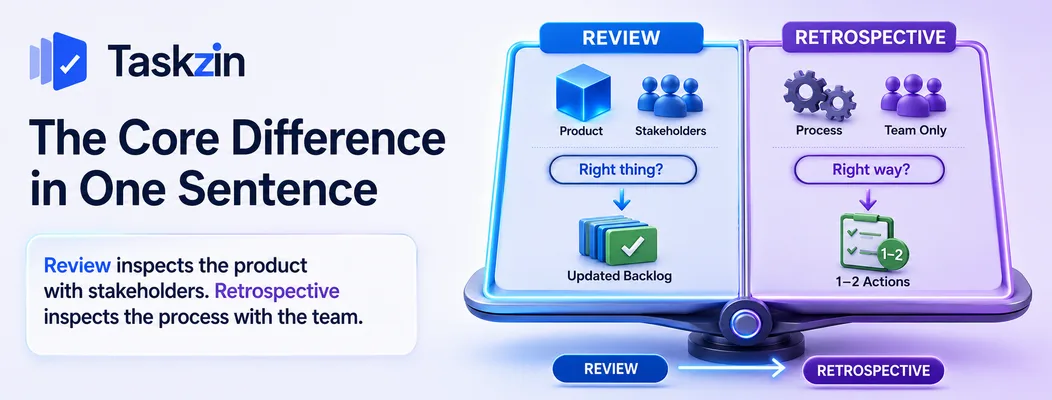
Quick answer: A sprint review examines the product — what was built, whether it meets the need, and what should come next — with stakeholders present. A retrospective examines the process — how the team worked and what to change — with only the team present. One asks whether you built the right thing; the other asks whether you are working the right way.
The Core Difference in One Sentence
Is the sprint review the same as a demo?
process with the team alone.
Both are inspect-and-adapt events, which is why they get conflated. The difference is entirely in what is being inspected and who is in the room.
The review is about the product
The review looks outward. The team shows working software, stakeholders respond, and the conversation is about whether what was built serves its purpose and what the product should do next.
The output is a changed product backlog. If a review does not affect what the team plans to build, the feedback either was not given or was not heard.
The retrospective is about the team
The retrospective looks inward. The team examines how it worked — what slowed it down, what went well, what to try differently — and commits to one or two changes.
The output is a change to how the team operates. Nothing about the product needs to be decided here, and nothing about the team's internal frictions needs to be shared outside the room.
Why the order matters
The review comes first, then the retrospective. This is not arbitrary.
What happens in the review is direct input to the retrospective. If stakeholders were surprised by what was delivered, or if a feature demonstrated poorly, that is process information the team should discuss immediately afterwards while it is fresh. Running the retrospective first means holding it without knowing how the work landed.
Sprint Review vs Retrospective Compared
What Happens in a Sprint Review
Subject The product The process Attendees Team plus stakeholders Team only Question Did we build the right thing? Are we working the right way?
Output Updated product backlog One or two process actions Typical length 45–60 min (two-week sprint) 45–60 min (two-week sprint) Facilitator Product owner Scrum master or rotating Order First Second Tone Collaborative, outward Candid, inward
What Happens in a Retrospective
What is the difference between a sprint review and a retrospective?
stakeholders give feedback, and the product backlog is adjusted based on what everyone learns.
It is a conversation, not a presentation. A review where the team talks for fifty minutes and stakeholders say "looks good" has produced nothing.
Who attends and why
The development team, the product owner, and anyone whose input affects what gets built next:
customers, sales, support, leadership, adjacent teams.
Stakeholder attendance is the point. A review with no stakeholders is a team demo — pleasant, but it cannot generate the external feedback the event exists for. If stakeholders consistently do not come, that is a signal worth addressing directly rather than continuing the ritual.
What gets demonstrated
Working software, from a real environment, operated live. Not slides describing what was built, and not a video recorded earlier.
Only completed work is shown — items meeting the definition of done. Demonstrating partially finished work invites feedback on something that may still change substantially, and it blurs what "done" means, which undermines the team's own standard.
What comes out of it
Three things: feedback recorded against specific items, a revised understanding of priorities, and an updated product backlog.
The product owner should leave with concrete changes to make. If the backlog looks identical afterwards, either the feedback was too vague to act on or the review did not surface any.
Capture the feedback during the meeting rather than afterwards from memory. A shared note taken live, with items attributed to who raised them, means nobody has to reconstruct the discussion the following day — and it lets you show stakeholders next sprint what happened to what they said, which is the single best way to keep them attending.
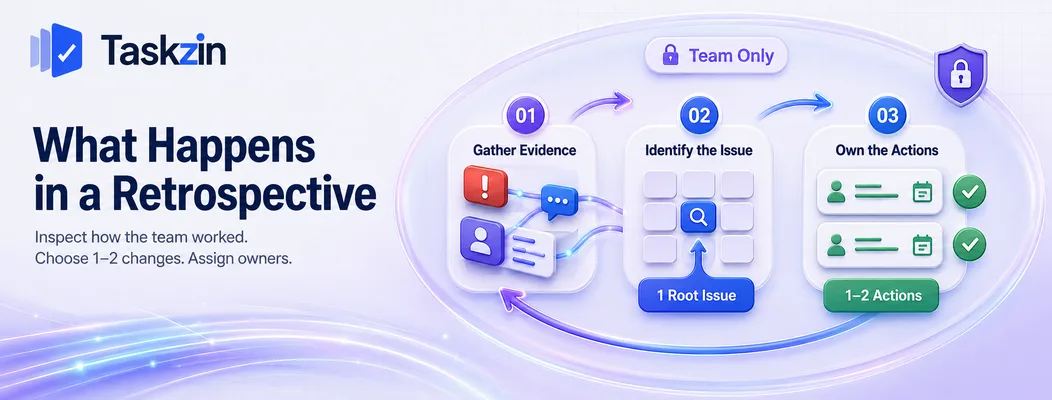
What Happens in a Retrospective A retrospective is a private team session that reviews how the sprint went, identifies what to change, and commits to a small number of actions with named owners.
Its value depends entirely on candour, which depends on who is present and what happens to what is said.
Who attends and why
The development team and the scrum master. The product owner usually attends, since they are part of the team.
Line managers, executives and external stakeholders generally should not. This is not secrecy — it is that people discuss problems differently when someone who influences their career is listening, and the retrospective's whole value is in discussing problems honestly.
What gets examined
How the team worked: handoffs, blockers, communication, tooling, estimation accuracy, interruptions, and anything that made the sprint harder than it needed to be.
Specific product decisions belong in the review. If the retrospective spends its time debating whether a feature was the right one to build, the two events have merged and the process discussion is not happening.
What comes out of it
One or two specific changes, each with a named owner and a due date, small enough to complete alongside delivery work.
The next retrospective opens by checking those actions. That check is what distinguishes a retrospective that changes things from one that produces a list every fortnight and nothing else.
How to Run Both Without Losing an Afternoon
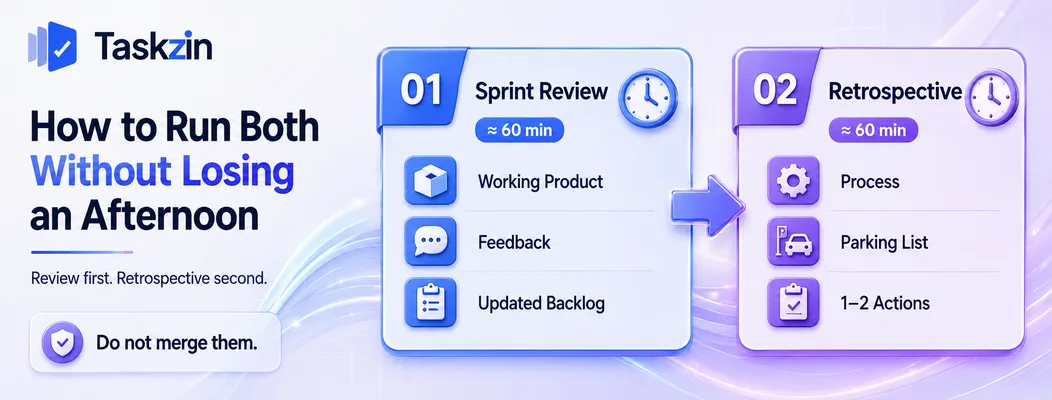
Timebox both sessions to roughly an hour each for a two-week sprint, stop the review turning into a status report, and stop the retrospective turning into a product discussion.
Timeboxing both sessions
Scrum guidance suggests up to four hours for the review and three for the retrospective on a one-month sprint, scaling proportionally. For a two-week sprint that means around two hours and ninety minutes respectively.
In practice, well-run sessions come in well under those ceilings — around an hour each. The ceilings are limits, not targets, and a team treating them as targets will fill the time without adding value.
Keeping the review from becoming a status report
The failure mode is the team narrating each completed ticket while stakeholders listen passively.
Fix it by showing outcomes rather than tickets. Demonstrate what a user can now do, and ask direct questions: does this solve the problem, what would you change, what should we do next.
Questions that require an answer are what turn a presentation into a working session.
Keeping the retrospective from becoming a review
The opposite failure is a team spending its improvement time relitigating product decisions.
The facilitator's job is to redirect: that is a product conversation, let us note it for the product owner and return to how we worked. A parking list for product topics handles this without dismissing anyone.
Common Mistakes With Both Ceremonies
The three most common errors are merging the two events, treating the review as an approval gate, and inviting stakeholders into the retrospective.
Merging them into one meeting
Combining them saves thirty minutes and costs the retrospective entirely. With stakeholders in the room the team will not raise the real process problems, so the session becomes a review with a few polite process observations at the end.
If time is genuinely tight, shorten both rather than merging them.
Treating the review as an approval gate
Some organisations turn the review into a sign-off meeting where stakeholders approve or reject the sprint's output. This changes the dynamic from collaborative to defensive, and the team starts managing the demo rather than seeking feedback.
The review is for inspection and adaptation. Whether work is complete is determined by the definition of done, not by a stakeholder's reaction in the meeting.
Inviting stakeholders to the retrospective
Even well-intentioned observers change the conversation. A manager who attends "just to listen" is still a manager, and people calibrate accordingly.
If leadership wants visibility into team improvement, share the actions rather than the discussion. That gives them the useful part without removing the candour that produced it.
There is a narrow exception worth noting. When a specific cross-team problem needs someone external to resolve it, inviting that person to a single focused session can work — provided it is announced in advance, scoped to that topic, and the team retrospects privately afterwards. The problem is not visitors as such; it is unannounced or permanent ones.
Frequently asked
Can you combine the sprint review and retrospective?
The review inspects the product with stakeholders present and results in an updated backlog. The retrospective inspects the team's process with only the team present and results in process changes.
Which comes first, the review or the retrospective?
The review comes first. Feedback from stakeholders is useful input to the retrospective, so holding the retrospective first means discussing the sprint without knowing how the work landed.
Who should attend a sprint review?
The development team, the product owner, and any stakeholders whose input shapes what gets built next — customers, sales, support and leadership. Broad attendance is the point of the event.
How long should each ceremony be?
For a two-week sprint, around an hour each is typical. Scrum's guidance sets ceilings of four hours for the review and three for the retrospective on a one-month sprint, scaled proportionally.
Can you combine the sprint review and retrospective?
You can, but it effectively removes the retrospective. Teams do not discuss process problems candidly with stakeholders present, so the combined session becomes a review with a few safe observations appended.
Is the sprint review the same as a demo?
A demo is part of it. The review includes the demonstration but is primarily a working conversation about what to build next, ending with an updated product backlog.
What if stakeholders don't attend the review?
Treat it as a signal rather than continuing regardless. Usually the meeting is too long, too detailed, or scheduled badly. Ask a few stakeholders directly what would make attending worth their time.
Sanju Shrestha is a SaaS content writer at Taskzin who explores smarter ways to manage work, organize priorities, and improve team performance. Her content covers productivity strategies, digital workflows, collaboration, and task management, with a focus on helping modern teams work more efficiently and stay aligned.
All posts by Sanju Shrestha
Comments