WSJF (Weighted Shortest Job First) Explained
A clear explanation of Weighted Shortest Job First, covering the economic idea behind it, the formula and its components, how to score each element, a worked example showing the ranking it produces, and common mistakes.

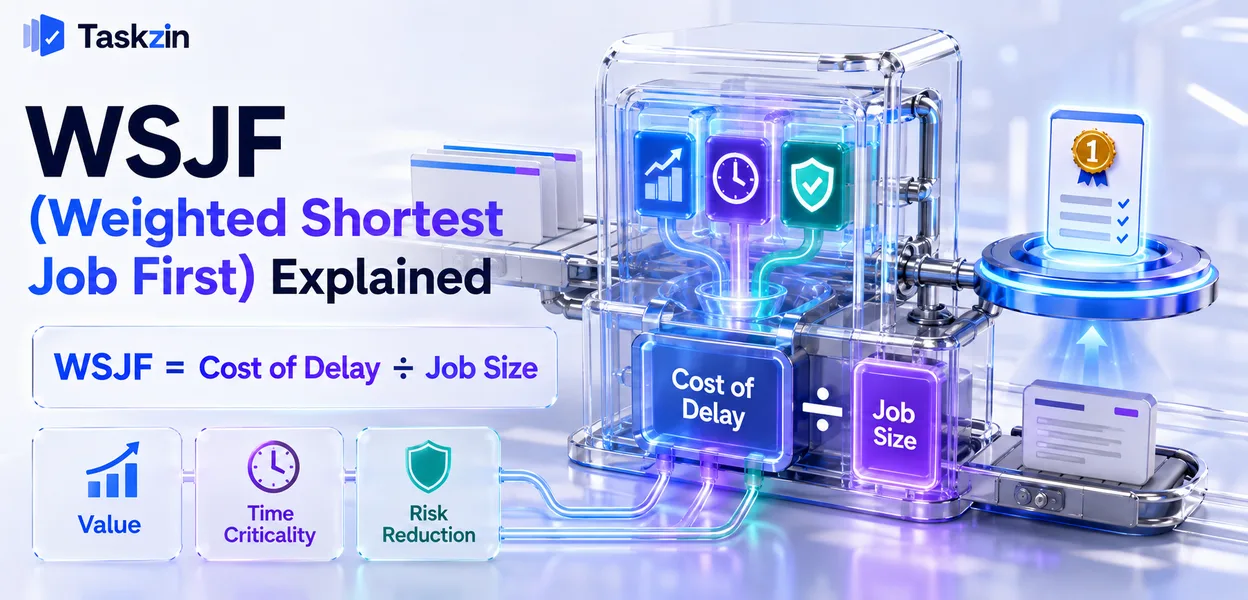
It comes from lean product development thinking and is most associated with SAFe, though the underlying logic works in any backlog. Its main value is that it forces small high-value items ahead of large ones, which teams consistently get wrong when ranking by gut feel.
Quick answer: WSJF prioritises work by dividing cost of delay by job size, so that items delivering the most value per unit of effort go first. Cost of delay is itself the sum of three scores:
user and business value, time criticality, and risk reduction or opportunity enablement. The output is a sequence, not a score — WSJF answers what to do next, not how valuable something is in absolute terms.
What WSJF Is Trying to Solve [IMG]
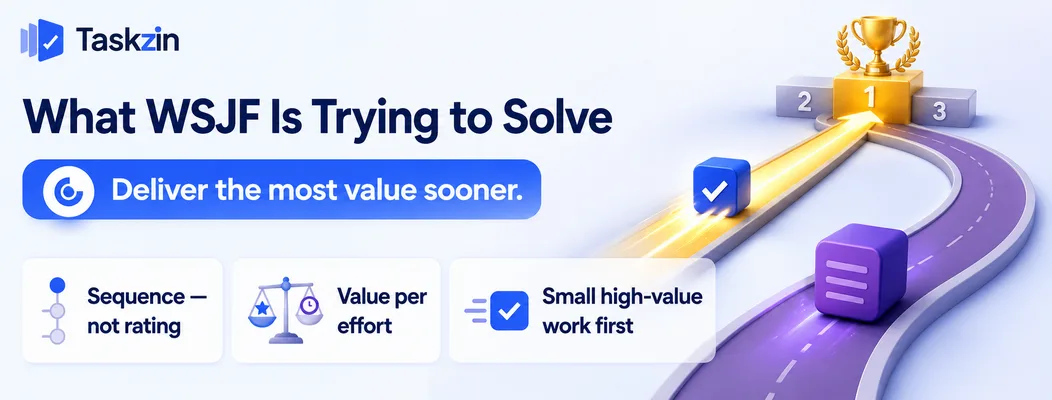
WSJF exists to sequence work economically — putting the items that deliver the most value soonest ahead of those that deliver more value eventually.
Sequencing, not scoring
The output is an order, not a rating. A WSJF of 4.2 means nothing on its own; it means something relative to the other items you scored.
This distinction matters because teams sometimes treat WSJF scores as a permanent property of an item. They are not — the score depends on what you compared it against and when.
The economic idea underneath
If two items deliver the same value and one takes a third of the time, doing the small one first delivers value sooner and costs nothing.
Cost of delay makes this explicit: every period an item is not delivered has a cost. Dividing by size means you are ranking by value delivered per unit of effort, which is the sequence that maximises value over time.
Teams left to rank by intuition consistently favour large, visible initiatives over small high-value ones. WSJF corrects that bias mechanically.
Where it comes from
The concept originates in lean product development economics and entered mainstream agile practice through SAFe, where it is the standard prioritisation method for programme backlogs.
You do not need to run SAFe to use it. The arithmetic works on any backlog where items differ meaningfully in size.
The Formula and Its Components
WSJF = Cost of Delay ÷ Job Size
Cost of Delay = User/Business Value + Time Criticality + Risk Reduction / Opportunity Enablement Component Question it answers Typical scale User/business value How much value does this deliver?
1, 2, 3, 5, 8, 13, 20
Time criticality
Does the value decay if delayed?
1, 2, 3, 5, 8, 13, 20
Risk reduction and opportunity enablement
enablement Does it reduce risk or unlock future work?
1, 2, 3, 5, 8, 13, 20 Job size How much effort is it? 1, 2, 3, 5, 8, 13, 20
All four are scored relatively against the other items in the set, usually on a modified Fibonacci scale.
Scoring Each Component [IMG]

Score all four components relatively rather than in absolute units, comparing items against each other within the same session.
User and business value
The direct value of having the thing: revenue, cost saving, user benefit, strategic progress.
Score relative to the other items. If item A delivers roughly three times the value of item B, and B scores 3, then A scores around 8 or 13.
Time criticality Whether the value decays if you delay. A feature tied to a seasonal event, a regulatory deadline, or a competitive window scores high. Something equally valuable next quarter scores low.
This component is what stops WSJF being purely value-per-effort. Two items with identical value differ if one has a hard date attached.
Risk reduction and opportunity enablement Whether doing this reduces uncertainty or unlocks other work.
This is the component teams most often score too low. Foundational work — an integration several features depend on, a migration that unblocks a roadmap — has value beyond its own delivery, and without this component that value is invisible in the ranking.
Job size
Relative effort, using the same scale. Not duration — effort, in the same sense as story points.
Because size is the denominator, it has outsized influence. A small item with moderate value frequently outranks a large item with high value, which is exactly the correction WSJF is designed to produce.
A Worked Example
Scoring five items shows how a small, moderately valuable item can legitimately outrank a large, highly valuable one.
Five items scored
Item Value Time crit. Risk/opp. CoD Size WSJF A.
Checkout redesign 13 5 3 21 20 1.05 B.
Password self-reset 5 3 2 10 3 3.33 C.
Compliance deadline work 8 20 5 33 8 4.13 D. API for partner integration 8 5 13 26 8 3.25 E. Admin reporting screen 5 1 1 7 5 1.40
Sequence: C, B, D, E, A.
What the ranking reveals
The checkout redesign has the highest raw value and ranks last, because it is large and not time-critical. The compliance work ranks first because a hard deadline makes its cost of delay enormous.
Password self-reset ranks second on a modest value score purely because it is small. That is the WSJF effect, and it is usually the ranking teams would not have produced intuitively.
Sanity-checking the result
If the sequence looks obviously wrong, examine the inputs rather than overriding the output.
Usually one component was scored carelessly — most often risk and opportunity enablement, which teams underweight. Occasionally the sequence is genuinely right and counterintuitive, which is when the method has earned its time.
Using WSJF Well [IMG]
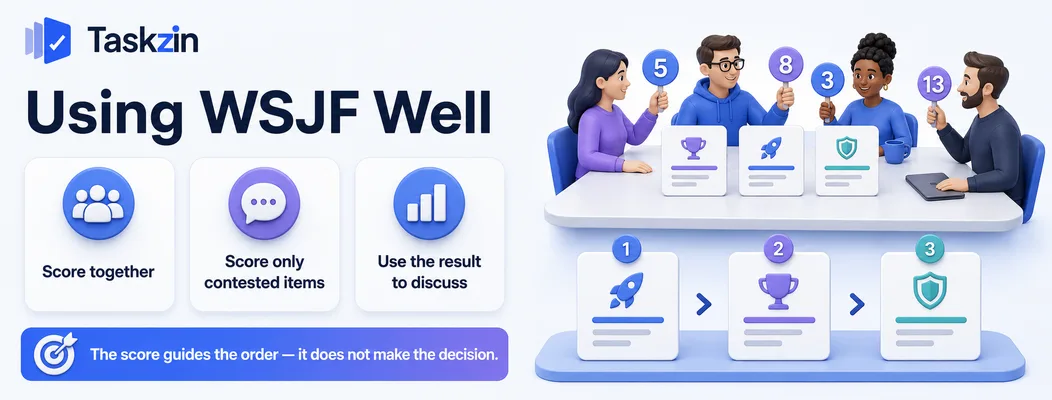
Score relatively in a group, only bother scoring items people disagree about, and treat the output as a prompt for discussion rather than a decision.
Score relatively, in a group
Score as a team, revealing simultaneously where possible, for the same anchoring reasons that apply to estimation.
The discussion when scores diverge widely is where the value is. A three-way disagreement about time criticality usually means people hold different assumptions about a deadline, and that is worth resolving regardless of the ranking.
Only score contested items
Scoring an entire backlog takes hours and mostly confirms what was already obvious.
Score the contested handful — the items where reasonable people disagree about order. That is where the method changes a decision, and it takes twenty minutes rather than an afternoon.
Treat the output as a prompt
The number is not a decision. It is a structured way of surfacing whether your intuition and your stated criteria agree.
Where they disagree, one of them is wrong, and finding out which is the point. Recording the resulting order in your backlog — as a simple ranked list rather than priority labels — is what makes the decision stick.
Common WSJF Mistakes
The three failures are implying precision the inputs cannot support, manipulating the size denominator, and using the method where sequence does not matter.
Precision the inputs do not support
A WSJF of 3.33 versus 3.25 is not a meaningful difference. The inputs are relative estimates on a coarse scale, so the outputs carry the same coarseness.
Treat items within roughly 20 percent of each other as equivalent and decide between them on other grounds.
Gaming the size denominator
Because size divides, understating it inflates the score. Teams advocating for a particular item sometimes do this unconsciously.
Score size independently of value, ideally at a different point in the session, and use the same people who will do the work.
Using it where the sequence does not matter
If items are all similar in size, or if there is no real contention about order, WSJF adds arithmetic without changing anything.
The method earns its cost when items differ substantially in size and people genuinely disagree about sequence. Applying it universally is overhead.
Frequently asked
What is WSJF?
Weighted Shortest Job First — a prioritisation method that divides cost of delay by job size to sequence work so the highest value per unit of effort is delivered first.
What is the WSJF formula?
WSJF equals cost of delay divided by job size, where cost of delay is the sum of user and business value, time criticality, and risk reduction or opportunity enablement.
What is cost of delay?
The economic cost of not having something yet. In WSJF it is approximated by summing three relative scores: value, time criticality, and risk reduction or opportunity enablement.
How do you score job size?
Relatively, on the same scale as the other components, estimating effort rather than duration. Score it separately from value to avoid unconsciously deflating it for items you favour.
Is WSJF only for SAFe?
No. It is SAFe's standard method for programme backlogs, but the arithmetic works on any backlog where items differ meaningfully in size and sequence matters.
How is WSJF different from RICE?
RICE multiplies reach, impact and confidence, then divides by effort. WSJF sums three value components including time criticality, then divides by size. WSJF handles deadlines better; RICE handles uncertainty better through its confidence factor.
When should you not use WSJF?
When items are similar in size, when there is no genuine disagreement about sequence, or when the backlog is small enough to order directly. In those cases it adds arithmetic without changing the outcome.
Binita Ray is a content writer at Taskzin, creating insightful and practical content on task management, team collaboration, productivity, workflow optimization, and SaaS solutions. She focuses on helping businesses, teams, and professionals simplify their work processes, improve efficiency, and make better use of modern productivity tools.
All posts by Binita Ray


Comments