Scrum Roles Explained: PO, Scrum Master, Dev Team
A clear explanation of the three scrum roles, covering why the framework defines only three, what each one decides and does daily, where each commonly goes wrong, and the role combinations that reliably cause trouble.

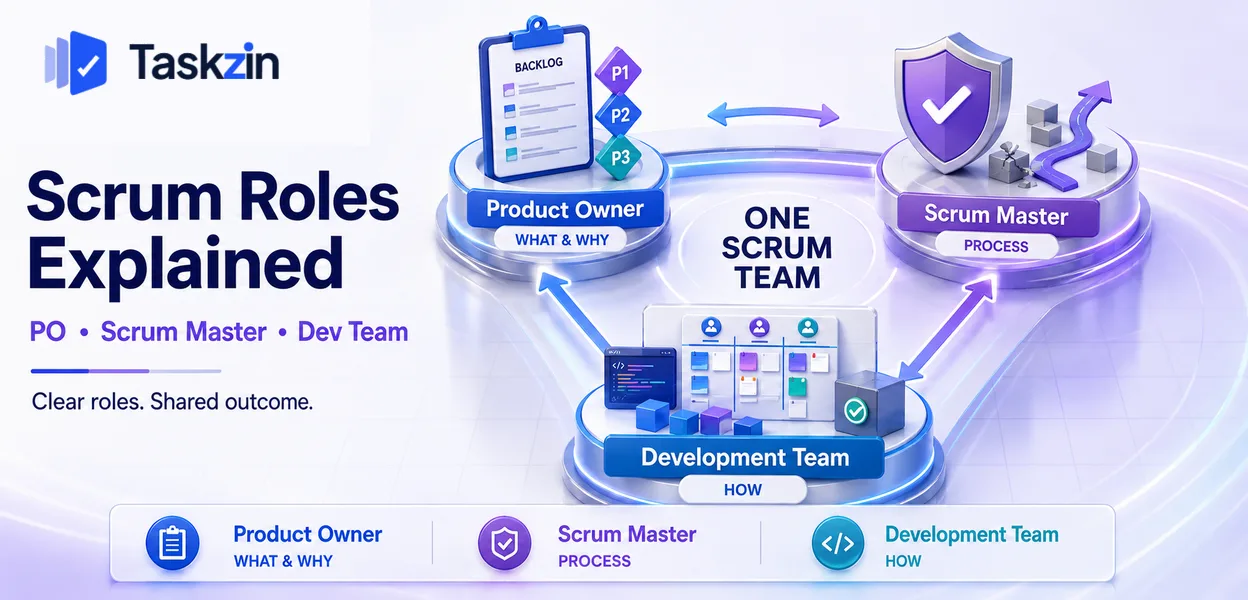
The most common source of confusion is that these are accountabilities rather than job descriptions. A person's employment title and their scrum role are different things, and problems usually start when an organisation maps them one to one without thinking about it.
This guide covers why there are only three, what each actually does, and the role combinations that reliably cause trouble.
Quick answer: Scrum defines three roles: the product owner decides what gets built and in what order, the development team decides how to build it and commits to what fits in a sprint, and the scrum master makes the process work and removes obstacles. Everything else — job titles, seniority, reporting lines — sits outside the framework.
Why Scrum Has Only Three Roles
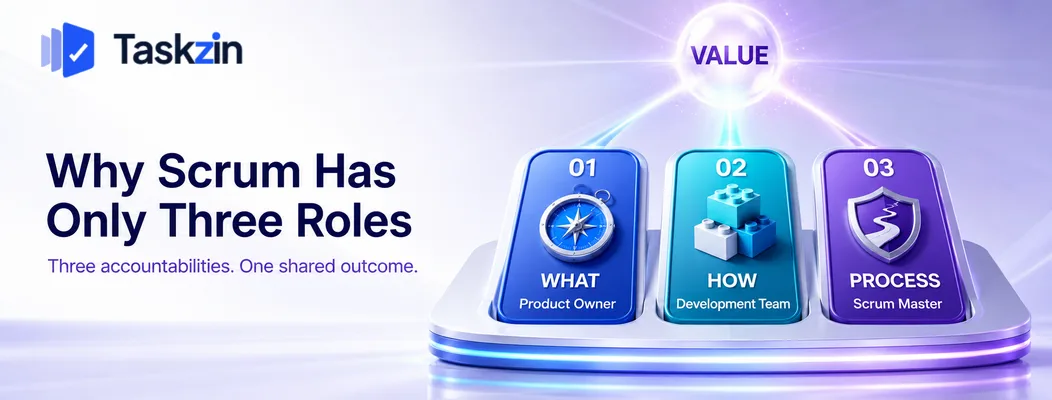
Scrum splits responsibility into deciding what to build, deciding how to build it, and keeping the process healthy — deliberately keeping the structure small so accountability is unambiguous.
Adding roles tends to add handoffs, and handoffs are what the framework is trying to reduce.
Separating what from how
The central division is that one person decides priority and the team decides implementation.
This separation is what makes the framework function. If the product owner starts specifying technical approach, the team loses ownership of quality decisions it is better placed to make. If the team starts deciding priority, there is no single point of accountability for value, and the loudest stakeholder wins by default.
Where traditional job titles fit
A senior engineer, a tech lead, a QA specialist and a designer are all members of the development team in scrum terms. The framework does not recognise sub-roles within it.
That does not abolish expertise or seniority — a tech lead still leads technically. It means scrum does not assign them different accountabilities within the sprint. Similarly, a line manager may exist and handle career development, hiring and pay, but that is an organisational role rather than a scrum one.
The Three Scrum Roles Compared
The Product Owner
What the team decides
What are the three roles in Scrum?
order How the process runs How the work gets done Owns Product backlog Scrum practice Sprint backlog Accountable for Value delivered Team effectiveness Quality of the increment Typical count One person One person Usually 3–9 people
Authority over people None None Self-managing Main failure mode Cannot decide Becomes a manager Waits to be told
The product owner who cannot decide
The product owner is one person accountable for maximising the value of what the team delivers, which they do by owning and ordering the product backlog.
The emphasis on one person is deliberate. Committees produce compromised priorities and no accountability.
What the role actually decides
What goes into the backlog, what order it sits in, what the acceptance criteria are, and whether a completed item meets the need.
Crucially, the product owner also decides what will not be built. That is the harder half of the job, and the one most product owners underperform on. A backlog containing every request ever made is a sign the role is being performed as an intake function rather than a decision-making one.
What a good product owner does daily
Talking to users and stakeholders, refining upcoming items, answering the team's questions quickly, and making small decisions that would otherwise block work.
Availability matters more than most organisations account for. A product owner who answers questions within a day keeps a team moving; one who is unreachable for a week turns every ambiguity into a multi-day delay. This is why a part-time product owner attached to a full-time team is such a common bottleneck.
Where product owners go wrong
Three patterns recur. The proxy product owner relays decisions from someone else, which adds a day to every question. The absent product owner is too senior or too busy to engage, so the team guesses. And the specifying product owner tells the team how to build things, removing the team's ownership of technical quality.
The Scrum Master
The scrum master is accountable for the team's effectiveness — facilitating events, removing impediments, and coaching the organisation on how scrum works — without authority over the people or the product.
The role is frequently misunderstood as a project manager with a new title, which is the opposite of what it is.
Facilitator, not manager
A scrum master does not assign work, set deadlines, or conduct performance reviews. They do not own the plan.
What they own is whether the team can work effectively. That means facilitating events well, protecting the team from interruption, surfacing problems the team cannot see, and pushing back on organisational behaviour that undermines the process. The authority is influence rather than position, which is why the role is genuinely difficult.
What a good scrum master does daily
Removing impediments — chasing the access request, resolving the dependency, escalating the blocker that has sat for three days.
Beyond that: noticing patterns the team is too close to see, coaching the product owner on backlog practice, improving how events run, and having uncomfortable conversations with the wider organisation about behaviour that damages delivery. A good scrum master is often invisible when things are going well.
Where scrum masters go wrong
The most common failure is becoming a secretary — booking meetings, updating the board, chasing status. That is administrative work, and a team that needs it is not self-managing.
The second is becoming a manager, assigning work and pushing for commitments. The third is process fundamentalism: enforcing ceremonies as rules rather than adapting them to what the team needs.
The Development Team
The development team is a self-managing, cross-functional group that decides how to build the work, how much to take into a sprint, and how to maintain quality.
Its defining property is that it collectively has the skills to deliver a working increment without depending on people outside it.
Self-managing and cross-functional
Self-managing means nobody outside the team tells it how to do its work or who does which task. Cross-functional means the team has all the skills needed — development, testing, design as required — rather than handing off between specialist groups.
Both are frequently claimed and rarely fully true. A team that must wait for an external QA group or a separate deployment team is not cross-functional, and the resulting queue is usually the largest single source of delay.
What the team decides
How much work to commit to in a sprint, how to break the work down, technical approach, and internal task allocation.
The team also owns quality. It decides the definition of done and holds it, which is why the definition cannot be imposed from outside — the accountability and the authority have to sit in the same place.
Where development teams go wrong
Waiting to be assigned work rather than pulling it. Accepting more than capacity allows because the product owner asked. And treating the definition of done as negotiable when a deadline approaches, which quietly converts quality into unmanaged technical debt.
The first of these is often a symptom rather than a cause. Teams that wait to be told usually learned to, because previous initiative was overridden or punished. Restoring self-management takes longer than announcing it, and it requires whoever used to assign the work to visibly stop doing so.
Role Combinations That Cause Problems
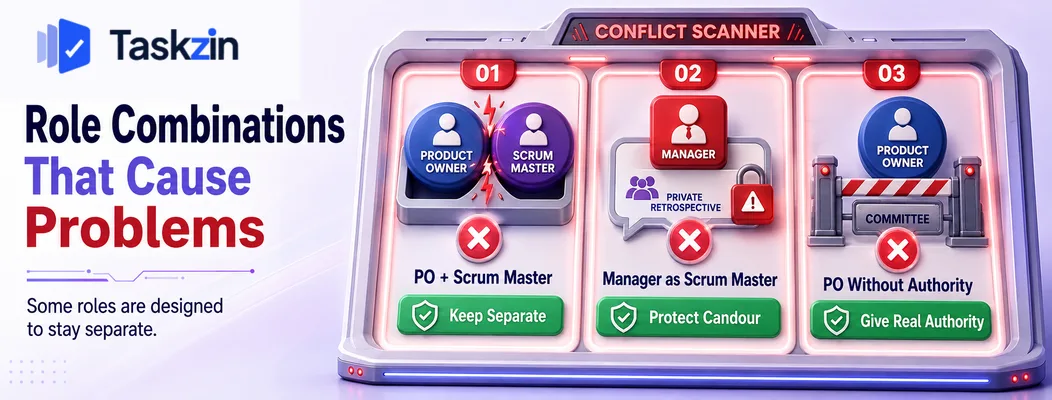
Combining the scrum master and product owner roles, putting a line manager in the scrum master role, and installing a product owner without decision authority are the three arrangements that reliably cause trouble.
Scrum master and product owner as one person
These roles are designed to be in tension. The product owner pushes for more scope; the scrum master protects the team's sustainability and process. One person holding both has to argue with themselves, and in practice the product side usually wins because it has visible stakeholders behind it.
Small organisations do combine them out of necessity. If you must, be explicit about the conflict and give the team an easy route to raise concerns elsewhere.
The manager as scrum master
When the person facilitating the retrospective also writes performance reviews, candour disappears. People do not raise problems honestly in front of someone who influences their pay.
The role can be filled by a team member on rotation, by a scrum master shared across teams, or by someone from outside the reporting line. Any of these beats the line manager.
The product owner who cannot decide A product owner who must check every decision with a committee or an executive is a message-passing layer, not a decision maker. Every question takes days, and the team learns to guess rather than ask.
The fix is organisational rather than procedural: either give the person real authority within agreed boundaries, or put the person who has that authority in the role.
A workable middle path is defining the boundary explicitly: the product owner decides freely within the current quarter's agreed direction, and escalates only changes to that direction. This gives them genuine authority over the decisions that block the team daily while keeping strategic changes where they belong. Vague authority is what causes the bottleneck, more than limited authority does.
Frequently asked
What are the three roles in Scrum?
The product owner, who decides what gets built and in what order; the development team, which decides how to build it; and the scrum master, who makes the process work and removes impediments.
What does a product owner do?
Owns and orders the product backlog, defines acceptance criteria, talks to users and stakeholders, answers the team's questions quickly, and decides what will not be built.
Is a scrum master a project manager?
No. A scrum master does not assign work, set deadlines or manage people. They facilitate events, remove impediments and coach the team and organisation, with influence rather than positional authority.
Can one person be both scrum master and product owner?
It is possible but problematic, because the roles are designed to be in tension. Where necessary in small organisations, be explicit about the conflict and give the team another route to raise concerns.
How big should a scrum team be?
Typically three to nine developers plus the product owner and scrum master. Larger teams spend disproportionate time coordinating and usually work better split into two.
Where do managers fit in Scrum?
Outside the framework. Line managers handle hiring, career development and pay. Scrum defines how work gets delivered, not how the organisation is structured, and mixing the two causes most role confusion.
Do you need a full-time scrum master?
Not always. Small or experienced teams often share one across two or three teams, or rotate the facilitation role internally. A struggling team or a new scrum adoption benefits from dedicated attention.
Binita Ray is a content writer at Taskzin, creating insightful and practical content on task management, team collaboration, productivity, workflow optimization, and SaaS solutions. She focuses on helping businesses, teams, and professionals simplify their work processes, improve efficiency, and make better use of modern productivity tools.
All posts by Binita Ray
Comments