Project Management for Construction Projects
A practical guide to construction project management, covering the programme as a contractual instrument, the project lifecycle, managing RFIs and submittals, coordinating subcontractors by sequence and access, and common mistakes.


The distinguishing feature is that delay costs money in a defined way. A late software release is disappointing; a late building can trigger liquidated damages, and establishing who caused the delay determines who pays. That single fact shapes every process on this page.
This guide covers the lifecycle, managing the programme, controlling information flow, and coordinating subcontractors.
Quick answer: Construction project management differs from other disciplines because the programme is a contractual document with financial consequences, because information flow — RFIs, submittals, drawing revisions — determines progress as much as materials do, and because most of the people delivering the work are employed by other companies. Managing it well means controlling the programme, the information trail and the coordination between parties simultaneously.
What Construction Project Management Involves
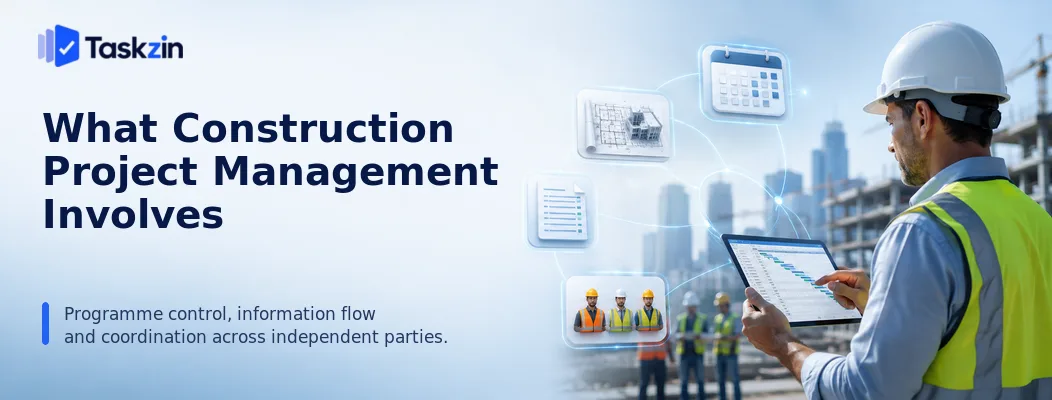
Construction project management covers the programme, the information flow that unblocks work, and the coordination of multiple independent companies working in the same physical space.
The physical constraint matters more than people from other industries expect: two trades cannot occupy the same area at the same time, so sequence is not a preference.
The programme is a contractual instrument
In most industries a schedule is a plan. In construction it is evidence.
If completion is late, the question becomes which delays were on the critical path and who was responsible for each. A baselined programme with recorded actual progress is what answers that. Without it, an extension of time claim rests on recollection, which is a poor foundation when significant money is involved.
Information flow is as critical as materials flow
Work stops waiting for answers as often as it stops waiting for materials. A question about a detail, an unapproved material submission, a drawing revision that has not reached site — each halts progress.
Managing this is a core project management responsibility rather than administration. The RFI register and the submittal register are as operationally significant as the delivery schedule, and their response times feed directly into whether the programme holds.
Coordination across parties you do not employ
The people building are largely subcontractors with their own commercial interests, their own other projects, and their own view of when they will attend.
You coordinate them through the contract, the programme and the site, not through authority.
That makes clear sequencing, adequate notice and accurate records considerably more important than they would be with a directly employed team.
The Construction Project Lifecycle
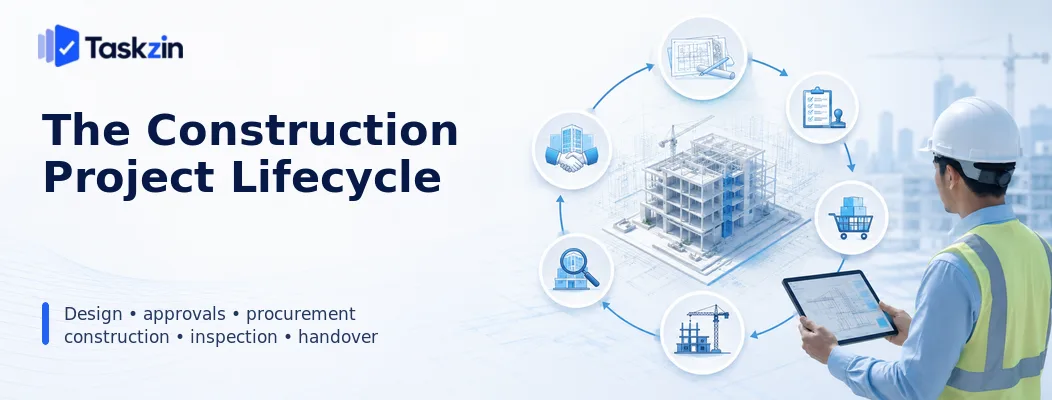
Phase Main project management focus Key artefacts Typical risk Pre-construction Buildability, procurement,
Managing the Programme

Baseline programme, procurement schedule Unrealistic durations Mobilisation Site setup, inductions, early works Site plan, method statements Late possession of site Substructure Ground risk, sequencing Daily reports, RFIs Unforeseen ground conditions Superstructure Trade sequencing, deliveries Look-ahead, submittal register Long-lead item delays Fit-out Trade congestion, access Access plan, coordination drawings Too many trades, one area Commissioning Testing, certification Test records, O&M manuals Late discovery of defects Handover Snagging, documentation Punch list, as-built drawings Incomplete documentation
Managing the Programme Build the programme from genuine sequence logic rather than desired dates, baseline it and record actual progress against it, and act on delay while there is still float to recover.
Build the critical path from real sequence logic
Link activities by what genuinely constrains what: concrete cures before loading, first fix before plastering, plastering dries before decoration.
Include lag where it reflects reality. Curing and drying times cannot be compressed by adding labour, and a programme that ignores them is wrong from the outset. The critical path that emerges tells you which activities deserve daily attention and which have slack, and that is the single most useful output of programming.
Baseline it and record actual progress
Save the agreed programme as a baseline, then record what actually happened against it.
Without a baseline, the programme silently rewrites itself as dates slip, and three months in nobody can demonstrate what was originally agreed. With one, variance is visible weekly, and the record supports whatever commercial conversation follows.
Deal with delay while it is still recoverable
Delay is cheapest to address at the moment it starts. A two-day slip on a non-critical activity may absorb into float; the same slip discovered six weeks later has consumed the float and moved the completion date.
This requires progress recorded at least weekly and someone actually reviewing the critical path against it. A programme updated monthly identifies problems roughly a month after the point at which they could have been fixed.
Managing Information: RFIs, Submittals and Drawings
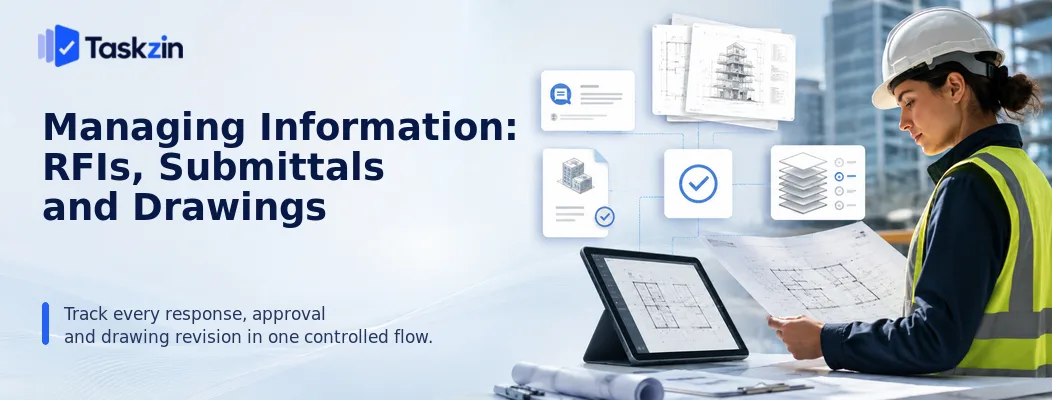
Track RFIs as a queue with response deadlines, maintain a submittal register that flags long-lead items early, and control drawing revisions so nobody builds from a superseded issue.
RFIs as a tracked queue with response times
Every RFI needs a number, a date raised, a responsible party, a required-by date and a record of the response.
The required-by date is the part most often omitted and the most important. An RFI without one sits in a designer's queue behind everything else, and the resulting delay is difficult to attribute afterwards. Tracking RFI ageing — how many are open beyond their required date — is one of the best early indicators of programme risk available.
Submittal registers and long-lead items
The submittal register tracks material and equipment approvals: what has been submitted, what is approved, what is outstanding.
Work backwards from installation dates through approval time and manufacturing lead time to find the submission deadline. Long-lead items are where this matters most — a switchgear approval missed by three weeks can push a completion date, and it will not be visible in the programme unless procurement is linked to it.
Drawing revision control on site
Someone building from a superseded drawing is an expensive and avoidable error, and the record of who held which revision when determines who bears the cost.
Maintain a single controlled source for current drawings, ensure site accesses that source rather than printed copies in a van, and log revision issues. This is the most common single cause of rework on site.
Coordinating Subcontractors
Coordinate trades by sequence and physical access rather than dates alone, run short look-ahead planning with the people doing the work, and record daily what actually happened.
Sequence and access, not just dates
Telling three trades they can start on Monday is not coordination if they need the same area.
Sequence and access are the real constraints, and a programme expressed only in dates hides them.
Plan by area as well as by activity: who is in which zone, in what order, with what handover between them. Congestion in fit-out is the classic failure, where everyone is technically on programme and nobody can work.
Look-ahead planning
A two to six week look-ahead reviewed weekly with subcontractor supervisors is the most effective coordination tool available on most sites.
The value is that the people doing the work identify constraints the office programme cannot see — access, plant, preceding work not actually complete, materials not on site. Surfacing those a fortnight ahead is what turns a programme into something achievable.
Recording what actually happened each day
Daily reports covering labour on site, work completed, weather, deliveries, visitors and any instruction given are the factual record of the project.
They feel like administration and become critical the moment there is a dispute. A consistent daily record covering the whole project is worth more in a delay claim than any retrospective analysis, because it was written at the time by someone with no reason to shade it.
Common Construction Project Management Mistakes
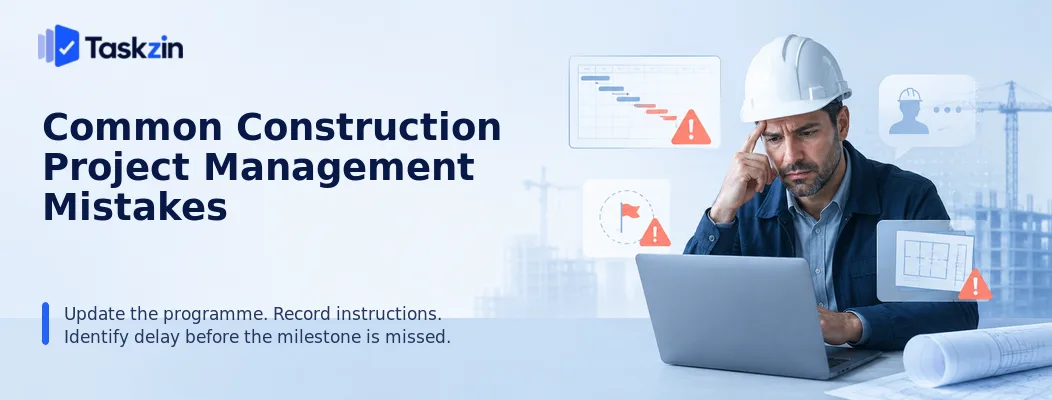
The three most damaging habits are letting the programme go stale, accepting verbal instructions, and discovering delay only when a milestone is missed.
A programme nobody updates after week two
A detailed programme produced for tender and never updated is a document rather than a tool.
It cannot warn you about anything, and by month three it describes a project that no longer exists.
Weekly progress recording against baseline is the minimum for a project of any size.
Verbal instructions with no written record
A client representative asking for a change on a site walk, agreed verbally, is a variation with no record. When the account is settled, the conversation about who authorised it and at what cost has no evidence behind it.
Confirm every instruction in writing the same day, however minor it seemed. This is unglamorous and protects margin more reliably than almost anything else.
Discovering delay at the milestone
If the first indication that a milestone will be missed comes in the week it was due, recovery options are minimal and expensive.
Track the critical path continuously and treat a slip on any critical activity as immediately significant, even when the milestone still looks distant. The whole purpose of identifying a critical path is to know which small slips matter. Note too that the critical path moves — an activity with three weeks of float can become critical after one delay elsewhere, so the path needs recalculating with each update rather than being identified once at the start.
Frequently asked
What does construction project management involve?
Managing the programme as a contractual record, controlling information flow through RFIs, submittals and drawing revisions, coordinating subcontractors by sequence and access, and maintaining the daily record of what happened.
What is the critical path in a construction programme?
The longest chain of dependent activities determining the completion date. Any delay to an activity on the critical path pushes completion directly, which is why those activities need continuous attention.
What is an RFI in construction?
A request for information — a formal query to the design team about a detail, discrepancy or specification. Each needs a number, a responsible party, a required-by date and a recorded response, because unanswered RFIs stop work.
What is a submittal and why does it matter?
A submission of proposed materials or equipment for approval before procurement. It matters because approval time plus manufacturing lead time determines when items arrive, and late approval of long-lead items can move the completion date.
How often should a construction programme be updated?
Weekly for progress recording on most projects, with a fuller review monthly. A programme updated only monthly identifies problems roughly a month after they could still have been fixed cheaply.
How do you manage subcontractor coordination?
Through look-ahead planning reviewed weekly with subcontractor supervisors, planning by physical area as well as by activity, and giving adequate notice of access and preceding work completion.
Why are daily reports important on site?
They are the contemporaneous factual record — labour, progress, weather, deliveries, instructions. In any delay or variation dispute, a consistent daily record carries far more weight than retrospective reconstruction.
Sanju Shrestha is a SaaS content writer at Taskzin who explores smarter ways to manage work, organize priorities, and improve team performance. Her content covers productivity strategies, digital workflows, collaboration, and task management, with a focus on helping modern teams work more efficiently and stay aligned.
All posts by Sanju Shrestha


Comments