How Do You Prioritise Tasks When Everything Is Urgent?
A practical guide to prioritising when everything is marked urgent, covering why urgency inflates, four methods for forcing a ranking, separating urgent from important, and how to handle the trade-off conversation.


"Everything is urgent" is almost never true. It is what happens when nobody has been forced to compare items against each other, so each request is assessed on its own merits, where it always looks reasonable.
This guide covers why urgency inflates, four ways to force a ranking, how to separate urgent from important, and how to have the conversation.
Quick answer: Force a single ordered list. When items can be labelled rather than ranked, everything becomes high priority; when they must be placed in sequence, real decisions get made. The practical method is to order the list top to bottom, then make the trade-off explicit to whoever is asking — this can be next, and here is what moves.
Why Everything Looks Urgent
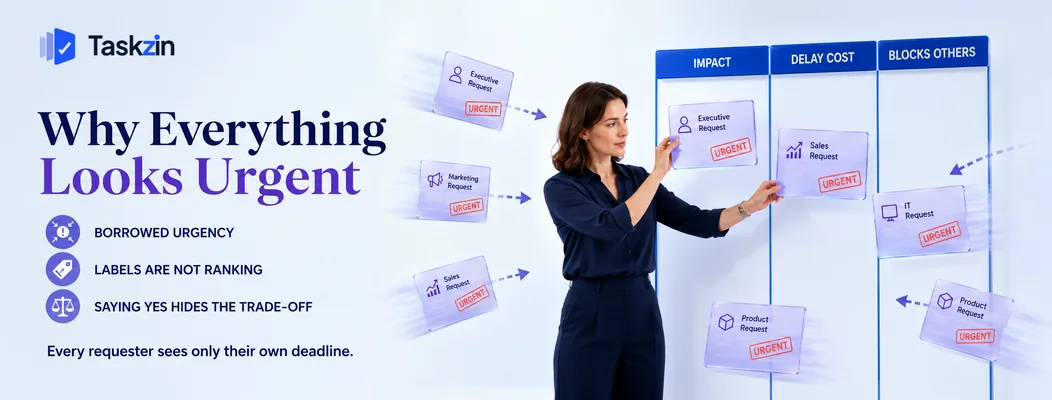
Urgency inflates because it is inherited from whoever asked, because priority is labelled rather than ranked, and because agreeing is easier than negotiating.
Urgency is usually borrowed from someone else
Most tasks arrive marked urgent by the person requesting them, and from their perspective it usually is.
The problem is that urgency does not survive aggregation. Ten people each with one genuinely urgent request produce ten urgent items for the person receiving them, and no basis for ordering them. The urgency was real individually and is meaningless collectively.
No agreed definition of priority
If nobody has defined what makes something high priority — revenue at risk, customer commitment, regulatory deadline, blocking someone else — then the label means "the person who asked wants it soon".
Without a definition, priority is assigned by tone of voice.
Saying yes is easier than negotiating
Accepting a request takes ten seconds. Explaining that accepting it means something else slips takes a conversation.
Under pressure, most people take the ten-second option repeatedly, and the accumulated result is a list where everything has been promised and nothing is ordered.
Four Ways to Force a Ranking
Method How it works Best for Time Ordered list Rank everything 1..n, no ties Any list under ~30 items Minutes Eisenhower matrix Sort by urgent ×
Separating Urgent From Important
Personal workload 15 min
MoSCoW Must / Should / Could / Won't Scoping a release 30 min Pairwise comparison Compare items two at a time Small contested sets 20 min
The Fastest Method: Order the List
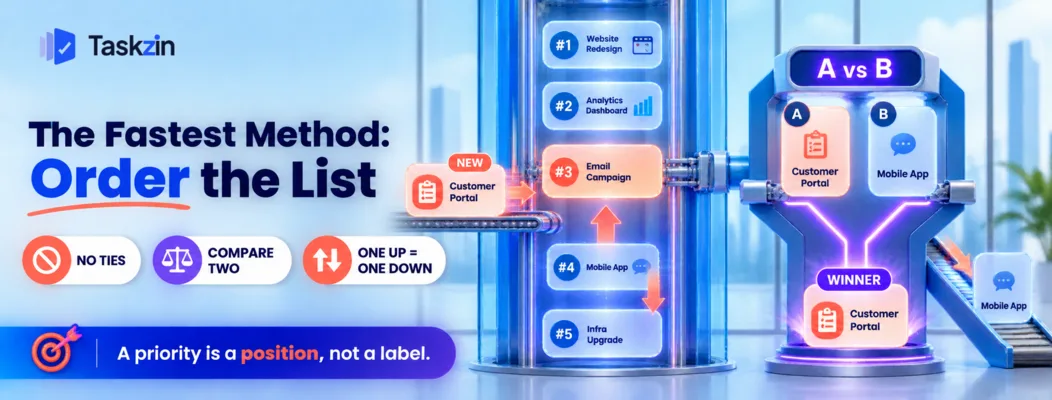
Put every item in a single ordered sequence with no ties, use pairwise comparison when you get stuck, and state the trade-off out loud whenever something moves up.
Rank, don't label
Priority labels let everyone avoid the decision. Twelve items marked high priority contain no information.
Ordering forces the choice. Item one is worked before item two — there is no tie for first. This is uncomfortable, and the discomfort is exactly the value: it surfaces disagreements that labelling conceals.
A board or list that enforces order rather than category helps here. Anything that lets you drag items into a sequence — Taskzin's list view among many — makes the ranking visible and stops people quietly re-labelling their own request upward.
Compare pairwise when stuck
When two items feel equally important, ask a single question: if you could only have one this week, which would it be?
That question almost always has an answer, even when "which is more important" does not.
Repeat it for the contested pairs and a sequence emerges quickly.
Make the trade-off explicit
Every time something moves up, something moves down. Say so.
"We can do this next, which pushes the reporting work to the following sprint" invites a genuine decision. "We'll add it to the list" invites the belief that everything fits, which is how the list became unordered in the first place.
Separating Urgent From Important Urgent means it demands attention now; important means it affects outcomes that matter. Most overload comes from urgent-but-unimportant work crowding out important-but-not-urgent work.
The four quadrants in practice
Urgent and important: do it now. Important but not urgent: schedule it. Urgent but not important:
delegate, batch or decline. Neither: delete.
The framework is old and still useful, because its value is in the third quadrant rather than the first.
What to do with urgent but unimportant work
This is where most avoidable time goes — requests that feel pressing, arrive with deadlines, and do not affect anything that matters.
Options in order of preference: decline it, batch it into a fixed window, or delegate it. What does not work is doing it immediately every time, which is the default and which trains people to keep sending it.
Protecting time for important but not urgent
Improvement work, documentation, planning and prevention are always important and never urgent, so they always lose.
The only reliable protection is structural — reserved capacity, a fixed block, a rotation. Intention does not survive a busy week.
Handling the Conversation

Ask what should be dropped rather than whether to add, offer a realistic date instead of refusing, and escalate the conflict between requesters rather than the individual task.
Ask what to drop, not whether to add
"Yes — which of these three should move to make room?" is a much better response than either agreeing or refusing.
It reframes the conversation from a request you might decline into a trade-off the requester participates in. Most people, shown the list, will pick something themselves.
Give a date instead of a refusal
"I can start this on the fourteenth" is easier to accept than "no", and it is honest.
If the date is unacceptable, that is the point at which the trade-off conversation becomes real — and it is now their decision about what to displace rather than your refusal.
Escalate the conflict, not the task
When two stakeholders both insist their item is first, the conflict is between them, not between you and either of them.
Present both requests and the capacity constraint to whoever can decide, and let them choose.
Absorbing the conflict by attempting both is how people end up delivering neither well.
Common Prioritisation Mistakes
The three habits that produce permanent overload are labelling everything high priority, ordering by who asked, and reprioritising every day.
Labelling everything high priority
A list where 80 percent of items are marked high has no priority system, only a field.
Cap the number of high-priority items — three, five, whatever fits your capacity — and enforce it. Adding a new one requires removing an existing one.
Prioritising by who asked
Ordering by seniority means the most senior person's least important request outranks a critical item from someone junior.
Priority should reference the agreed definition — customer impact, revenue, blocking others — not the requester. This requires the definition to exist, which is why the first step is agreeing one.
Reprioritising daily
A list that changes completely every morning means nothing gets finished, because everything is repeatedly interrupted before completion.
Reprioritise on a rhythm — weekly for most teams — and treat mid-week changes as exceptions requiring a deliberate decision rather than a routine adjustment.
Frequently asked
How do you prioritise when everything is urgent?
Force everything into a single ordered list with no ties. When items must be ranked against each other rather than labelled individually, genuine decisions get made and the false urgency resolves itself.
What is the Eisenhower matrix?
A four-quadrant method sorting tasks by urgency and importance: do the urgent and important, schedule the important but not urgent, delegate or decline the urgent but unimportant, and delete the rest.
How do you say no to a request without damaging the relationship?
Rarely say no outright. Offer a realistic start date, or show the current list and ask what should move to make room. Both give the requester agency and keep the conversation collaborative.
What if your manager says everything is priority one?
Present the list with your realistic capacity and ask them to order it. Most managers, faced with the constraint made explicit, will prioritise — the label was shorthand for "all of this matters", not a considered ranking.
How often should you reprioritise?
Weekly for most teams. Daily reprioritisation means nothing gets finished; monthly means you cannot respond to genuine changes.
What is the difference between urgent and important?
Urgent means it demands attention now. Important means it affects outcomes that matter. They frequently do not overlap, and most avoidable overload comes from urgent work that is not important.
How do you prioritise across multiple projects?
Order across projects rather than within them. Separate per-project lists hide the real conflict, which is that the same people are needed by several projects simultaneously.
Sujan Sharma is a content writer at Taskzin with a strong focus on productivity systems, task management, workflow optimization, team collaboration, and SaaS technology. He creates research-driven, practical content that helps professionals and growing teams improve operational efficiency, streamline processes, and make informed decisions about modern work management tools.
All posts by Sujan Sharma


Comments