30 Questions for Better 1:1 Meetings
Thirty questions for one-to-one meetings organised by purpose, with situational questions for new starters, disengagement and skip-levels, guidance on asking them well, and the mistakes that turn one-to-ones into status reports.

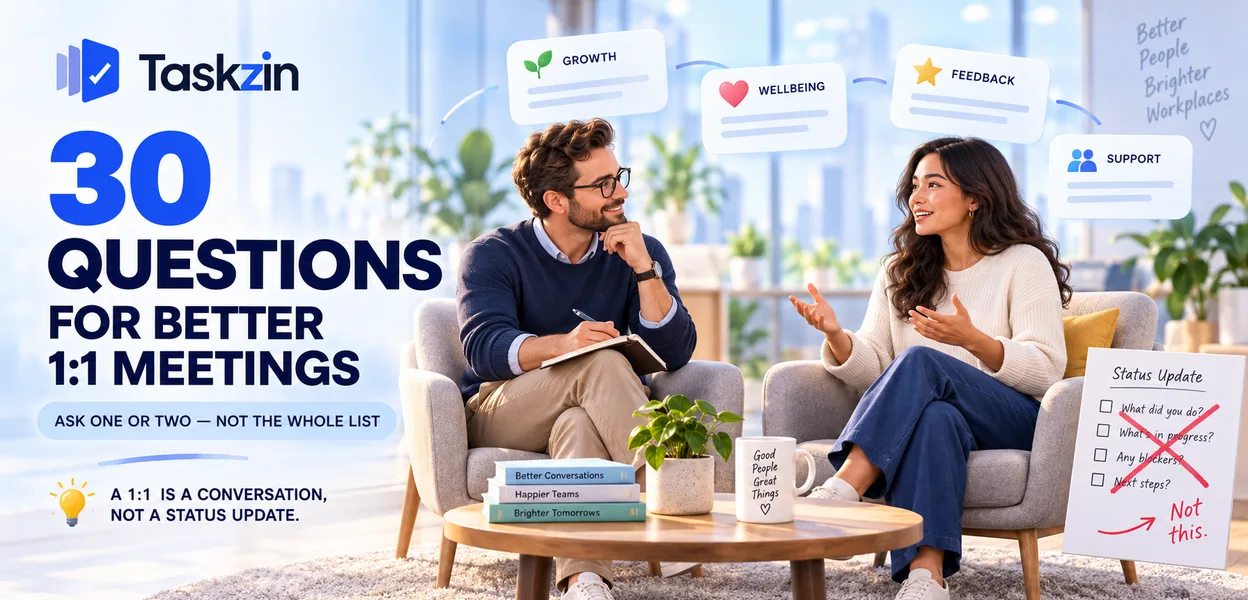
A one-to-one belongs to the person you are meeting, not to you. The fastest way to ruin one is to use it for a status update — that information is available elsewhere, and using the only protected conversation you have with someone to collect it wastes both your time. The questions below are organised by what you are trying to find out.
Ask one or two per meeting, not a list. A one-to-one that feels like an interview stops producing anything honest.
What a One-to-One Is Actually For

A one-to-one exists to surface what would otherwise go unsaid — obstacles, frustrations, ambitions and quiet problems.
Their meeting, not yours
The default should be that they bring the agenda and you listen. Your items come after theirs, not before.
This inversion is what makes one-to-ones work. A meeting where the manager arrives with a list is a review, and people prepare differently for reviews than for conversations.
Why status updates ruin them
Project status is visible in the tool, the board, or a written update. Using a one-to-one to collect it means the genuinely useful conversation — what is hard, what is frustrating, what they are worried about — never happens.
If you find your one-to-ones are status meetings, the fix is not better questions. It is getting status somewhere else so this time is free for something else.
What good looks like
The person raises something you did not know. That is the test.
If you leave every one-to-one having learned nothing new, either nothing is wrong or the person does not feel able to tell you. The second is far more likely, and far more important.
30 Questions by Purpose
Six categories, five questions each. Pick one or two.
Purpose Questions Current work What are you working on that you are most and least looking forward to? · What is taking longer than it should? · Is there anything you are working on that you do not think matters? · What would you drop if you could? · What is the most frustrating part of your week?
Obstacles What is blocking you that you have not raised? · Is there anything you are waiting on from me? · What do you need that you do not have? · Where are you having to work around a process? · Is anything unclear about what is expected of you?
Growth What do you want to be better at in six months? · What part of your work do you find most interesting?
· Is there anything you want to try that you have not been given the chance to? · What skill are you not using here? · Where do you want to be in two years — honestly, including elsewhere?
Feedback upward What should I be doing differently? · Is there anything I do that makes your job harder? · What decision have I made recently that you disagreed with? · Am I giving you too much or too little direction? · What am I not paying enough attention to?
Team and environment Who on the team do you find it hardest to work with, and why? · Is there anything the team does that you think is a waste of time? · Do you feel able to disagree in team meetings? · Who has helped you recently that I might not know about? · What would you change about how we work if you could change one thing?
Workload and sustainability How is your workload at the moment, honestly? · Are you working hours you are not telling me about? · When did you last take a proper break? · Is there anything you have taken on that should not be yours? · If this pace continued for six months, how would that feel?
Questions for Specific Situations
Different moments need different questions.
Situation Ask New starter, first month What has surprised you? What do you still not understand that you feel you should by now?
After a difficult project What would you do differently? What should I have done differently?
Someone seems disengaged What part of your work still feels worth doing? Has something changed?
Someone is performing well What is making this work? What would let you do more of it?
Before a promotion conversation What do you think is standing between you and the next step?
Someone is overloaded What can we stop or hand to someone else? Not reduce — stop.
After you made an unpopular decision Tell me what you think I got wrong about that.
Skip-level (their manager's report) What would you want your manager to know that is hard to say directly?
How to Ask Them Well
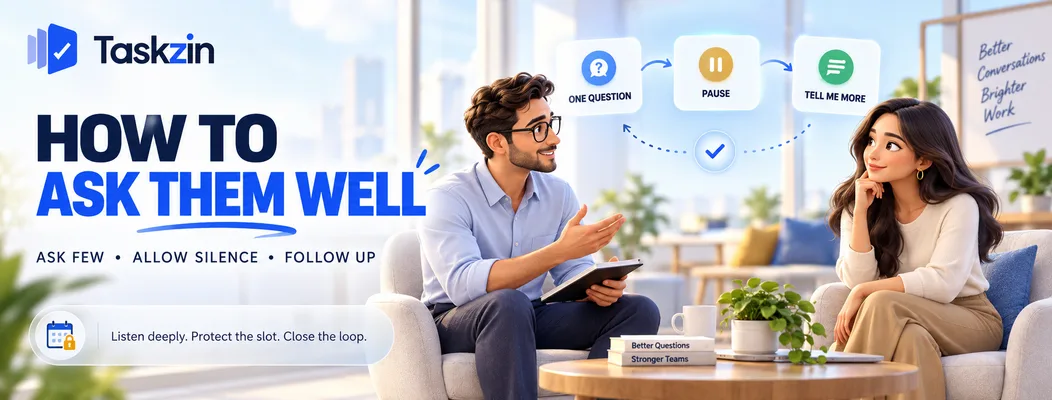
Ask few questions, tolerate the pause, and follow up on the answer rather than moving on.
One or two, not a list
Working through ten questions produces short answers and no depth. The value comes from following one thread properly.
Choose based on what you already suspect. If someone has seemed flat for a fortnight, ask a workload or environment question and stay with it.
Sit with the silence
After asking something substantial, wait. Most people need several seconds to answer honestly, and managers routinely fill that gap.
The silence is where the real answer forms. Filling it gets you the easy answer instead.
Ask the follow-up
"Why?" or "tell me more about that" or "what would need to change?"
First answers are usually the polite version. The second answer, prompted by a follow-up, is the useful one — and asking a follow-up demonstrates you actually wanted to know.
Running the Meeting
Let them set the agenda, protect the slot absolutely, and close the loop on what they raise.
Let them set the agenda
Ask them to bring topics, and start with theirs. A shared running document works well — either of you can add to it during the fortnight so nothing waits for the meeting to be remembered.
Where the tool lets you keep a doc linked to the work rather than in a separate drive, it stays in the flow of what you are both already looking at.
Never cancel, reschedule
Cancelling a one-to-one signals that it is the lowest-priority thing in your week, and people notice.
Move it rather than dropping it. A manager who reliably cancels when busy trains their team not to save anything important for it, which defeats the purpose entirely.
Close the loop on what they raise
If someone raises something, come back to it — even if the answer is that nothing can change.
Unanswered raises are worse than not asking. After two of them, people stop raising things, and you have converted a useful meeting into a pleasant one.
Common One-to-One Mistakes

Three failures: status reporting, meeting only in a crisis, and asking without acting.
Turning it into a status report
The most common failure. Project status belongs on a board or in a written update; using this time for it means the useful conversation never happens.
If you genuinely need a status conversation, have it separately and keep this slot for everything else.
Only meeting when something is wrong
If one-to-ones only happen when there is a problem, being invited to one becomes alarming.
Regular cadence — fortnightly at minimum — means the difficult conversation happens in an established rhythm rather than as an event.
Asking and then doing nothing
Asking for upward feedback and then not changing anything is worse than not asking. It demonstrates that the question was performative.
If you cannot act on something, say so plainly and explain why. That is a legitimate answer; silence is not.
Frequently asked
What should you talk about in a 1:1?
Whatever the person brings, first. Then obstacles, growth, upward feedback and workload. Not project status — that belongs in a written update or on the board.
How often should 1:1s happen?
Weekly or fortnightly. Monthly is too infrequent for anything to surface in time to act on it.
How long should a 1:1 be?
Thirty minutes fortnightly, or twenty-five weekly. Long enough to get past the first polite answer, short enough to sustain.
Who sets the agenda?
The person being managed, primarily. Your items come after theirs. A shared running document that either of you can add to during the fortnight works well.
Should you take notes in a 1:1?
Yes, particularly commitments you made. Not verbatim — note what they raised and what you agreed to do, so you can close the loop next time.
What if the person has nothing to say?
Ask a specific question rather than an open one, and wait through the silence. Persistent nothing usually means they do not feel able to say something, which is worth addressing directly.
Should skip-level 1:1s happen?
Periodically, yes — quarterly is common. They surface things people find hard to say to their direct manager. Be clear about what you will and will not pass on.
Sujan Sharma is a content writer at Taskzin with a strong focus on productivity systems, task management, workflow optimization, team collaboration, and SaaS technology. He creates research-driven, practical content that helps professionals and growing teams improve operational efficiency, streamline processes, and make informed decisions about modern work management tools.
All posts by Sujan Sharma

Comments