Employee Onboarding Checklist Template
An employee onboarding checklist template covering pre-arrival through to 90 days, with named owners for each item, the three goals onboarding must achieve, how to split ownership between HR, manager and buddy, and common mistakes.

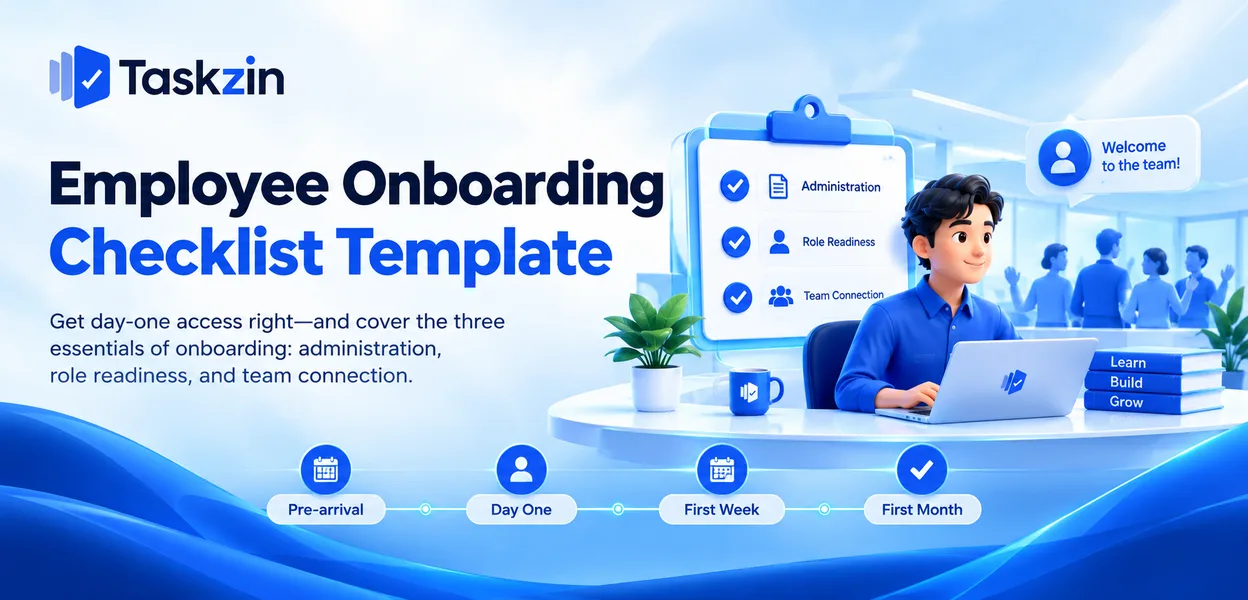
The item that causes the most damage is also the most avoidable: access not working on day one.
Quick answer: Onboarding has three separate goals: completing the administration, making the person capable in their role, and connecting them to the team. Most checklists cover the first thoroughly and the other two barely. The template below covers all three across pre-arrival, day one, first week and first month.
What Onboarding Has to Achieve
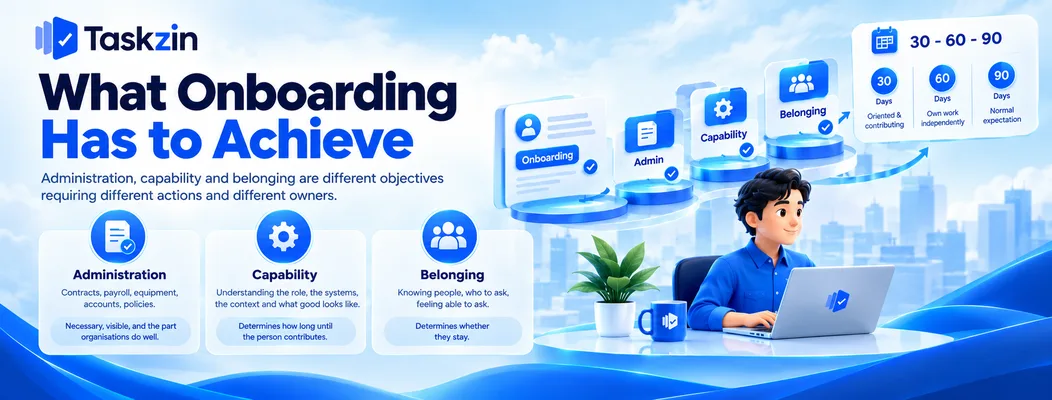
Administration, capability and belonging are different objectives requiring different actions and different owners.
Three separate goals
Administrative: contracts, payroll, equipment, accounts, policies. Necessary, visible, and the part organisations do well.
Capability: understanding the role, the systems, the context and what good looks like. This determines how long until the person contributes.
Belonging: knowing people, knowing who to ask, feeling able to ask. This determines whether they stay.
Why access failures dominate
An account that does not work on day one is the most common onboarding failure and the most demoralising.
The new person cannot do anything, cannot fix it themselves, and must ask strangers for help before they know anyone. It signals that their arrival was not prepared for, and that impression persists longer than the outage.
The 30-60-90 framing
A useful structure: by 30 days, oriented and contributing to small tasks. By 60 days, owning work independently. By 90 days, operating at normal expectation.
Write these out for the specific role and give them to the person on day one. Not knowing whether you are progressing at the right pace is a significant source of new-starter anxiety, and this removes it.
Before Day One
Everything below should be complete and tested before the person arrives.
Item Owner Deadline Contract signed and returned HR Before start Payroll and tax details recorded HR Before start Equipment ordered and delivered IT 3 days before All accounts created and tested by logging in IT 2 days before Access to tools and systems for the role confirmed Manager + IT 2 days before First-month plan written Manager 1 week before Onboarding buddy assigned and briefed Manager 1 week before First-week meetings scheduled Manager 1 week before Welcome message to the team Manager 1 day before First real task identified Manager 1 day before
First Day, First Week, First Month
Phased items with owners, covering all three goals rather than just administration.
Phase Item Owner **Day 1** Welcome and equipment check Manager
Introduction to the team Manager
The buddy owns the questions
Walk through the first-month plan Manager
Policies, security and compliance basics
HR owns the process
Lunch or informal time with the team Buddy **Week 1** First real task started (by day 2) Manager
Tools and systems walkthrough Buddy
Meet key people outside the team Manager
Daily check-in, short Manager
First piece of work shipped New joiner
End-of-week conversation:
What is a 30-60-90 day plan?
Manager **Weeks 2–4** Scope widened, owns a small piece end to end Manager
Meet wider stakeholders Manager
Context sessions: how decisions get made, history Manager / team
Check-in every other day, then weekly Manager
30-day review against the plan Manager
Feedback collected: what was missing?
HR / manager
**Days 30–90** 60-day check against plan Manager
Probation or 90-day review Manager + HR
Onboarding feedback fed back
Making the Checklist Improve Itself
HR
Who Owns Each Part
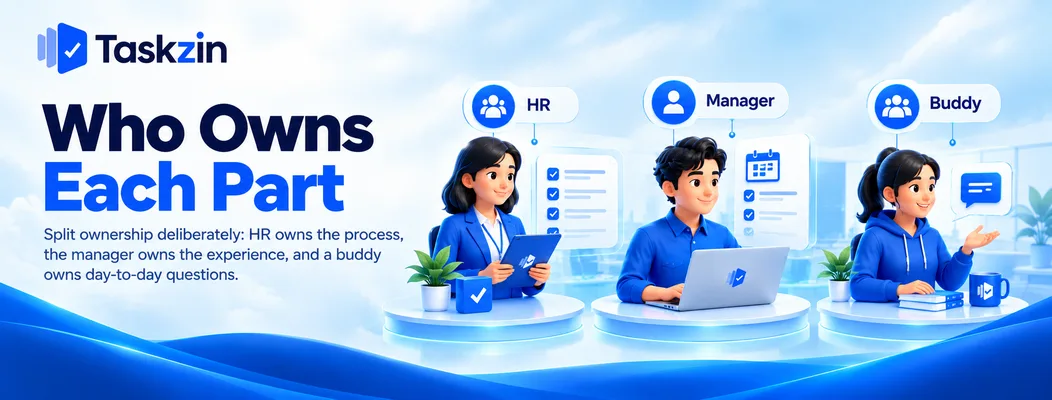
Split ownership deliberately: HR owns the process, the manager owns the experience, and a buddy owns day-to-day questions.
HR owns the process Contracts, payroll, compliance, policy acknowledgement, and maintaining the checklist itself.
HR's job is that the process happens consistently for every hire. It is not to deliver the role-specific parts, which HR cannot do.
The manager owns the experience
The first-month plan, the first task, introductions, check-ins, expectations and reviews.
This is the part that determines whether onboarding works, and it is the part most often deprioritised because managers are busy. Blocking the time in advance is the only reliable fix.
The buddy owns the questions A named colleague, not the manager, whose explicit job is answering questions without the new person worrying about interrupting.
Naming one person matters. "Ask anyone" results in asking nobody, because a new joiner cannot judge who is busy or who minds. Running the checklist as tasks with owners in your project tool means each person sees their own items rather than relying on one coordinator to chase everyone.
Making the Checklist Improve Itself New joiners are the only people who can see the gaps, and they lose that ability within about a month.
Ask new joiners what was missing
At day 30, ask three questions: what did you have to work out on your own, what took longer than it should have, and what did you not know that you needed to?
Answers go straight into the checklist. This is the highest-return feedback available and takes fifteen minutes.
Track time to first contribution
How long until the person shipped something real? Days, not weeks, is achievable for most roles.
If it is consistently three weeks, something in the process is slow — usually access, or the absence of an identified first task.
Update it after every hire
The checklist should change slightly with each hire. If it has not changed in a year, nobody is collecting feedback.
Treat it as a living document owned by HR but edited by managers who have just used it.
Common Onboarding Mistakes
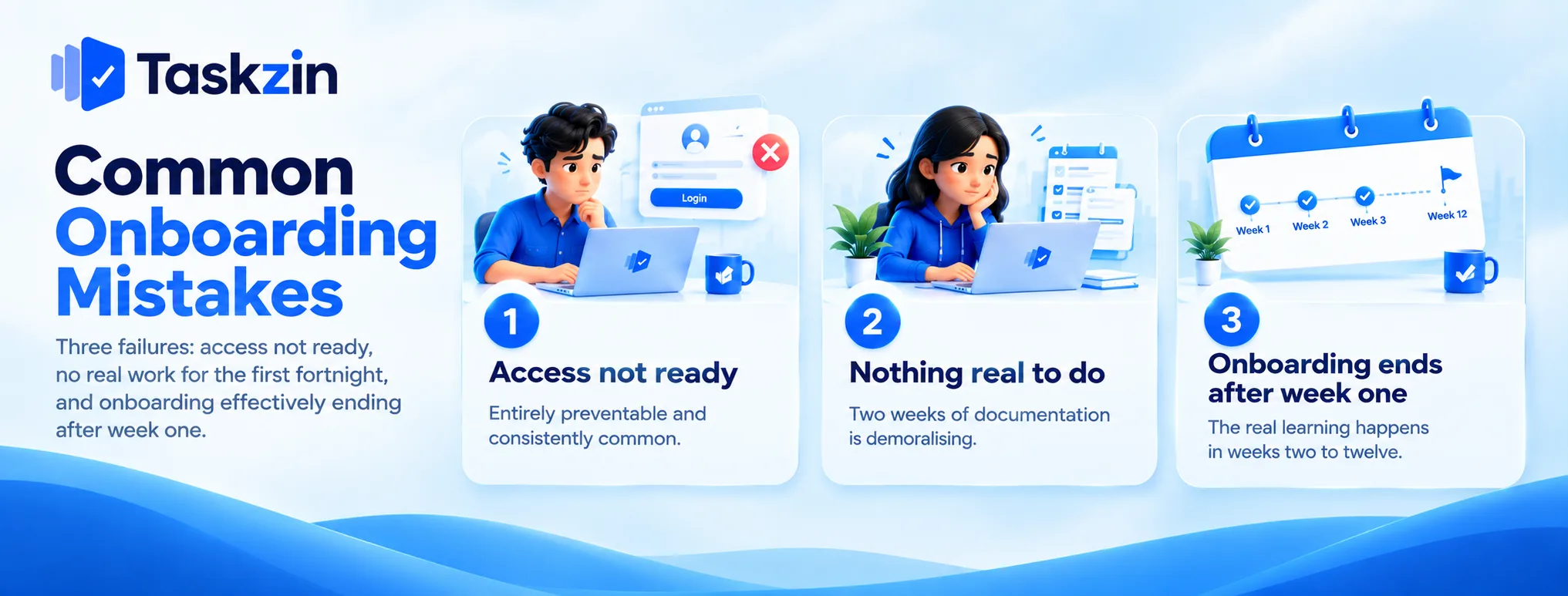
Three failures: access not ready, no real work for the first fortnight, and onboarding effectively ending after week one.
Access not ready
Entirely preventable and consistently common. The fix is testing every account by actually logging in two days before the start date.
Not creating them, testing them. Created accounts frequently fail on first use for permission reasons nobody checked.
Nothing real to do
Two weeks of documentation reading is demoralising and mostly forgotten, because there is nothing to attach it to.
Identify a small, real, completable task before the person starts, and have them working on it by day two. Shipping early does more for confidence than any amount of orientation.
Onboarding ends after week one
Most checklists stop at day five. The person is then left to work out weeks two to twelve alone, which is when most of the real learning happens.
Extend the plan to 90 days with defined check-ins. The 30-day and 60-day conversations are where problems surface early enough to fix.
Frequently asked
What should an employee onboarding checklist include?
Pre-arrival administration and tested access, day-one orientation and introductions, a first real task by day two, widening scope through the first month, and reviews at 30, 60 and 90 days.
How long should onboarding last?
Ninety days for most roles. Checklists that stop at day five leave the person to work out the hardest period — weeks two to twelve — without support.
What should a new employee do on day one?
Meet the team and their buddy, check equipment and access, walk through their first-month plan, cover essential policies, and have informal time with colleagues. Not a full day of documentation.
Who is responsible for onboarding?
HR owns the process, the manager owns the experience and the role-specific parts, and a named buddy owns day-to-day questions. Splitting these three prevents the manager becoming a bottleneck.
What is a 30-60-90 day plan?
A written statement of what the person should be able to do at each milestone — oriented and contributing at 30 days, working independently at 60, at full expectation at 90. Give it to them on day one.
How do you onboard someone remotely?
The same checklist plus deliberate replacements for what an office provides: scheduled informal conversations, written context they can read at their own pace, and more frequent check-ins in the first fortnight.
How do you measure onboarding success?
Time to first real contribution, retention through the first year, and direct feedback at day 30 asking what the person had to work out alone.
Sanju Shrestha is a SaaS content writer at Taskzin who explores smarter ways to manage work, organize priorities, and improve team performance. Her content covers productivity strategies, digital workflows, collaboration, and task management, with a focus on helping modern teams work more efficiently and stay aligned.
All posts by Sanju Shrestha

Comments