Product Launch Checklist Template
A product launch checklist template organised around what launches actually fail on, covering four weeks out to the week after launch, go/no-go criteria, rollback triggers, and how to adapt it to different launch sizes.

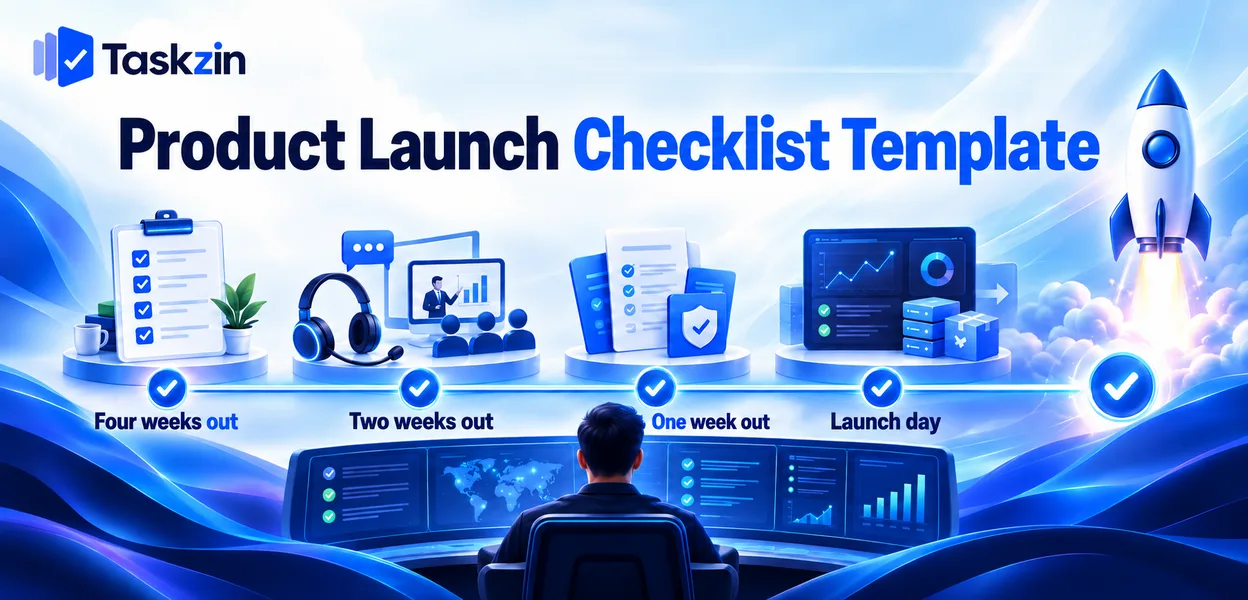
It covers four weeks out to one week after, with go/no-go criteria decided in advance rather than argued about the night before.
Quick answer: Launches rarely fail because the product was not ready. They fail because support did not know, sales could not explain it, documentation did not exist, or nobody owned launch day. The checklist below is organised around those failures rather than around engineering readiness, which is usually the best-covered part.
What Launches Actually Fail On
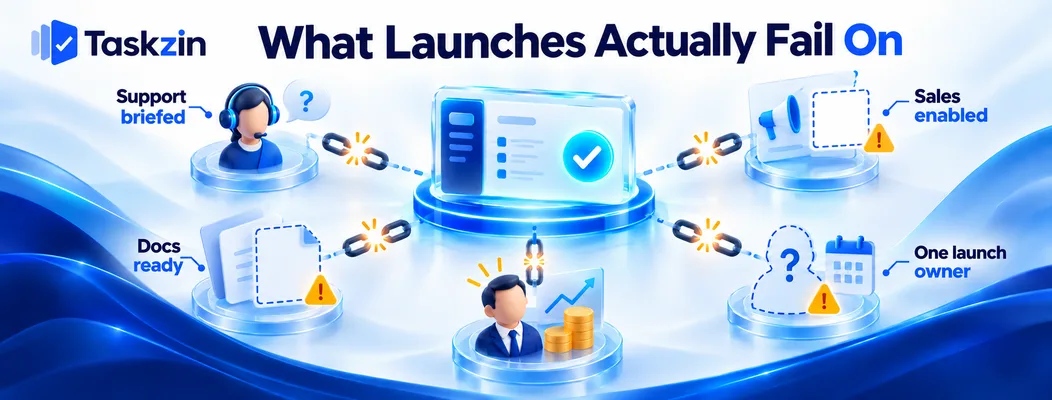
The common failures are cross-functional rather than technical, and they are all predictable.
Rarely the product itself
By launch day the product usually works. It has been tested, reviewed and staged.
The failures come from everything around it — the parts owned by people who were not in the build meetings and found out late.
The functions nobody told
Support receives tickets about a feature they have never seen. Sales is asked about something not in their materials. Finance discovers a pricing implication after the fact.
Each of these is a two-line item on a checklist and a genuinely bad day when omitted. Support in particular is the one that damages customer experience directly.
No named owner for launch day
Launches with several contributors and no single owner produce the specific failure where everyone assumes someone else is watching.
One person owns launch day, with authority to pause. Not a committee, and not "the team".
The Launch Checklist Template
Four phases, each with owners. Adapt the timings to your launch size.
Phase Item Typical owner **4 weeks out** Launch owner named Product lead
Success metrics and targets agreed
New product launches
Go/no-go criteria written Product + engineering
Pricing and packaging confirmed Product + finance
Support briefed on what is coming Product → support
Documentation drafted Product / technical writer **2 weeks out** Sales enablement materials ready Marketing
Support macros and FAQ written Support lead
Release notes drafted Product
Marketing assets ready Marketing
Internal demo held for all functions Product
No rollback plan
tested Engineering **1 week out** Go/no-go review held Launch owner
Staged rollout plan confirmed Engineering
Monitoring and alerts in place Engineering
Support rota confirmed for launch week Support lead
Customer comms scheduled Marketing
Known issues list circulated internally Product **Launch day** Final go/no-go call Launch owner
Staged rollout begun Engineering
Monitoring watched actively Engineering
Internal announcement sent Launch owner
Customer announcement published Marketing
Support standing by Support lead
Launch Day and the Week After
What to watch, when to act, and how to close the launch out properly.
Timing Action Trigger to escalate First 2 hours Watch error rates, monitor support queue Error rate above baseline, or any data-integrity issue First day Track adoption against target, collect early feedback Adoption far below expectation, or repeated confusion in tickets Day 2–3 Expand rollout percentage if staged Any severity-1 issue pauses expansion End of week 1 Review metrics against targets, triage feedback — Week 2 Post-launch review with all functions — Week 2 Decide: iterate, expand, or roll back —
Setting the Go/No-Go Criteria
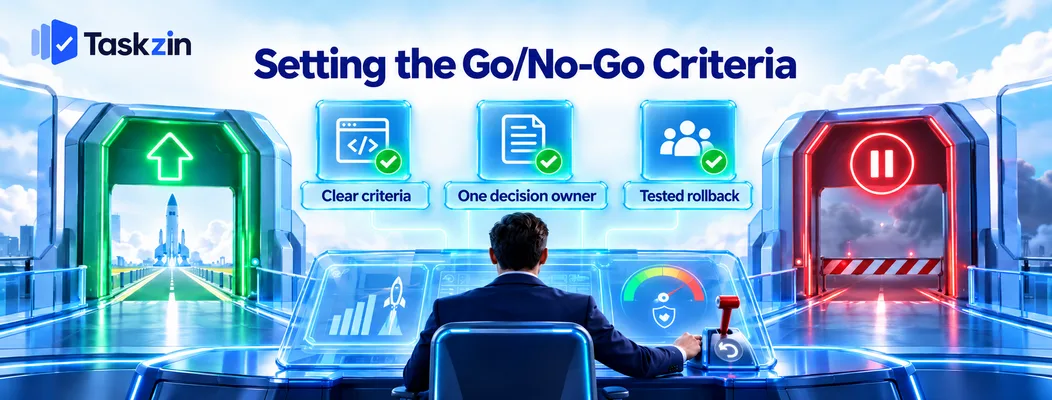
Write the criteria before the pressure arrives, name who decides, and agree what triggers a rollback.
Decide the criteria before you need them
Write down, four weeks out, what would make you not launch. Specific and measurable: no open severity-1 defects, documentation published, support materials complete, rollback tested successfully.
Criteria written under launch pressure get written to justify launching. Criteria written in advance are the ones you can actually hold to.
Name who makes the call
One person decides go or no-go. They should be senior enough that overriding them is awkward and close enough to the work to judge.
Committee decisions under launch pressure default to launching, because saying no requires someone to take responsibility and nobody in a group does.
Agree the rollback trigger
Define in advance what would cause you to roll back: error rate above a threshold, any data integrity issue, support volume beyond a level.
Rollback decisions made in the moment are slow because everyone is invested. A pre-agreed trigger converts a judgement call into a rule, which is precisely what you want at 2am.
Adapting It to Launch Size
Scale the checklist to what you are actually shipping — most releases need a fraction of it.
Minor feature releases
Ten items: release notes, support briefed, documentation updated, monitoring in place, rollback available, owner named.
Running a full launch process for a small feature is how launch processes get abandoned.
Match the ceremony to the risk.
Major feature launches
The full checklist above, over four weeks, with all functions involved and a formal go/no-go.
The distinguishing feature is cross-functional impact. If support, sales and marketing all need to do something, you need the full version.
New product launches The full checklist plus commercial readiness: pricing systems, billing, contracts, legal review, partner communications, analyst or press outreach where relevant.
These need eight to twelve weeks and a dedicated owner. Where the launch runs as a project with the checklist as tasks and named owners, the status is visible without a weekly status meeting to assemble it.
Common Launch Mistakes
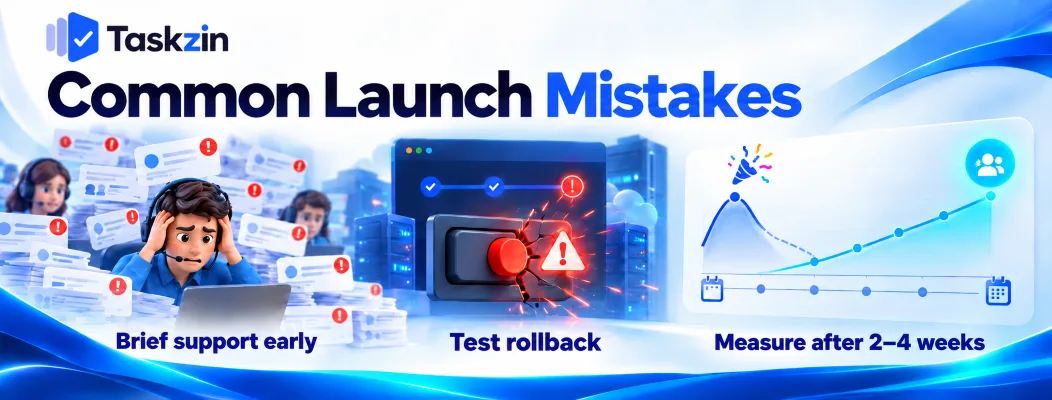
Three failures: support finding out late, no tested rollback, and calling the launch a success on day one.
Support finding out at launch
The most damaging and most common. Support receives questions about something they have never seen, and the customer experience is worse than if you had not launched.
Brief support four weeks out, demo it two weeks out, and give them macros and an FAQ before launch day. This is cheap and prevents the failure entirely.
No rollback plan Not just documented — tested. An untested rollback is a hope.
Feature flags and staged rollouts make this considerably easier, since rolling back becomes changing a setting rather than deploying under pressure.
Declaring success on day one
Day-one numbers reflect novelty and announcement traffic, not sustained adoption.
Judge at two to four weeks against the targets agreed in advance. Teams that celebrate on day one frequently stop watching, and the actual signal — whether people came back — arrives later.
Frequently asked
What should a product launch checklist include?
Owner and success metrics four weeks out, enablement materials and rollback plan two weeks out, go/no-go review one week out, and staged rollout with active monitoring on the day.
How far ahead should launch planning start?
Four weeks for a major feature, eight to twelve for a new product, and about a week for minor releases. The driver is cross-functional impact rather than engineering effort.
What are go/no-go criteria?
Specific, measurable conditions written in advance that must be met to launch — no open severity-1 defects, documentation published, support materials ready, rollback tested.
Who owns a product launch?
One named person with authority to pause it. Committee ownership under launch pressure defaults to launching, because nobody takes responsibility for saying no.
What should happen on launch day?
Final go/no-go call, staged rollout, active monitoring for the first two hours, internal announcement before external, and support briefed and standing by.
How do you know if a launch succeeded?
Measure at two to four weeks against targets agreed in advance. Day-one numbers reflect announcement traffic rather than sustained adoption.
When should you delay a launch?
When any pre-agreed go/no-go criterion is unmet — particularly an untested rollback or unprepared support. Delaying costs a week; launching into an unprepared support team costs customer trust.
Sanju Shrestha is a SaaS content writer at Taskzin who explores smarter ways to manage work, organize priorities, and improve team performance. Her content covers productivity strategies, digital workflows, collaboration, and task management, with a focus on helping modern teams work more efficiently and stay aligned.
All posts by Sanju Shrestha

Comments