Client Onboarding Template for Agencies
A client onboarding template for agencies covering signature through the first month, with a structured kickoff agenda, the working agreements that prevent most scope disputes, how to get client inputs on time, and common mistakes.

The template below runs from contract signature to the end of the first month, with a kickoff agenda and the working agreements worth settling before any work begins.
Quick answer: Client onboarding sets the working habits for the entire engagement, and the two things that prevent most later disputes are a named approver and a written definition of what counts as a change request. Both take ten minutes to agree at the start and are nearly impossible to establish once the relationship is under strain.
What Client Onboarding Decides
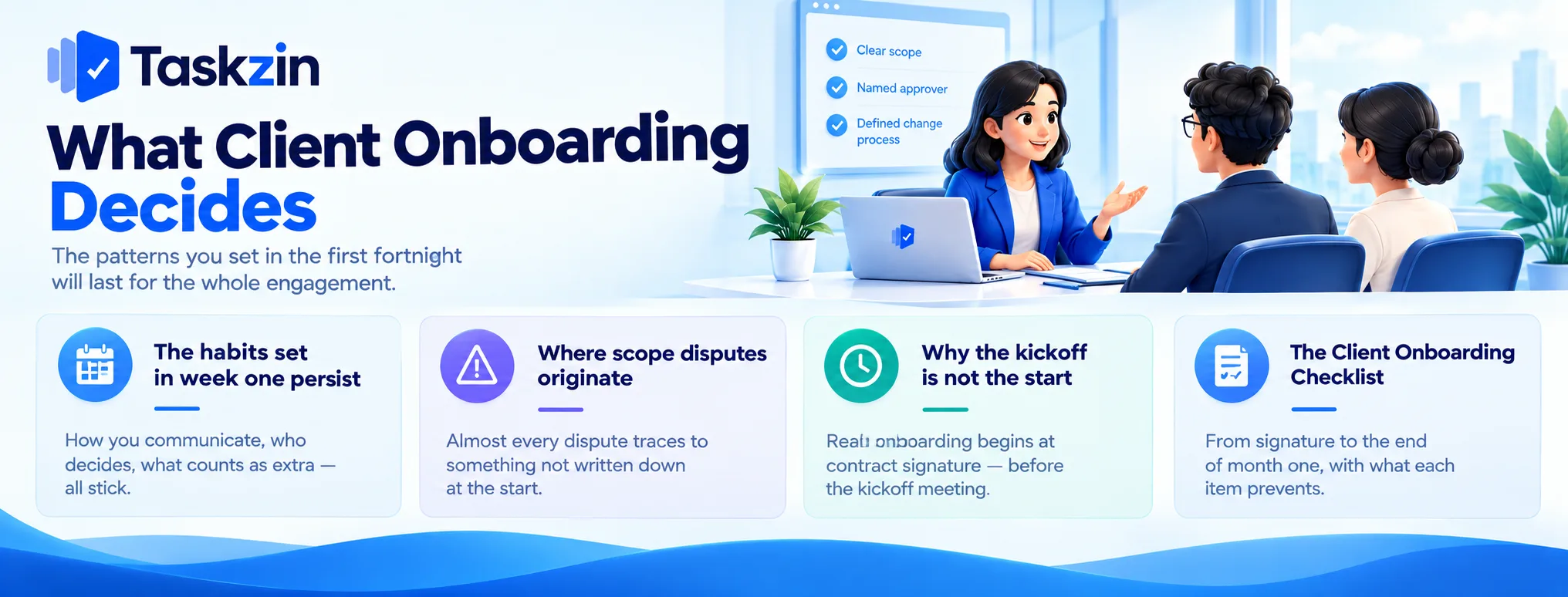
The patterns established in the first fortnight — how you communicate, who decides, what counts as extra — persist for the whole engagement.
The habits set in week one persist
If the client emails individual team members in week one, they will do it in month nine. If approvals arrive verbally on calls, they will always arrive that way.
Establishing the pattern you want is far easier before any work exists than after. This is the practical argument for treating onboarding as a defined process rather than a formality.
Where scope disputes originate
Almost every scope dispute traces to something not written down at the start: an assumed inclusion, an unnamed approver, or an undefined change process.
Naming exclusions explicitly is uncomfortable in week one and considerably less uncomfortable than the conversation in month four.
Why the kickoff is not the start
Real onboarding begins at contract signature. Access requests, asset gathering and approver identification all need to happen before the kickoff meeting.
Kickoffs where the first half is spent working out who can approve things waste the most valuable meeting of the engagement.
The Client Onboarding Checklist
From signature to the end of month one, with what each item prevents.
Phase Item Prevents **On signature** Send welcome pack and process overview Uncertainty about what happens next
Request access to all systems needed Week-three access delays
Request brand assets, guidelines, credentials Repeated small requests
Ask who can approve work, by name Approval ambiguity
Schedule the kickoff Drift before starting **Before kickoff** Confirm scope and exclusions in writing Scope disputes
Confirm response time expectations both ways Chasing and frustration
Set up project and client access Ad hoc status requests
Internal handover from sales to delivery Promises delivery did not hear **Kickoff** Run the agenda below Misaligned start **Week 1–2** First deliverable or milestone scheduled Slow start impressions
Reporting cadence established Status chasing
Escalation path agreed Problems surfacing late **Month 1** First review of how the engagement is working Small frictions becoming resentments
Confirm invoicing and billing details working Payment delays
The Kickoff Meeting Agenda
Ninety minutes, structured to produce decisions rather than introductions alone.
Time Section Output 0:00–0:10 Introductions, roles on both sides Who does what, both teams 0:10–0:25 Objectives and success criteria Agreed measurable outcomes 0:25–0:40 Scope walkthrough, including exclusions Shared understanding of boundaries 0:40–0:55 Timeline and milestones Dates agreed, dependencies
No named approver
Setting Working Agreements Early
Response times, both directions
change process 1:10–1:20 What we need from you, and by when Client dependency list with dates 1:20–1:30 Tools, access, reporting cadence Client set up, next steps clear
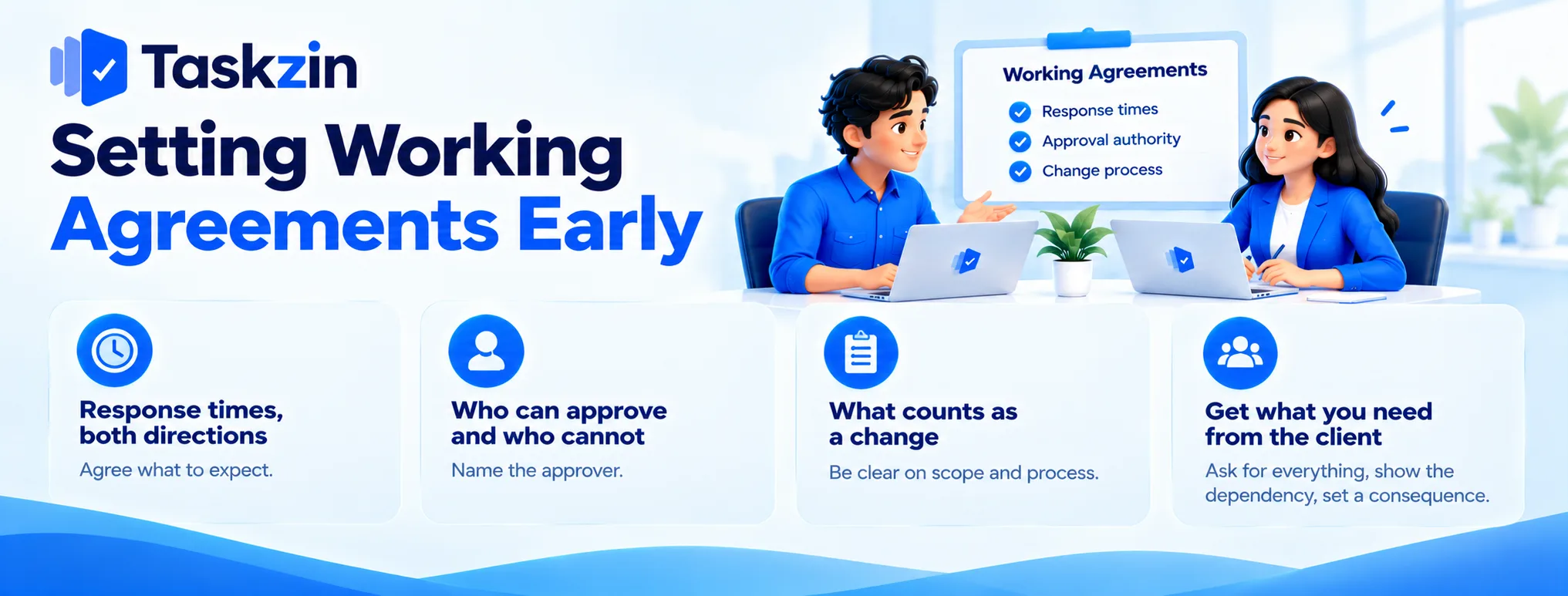
Setting Working Agreements Early Three agreements prevent most engagement friction: response times, approval authority, and what constitutes a change.
Response times, both directions
Agree what response time each side expects, in both directions. Clients frequently expect same-day responses while taking a week to review deliverables.
Making it mutual and explicit makes it fair, and it gives you a reasonable basis for raising delays later without it seeming like a complaint.
Who can approve and who cannot
Name the approver. One person, or a defined small group, with the authority to sign off.
The alternative is work approved by a project contact and then reversed by someone more senior who was never involved. That is the single most expensive pattern in agency work, and naming the approver at kickoff prevents it.
What counts as a change request
Define it plainly: work outside the agreed scope, or rework beyond an agreed number of revision rounds.
Agree the process too — how it gets raised, who approves it, and that it affects timeline and cost. Doing this before any change arises means the first change request is procedural rather than confrontational.
Getting What You Need From the Client
Ask for everything at once, make the dependency visible, and state what happens if it is late.
Ask for everything at once
Send one consolidated request: access, assets, credentials, brand materials, contacts, historical data.
Drip-feeding requests over three weeks is the most common cause of slow starts, and it makes the agency look disorganised. One list, one deadline.
Make the dependency visible
Put client-owned items in the project as tasks with the client named as owner and a date attached.
This changes the conversation entirely. Instead of "we're still waiting on assets", the client sees their own outstanding items alongside your progress. Free unlimited guest access means every client contact can see this without a licence cost, which is what makes it practical for agencies with many stakeholders.
Set a consequence for delay
State plainly what happens if inputs arrive late: the timeline moves by the same amount.
Not as a threat, as a fact stated at kickoff. Agencies that absorb client delays silently end up compressing their own delivery and taking the blame for the result.
Common Client Onboarding Mistakes
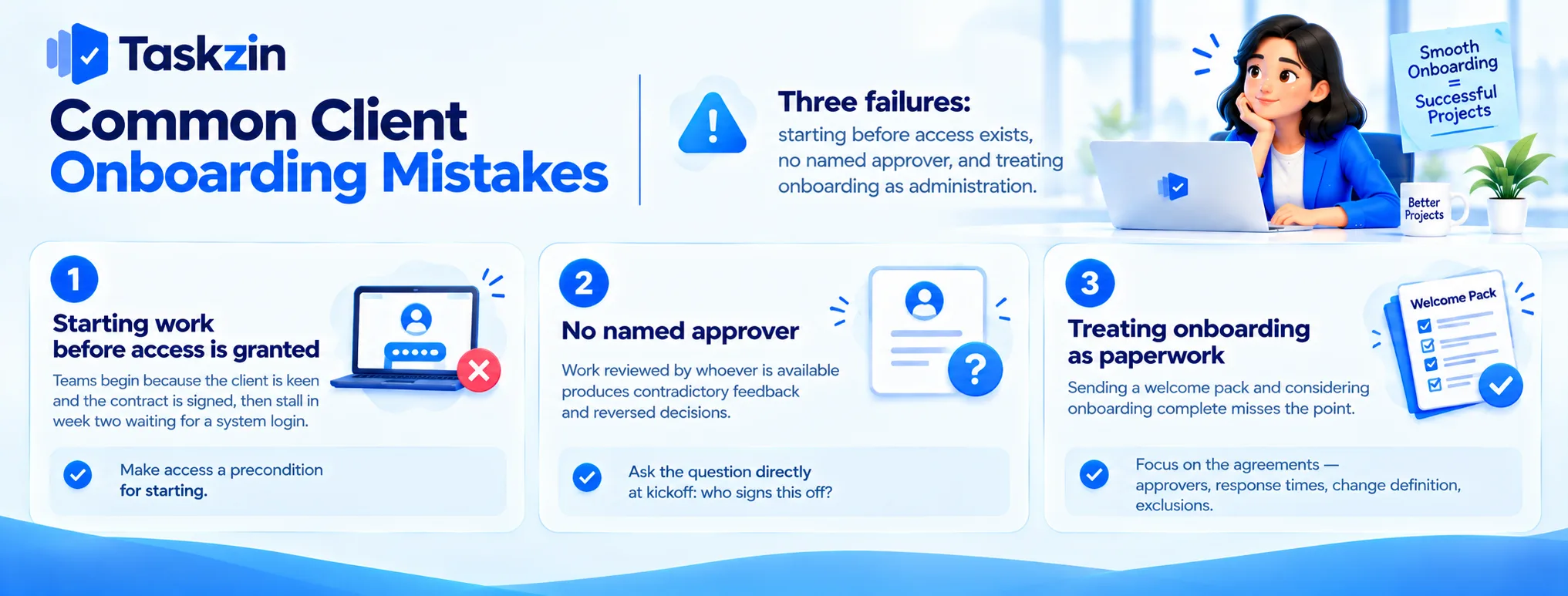
Three failures: starting before access exists, no named approver, and treating onboarding as administration.
Starting work before access is granted
Teams begin because the client is keen and the contract is signed, then stall in week two waiting for a system login.
Make access a precondition for starting. It is a reasonable position and it protects the timeline.
No named approver Work reviewed by whoever is available produces contradictory feedback and reversed decisions.
Ask the question directly at kickoff: who signs this off? If the answer is unclear, that is a risk to record and raise.
Treating onboarding as paperwork
Sending a welcome pack and considering onboarding complete misses the point entirely.
The value is in the agreements — approvers, response times, change definition, exclusions.
Those are decisions, and they need a conversation rather than a document.
Frequently asked
What should client onboarding include?
Access and asset requests on signature, written scope with exclusions, a structured kickoff, working agreements on response times and approvals, a client dependency list with dates, and a first-month review.
How long should client onboarding take?
Two weeks from signature to first deliverable is achievable if access requests go out immediately. Longer usually means requests were drip-fed rather than batched.
What should be covered in a kickoff meeting?
Roles on both sides, objectives and success criteria, scope including exclusions, timeline and milestones, working agreements, what you need from the client and by when, and tool access.
How do you set client expectations early?
Agree response times in both directions, name the approver, define what counts as a change request, and state what happens if client inputs arrive late — all at kickoff, before work starts.
What if the client does not provide what you need?
Make the dependency visible as a task owned by them with a date, and state at kickoff that late inputs move the timeline by the same amount. Absorbing delays silently means taking the blame for the result.
Should clients have access to your project tool?
Generally yes — it replaces status chasing with self-service and makes client-owned dependencies visible. Free unlimited guest access makes this practical regardless of how many contacts an account has.
How do you handle scope changes with a new client?
Define what counts as a change at kickoff, along with how it is raised and approved, and state that changes affect timeline and cost. Agreeing this before any change arises makes the first one procedural.
Sanju Shrestha is a SaaS content writer at Taskzin who explores smarter ways to manage work, organize priorities, and improve team performance. Her content covers productivity strategies, digital workflows, collaboration, and task management, with a focus on helping modern teams work more efficiently and stay aligned.
All posts by Sanju Shrestha

Comments