How to Onboard a New Team Member Remotely
A practical guide to remote onboarding, covering the three things an office provides that must be deliberately replaced, a week-by-week first month, what to prepare before day one, and the mistakes that leave new joiners politely lost.


Remote onboarding takes longer than in-person and requires more preparation.
Underestimating that is the most common error, and it produces a first month where the new person is politely lost.
Quick answer: Remote onboarding has to deliberately supply three things an office provides for free: passive absorption of context, knowledge of who to ask, and the visible signal that someone is stuck. Everything else — equipment, access, documentation — is logistics that also matter but that most organisations already handle.
What Remote Onboarding Has to Replace
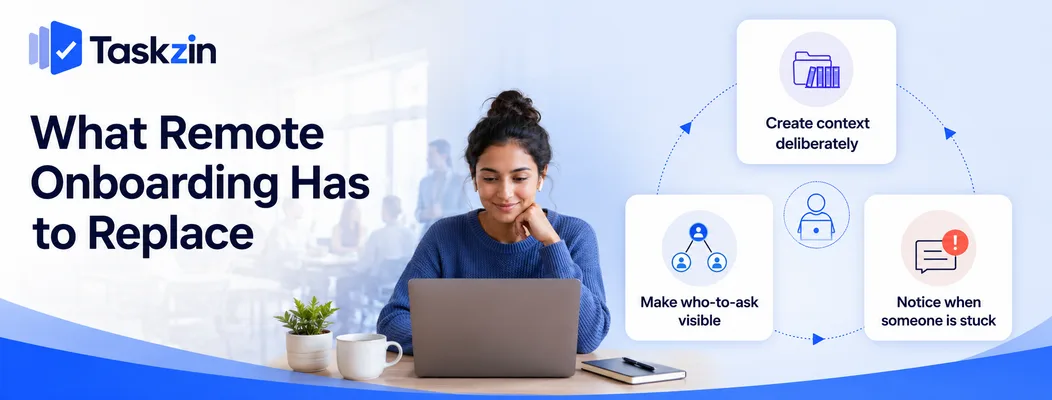
Three mechanisms disappear without an office, and each needs an explicit substitute.
Passive absorption of context
In an office, a new joiner absorbs an enormous amount without trying — overheard conversations, seeing how people talk to each other, noticing what gets escalated and what does not.
Remotely, none of that happens. Everything they would have absorbed must be either written down or deliberately scheduled. This is the largest single difference and the one that determines how long ramp-up takes.
Knowing who to ask
New people build an informal map of who knows what, mostly by proximity and coincidence.
Without it, a remote joiner faces a directory of names and no sense of who to approach. They then either guess, ask their manager everything, or — most commonly — do not ask and work it out slowly on their own.
Being noticed when stuck
Someone struggling in an office is visible. Someone struggling remotely looks exactly like someone working quietly.
A new joiner can be blocked for two days without anyone knowing, and new joiners are the least likely to raise it, because they do not want to appear slow in their first fortnight.
The First Month, Week by Week
Period Focus New joiner should be Manager should be
Before Day One
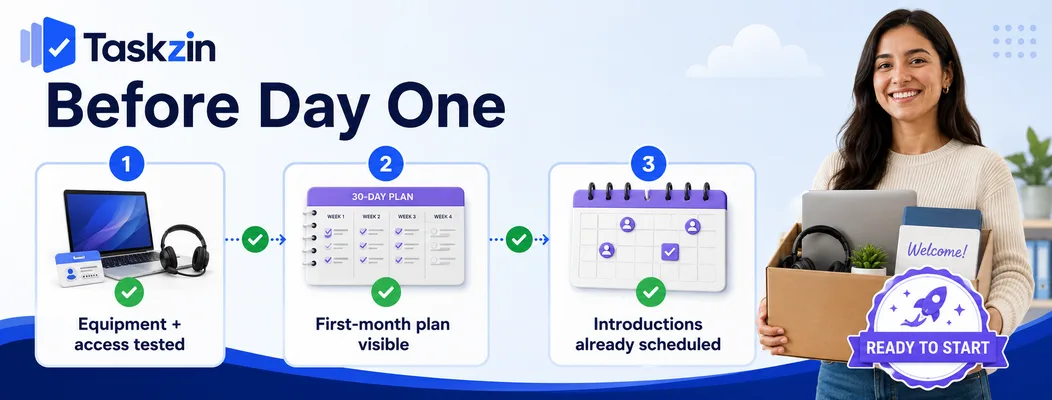
Testing access, writing the plan Day 1 Orientation, people Meeting the team, reading Present, unhurried
Days 2–5 First real task Shipping something small Checking in daily Week 2 Widening scope Working with more of the team Checking in every other day Week 3 Increasing independence Owning a small piece of work Weekly one-to-one Week 4 Feedback both ways Contributing normally Asking what was
Checking what is missing
Access not ready on day one
Have equipment and access working and tested, a written plan the new person can read, and introductions already in the calendar.
Equipment and access, ready and tested
Laptop delivered and working. Accounts created. Permissions granted. Someone has logged in and confirmed each one works.
Access problems on day one are the most common and most avoidable failure. They are also demoralising in a specific way — the new person cannot do anything, cannot fix it themselves, and has to ask strangers for help before they know anyone.
A written plan they can see
A document covering what their first month looks like: what they will learn, what they will work on, who they will meet, and what success looks like at 30 days.
Give it to them on day one, or before. It removes the disorientation of not knowing what is expected, and it lets them see progress rather than wondering whether they are doing enough.
Keeping it as a checklist in the team's project tool means they can tick things off and the manager can see where they have reached without asking.
Introductions scheduled in advance
Book the first week's introductions before they start — the team, key people outside the team, anyone they will depend on.
Left to happen organically, these take a month. Scheduled, they take a week, and the new person has a map of who to approach far sooner.
The First Week
Give them something real by day two, name one person for questions, and create deliberate low-stakes contact.
A real task on day two
Not reading documentation for a fortnight. Something small, real and completable — a minor fix, a small piece of content, a genuine but bounded task.
Shipping something in the first few days does more for confidence and belonging than any amount of orientation. It also surfaces access and process problems immediately, while everyone is expecting friction.
A named person for questions
An onboarding buddy — someone other than the manager whose explicit job is to answer questions without the new person worrying about interrupting.
Naming the person matters. "Ask anyone" produces asking nobody, because a new joiner does not know who is busy or who minds being interrupted. One named person removes that calculation entirely.
Deliberate low-stakes contact
Schedule short informal conversations with several colleagues in the first two weeks, with no agenda beyond meeting each other.
This feels artificial and works. The relationships that form naturally around a coffee machine have to be created deliberately, and fifteen minutes with six people is a reasonable substitute.
Weeks Two to Four
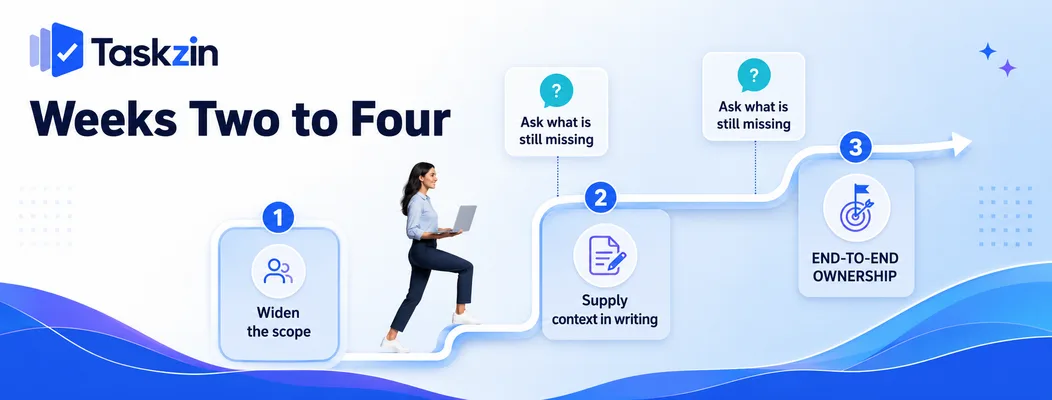
Widen the scope of what they own rather than just the volume, supply context in writing, and ask directly what is still missing.
Increasing scope, not just volume
Progress means owning something slightly larger and more ambiguous, not doing more of the same small tasks.
By week three, aim for a small piece of work they own end to end — including deciding how to approach it. Ownership accelerates learning far more than volume does.
Written context over meetings
The instinct is to schedule more meetings for a new remote hire. This is usually wrong past the first week.
What they need is written context they can read at their own pace and return to: how decisions get made, why the architecture is the way it is, what was tried before. A meeting delivers this once, badly. A document delivers it repeatedly.
Checking what is missing
At the end of week two and week four, ask directly: what do you still not understand, what has been harder than it should have been, what did you have to work out on your own?
The answers improve onboarding for the next person and reveal what your documentation does not cover. New joiners are the only people who can see those gaps, and they lose that ability within about a month.
Common Remote Onboarding Mistakes
The three failures are access not being ready, no real work for the first fortnight, and interpreting silence as everything being fine.
Access not ready on day one Entirely avoidable and consistently common. Test every account and permission the week before, with someone actually logging in.
Nothing real to do for two weeks
A fortnight of documentation reading is demoralising, and most of it is forgotten because there is nothing to attach it to.
Give context in the moment it becomes relevant, alongside real work, rather than in a block at the start.
Assuming silence means fine
A quiet new joiner is more likely to be struggling than thriving. They do not yet know what is normal, who to ask, or whether their pace is acceptable.
Check in more often than feels necessary in the first fortnight — daily in week one, every other day in week two. The frequency can drop quickly once they are settled, but starting light is difficult to correct.
Frequently asked
How long does remote onboarding take?
Longer than in-person — typically a month to feel oriented and two to three months to be fully productive, depending on role complexity. Plan for the longer figure rather than hoping for the shorter.
What should a new remote employee do on day one?
Meet the team, read the plan for their first month, get set up with working access, and meet their onboarding buddy. Not a full day of documentation.
How do you help a remote hire build relationships?
Schedule short informal conversations with several colleagues in the first fortnight. Relationships that would form incidentally in an office have to be arranged deliberately.
Should new remote hires have more meetings?
More in the first week, fewer afterwards. Past week one, written context they can read at their own pace is more useful than additional meetings.
What is an onboarding buddy?
A named colleague, other than the manager, whose explicit role is answering questions. Naming one person removes the new joiner's worry about who they can interrupt.
When should a new remote hire do real work?
Day two. Something small, real and completable. Shipping early builds confidence and surfaces access or process problems while everyone still expects friction.
How do you know if remote onboarding is going badly?
Silence is the main signal. Also: no questions after the first few days, no completed work by the end of week one, and no contact with anyone outside their immediate manager.
Sujan Sharma is a content writer at Taskzin with a strong focus on productivity systems, task management, workflow optimization, team collaboration, and SaaS technology. He creates research-driven, practical content that helps professionals and growing teams improve operational efficiency, streamline processes, and make informed decisions about modern work management tools.
All posts by Sujan Sharma


Comments