What Does a Project Manager Actually Do All Day?
A realistic explanation of what project managers do day to day, covering the five core activities, a typical daily schedule, how the role changes across project phases, what it excludes, and common misconceptions.

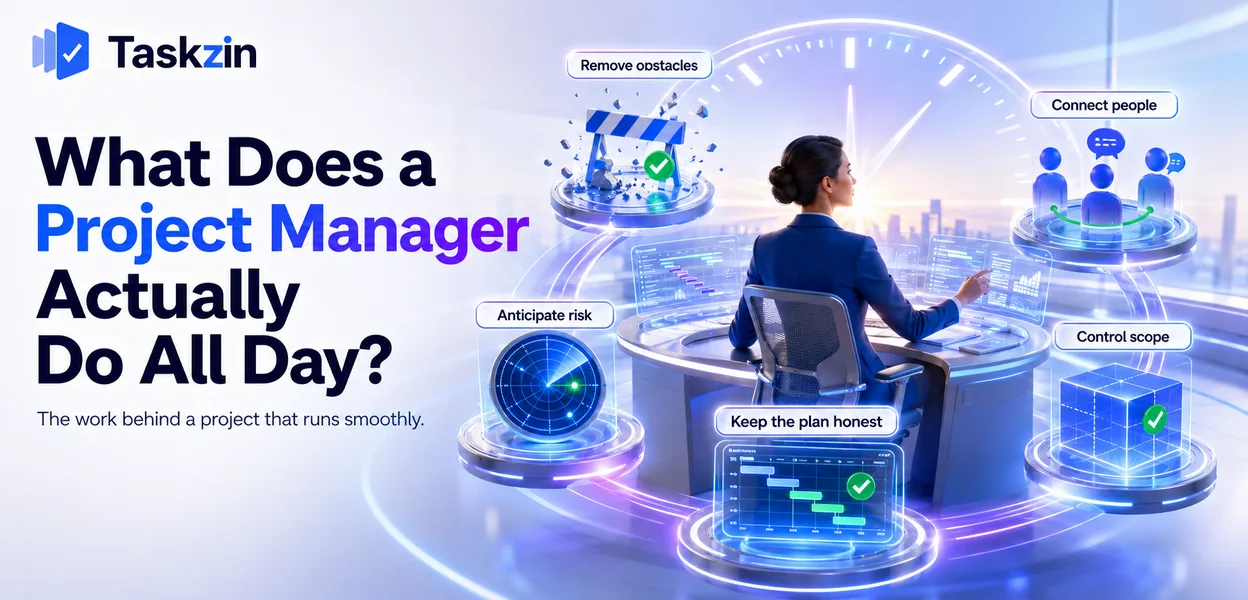
The confusion is understandable. When a project manager is doing the job well, the project appears to run smoothly and their contribution is hard to see. The evidence of good project management is the absence of problems, which is a difficult thing to point at.
This guide covers what the role actually involves hour to hour, how it changes by phase, and what it deliberately excludes.
Quick answer: A project manager spends most of the day removing obstacles, communicating between people who would otherwise not talk, controlling scope, anticipating problems before they land, and keeping the plan honest. Very little of it looks like managing, which is why the role is frequently misunderstood as administration.
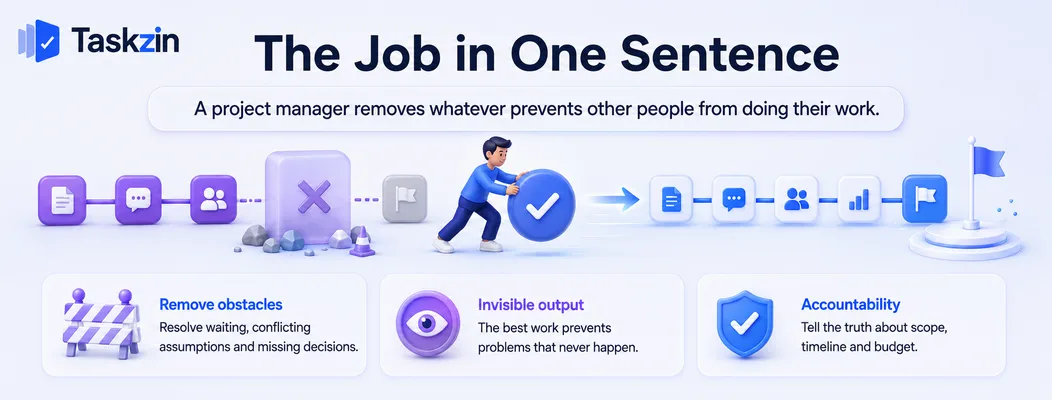
The Job in One Sentence
What is the difference between a project manager and a scrum master?
achieve that mainly by removing whatever is preventing other people from doing their work.
Removing obstacles, not assigning work
The common assumption is that a project manager tells people what to do. In most modern teams they do not — the team decides how to do the work.
What the project manager does is notice that the design has been waiting on legal for nine days, that two workstreams have made incompatible assumptions, that the vendor has not confirmed a delivery date. Then they resolve those things. That is the bulk of the job.
Why the output is invisible
A project manager's best work prevents problems that therefore never happen. Nobody notices the crisis that was avoided.
This makes the role hard to evaluate from outside and easy to undervalue. The visible artefacts — plans, status reports — are a small part of the job and the part most often mistaken for the whole of it.
What they are accountable for
Delivery against the agreed scope, timeline and budget, and for telling the truth about all three.
That last part matters more than it sounds. A project manager who reports green until the week before a missed deadline has failed at the central duty of the role, regardless of how well the plan was written.
A Realistic Day
Time Activity Why it matters Early Scan the board for anything stuck overnight Catch blockers before they cost a day Morning Standup or team check-in Surface issues, confirm the day's plan Morning Chase two or three outstanding items Most delay is waiting, not working Midday Stakeholder conversation or update Manage expectations before they diverge Afternoon Resolve a scope or dependency question Prevent rework Afternoon Update plan, review upcoming risks Keep the forecast honest Late Prepare for tomorrow's decisions Nothing waits on the PM overnight
Roughly a third of the day is unplanned: something breaks, someone escalates, a decision is needed now.
The Five Core Activities
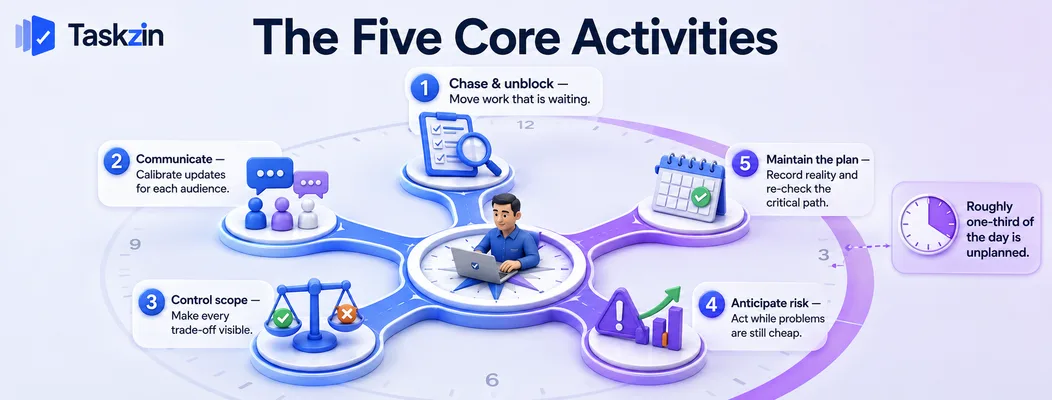
The role divides into chasing and unblocking, communicating, controlling scope, anticipating risk, and keeping the plan accurate.
Chasing and unblocking
The largest single share of the day. Something is waiting on someone, and it will keep waiting unless a person makes it their business to move it.
This is unglamorous and disproportionately valuable, because most elapsed time in any project is waiting rather than working. A project manager who reduces average waiting time by two days across twenty handoffs has saved more than any planning exercise would.
Doing it well requires knowing what is outstanding at any moment. That is why the board matters — not for reporting, but because a project manager without a current view of what is stuck is chasing from memory.
Communicating status upward and outward
Sponsors, clients and adjacent teams all need to know where things stand, at different levels of detail and different frequencies.
The skill is calibration. Executives need the exception and the decision required; the team needs the detail. Sending everyone the same update means most recipients ignore it.
Managing scope and change
Requests arrive constantly, most of them reasonable individually. The project manager's job is to make the trade-off visible: yes, and this is what moves.
Doing this consistently is what prevents scope creep. Doing it politely is what keeps the relationship intact while doing it.
Anticipating risk
Looking two to six weeks ahead and asking what could go wrong, then acting while it is still cheap.
This is the part most easily crowded out by daily firefighting, and the part that most distinguishes an experienced project manager. A risk identified six weeks out has options; the same risk discovered in the week it lands has none.
Maintaining the plan
Recording what actually happened, adjusting what moved, and re-checking the critical path.
A plan that is not updated stops being a forecast within a fortnight. This is the administrative part of the job, and it is genuinely small — perhaps thirty minutes a day — despite being what people picture when they think of project management.
How the Job Changes by Project Phase
Planning is mostly definition and negotiation, delivery is mostly unblocking and communication, and closure is mostly verification and handover.
Planning phase
Defining scope, identifying stakeholders, building the schedule, agreeing success criteria, surfacing assumptions.
The work is largely conversational — getting people to state what they actually expect, which is frequently the first time anyone has asked them directly.
Delivery phase
Chasing, unblocking, communicating, controlling change. The longest phase and the one described above.
The plan matters less here than the ability to notice what is stuck and act on it quickly.
Closing phase
Verifying deliverables against the agreed criteria, handing over, capturing lessons, closing contracts.
This phase is routinely rushed because the team has moved on. The lessons captured here are the only mechanism by which the next project goes better.
What a Project Manager Does Not Do
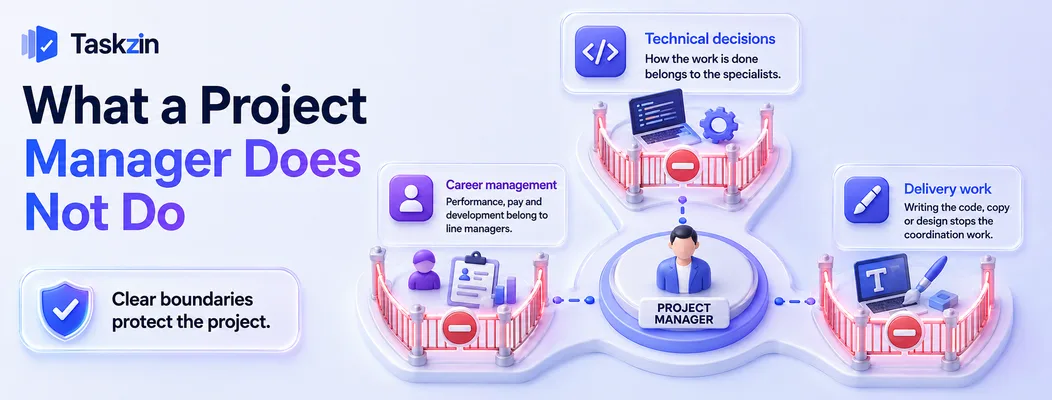
The role excludes technical decisions, line management, and doing the delivery work — and blurring those boundaries damages the project.
Decide technical approach
How the work is done belongs to the people doing it. A project manager who dictates technical approach removes the team's ownership of quality and takes on a decision they are not best placed to make.
Manage people's careers
Performance, pay and development belong to line managers. A project manager without line authority coordinates through influence and clarity, which is a different skill and one the role depends on.
Do the delivery work
A project manager who starts writing the code, the copy or the design has stopped doing project management — and the chasing, communicating and risk work stops with it.
This happens most often under pressure, and it is almost always a false economy. The tasks the project manager picks up are visible; the coordination that lapses is not, until something breaks.
Common Misconceptions
The three most common misunderstandings are that the role is mostly administration, that a smooth project means the PM did little, and that every team needs one.
That it is mostly updating spreadsheets
Plan maintenance is perhaps half an hour a day. The rest is conversation, negotiation and problem-solving.
The artefacts are visible and the work is not, which is why the impression persists.
That good projects mean the PM did little
A project that ran smoothly is usually evidence of good project management rather than an easy project. Problems were removed before anyone else noticed them.
That every team needs one
Small teams doing one thing at a time coordinate perfectly well without a dedicated project manager. The role earns its place when there are enough moving parts, dependencies and stakeholders that coordination becomes a full job.
Adding one to a team of five doing sequential work adds overhead rather than capability.
Frequently asked
What does a project manager do day to day?
Chases and removes blockers, communicates status to stakeholders, controls scope changes, anticipates risks, and keeps the plan accurate. Roughly a third of the day is unplanned problem-solving.
What skills does a project manager need?
Clear communication, negotiation, comfort with ambiguity, the ability to influence without authority, and enough domain understanding to know when something is going wrong before it is reported.
What is the difference between a project manager and a scrum master?
A project manager is accountable for delivering a defined scope on time and budget. A scrum master is accountable for the team's effectiveness and process, without owning the plan or the scope.
Does a project manager assign tasks?
In traditional environments sometimes; in agile teams generally not. Modern practice has the team decide who does what, with the project manager coordinating dependencies and removing obstacles.
How many projects can one PM handle?
It depends on complexity and stakeholder load. Two to four small projects is common; one large or politically complex programme can be a full-time role on its own.
Do agile teams need project managers?
Not always. Many replace the role with a product owner and scrum master. Project managers remain valuable where projects span multiple teams, involve external parties, or carry contractual obligations.
What makes a good project manager?
Noticing problems early, communicating honestly including when the news is bad, and making trade-offs visible rather than absorbing them silently. Planning ability matters less than these three.
Sujan Sharma is a content writer at Taskzin with a strong focus on productivity systems, task management, workflow optimization, team collaboration, and SaaS technology. He creates research-driven, practical content that helps professionals and growing teams improve operational efficiency, streamline processes, and make informed decisions about modern work management tools.
All posts by Sujan Sharma
Comments