What Is a Daily Standup and How Long Should It Be?
A clear explanation of the daily standup, covering its purpose as coordination rather than reporting, the formats available, how to run one worth attending, async options for distributed teams, and common mistakes.

Standups have a poor reputation because most are run badly. Done properly, the meeting is short, changes what people do that day, and nobody minds attending. Done badly, it is a daily status recital that helps no one.
This guide covers what standups are for, the formats available, how to run one worth attending, and how to make them work for distributed teams.
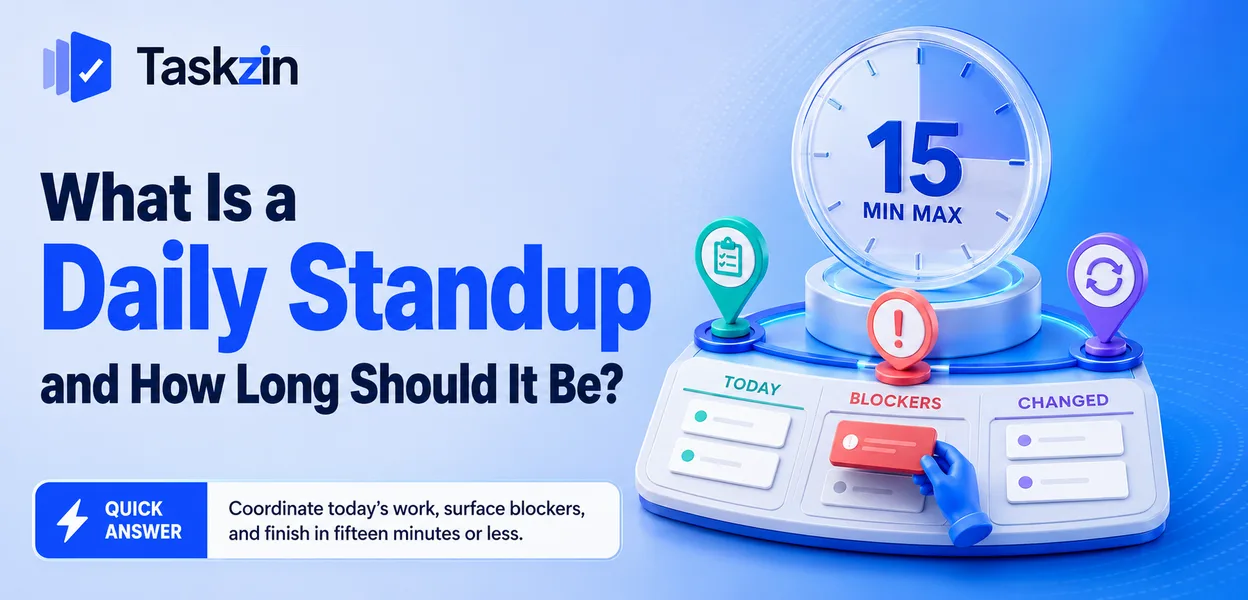
Quick answer: A daily standup is a short team meeting — fifteen minutes or less — where the team coordinates its plan for the day and surfaces anything blocking progress. It is for the team, not for a manager, and its purpose is coordination rather than reporting. Fifteen minutes is a maximum, not a target; many effective standups take five.
What a Daily Standup Is For
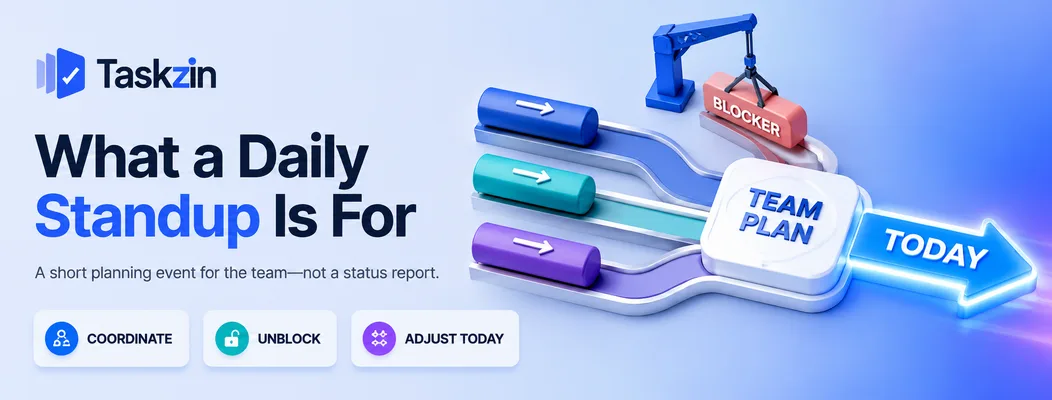
The standup exists so the team can coordinate its own work and raise blockers early — it is a planning event for the people doing the work.
Coordination, not reporting
The useful outcome is that someone changes what they were going to do today: two people realise they are working on the same thing, someone offers to unblock someone else, priorities shift.
If nothing changes as a result of the meeting, it produced information without producing coordination — which is the definition of a status report. Status can be read asynchronously; coordination sometimes benefits from being live.
Why fifteen minutes
The timebox exists to force focus. Fifteen minutes for a team of five is roughly two minutes each, which is enough to say what matters and not enough to narrate.
Treat it as a ceiling. A team that consistently uses the full fifteen minutes is usually discussing rather than coordinating, and the discussion belongs elsewhere.
Why people stand
The convention comes from the observation that physical discomfort keeps meetings short. It is a mechanism, not a principle.
Remote teams cannot use it, which is partly why distributed standups tend to run longer and need firmer facilitation.
Standup Formats Compared
Format How it works Best for Watch out for Three questions Each person: did, doing, blocked Small co-located teams Becomes a recital
Walk the board, not the people
Move right to left through in-progress items Most teams Needs an accurate board Blockers only Only raise what is stuck Experienced teams Loses coordination value Async written Everyone posts an update Distributed, many time zones Becomes reporting Rotating facilitator Different person leads daily Reducing manager-centring Inconsistent facilitation
Running a Standup That Is Worth Attending
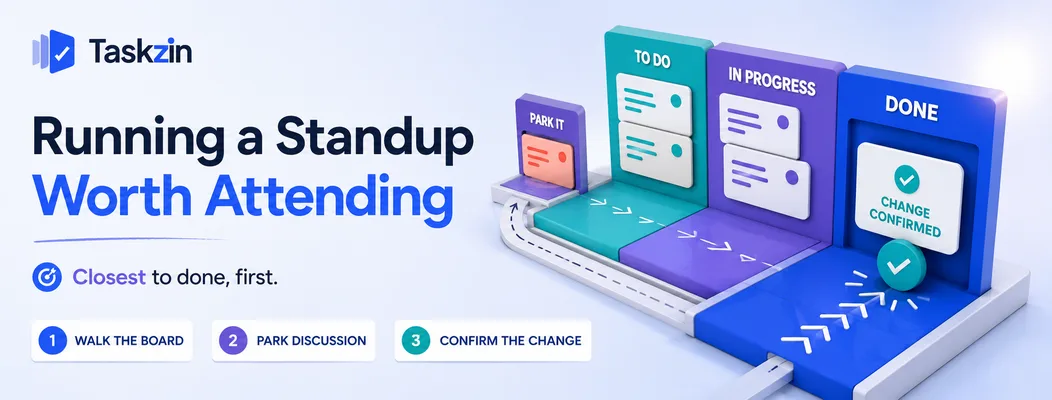
Walk the board rather than going round the people, park anything needing discussion, and finish by confirming what changed.
People report to the manager
Instead of asking each person in turn, move through the in-progress items on the board from right to left — closest to done first.
This changes the meeting's character. It focuses on the work rather than on individuals justifying their day, it naturally highlights items that are stuck, and it stops people who have nothing to report from inventing something. It also requires the board to be current, which is a useful forcing function.
Teams using a shared board — Taskzin's board view with WIP limits, for instance — can run the standup directly from it, which keeps the meeting anchored to what is actually in flight rather than to memory.
Park anything that needs discussion
When a topic needs more than a sentence, name it, note who needs to be involved, and move on. Hold the discussion immediately afterwards with only the relevant people.
This single habit is the difference between a five-minute standup and a twenty-five-minute one.
The discussion still happens — it just does not consume six people's time when it concerns two.
End with what changed
Close by confirming anything that shifted: who is picking up what, what got unblocked, what moved.
If nothing changed, that is worth noticing. A run of standups producing no change suggests the team either does not need a daily meeting or is not raising real issues in it.
Async and Distributed Standups
Written standups work well across time zones, provided the update focuses on blockers and changes rather than becoming a daily activity log.
When written beats live
If the team spans more than about four hours of time zone difference, a live daily meeting is inconvenient for someone every day.
A written update posted in a shared channel or on the board takes two minutes to write and thirty seconds to read, stays searchable, and does not require anyone to be awake at an awkward hour.
What a written update should contain
Keep it to three short lines: what changed since yesterday, what you are working on today, and anything blocking you.
The blocker line is the one that matters. If nobody in the team ever posts a blocker, either the format is being treated as a formality or people do not feel able to say they are stuck.
Keeping it from becoming a status report
The risk with written standups is that they become updates written for management rather than coordination between peers.
Guard against it by requiring responses. If someone posts a blocker and nobody replies, the format has failed. The value is in the reaction, not the posting.
Signs Your Standup Has Gone Wrong
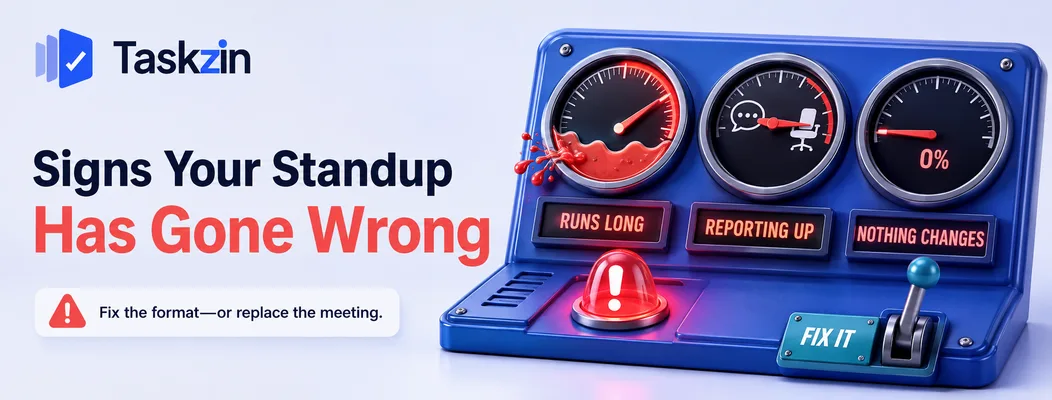
Three signals indicate a standup has stopped working: it consistently runs long, people address the manager rather than each other, and nothing changes as a result.
It runs long every day
Occasional overrun is fine. Consistent overrun means discussion is happening in the meeting instead of after it.
Enforce the parking habit for two weeks and the length usually corrects itself.
People report to the manager Watch where people look while speaking. If they address one person rather than the team, the meeting has become a reporting ritual and people will present rather than coordinate.
Rotating facilitation helps. So does the manager saying less, or occasionally not attending.
Nothing changes as a result
If you could cancel the standup and nobody would notice, the meeting is not producing coordination.
Either fix it — walk the board, focus on blockers — or replace it with a written update and use the time differently.
Common Standup Mistakes
The three habits that ruin standups are treating them as status meetings, solving problems in the room, and holding them at a disruptive time.
Treating it as a status meeting
Status is better read than heard. If the purpose is keeping a manager informed, a written update does it better and costs the team less.
Solving problems in the meeting
The moment two people start debugging, four others are spectators. Park it and move on.
Holding it at the wrong time
A standup at 11am fragments the morning — nobody starts deep work beforehand. Immediately after the usual start time, or at the point most of the team is naturally online, works better.
Ask the team. The right time is the one that interrupts the fewest people's focus, and it is often not the time the meeting was originally set.
Frequently asked
What is a daily standup?
A short daily team meeting, fifteen minutes or less, where the team coordinates the day's plan and surfaces blockers. It is run by and for the team rather than for a manager.
How long should a daily standup be?
Fifteen minutes maximum for a team of up to nine people. Many effective standups take five. Consistent overrun usually means discussion is happening in the meeting rather than after it.
What are the three standup questions?
What did I do yesterday, what will I do today, and what is blocking me. Many teams find walking the board more effective, since it focuses on the work rather than on individuals.
Should managers attend the daily standup?
They can, but their presence changes the dynamic — people tend to report rather than coordinate. If that happens, having the manager attend less often or say nothing usually restores it.
What time should you hold a standup?
At a point that fragments the fewest people's focus, usually near the start of the shared working day. Mid-morning is common and often the worst option, since it breaks the deep work window.
Can standups be asynchronous?
Yes, and for teams spanning several time zones written updates usually work better. Keep them to three lines and make sure blockers get responses, or the format becomes reporting.
Do you need a standup every day?
Not always. Teams working on independent items with few handoffs often function well with two or three a week. The test is whether the meeting regularly changes what people do.
Sujan Sharma is a content writer at Taskzin with a strong focus on productivity systems, task management, workflow optimization, team collaboration, and SaaS technology. He creates research-driven, practical content that helps professionals and growing teams improve operational efficiency, streamline processes, and make informed decisions about modern work management tools.
All posts by Sujan Sharma

Comments