What Is a Milestone in Project Management?
A clear explanation of project milestones, covering what they are and are not, the types of milestone, what makes a good one, how many a project needs, and how to use them for early warning and reporting.

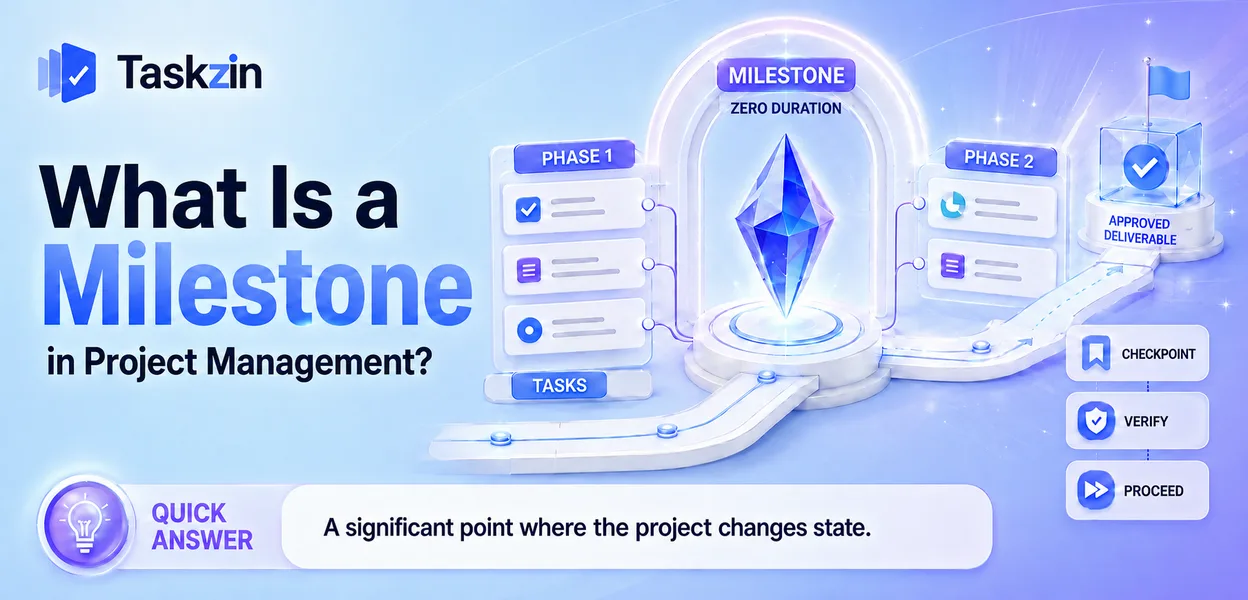
What is a milestone in project management?
The confusion is common: teams create milestones that are actually tasks, then wonder why the milestone "takes three days". A milestone takes no time at all. The work leading to it takes time.
This guide covers what milestones are, what makes a good one, how many a project needs, and how to use them as more than markers on a chart.
Quick answer: A milestone is a significant point in a project timeline that marks a change of state — a phase completed, an approval received, a deliverable handed over. It has no duration and no work attached to it; it is the moment something becomes true. Milestones exist to give a project checkpoints where progress can be verified rather than assumed.
What a Milestone Is and Is Not
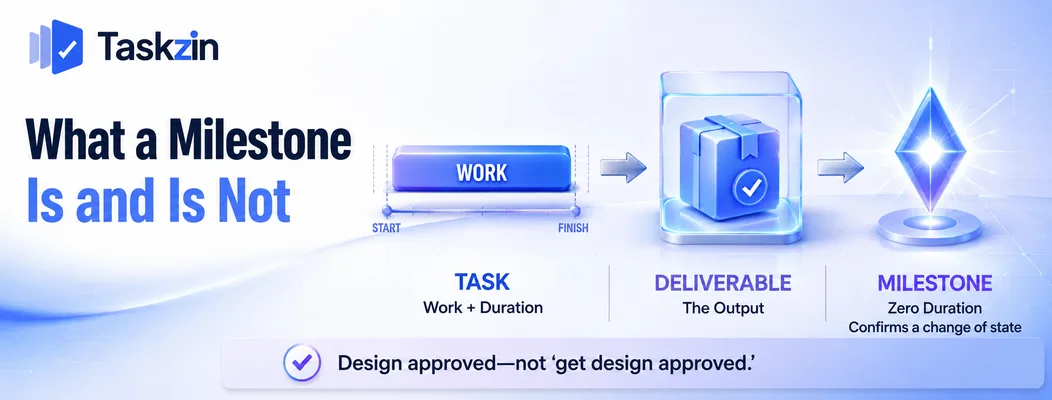
A milestone is a zero-duration marker confirming that something is now true, distinct from the tasks that produced it.
A point in time, not a piece of work
"Design approved" is a milestone. "Get design approved" is a task.
The distinction sounds pedantic and has practical consequences. Tasks have owners, estimates and effort. Milestones have a date and a verification. Mixing them produces plans where you cannot tell what is work and what is a checkpoint.
How milestones differ from tasks
A task changes something. A milestone confirms something has changed.
A deliverable sits between the two: it is the artefact produced, while the milestone is the moment it is accepted. "Draft specification written" is a deliverable; "Specification signed off by sponsor" is the milestone, and only one of those tells you the project can proceed.
Why they have no duration
Milestones are shown as diamonds on a Gantt chart precisely because they occupy no time.
They are the boundary between two periods of work.
If your milestone appears to have a duration, it is a task or a phase that needs renaming.
Types of Milestone
Type Marks Example Phase completion End of a stage of work Discovery complete Approval gate A decision has been made Budget approved Delivery point Something handed over Beta released to customers External deadline A date set outside the project Regulatory filing submitted Dependency point Another party has delivered Vendor data received Contractual A payment or obligation triggers Stage 2 invoice due Start marker Work is authorised to begin Development kickoff
What Makes a Good Milestone

A good milestone marks a genuine change of state, can be verified objectively by someone who was not involved, and has a named owner.
It marks a genuine change of state
Before the milestone, something was not true. After it, it is. The project can now proceed differently.
Milestones that mark arbitrary points — "50 percent complete" — fail this test. Nothing changes when they pass, so nobody acts on them.
It can be verified objectively
"Design approved" is verifiable: either the approval exists or it does not. "Design mostly finished" is not.
The test is whether someone outside the project could confirm it without asking for interpretation. Milestones that require judgement to assess get quietly declared complete when the date arrives.
Someone owns it
A milestone with no owner is a date on a chart. Someone must be accountable for it being reached and for raising the alarm if it will not be.
How Many Milestones a Project Needs
Most projects need one milestone every two to four weeks, spread across the timeline rather than clustered at the end.
Spacing them usefully
The purpose is early warning. A milestone every few weeks gives you regular evidence about whether the project is where it should be.
Spacing them evenly matters more than the exact count. A long stretch without any is a period where you have no verified information about progress.
Too few and too many
Three milestones on a nine-month project means you learn you are behind in month six. Thirty milestones means each one is trivial and nobody takes them seriously.
For most projects, five to ten meaningful milestones is right. Each should represent something a sponsor would genuinely want to know had happened.
Milestones on short projects
A two-week project may need only two: start and delivery. Adding checkpoints to work that short is overhead.
The rule of thumb is that a milestone should have real work either side of it. If two milestones are three days apart, one of them is probably unnecessary.
Using Milestones to Manage a Project
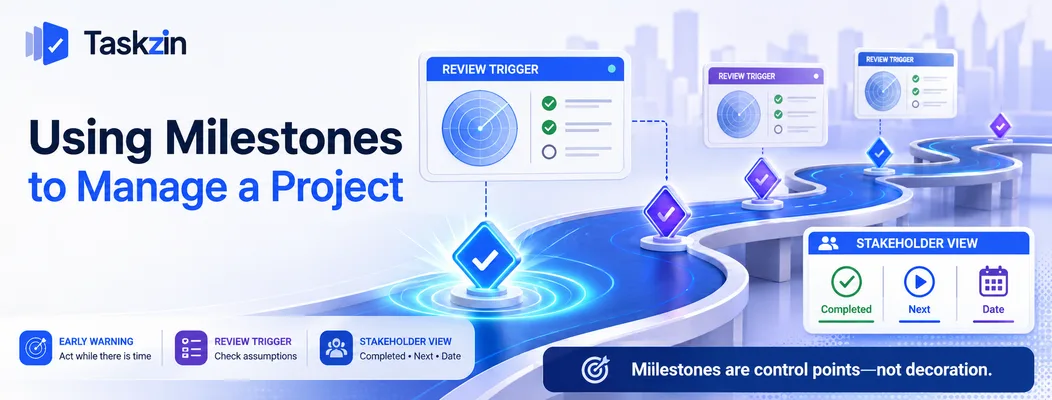
Treat milestones as review triggers rather than markers, place early ones deliberately to give warning, and use them as the basis for stakeholder reporting.
Review points, not just markers
A milestone reached should prompt a short review: is the project still on track, are the assumptions still valid, has anything changed that affects the rest of the plan?
This turns milestones from decoration into control. A project with ten milestones and no reviews has ten dates; one with reviews has ten opportunities to correct course.
Early warning through leading milestones
Place milestones early enough that a slip tells you something useful while there is still time to respond.
If the first meaningful checkpoint is at the halfway point, you cannot detect a problem in the first half. Deliberately setting an early milestone — even a modest one — buys you information when it is still actionable.
Reporting to stakeholders
Stakeholders rarely want task-level detail. Milestones are the right granularity: what has been completed, what is next, and whether dates have moved.
A timeline view showing milestone dates against the original plan communicates status faster than any written summary. In tools with timeline views — Taskzin's Gantt view among them — milestones show as fixed points with dependencies feeding into them, so a slip upstream visibly moves the marker.
Common Milestone Mistakes
The three recurring errors are creating milestones that are really tasks, clustering them at the end, and missing one without changing anything.
Milestones that are really tasks
If it has an owner doing work over several days, it is a task. Renaming tasks as milestones inflates the plan and makes genuine checkpoints harder to see.
Everything clustered at the end
Plans where the first milestone falls at 70 percent elapsed time provide no early warning. By the time you learn you are behind, the remaining time cannot absorb it.
Front-load at least one or two meaningful checkpoints.
Missing one and carrying on regardless
A missed milestone that produces no response teaches everyone that milestones do not matter, and the next one is missed more easily.
Missing a milestone should trigger a specific action: reassess the remaining plan, escalate, or formally move the date with the sponsor's agreement. Any of those is better than noting it and continuing.
Frequently asked
What Is a Milestone in Project Management?
A zero-duration point in the timeline marking a significant change of state — a phase completed, an approval given, a deliverable accepted. It confirms something is now true rather than representing work.
What is the difference between a milestone and a task?
A task is work with duration, effort and an owner. A milestone is a point in time confirming something has been achieved. "Write specification" is a task; "Specification approved" is a milestone.
How many milestones should a project have?
Roughly one every two to four weeks, giving five to ten for a typical project. Each should mark something a sponsor would genuinely want to know had happened.
What are examples of project milestones?
Requirements signed off, design approved, development complete, beta released, user testing finished, go-live, and project closure. External dates such as regulatory deadlines also count.
Do milestones have a duration?
No. They are shown as points — diamonds on a Gantt chart — because they mark a moment rather than a period. Anything with duration is a task or a phase.
What happens when you miss a milestone?
It should trigger a response: reassess the remaining plan, escalate to the sponsor, or formally reschedule. A missed milestone with no consequence teaches the team that milestones can be ignored.
How do milestones appear on a Gantt chart?
As diamond markers on the timeline rather than bars, since they have no duration. Dependencies can feed into them, so a delay in preceding work visibly moves the marker.
Sujan Sharma is a content writer at Taskzin with a strong focus on productivity systems, task management, workflow optimization, team collaboration, and SaaS technology. He creates research-driven, practical content that helps professionals and growing teams improve operational efficiency, streamline processes, and make informed decisions about modern work management tools.
All posts by Sujan Sharma


Comments