Project Management for Design Teams
A practical guide to project management for design teams, covering why design resists standard planning, a stage-by-stage flow, how to structure feedback and critique, working with engineering, and common mistakes.

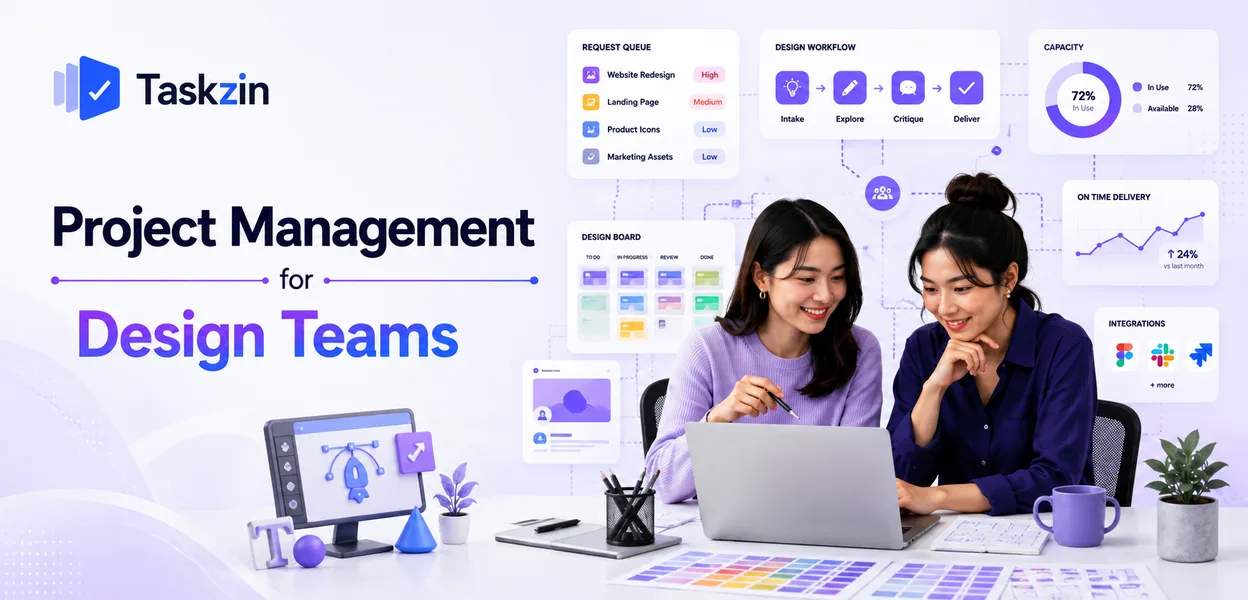
The familiar failure is a design team that appears to be a bottleneck. Requests arrive faster than they complete, deadlines slip during "one more round", and engineering waits. The underlying cause is almost never designer speed — it is unbounded intake and unstructured feedback.
This guide covers why design behaves differently, how to set up a workflow, how to run critique that actually improves work, and how to collaborate with engineering without constant rework.
Why Design Work Doesn't Fit Standard Project Management
be scheduled precisely, feedback tends to be subjective unless deliberately structured, and design teams usually serve other teams rather than owning their own roadmap. Managing it well means separating exploration from execution, structuring feedback against the brief, and making the request queue visible.
Setting Up Design Project Management
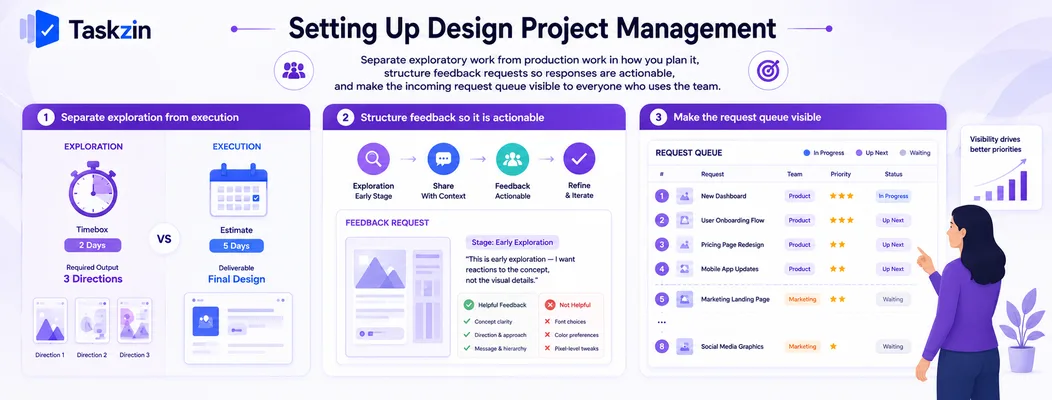
Three properties distinguish design work: exploration has genuinely unpredictable duration, feedback arrives as opinion unless structured otherwise, and the team's priorities are largely set by other teams' needs.
Each requires a specific accommodation rather than an attempt to make design behave like production work.
Exploration cannot be scheduled precisely
Producing a fifth variation of an established component takes a predictable amount of time.
Finding the right approach to an unsolved problem does not.
Treating both the same way is where most design planning fails. The right answer might arrive in the first hour or the third day, and no amount of estimation discipline changes that. The workable response is to timebox exploration — two days to produce three directions — rather than estimating it, which converts an unpredictable duration into a fixed one with variable output.
Feedback is subjective by default
Everyone has an opinion about design, and most people express it as preference. "I don't like the blue" is unactionable, and a designer receiving it either guesses or asks a clarifying question that costs a day.
This is not a failure of the people giving feedback. It is a failure to ask for the right kind, and it is entirely fixable with structure.
Design is a service to other teams
Most design teams do not own a roadmap. Product, marketing and engineering all generate demand, and the design lead has limited authority to decline.
The consequence is that a design team without visible intake will be permanently over-committed, because each individual request looks reasonable to the person making it and nobody sees the total.
The Design Delivery Flow
Stage Timeboxed? Output Common failure Request intake No Accepted brief No brief, verbal request Discovery Yes Problem understanding Skipped entirely Exploration Yes 2–3 directions Estimated rather than timeboxed Critique Yes Chosen direction Unstructured opinion Refinement Partly Production-ready design Endless rounds Handoff No Specs and assets Engineering not involved earlier Build support No Answered questions Designer already on next project
Common Design Project Management Mistakes
Separate exploratory work from production work in how you plan it, structure feedback requests so responses are actionable, and make the incoming request queue visible to everyone who uses the team.
Separate exploration from execution
Track them differently. Exploration gets a timebox and a required output — "two days, three directions". Execution gets an estimate, because producing a known component is genuinely estimable.
Mixing them produces plans nobody trusts, because the estimable half is dragged down by the unpredictable half. Separating them also makes the conversation with stakeholders honest: you can commit to production work in a way you cannot commit to finding a good idea.
Structure feedback so it is actionable
When sharing work, state what stage it is at and what feedback is wanted. "This is early exploration — I want reactions to the concept, not the visual details" prevents an hour of comments about typography on a wireframe.
This one habit removes a large share of design rework. Most unhelpful feedback comes from people who genuinely do not know what kind of response is useful at that moment.
Make the request queue visible
A shared, ordered list of every incoming request, with what is in progress and what is waiting, changes stakeholder behaviour more than any conversation.
When a marketing lead can see their request is eighth in the queue behind four product items, the conversation becomes about relative priority rather than about design being slow. Visibility converts an invisible capacity problem into a normal prioritisation discussion.
Running Design Critique That Improves Work
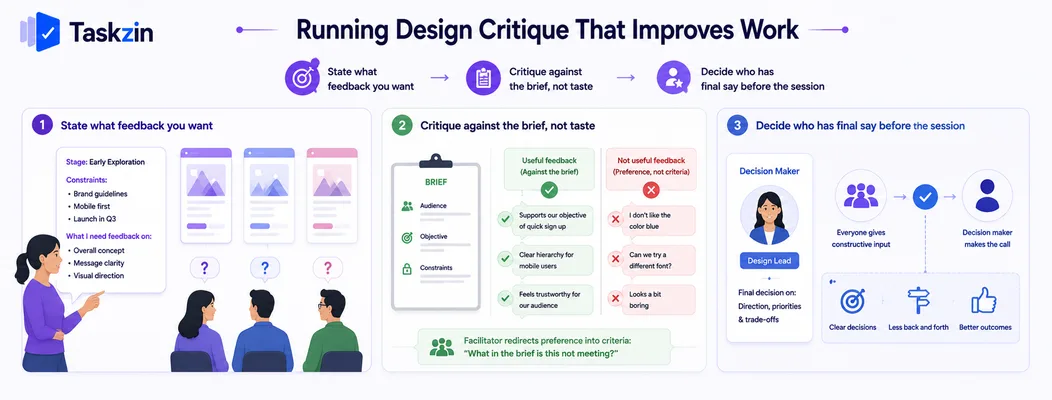
Effective critique starts with the designer stating what feedback they need, evaluates work against the brief rather than personal taste, and has an agreed decision-maker identified before the session.
State what feedback you want
The designer opens by naming the stage, the constraints, and the specific questions they want answered. Without this, critique defaults to whatever each participant happens to notice.
Ten seconds of framing changes the entire quality of the following thirty minutes.
Critique against the brief, not taste
Every piece of feedback should reference the brief: the audience, the objective, the constraints.
"This doesn't feel premium enough for the target audience" is useful. "I'd prefer a different font" is not.
The facilitator's job is to redirect preference into criteria. Asking "what in the brief is this not meeting?" does that without dismissing anyone, and it teaches the habit over a few sessions.
Decide who has final say before the session
Critique gathers input; someone decides. If that person is not named in advance, the session ends in ambiguity and the designer has to reconcile contradictory feedback alone.
Name the decision-maker at the start. It is usually the design lead or the product owner, and knowing who it is makes conflicting input a decision to be made rather than a problem to be solved.
Working With Engineering Without Constant Rework
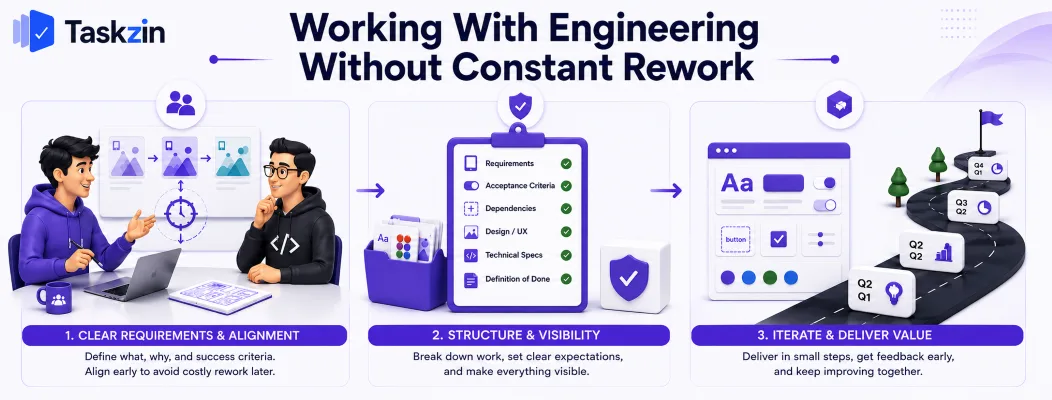
Bring engineering into exploration rather than handing over finished designs, agree handoff standards once instead of negotiating per project, and keep the design system ahead of the roadmap.
Involve engineering during exploration
A designer who explores alone for two weeks and then presents a finished design will regularly hear that something is technically impractical or disproportionately expensive.
Fifteen minutes with an engineer during exploration prevents that entirely. The point is not to constrain design to what is easy — it is to know the cost of each direction while there is still time to choose differently.
Agree handoff standards once
Decide as a team what a handoff includes: which states are specified, how spacing and tokens are documented, what assets are exported, where edge cases are described.
Agreeing it once removes a recurring negotiation and a recurring source of friction. It also makes handoff checkable, so incomplete handovers get caught before engineering starts rather than three days in.
Keep the design system ahead of the roadmap
If the system lacks a component the roadmap needs next quarter, that component gets designed under deadline pressure and enters the system badly.
Treat system work as a standing allocation rather than something done when there is time. A system that lags the roadmap generates one-off components, and one-off components are what turn a system into a library of inconsistencies.
Metrics Design Teams Can Reasonably Track
Track requests received against requests completed, revision rounds per deliverable, and the split between time designing and time waiting on feedback.
Requests received versus completed
This is the clearest possible evidence of a capacity problem. If twenty requests arrive monthly and twelve complete, the queue grows by eight every month regardless of how hard anyone works.
Presenting that comparison is far more effective than describing the team as busy, because it converts a subjective claim into arithmetic.
Revision rounds per deliverable
Count how many rounds each deliverable goes through. A consistently high number points to unclear briefs or unstructured feedback rather than weak design.
Investigating the outliers is where the useful information sits — the deliverable that took nine rounds usually reveals a specific broken part of the process.
Time in feedback versus time designing
Measure elapsed time waiting for review against active design time. The ratio is often uncomfortable and is the strongest argument available for setting deadlines on review steps.
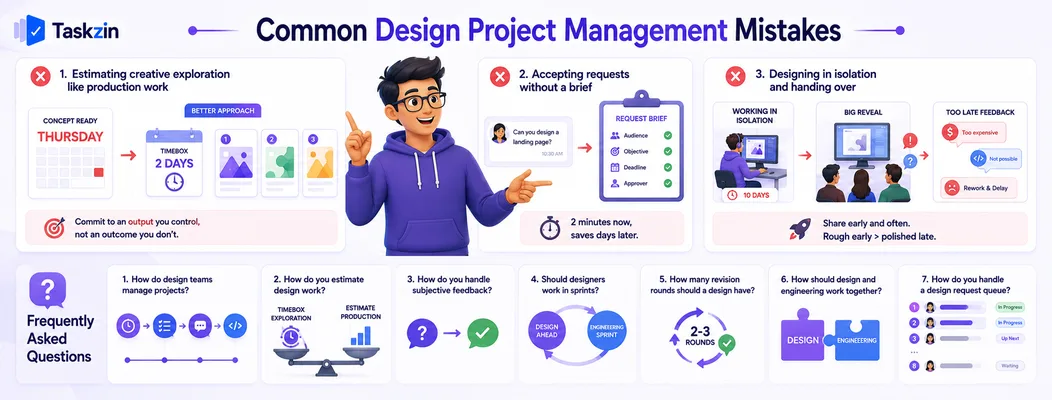
Common Design Project Management Mistakes The three habits that hurt design delivery most are estimating exploration like production, accepting requests without a brief, and designing in isolation before handover.
Estimating creative exploration like production work
Committing to "the concept will be ready Thursday" treats an unpredictable activity as a predictable one. Timebox instead: by Thursday there will be three directions to review.
The commitment is then to an output you control rather than to an outcome you do not.
Accepting requests without a brief
A request without audience, objective, deadline and approver produces work that fails review for reasons the designer could not have anticipated.
A short required-fields form solves this. The two minutes it costs the requester saves days of revision.
Designing in isolation and handing over
Long solo work followed by a big reveal invites late, expensive feedback and technical objections that arrive too late to accommodate cheaply.
Share early and often, in a form that signals it is early. Rough work shared at day two is easier to change than polished work shared at day ten, and it produces better feedback because nobody is worried about criticising something that looks finished.
Frequently asked
How do design teams manage projects?
By separating timeboxed exploration from estimable production work, running a visible request queue, structuring feedback against the brief, and involving engineering before designs are finished.
How do you estimate design work?
Estimate production work normally; timebox exploration instead of estimating it. Committing to three directions in two days is achievable, while committing to finding the right answer by Thursday is not.
How do you handle subjective design feedback?
Ask for specific feedback at the start, require every comment to reference the brief, and name the decision-maker in advance. Most unhelpful feedback comes from people who do not know what response is useful.
Should designers work in sprints?
Partially. Production work fits sprints well; exploration often needs to run ahead of the engineering cycle. Many teams have designers work a sprint ahead so designs are ready when engineering starts.
How many revision rounds should a design have?
Two or three for most deliverables. Consistently more usually indicates an unclear brief or unstructured feedback rather than a design problem, and the outliers are worth investigating individually.
How should design and engineering work together?
Involve engineering during exploration to understand implementation cost, agree handoff standards once rather than per project, and keep designers available for questions during the build.
How do you handle a design request queue?
Make it visible and ordered. When stakeholders can see where their request sits relative to others, the conversation becomes about priority rather than about the design team being slow.
Sujan Sharma is a content writer at Taskzin with a strong focus on productivity systems, task management, workflow optimization, team collaboration, and SaaS technology. He creates research-driven, practical content that helps professionals and growing teams improve operational efficiency, streamline processes, and make informed decisions about modern work management tools.
All posts by Sujan Sharma


Comments