Project Management for Freelancers and Solo Operators
A practical guide to project management for freelancers and solo operators, covering what changes when you are the whole team, running multiple clients, protecting your time and rate, managing capacity against pipeline, and common mistakes.

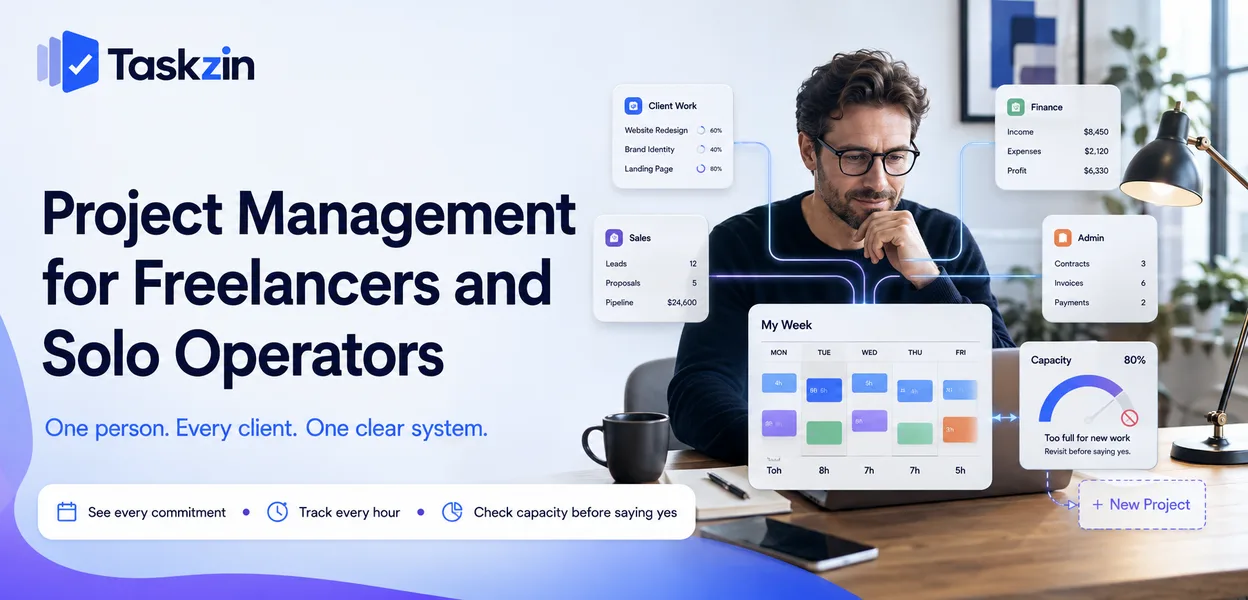
Most freelance project management advice is team advice scaled down. It should not be — the constraints are genuinely different, and some of what teams need is pure overhead for one person.
Quick answer: Working alone removes the coordination problem and replaces it with three others: there is no cover when you are unavailable, every hour of admin competes directly with billable work, and you are simultaneously the delivery team, the salesperson and the accountant. Managing this well means keeping one view across every client, tracking time even on fixed-price work, and checking capacity before saying yes.
What Changes When You Are the Whole Team
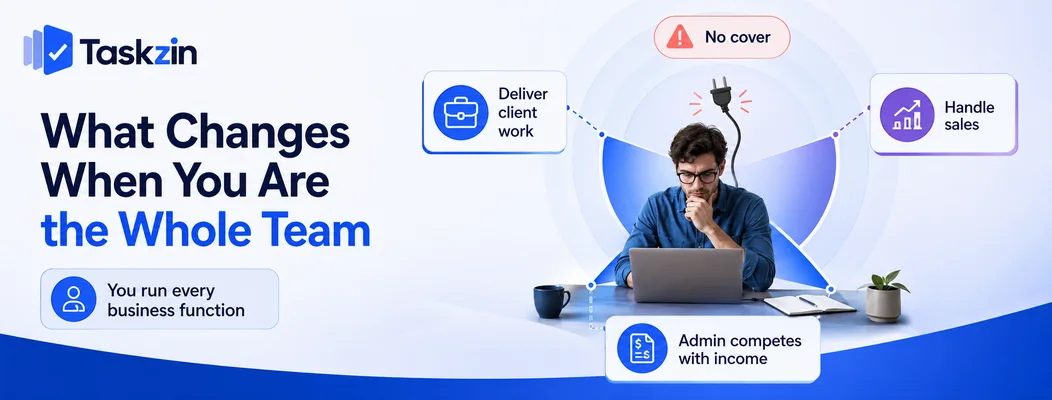
Solo work eliminates handoffs and introduces single-point-of-failure risk, direct competition between admin and income, and the need to perform several business functions simultaneously.
No handoffs, but no cover either
Nothing waits for someone else's review. Work moves as fast as you move it, and coordination overhead is close to zero.
The reverse is that illness, a family emergency or a bad week has no absorber. Clients experience the disruption directly. This makes forward visibility of commitments — knowing exactly what is due when — more important than it is for someone with colleagues.
Admin competes directly with billable time
For an employee, an hour of admin is an hour of the day. For a freelancer, it is an hour that was not invoiced.
This is why heavy process is genuinely wrong at this scale. Every system you adopt must earn its time back, and most team-oriented practices do not.
You are also the salesperson and the accountant
Delivery is one of four or five jobs. Sales, invoicing, contracts, tax and business development all compete for the same week.
A system that tracks only client work leaves the rest invisible, which is why business tasks reliably get displaced by client tasks until something becomes urgent.
The Solo Operator's Working System
Need What it looks like What it prevents
One view across every client
Single list or board with every commitment Overcommitting, forgotten work
Deadline visibility Everything due in the next fortnight, visible Missed dates Time tracked to project Hours against each piece of work Unknown profitability Scope change log Every extra request recorded when it arrives Unpaid scope creep Capacity figure Available hours per week, known Saying yes without room Client onboarding template Repeatable start-up sequence Forgotten steps, unprofessional starts Weekly review Fixed 30 minutes Everything above quietly decaying
Running Multiple Clients Without Dropping Anything
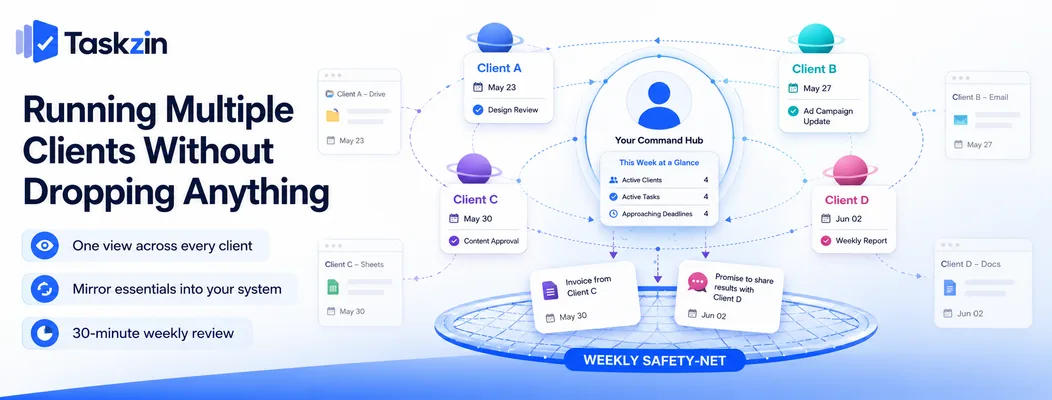
Keep one system that spans every client, mirror into client tools rather than living in them, and hold a weekly review that catches what slipped.
One view across every client The single most important thing. You need one place showing everything you have committed to, across all clients, with dates.
Without it you cannot answer the only question that matters when a new request arrives: do I actually have room for this? Freelancers who overcommit almost always do so because they could not see the total at the moment they said yes.
Never work only inside client systems
Clients will ask you to work in their tool. Do it where required, but keep your own system as the source of truth.
Working only in client systems means your commitments are spread across four platforms with no combined view, and you lose visibility of your own workload entirely. Mirror the essentials into your own list — task, client, deadline — and keep the detail wherever the client wants it.
Whichever tool you use for that, it needs to hold every client in one place rather than one project each.
Weekly review as the safety net
Thirty minutes, same time each week: what is due in the next fortnight, what has not moved, what did I promise verbally that never got recorded, what needs invoicing.
This is the mechanism that catches everything the system missed. Solo operators without a weekly review discover problems when a client chases, which is always later than they would have found them.
Protecting Your Time and Your Rate
Track hours regardless of pricing model, record scope changes as they arrive, and calculate what each client actually pays you per hour.
Track hours even on fixed price
On fixed-price work, hours determine whether the price was right. A project that felt fine may have taken three times what you assumed.
Tracking costs seconds per session and turns future quoting from instinct into arithmetic. It also identifies the client who consumes double the hours for the same fee — information you cannot obtain any other way.
Log scope changes at the moment they arrive
Every additional request, however small. Individually they feel unreasonable to charge for; collectively they can consume a fifth of a project.
The log also makes the conversation easier. Presenting eleven small additions is factual; saying "this feels like more than we agreed" is not, and only one of those is likely to result in payment.
Know your effective rate per client
Divide what a client paid by the hours you spent. That figure, not your quoted rate, is what you actually earn from them.
The results are usually uncomfortable and always useful. The client paying your highest rate may sit near the bottom once revisions and meetings are counted, while a lower-rate client with clear briefs may be your most profitable.
Managing Capacity and Pipeline Together
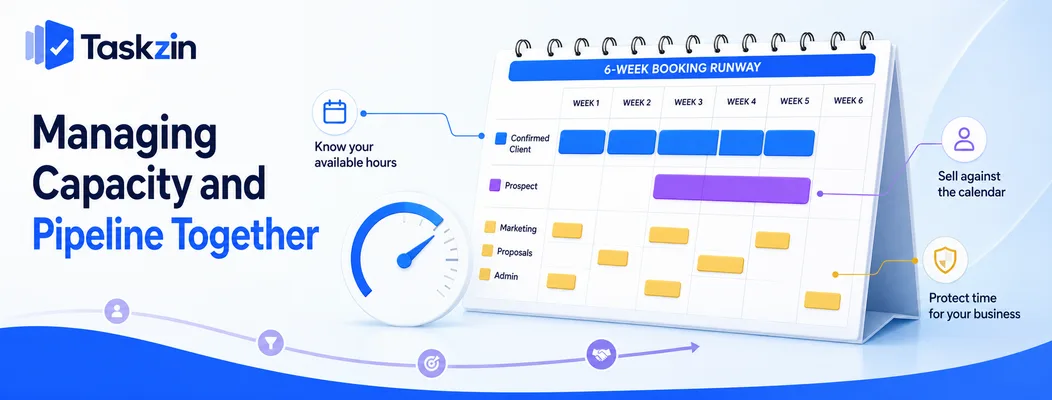
Know your available hours before accepting work, sell against a real calendar, and reserve time for your own business.
Know your available hours before saying yes
A realistic weekly figure: total working hours minus admin, sales, and the proportion that historically goes to non-billable work. For most freelancers, billable capacity is well under thirty hours a week.
Knowing that number turns "can I take this on?" from a feeling into a calculation.
Sell against a calendar, not against optimism
When a prospect asks when you can start, the honest answer comes from your committed capacity, not from wanting the work.
Proposing a start date two weeks out reads as being in demand. Accepting immediately and delivering late reads as unreliable, and the second is far more damaging to a freelance reputation than the first.
Protect time for the business itself
Marketing, proposals, invoicing, admin, learning. None is urgent, all are important, and all get displaced by client work.
Block it in the calendar as if it were a client commitment. Freelancers who do not do this experience the feast-and-famine cycle — fully booked with no pipeline, then empty with no prospects — because business development only happens when there is no client work, which is the worst possible time to start.
Common Freelance Project Management Mistakes
The three habits that cost most are living entirely in client tools, accepting work before checking capacity, and having no repeatable process for routine work.
Living in client tools
Commitments spread across four client systems with no combined view. You overcommit, you miss things, and you spend unpaid time reconciling.
Keep your own view regardless of what clients use.
Saying yes before checking capacity
Accepting work because it was offered rather than because there is room is how freelancers end up working weekends for no additional money.
Check the hours. Propose a later start rather than an impossible one.
No process for the boring parts
Onboarding, contracts, invoicing, project close. These recur with every client and get reinvented each time.
Build a template once — contract, deposit, kickoff, access, brand assets, review schedule, invoicing details. It removes setup time, ensures nothing is forgotten, and looks noticeably more professional than assembling it from memory.
Frequently asked
How do freelancers manage multiple client projects?
By keeping one system that spans every client with all commitments and deadlines visible together, mirroring into client tools where required, and holding a weekly review to catch anything that slipped.
Should freelancers work in their client's project tool?
Use it where the client requires, but keep your own system as the source of truth. Working only in client tools leaves your commitments spread across platforms with no combined view.
Do freelancers need to track time on fixed-price work?
Yes, arguably more than on hourly work. Hours are the only way to tell whether a fixed price was right, and the data turns future quoting from guesswork into arithmetic.
How do you calculate your effective hourly rate?
Divide total fees received from a client by total hours spent, including revisions, meetings and admin. This is what you actually earn, as distinct from your quoted rate.
How do you handle scope creep as a freelancer?
Log every additional request when it arrives, with the date. Review the list with the client periodically rather than presenting it at the end, when it reads as a complaint rather than a record.
How far ahead should a freelancer plan capacity?
Four to eight weeks of committed work, with a rough view further out. Knowing your realistic weekly billable hours is more important than planning far ahead.
How do solo operators protect time for their own business?
By blocking it in the calendar as a fixed commitment. Marketing, proposals and admin are never urgent and will otherwise be displaced entirely by client work until the pipeline is empty.
Sujan Sharma is a content writer at Taskzin with a strong focus on productivity systems, task management, workflow optimization, team collaboration, and SaaS technology. He creates research-driven, practical content that helps professionals and growing teams improve operational efficiency, streamline processes, and make informed decisions about modern work management tools.
All posts by Sujan Sharma


Comments