Project Management for HR Teams
A practical guide to project management for HR teams, covering what makes HR work different, which processes to template, running recruitment as a managed pipeline, fixing onboarding, and common mistakes.

The recognisable pattern is an HR team that is capable and permanently behind, because every recruitment round, every onboarding and every review cycle is assembled from memory and last time's emails. Nothing is hard; everything is slower than it should be.
This guide covers what makes HR work different, which processes to template, how to run recruitment as a managed pipeline, and how to fix onboarding.
Quick answer: HR project work is dominated by recurring processes with externally fixed deadlines and a significant confidentiality requirement — which means templating repeatable workflows matters more than planning individual projects, and access control matters more than it does for most other functions. The teams that manage this well spend almost no time rebuilding processes they have already run.
What Makes HR Project Work Different
HR work is mostly recurring rather than novel, its deadlines are set by external events rather than negotiated, and a meaningful share of it cannot be visible to the whole organisation.
Each of these has a direct implication for how the work should be organised.
Most of it is recurring, not one-off
Recruitment, onboarding, probation reviews, performance cycles, compliance training, offboarding, annual leave processing — HR runs the same processes repeatedly, with different people in the slots.
This is unusually good news, because recurring work is the easiest kind to systematise. A team that templates its processes converts most of its planning effort into a one-time cost, and the return compounds every cycle.
Deadlines are external and immovable
A new starter arrives on the fifteenth. The performance cycle closes at quarter end. Statutory filings have fixed dates.
Unlike product work, these cannot slip. That changes planning: the question is never whether to hit the date but what must start when in order to. Working backwards from fixed dates should be the default planning method, and templates with relative dates make that automatic.
It also means HR carries more concurrent deadline pressure than most functions, because the dates are set by events rather than sequenced by anyone. Two people starting the same week and a compliance filing falling in the same fortnight is not poor planning — it is the normal condition, and capacity has to be reserved for it.
Much of the work is confidential
Grievances, investigations, salary decisions, performance concerns and health-related matters cannot sit in a workspace the whole company can see.
This is not solved by remembering to mark things private. It needs structural separation, because a single misconfigured permission on a sensitive matter causes damage that no amount of process efficiency offsets.
The Recurring HR Workflows Worth Templating
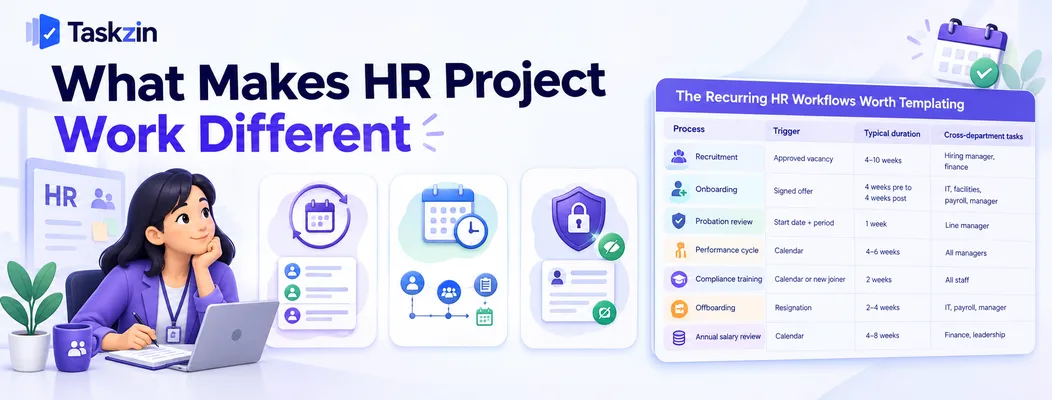
Process Trigger Typical duration Cross-department tasks Recruitment Approved vacancy 4–10 weeks Hiring manager, finance Onboarding Signed offer 4 weeks pre to 4 weeks post IT, facilities, payroll, manager Probation review Start date + period 1 week Line manager Performance cycle Calendar 4–6 weeks All managers Compliance training Calendar or new joiner 2 weeks All staff Offboarding Resignation 2–4 weeks IT, payroll, manager Annual salary review Calendar 4–8 weeks Finance, leadership
Setting Up HR Project Management
Template every process you run more than twice a year, keep confidential work in a structurally separate space, and give employees one route to reach HR.
Template every recurring process
Build each recurring process once, with every task, owner and relative date. Onboarding then starts as a complete plan triggered by a signed offer rather than as a set of remembered steps.
The gain is larger than the time saved. Templates capture institutional knowledge, so the process survives the person who designed it, and they make the process improvable — you can fix the template once and every future run inherits the improvement.
Separate confidential work from general projects
Use a distinct workspace with restricted membership for anything sensitive, rather than relying on per-item privacy settings within a shared space.
Structural separation makes the safe option the default. Per-item settings make exposure one forgotten toggle away, and the consequences of that mistake in HR are considerably worse than in most functions.
Build a single intake route for employee requests
Employees ask HR things constantly — leave queries, contract questions, expenses, policy clarifications. Arriving by email, chat and corridor conversation, these are impossible to track and easy to lose.
A simple request form creates a record, an owner and a response time. It also makes the volume visible, which is usually the only way to demonstrate that a small HR team is handling several hundred interactions a month alongside its project work.
Running Recruitment as a Managed Pipeline
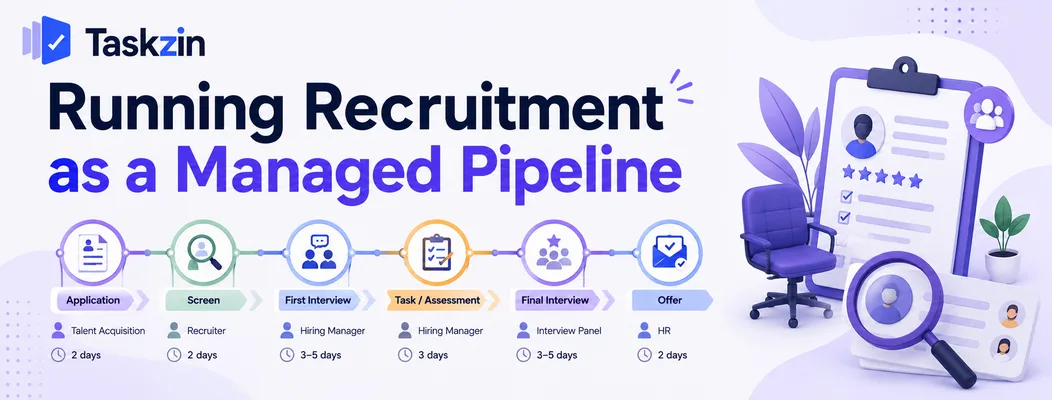
Treat recruitment as a pipeline with defined stages, a named owner per stage and agreed response times, because most candidate loss happens in the gaps between stages rather than at decision points.
Stages, owners and service levels
Define the stages — application, screen, first interview, task, final, offer — and for each, who owns it and how quickly it should happen.
The service level is the important part. "CV screened within two working days" and "interview feedback within 24 hours" are commitments that can be tracked. Without them, candidates sit in queues for reasons nobody notices, and strong candidates accept other offers while waiting.
Where candidates actually get lost
Almost always waiting for feedback from a hiring manager, or waiting for an interview to be scheduled.
Both are visible if you measure time in stage rather than only tracking who is at which stage. A dashboard showing three candidates who have been waiting more than five days at the same stage tells you exactly where to intervene, and the intervention is usually a single conversation.
Coordinating interviewers without email chains
Scheduling four interviewers across two weeks by email is a substantial hidden cost, and it is the stage where the process most often visibly stalls.
Use scheduling links or shared availability rather than negotiating in threads, and put the scheduling task in the pipeline with an owner. Treating it as a step in the process rather than an administrative afterthought is what stops it consuming days.
Onboarding: The Process Most Worth Fixing
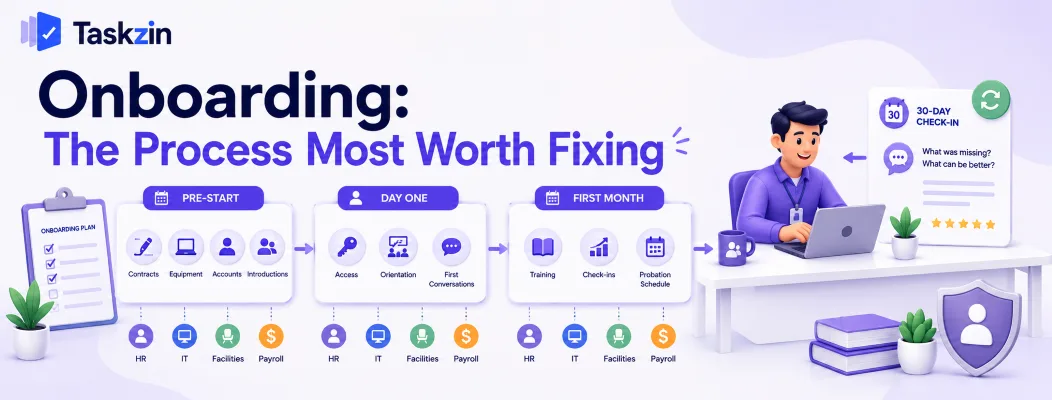
Onboarding is the highest-return HR process to systematise, because it spans several departments, has a fixed date, and its failures are immediately visible to a new employee forming their first impression.
Pre-start, day one, first month
Split the template into three phases. Pre-start covers contracts, equipment, accounts and introductions. Day one covers access, orientation and the first conversations. The first month covers training, check-ins and the probation schedule.
Each phase has different owners and different deadlines relative to the start date. Building it as one undifferentiated checklist makes it hard to see what is at risk, whereas phased templates surface a missed pre-start task while there is still time.
Tasks that belong to other departments
Most onboarding failures are not HR failures. IT did not create the account, facilities did not order the desk, payroll did not receive the details in time.
Put those tasks in the same template with the right owners and dates, so the whole process is visible in one place. HR remains accountable for the outcome, which means HR needs visibility of the tasks it does not perform.
Checking it worked
Add a task at thirty days to ask the new joiner what was missing. This costs ten minutes and produces the only reliable information about whether the process works.
Feed the answers back into the template. An onboarding process improved four times a year is noticeably better after a year than one designed once and never revisited.
Common HR Project Management Mistakes
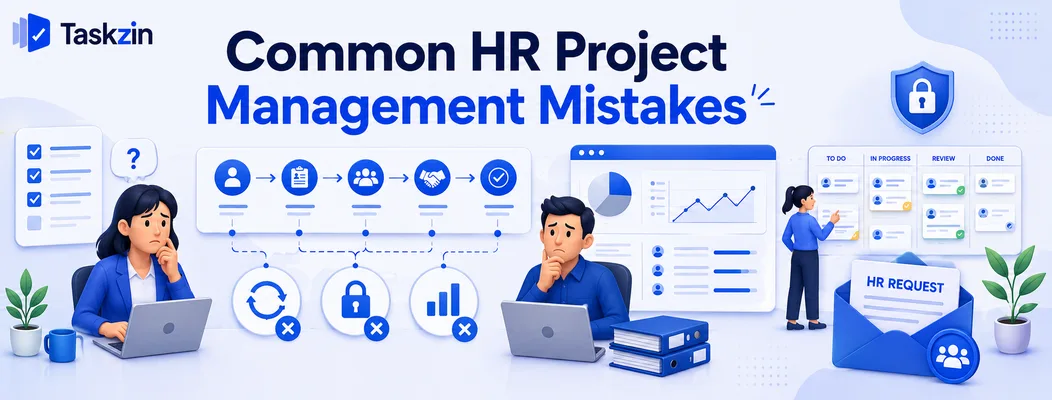
The three most costly habits are rebuilding recurring processes each time, keeping confidential work in the general workspace, and having no visible measure of total workload.
Rebuilding the same process every cycle
Running recruitment from memory and last time's emails means every round takes longer than necessary and each one forgets something different.
Template it. This is the single highest-return change available to most HR teams, and it takes an afternoon per process.
Keeping confidential work in the general workspace
Relying on per-item privacy for sensitive matters puts the organisation one misconfiguration away from a serious problem. Use a separate restricted space so the default is safe.
No visibility of total workload
HR work is largely invisible to the rest of the organisation. Nobody sees the two hundred employee queries, the three concurrent recruitments and the compliance deadline.
Without a visible measure of total commitment, requests keep arriving and the team is judged on responsiveness it has no capacity to deliver. A shared view of active work is the evidence that makes a resourcing conversation possible.
The simplest version is a monthly count: requests received, requests closed, active recruitments, upcoming fixed deadlines. Four numbers, reported consistently, do more to explain an HR team's capacity than any narrative description, and they make the case for another pair of hands long before the team reaches breaking point.
Frequently asked
How do HR teams use project management software?
Mainly to template recurring processes — recruitment, onboarding, performance cycles — so each run starts as a complete plan, and to track employee requests through a single intake route with owners and response times.
What HR processes should be templated?
Anything run more than twice a year: recruitment, onboarding, offboarding, probation reviews, performance cycles, compliance training and annual salary review. Onboarding usually delivers the largest immediate gain.
How do you handle confidential HR work in a shared tool?
Use a structurally separate workspace with restricted membership rather than per-item privacy settings, so the safe option is the default and exposure requires a deliberate action.
How should HR manage recruitment pipelines?
As stages with named owners and agreed response times, tracking how long candidates sit in each stage. Most candidate loss happens waiting for feedback or scheduling rather than at decision points.
What should an onboarding checklist include?
Three phases: pre-start (contract, equipment, accounts), day one (access, orientation, introductions) and first month (training, check-ins, probation schedule), with tasks for IT, facilities, payroll and the line manager included.
How do you manage employee requests to HR?
A single intake form that creates a tracked item with an owner and a response time. This prevents requests being lost across email and chat, and makes the true volume visible.
Do small HR teams need project management software?
Yes, arguably more than large ones. A small team carries the same recurring processes with less slack, so templating and a visible request queue return more per person than they do at scale.
Sujan Sharma is a content writer at Taskzin with a strong focus on productivity systems, task management, workflow optimization, team collaboration, and SaaS technology. He creates research-driven, practical content that helps professionals and growing teams improve operational efficiency, streamline processes, and make informed decisions about modern work management tools.
All posts by Sujan Sharma

Comments