Project Management for Manufacturing
A practical guide to project management in manufacturing, covering the difference between production operations and project work, running new product introduction, planning line changes and capital projects, continuous improvement, and common mistakes.

The confusion is common and expensive. A plant applies production discipline to an NPI programme and is surprised when the unknowns do not respond to scheduling. Or it treats a capital project as something that happens around production and discovers the commissioning window was never protected.
This guide covers where project management genuinely applies, how to run new product introduction, how to plan line changes, and how to manage improvement work.
Quick answer: Manufacturing plants run two distinct kinds of work: production, which is a repeating operation managed by scheduling and throughput, and projects — new product introduction, line changes, capital equipment, improvement initiatives — which have a start, an end and a defined outcome. Managing them well means keeping the two separate, because the tools and mindsets that suit one actively hinder the other.
Two Different Kinds of Work in One Plant
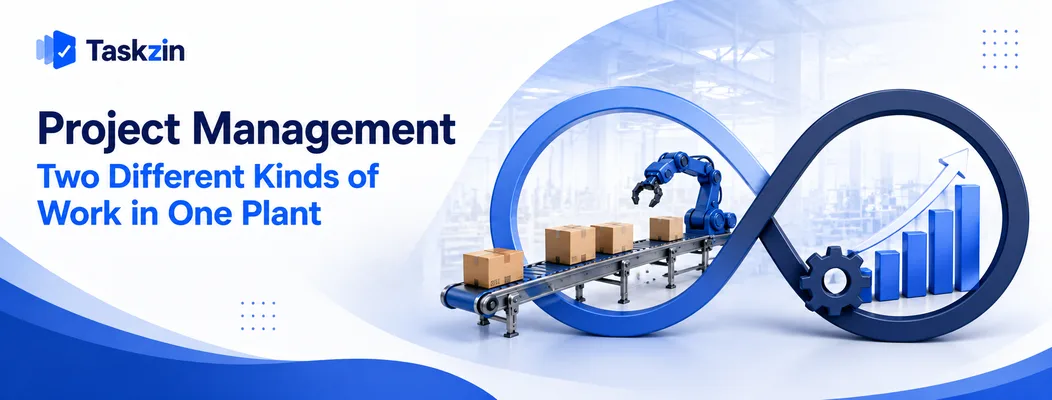
Production is a repeating operation optimised for throughput and consistency; projects are one-off efforts with a defined end. Applying the management approach of one to the other is the root of most manufacturing project failure.
Production is operations, not projects
Making the same part every day is not a project. It is a process, managed through scheduling, capacity planning, quality control and throughput measurement.
Project management adds nothing here and can subtract. Production benefits from stability, standard work and variance reduction, whereas project management is designed for work that has never been done before. An MRP or scheduling system is the right tool for production, not a project board.
Where project management genuinely applies
New product introduction. Installing or replacing equipment. Line reconfiguration. Facility changes. Regulatory or certification programmes. Continuous improvement initiatives. ERP or system implementations.
Each has a defined start and end, a cross-functional team, dependencies and unknowns. These are projects by any definition, and they are typically managed worst in plants that are otherwise operationally excellent, because the organisation's instincts are all tuned for repetition.
Why mixing them causes trouble
When project work and production work share a queue, production wins every time. It has volume commitments, customer orders and daily visibility, while the improvement project has none of those.
The result is familiar: capital projects slip repeatedly, improvement initiatives stall at 60 percent, and the plant is permanently busy without changing. Separating the two — different tracking, protected capacity, named owners — is what allows project work to progress at all.
Manufacturing Project Types
Project type Typical duration Main constraint Frequent failure
Running New Product Introduction
introduction 3–18 months Design maturity Late design changes Capital equipment install 3–12 months Delivery lead time
Underestimating ramp-up
underestimated Line changeover / reconfiguration Days–weeks Production downtime Window overruns Facility change Weeks–months Site access Disruption to production Certification / compliance 2–12 months Evidence gathering Documentation gaps Continuous improvement Weeks Engineer availability
Improvement initiatives with no owner
measurement ERP / MES implementation 6–24 months Data quality Underestimated data cleansing
What is new product introduction (NPI)?
Run NPI through stage gates where each gate makes a specific decision, involve manufacturing engineering during design rather than after it, and prove the process with pilot runs before committing to full production.
Stage gates and what each one decides
A stage gate is a decision point, not a status meeting. Each should have defined entry criteria and a clear decision: proceed, hold, or stop.
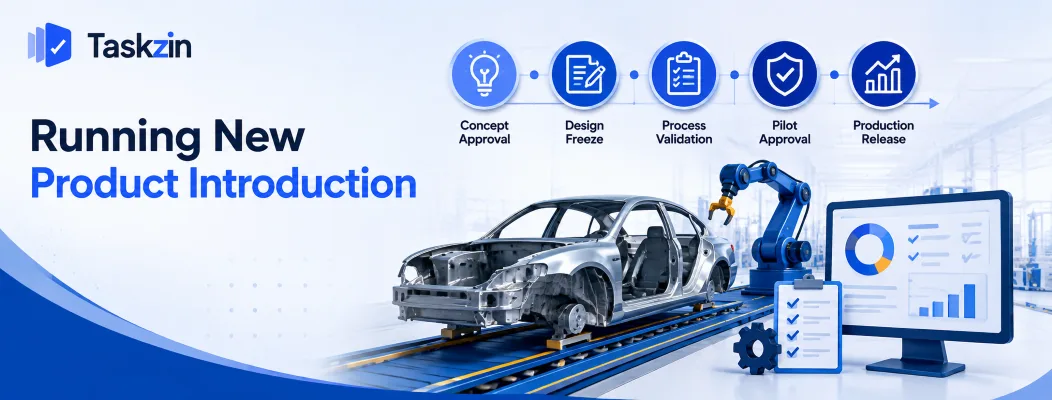
Typical gates are concept approval, design freeze, process validation, pilot approval and production release. The value comes from enforcing them — a gate passed because the schedule says so, with criteria unmet, transfers the problem downstream where it costs considerably more to fix.
Design for manufacture, early
The largest cost driver in NPI is design decisions made without manufacturing input. A tolerance that requires a slower process, a geometry needing custom tooling, a material with a long lead time — each is cheap to change during design and expensive afterwards.
Involve process engineering from concept stage rather than at handover. This is the single highest-return practice in NPI, and it is routinely skipped because design and manufacturing sit in different reporting lines.
Pilot runs before full production
A pilot run on production equipment with production operators reveals what a prototype cannot:
cycle time reality, operator ergonomics, fixture problems, quality variation.
Plan the pilot as a project phase with defined success criteria and time allowed to act on findings. A pilot scheduled so tightly that its findings cannot be addressed before launch is a formality rather than a test.
Managing Line Changes and Capital Projects
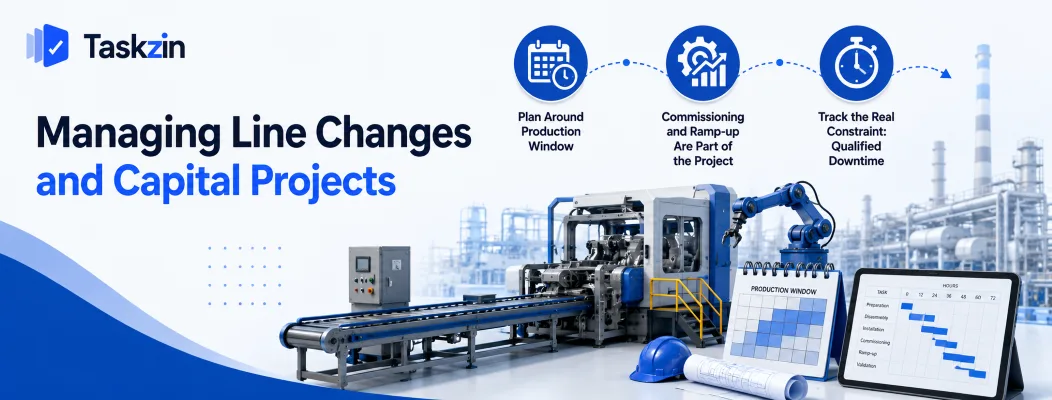
Plan line changes around the available production window rather than the calendar, treat commissioning and ramp-up as project phases rather than the end, and recognise that qualified downtime is the real constraint.
Plan around the production window, not the calendar
The binding constraint on a line change is rarely the work itself — it is when the line can be stopped. Shutdowns, holiday periods and low-demand windows determine the plan.
Work backwards from that window. Everything that can be prefabricated, pre-tested or staged in advance should be, because time inside the window is the scarcest resource on the project and no amount of resource elsewhere substitutes for it.
Commissioning and ramp-up are part of the project
Equipment installed is not equipment producing. Commissioning, operator training, process qualification and ramp to full rate can take as long as the installation.
Plans that end at installation systematically overrun, because the ramp-up period is real, predictable and unbudgeted. Include it explicitly with its own milestones and an expected yield curve, so a slower start is recognised as normal rather than treated as a failure.
Track the real constraint: qualified downtime
Measure the project against downtime consumed rather than calendar days elapsed. If the window is seventy-two hours, that number is the plan.
This changes how you sequence: tasks that can run in parallel inside the window should, tasks that can move outside it must, and contingency should be expressed in hours of window rather than days of schedule.
Continuous Improvement as Managed Work
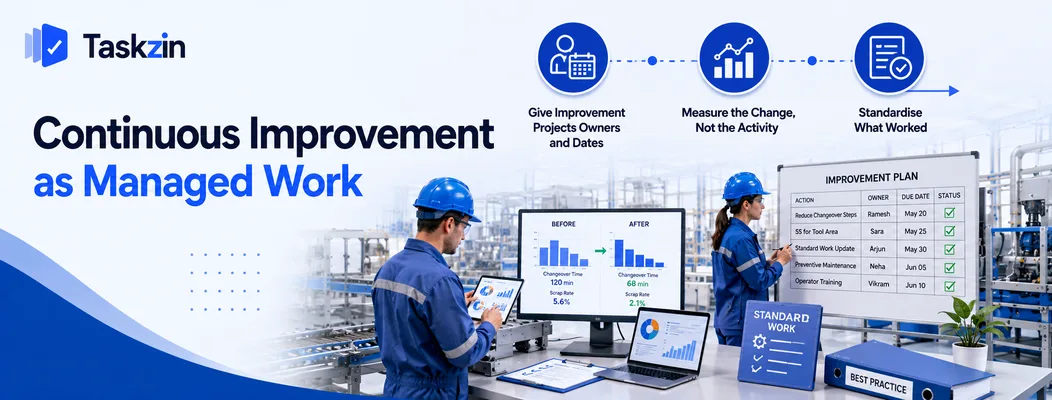
Improvement initiatives need named owners, dates and measured outcomes, or they become activity that consumes engineering time without changing performance.
Give improvement projects owners and dates
A kaizen event that produces fifteen actions with no owners produces nothing. Every action needs one named person and a date, and someone needs to check them.
This is unremarkable project management, and it is what separates plants where improvement compounds from plants that hold enthusiastic events and stay the same.
Measure the change, not the activity
Counting improvement events held, or suggestions submitted, measures activity. Measuring changeover time before and after, or scrap rate before and after, measures results.
Define the metric and the baseline before starting. Retrospective measurement invites optimistic interpretation, and a project without a baseline cannot be honestly evaluated at all.
Standardise what worked
An improvement that works on one line and is never documented or replicated captures a fraction of its value.
Update the standard work, train the other shifts, and apply it to comparable lines. The documentation step is consistently the one skipped, and it is the difference between a local fix and a plant-wide gain. Without it the improvement also decays — the shift that was not trained gradually reverts, and within a year the line is running as it did before.
Common Manufacturing Project Management Mistakes
The three most costly errors are treating production scheduling as project management, underestimating ramp-up, and running improvement initiatives without owners.
Treating production scheduling as project management
They solve different problems. Scheduling optimises repeated work against capacity; project management coordinates novel work with dependencies and unknowns.
Plants that try to run NPI through the production scheduling system find it cannot represent uncertainty, cross-functional ownership or stage gates, and the project ends up managed in spreadsheets anyway.
Underestimating ramp-up New equipment and new products do not reach target rate immediately. Yield is lower, cycle times are longer, and operators are still learning.
Plan the ramp explicitly with an expected curve. Commitments made on the assumption of immediate full rate cause missed customer promises in the first weeks, which is exactly when a new product most needs to look reliable.
Improvement initiatives with no owner Actions assigned to a department rather than a person are assigned to nobody. Six months later the same problem is raised at another event.
One named person per action, with a date, reviewed regularly. Nothing more sophisticated is required, and nothing less works.
Be realistic about how many run at once. A plant with forty open improvement actions and two process engineers has a list rather than a programme. Limiting work in progress to what the available engineering capacity can genuinely finish produces more completed improvements per year than an ambitious list that stalls.
Frequently asked
How is project management used in manufacturing?
For work with a defined start and end — new product introduction, capital equipment installation, line changeovers, facility changes, certification programmes and improvement initiatives. Day-to-day production is managed through scheduling instead.
What is the difference between production scheduling and project management?
Scheduling allocates repeated work against capacity to optimise throughput. Project management coordinates one-off work with dependencies, unknowns and a defined end point. Plants need both, applied to the right work.
What is new product introduction (NPI)?
The process of taking a product from concept to full production, typically through stage gates covering design, process validation, pilot runs and production release, with manufacturing engineering involved from the design phase.
How do you plan a production line changeover?
Work backwards from the available production window, prefabricate and pre-test everything possible outside it, sequence tasks to run in parallel inside it, and express contingency in hours of downtime rather than calendar days.
How should manufacturers manage continuous improvement projects?
With one named owner and a date per action, a defined metric and baseline set before starting, and a documentation step that updates standard work so the improvement spreads beyond the line where it was made.
What are stage gates in manufacturing?
Decision points in a project with defined entry criteria, where the outcome is proceed, hold or stop. Their value depends on enforcement — a gate passed with criteria unmet moves the problem downstream where it costs more.
How do you account for ramp-up in project planning?
Include it as an explicit phase with its own milestones and an expected yield and rate curve. Equipment installed is not equipment producing, and plans ending at installation systematically overrun.
Sujan Sharma is a content writer at Taskzin with a strong focus on productivity systems, task management, workflow optimization, team collaboration, and SaaS technology. He creates research-driven, practical content that helps professionals and growing teams improve operational efficiency, streamline processes, and make informed decisions about modern work management tools.
All posts by Sujan Sharma


Comments