Project Management for Real Estate Teams
A practical guide to project management for real estate teams, covering transaction pipelines and chase discipline, property development programmes, lettings compliance and maintenance queues, and the mistakes that cost deals.


The familiar version is a negotiator holding twenty live transactions across their inbox, memory and a spreadsheet. Most progress fine. Two stall unnoticed, and by the time anyone realises, one buyer has withdrawn.
This guide covers running transactions as a managed pipeline, handling development projects, coordinating lettings and property management, and the mistakes that cost deals.
Quick answer: Real estate work is a high volume of near-identical transactions whose progress depends almost entirely on third parties — solicitors, surveyors, lenders, local authorities — which means the discipline that matters most is systematic chasing rather than planning. Deals rarely fail because of a decision; they fail because nobody noticed something had been sitting with a third party for three weeks.
What Real Estate Work Actually Looks Like
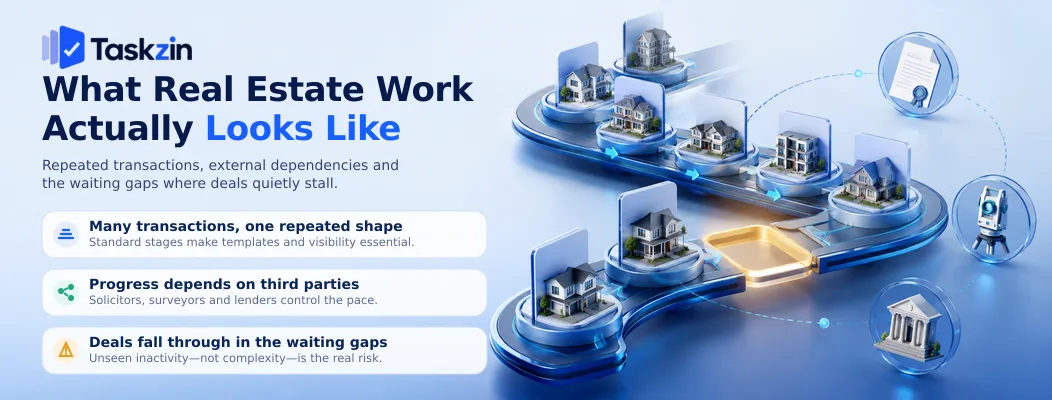
Real estate teams run many concurrent transactions that follow the same sequence, where progress is controlled by external parties and most failures happen in the waiting periods between stages.
That combination — repetitive shape, external dependency, failure in the gaps — points directly at what the process needs to do.
Many transactions, each with the same shape
A property sale follows a predictable sequence: offer accepted, memorandum of sale, solicitors instructed, searches, survey, mortgage offer, enquiries, exchange, completion.
Because the shape repeats, it templates well. A team running each transaction from memory is redoing the same thinking twenty times a month, and the variation between negotiators means service quality depends on who happens to be handling it.
Progress depends on third parties
You cannot make a local authority return searches faster, or a lender issue an offer sooner. Most of the elapsed time in a transaction is spent waiting for someone outside your organisation.
This inverts the usual project management emphasis. Your controllable activity is not doing the work but knowing precisely what is outstanding, with whom, and for how long — and applying pressure at the right moment.
Deals fall through in the gaps
Transactions rarely collapse at a decision point. They collapse because momentum was lost:
three weeks of silence, a buyer who feels forgotten, a chain that stalled while nobody was watching.
The consequence is that a systematic chase schedule — checking what is outstanding on a fixed rhythm rather than when someone remembers — is the highest-value process a sales team can adopt. Regular contact also matters independently of progress. A buyer told weekly that searches are still outstanding stays committed; the same buyer hearing nothing for three weeks starts viewing other properties, whether or not anything was actually going wrong.
Real Estate Work Types and What Each Needs
Work type Volume Main constraint What it needs Sales progression High Third-party response Template plus chase schedule Lettings and tenancies High Compliance dates
Recurring compliance as scheduled work
tasks Property management Continuous Maintenance volume Tracked request queue Development projects Low Planning approval Programme with cost tracking Refurbishment Medium Contractor availability Short project plans Portfolio acquisition Low Due diligence Checklist with evidence Compliance across portfolio Continuous Certificate expiry Automated recurring reminders
Running Transactions as a Managed Pipeline
Build one transaction template covering every stage, track what you are chasing rather than only which stage a deal is at, and make the whole pipeline visible so nothing depends on one person's memory.
Build one transaction template
Create the standard sequence once with every task, the party responsible, and typical timescales. Each new transaction starts from it.
This gives consistency across negotiators and means nothing is forgotten on a busy week. It also makes the process improvable: when you notice that mortgage offers routinely take longer than assumed, you adjust the template and every future transaction benefits.
Keeping these in a shared workspace matters more than which tool. In Taskzin, for instance, a transaction template can carry each stage with owners and relative dates, so the pipeline view shows every live deal and what each is waiting on.
Track chase actions, not just stage
Knowing a transaction is at "searches" is insufficient. You need to know searches were ordered on the fourth, are typically returned within three weeks, and are therefore now overdue.
Record what is outstanding, with whom, since when, and when you last chased. A daily view of everything overdue turns chasing from a memory exercise into a short routine, and it is the single change that most reduces fall-through.
Make the whole pipeline visible to the team
Transactions held in individual inboxes are invisible when that person is on leave or ill. Buyers and vendors calling for updates get nothing useful, and confidence erodes quickly.
Shared visibility means anyone can answer a status question and anyone can pick up a transaction. In a business where perceived responsiveness affects whether a deal holds, that is a commercial advantage rather than an administrative nicety.
Managing Property Development Projects
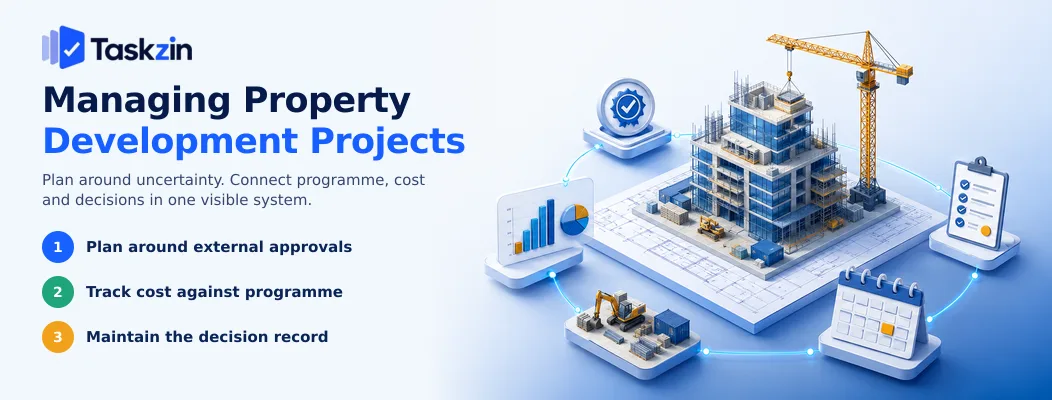
Development projects should be planned around approvals you do not control, with cost tracked against programme rather than separately, and a maintained record of decisions.
Plan around approvals you do not control
Planning permission, building regulations, utility connections and discharge of conditions all sit with external bodies operating to their own timescales.
Build realistic durations for these from experience rather than optimism, and identify what can proceed in parallel while waiting. The programme should make visible which activities are genuinely blocked by an approval and which merely feel blocked.
Track cost against programme, not separately
Cost and time are linked on development projects. A three-month delay carries finance costs, extended site security, and possibly a missed market window.
Reviewing them together means a programme slip triggers a cost conversation immediately rather than at the next monthly report, when the position has already worsened.
Keep the decision record
Development projects run for years and involve many parties. Decisions about specification, layout and materials get revisited repeatedly, often by people who were not present when they were made.
Recording each decision with its reasoning and date prevents relitigating settled questions, and it is valuable if a dispute arises later.
Coordinating Lettings and Property Management
Treat recurring compliance as scheduled work, manage maintenance as a tracked queue with response times, and plan tenancy renewals backwards from expiry.
Recurring compliance as scheduled work Gas safety, electrical inspections, fire safety, insurance renewals and licensing all recur on fixed cycles, and lapsing on any of them carries legal consequences.
Set them as recurring tasks generated automatically with adequate lead time, rather than tracked in a spreadsheet someone checks monthly. Across a portfolio of any size, manual tracking will eventually miss one.
Maintenance requests as a tracked queue
Maintenance arriving by phone, email and text is impossible to manage reliably, and tenants chase because they cannot see whether anything is happening.
A single intake route creating a tracked item with an owner and a target response time solves both problems. It also produces data: recurring issues at the same property usually indicate something worth fixing properly rather than repeatedly patching.
Tenancy renewals planned backwards
Renewals require notice periods, rent review and negotiation time. Working backwards from expiry with a first task several months ahead prevents the rushed renewal or the unintended periodic tenancy.
Common Real Estate Project Management Mistakes
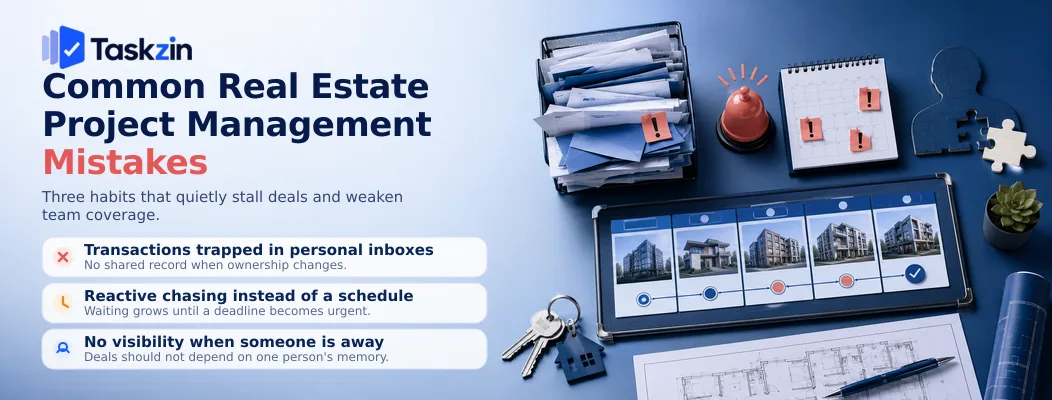
The three habits that cost most deals are running transactions from individual inboxes, chasing reactively, and having no coverage when someone is away.
Managing transactions in individual inboxes
The information exists but only one person can see it. Colleagues cannot help, managers cannot spot a stalling deal, and the client experience depends entirely on one person's workload that week.
Chasing reactively rather than on a schedule
Chasing when a client calls to complain means you are always behind. A fixed daily review of everything overdue takes fifteen minutes and catches problems before the client notices them.
No visibility when someone is away
A negotiator on holiday with twenty live transactions in their inbox is a real business risk. Deals stall for a fortnight, and some do not recover.
Shared pipeline visibility makes absence manageable rather than damaging, and it costs nothing beyond the discipline of recording in a shared place.
The same applies to staff turnover, which is high in this sector. A negotiator leaving with their pipeline in their own inbox takes the relationship history, the outstanding chases and the context of every live deal with them. A shared record means the successor inherits a working pipeline rather than a list of names and a fortnight of reconstruction.
Frequently asked
How do real estate teams manage projects?
By templating the standard transaction sequence, tracking what is outstanding with each third party and for how long, and keeping the whole pipeline visible so any team member can pick up any deal.
What is the difference between a CRM and project management in real estate?
A CRM holds contacts, properties and pipeline value. Project management tracks the tasks required to progress each transaction — what has been chased, what is outstanding, and what happens next.
How do you stop property transactions stalling?
With a systematic chase schedule rather than reactive chasing. Record what is outstanding, with whom and since when, and review everything overdue on a fixed daily rhythm.
How should agencies manage compliance deadlines?
As automatically generated recurring tasks with adequate lead time before expiry. Manual spreadsheet tracking across a portfolio will eventually miss a certificate, and the consequences are legal rather than administrative.
How do you manage a property development project?
Plan around approval timescales you do not control, identify what can proceed in parallel, review cost and programme together rather than separately, and maintain a decision record across the project's life.
How do you handle maintenance requests efficiently?
Through a single intake route that creates a tracked item with an owner and target response time, giving tenants visibility and producing data on recurring issues worth fixing properly.
Do small agencies need project management software?
Small agencies benefit particularly, since they have less cover when someone is away. Shared pipeline visibility and a chase schedule protect deals that would otherwise stall unnoticed.
Sujan Sharma is a content writer at Taskzin with a strong focus on productivity systems, task management, workflow optimization, team collaboration, and SaaS technology. He creates research-driven, practical content that helps professionals and growing teams improve operational efficiency, streamline processes, and make informed decisions about modern work management tools.
All posts by Sujan Sharma


Comments