Project Management for Finance Teams
A practical guide to project management for finance teams, covering what makes finance work distinctive, running month-end close as a managed process, audit and compliance deadlines, budgeting cycles, and common mistakes.


The familiar version is a month-end close held together by one person's memory and a spreadsheet they built years ago. It works, until they are on leave or leave the company, and then it takes twice as long and something gets missed.
This guide covers what makes finance work distinctive, how to run month-end close as a managed process, how to handle audit, and how to run budgeting cycles.
Quick answer: Finance project work is defined by a recurring calendar of fixed external deadlines, strict task sequencing, and a requirement that completion is evidenced rather than merely reported — which makes templated checklists with explicit owners and dependencies more valuable than flexible planning. The teams that close fastest are the ones that treat each cycle as the same project run again.
What Makes Finance Project Work Distinctive
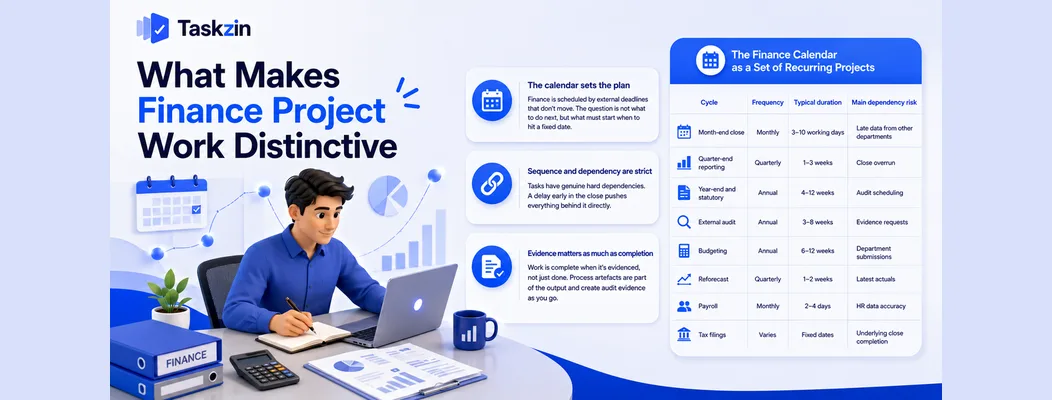
Finance work is scheduled by an external calendar rather than by priority, its tasks have genuine hard dependencies, and completion has to be demonstrable to someone outside the team.
Each of these pushes toward tighter process than most functions need.
The calendar sets the plan
Month-end, quarter-end, year-end, tax deadlines, statutory filings, audit fieldwork. Finance does not choose when these happen, and they do not move.
The planning question is therefore never what to do next — it is what must start when in order to hit a date that is already fixed. That makes backwards planning from deadlines the natural default, and it makes templates with relative dates unusually valuable.
Sequence and dependency are strict
You cannot reconcile before the sub-ledger closes. You cannot report before reconciliation. You cannot file before review and approval.
Unlike many functions where sequencing is a convention, finance dependencies are real. A delay early in the close pushes everything behind it directly, which is why a close that runs late usually failed on day two rather than at the end.
Evidence matters as much as completion
A reconciliation is not complete because someone says so. It is complete because there is a record showing who performed it, when, what was checked and who reviewed it.
This means the process artefacts are part of the output rather than administrative overhead. A tool that records who completed what and when is producing audit evidence as a by-product, which is materially cheaper than assembling it later.
The Finance Calendar as a Set of Recurring Projects
Cycle Frequenc y Typical duration Main dependency risk Month-end close Monthly 3–10 working days Late data from other departments Quarter-end reporting Quarterly 1–3 weeks Close overrun Year-end and statutory Annual 4–12 weeks Audit scheduling External audit Annual 3–8 weeks Evidence requests Budgeting Annual 6–12 weeks Department submissions Reforecast Quarterly 1–2 weeks Latest actuals Payroll Monthly 2–4 days HR data accuracy Tax filings Varies Fixed dates Underlying close completion
Running Month-End Close as a Managed Process
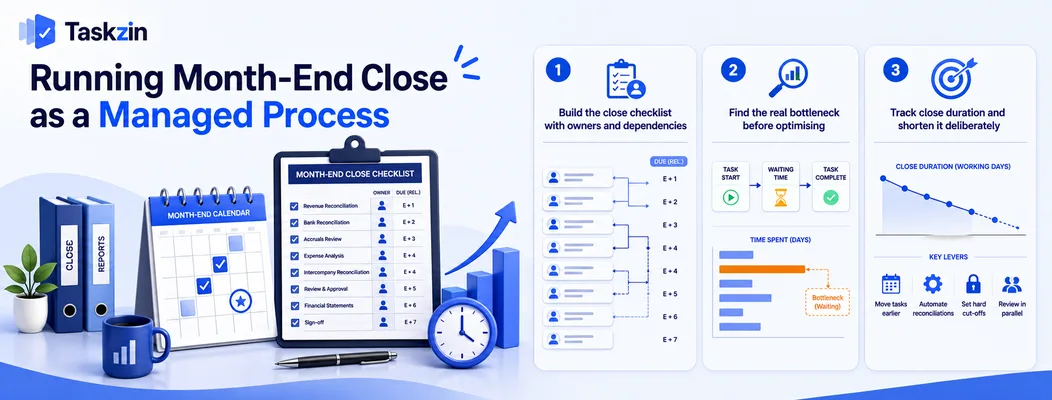
Build the close as a templated checklist with named owners, explicit dependencies and relative due dates, identify where it actually stalls, and shorten it deliberately over successive months.
Build the close checklist with owners and dependencies
List every task in the close, who performs it, who reviews it, what must be finished first, and which working day it is due relative to period end.
Building this once converts the close from a remembered routine into a visible process. The immediate benefit is resilience — someone else can run it — but the larger benefit is that it becomes improvable, because you can finally see the whole shape of it.
Find the real bottleneck before optimising
Teams often try to speed up the tasks they control, which are rarely the constraint. The delay is usually waiting: for a department to submit expenses, for a bank statement, for a system feed, for an approver.
Record when each task actually starts and finishes for two or three cycles. The waiting time will be concentrated in a few specific places, and those are the only ones worth attacking.
Optimising a task that was never on the critical path changes nothing.
Track close duration and shorten it deliberately
Measure working days from period end to sign-off, and treat reducing it as an ongoing project rather than an aspiration.
Common levers, roughly in order of return: moving tasks earlier that do not truly need period-end data, automating reconciliations, setting hard cut-offs for other departments, and reviewing in parallel rather than sequentially. Each is a small improvement; applied across several cycles they compound noticeably.
Managing Audit and Compliance Deadlines

Plan audits backwards from the filing deadline with real buffer at the end, collect evidence throughout the year rather than during fieldwork, and track auditor requests as a managed queue.
Work backwards with buffer at the end
Start from the filing date and work back through sign-off, board approval, audit completion, fieldwork and preparation.
Put the buffer immediately before the deadline rather than distributing it, so you can see it being consumed. Audits reliably produce unexpected requests, and a plan with no visible slack turns each one into a crisis.
Collect evidence as you go
The expensive part of an audit is usually retrieving documentation for transactions from eleven months ago.
If your close process already records who performed and reviewed each reconciliation, with supporting documents attached, most of that evidence exists before fieldwork begins. This is the strongest practical argument for running the close in a system rather than a spreadsheet.
Track requests from external parties
During fieldwork, auditors generate a steady stream of requests, each needing an owner, a due date and a record of what was provided.
Managing these in email guarantees duplicates, gaps and disputes about what was sent. A simple tracked list with status is enough, and it also gives you the data to argue about scope if requests expand beyond what was agreed.
Budgeting and Forecasting Cycles
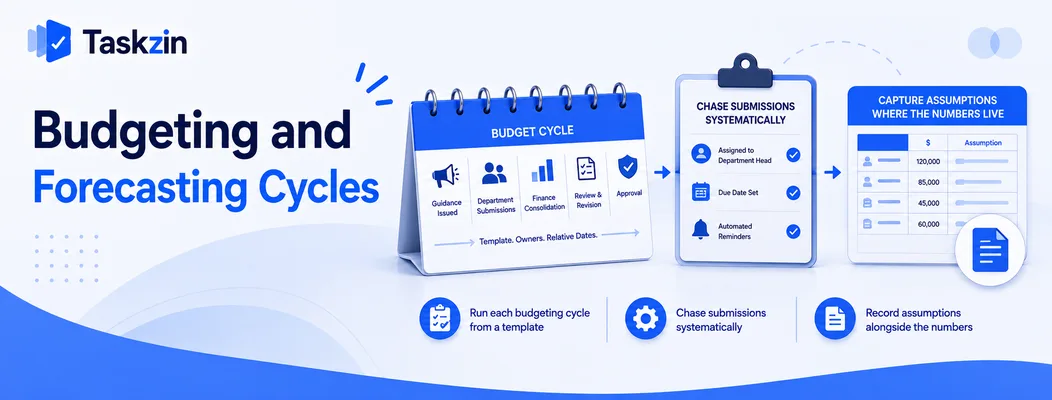
Run each budgeting cycle from a template, chase submissions systematically rather than personally, and record the assumptions alongside the numbers.
Treat each cycle as a project with a template
Budgeting runs the same way every year: guidance issued, departments submit, finance consolidates, review, revision, approval.
Template it with owners and relative dates, and each year starts as a complete plan. This also lets you improve the process annually rather than rediscovering the same problems, which is what happens when the cycle is rebuilt from last year's emails.
Chase submissions systematically
Late departmental submissions are the main cause of budget overrun, and chasing them personally consumes a disproportionate amount of a controller's time.
Assign each submission as a task to the responsible department head with a due date and automated reminders. This makes lateness visible rather than something finance absorbs quietly, and visibility does more to fix it than any amount of individual chasing.
Capture assumptions where the numbers live
A budget line without its assumption is uninterpretable three months later. Nobody remembers why marketing spend was set where it was, so variance analysis becomes guesswork.
Record the assumption against the line at the time. This costs minutes during the cycle and saves considerable argument during the first reforecast.
Common Finance Project Management Mistakes
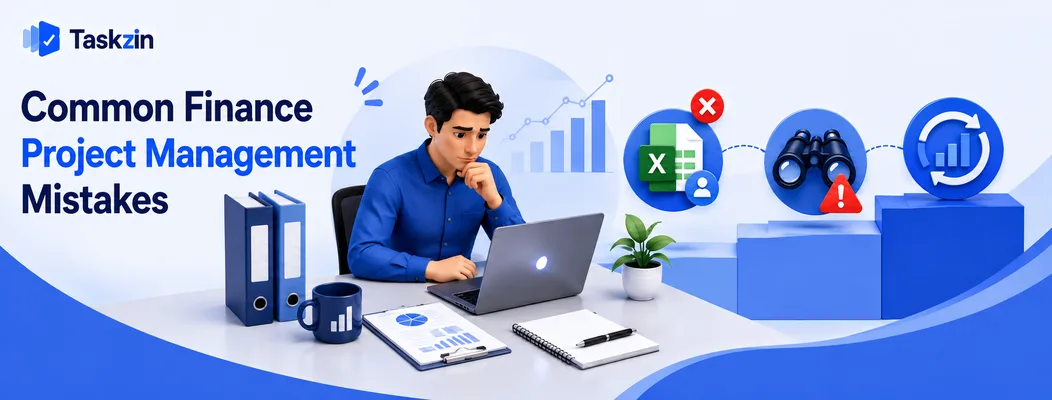
Running the close from a spreadsheet in one person's head
having no visibility of what other departments owe you, and never reviewing the process between cycles.
Running the close from a spreadsheet in one person's head It works until it does not. There is no audit trail of who did what, no way for anyone else to run it, and no data with which to improve it.
Moving the checklist into a system with owners and timestamps is a modest change that addresses resilience, evidence and improvement simultaneously.
No visibility of what other departments owe you
Most close delay originates outside finance. If those dependencies are not visible as tasks assigned to named people with deadlines, finance carries the delay silently and gets blamed for the overrun.
Make them visible. A department head who can see they are the reason close is late behaves differently from one who never hears about it.
Improving nothing between cycles
The close finishes, everyone is relieved, and the same problems recur next month.
Spend thirty minutes after each close identifying the single largest delay and fixing one thing.
Twelve small improvements a year is how teams get from a ten-day close to a five-day one, and no single change achieves that on its own.
Hold the review immediately rather than scheduling it for later in the month. Two weeks after close, nobody remembers which reconciliation held things up or why the bank feed was late, and the session produces general observations instead of a specific fix.
Frequently asked
How do finance teams use project management software?
Mainly to run recurring cycles as templated checklists with owners, dependencies and relative due dates — month-end close, audit preparation, budgeting — and to make dependencies on other departments visible.
How do you manage month-end close effectively?
Template the full task list with owners, reviewers and dependencies, measure where time is actually lost, and attack the specific waiting points rather than trying to speed up tasks that were never the constraint.
How long should month-end close take?
It varies widely by size and complexity, commonly three to ten working days. More useful than a benchmark is your own trend — a close getting shorter over successive months indicates the process is working.
How should finance teams prepare for an audit?
By collecting evidence throughout the year as part of the close, planning backwards from the filing deadline with visible buffer, and tracking auditor requests as a managed queue rather than in email.
How do you chase other departments for financial inputs?
Assign submissions as tasks to named department heads with due dates and automated reminders, so lateness is visible to them rather than absorbed silently by finance.
Should finance use the same project tool as the rest of the company?
Often yes, since most close and budget delays come from other departments and shared visibility helps. Genuinely sensitive work — payroll, restructuring — needs a separate restricted space.
How do you shorten the budgeting cycle?
Template it, issue guidance earlier, set firm submission deadlines with automated chasing, and reduce the number of revision rounds by agreeing constraints before departments start rather than after.
Sanju Shrestha is a SaaS content writer at Taskzin who explores smarter ways to manage work, organize priorities, and improve team performance. Her content covers productivity strategies, digital workflows, collaboration, and task management, with a focus on helping modern teams work more efficiently and stay aligned.
All posts by Sanju Shrestha

Comments