Project Management for Law Firms
A practical guide to legal project management, covering why fixed fees made it necessary, running a matter as a project, managing critical dates and limitation periods, confidentiality and conflicts, and common mistakes.


Under pure hourly billing, inefficiency was passed to the client. That is no longer the norm for much commercial and volume work, and firms that never adapted their internal processes are discovering the difference at the point of invoicing rather than during the matter.
This guide covers where project management applies in legal work, how to run a matter as a project, how to manage critical dates, and how to handle confidentiality.
Quick answer: Legal project management became necessary when fees moved from purely hourly to fixed and capped arrangements, because under a fixed fee the firm absorbs every hour of overrun. Managing matters as projects — scoped, phased, budgeted and tracked — is what separates fixed-fee work that is profitable from fixed-fee work that quietly is not.
Why Legal Work Needs Project Management
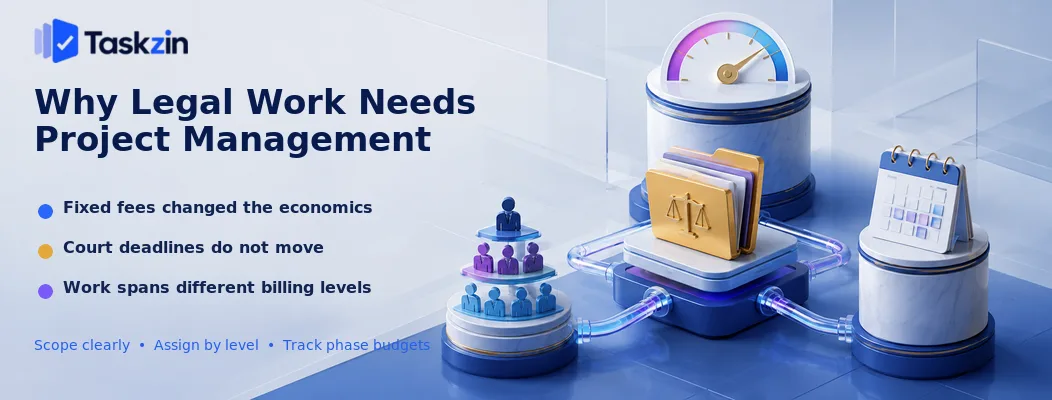
Fixed and capped fees transfer overrun risk to the firm, court and counterparty deadlines are immovable, and matters are delivered by people at very different charge-out rates whose time allocation determines profitability.
Each of these makes visibility during the matter far more valuable than analysis afterwards.
Fixed fees changed the economics
When a matter is billed hourly, an extra thirty hours is extra revenue. When it is a fixed fee, those thirty hours are absorbed by the firm.
That single change makes matter budgeting and phase tracking commercially significant rather than administrative. A firm that discovers overrun only when preparing the bill has no opportunity to have the scope conversation that would have prevented it.
Matters have deadlines set by courts and counterparties
Filing deadlines, limitation periods, exchange dates, completion dates. These are set externally and missing them can cause irreversible harm to a client and expose the firm.
This raises the bar on deadline management well above ordinary project practice. A missed marketing deadline is embarrassing; a missed limitation date is a negligence claim.
Work is distributed across people who bill differently
The economics of a matter depend heavily on whether work sits with a partner, an associate or a paralegal.
Work that drifts upward to more senior fee earners because delegation was unclear destroys margin quietly. Visibility of who is actually doing what, while the matter is running, is what allows
that to be corrected. The drift is rarely deliberate — it happens because the partner is available at the moment something needs doing and delegating it would take longer than doing it, which is true in the moment and expensive across a year.
Where Legal Project Management Applies
Work type Project management value Main driver Fixed-fee transactional work High Margin protection Litigation with court timetable High Deadline management Volume or process work High Consistency and automation Large disputes with teams High Coordination and budget Hourly bespoke advisory Moderate Client budget visibility Regulatory and compliance projects High Evidence and deadlines Internal firm projects High Nobody owns them otherwise Ad hoc short advice Low Overhead exceeds benefit
Running a Matter as a Project
Scope the matter explicitly before work starts, map the phases with named owners at appropriate levels, and track budget consumption by phase rather than against the total.
Scope the matter before the work starts
Write down what is included, what is excluded, what assumptions the fee rests on, and what happens if those assumptions prove wrong.
The exclusions matter most. A fixed fee for a transaction assuming standard documentation and one round of negotiation is a different matter from one with three rounds and a novel structure.
Recording the assumption at the outset makes the later conversation factual rather than a disagreement about what was understood.
Map the phases and who does what
Break the matter into phases — due diligence, drafting, negotiation, completion, post-completion — with an estimated effort and an intended owner for each.
Naming the intended level for each task is the part that protects margin. Document review sitting with an associate rather than a partner is a deliberate decision that should be made at planning, not something that happens by default when a partner picks up whatever is in front of them.
Holding this in a shared system rather than a partner's notes matters. In Taskzin, for example, a matter template can carry the standard phases, tasks and owners for a common transaction type, so each new matter starts with the structure already in place and variations become visible.
Track budget consumption against phase, not total
Knowing you have used 60 percent of the fee tells you little. Knowing you have used 60 percent while only completing due diligence tells you the matter is in trouble.
Phase-level tracking gives you time to act — to have the scope conversation, to redistribute work, to adjust approach. Total-level tracking tells you at 95 percent, when the only remaining option is absorbing the cost.
Managing Deadlines and Limitation Dates
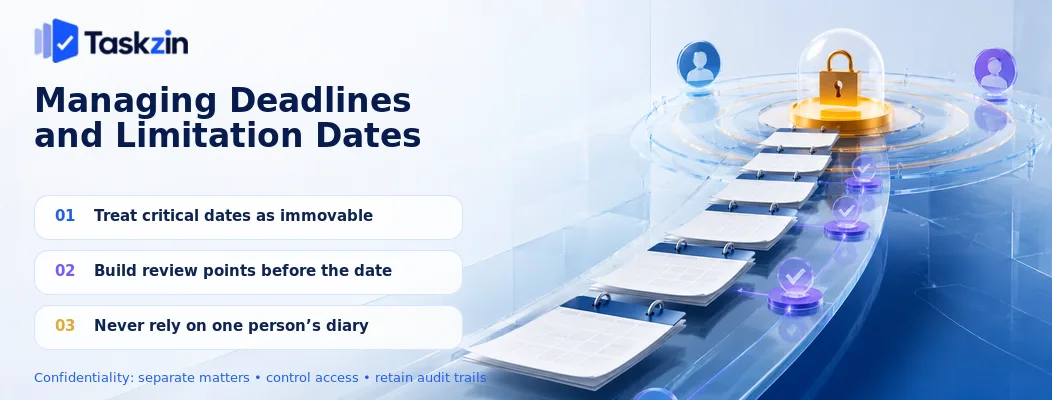
Treat critical dates as immovable milestones with multiple layers of protection, build review points well before each date, and never allow a critical date to exist only in one person's diary.
Treat critical dates as immovable milestones
Limitation dates, filing deadlines and court directions belong in the matter plan as hard milestones with everything else planned backwards from them.
They should be visible to more than one person by default. This is the single highest-risk area in legal practice management, and redundancy is the appropriate response.
Build in review points before the date
A limitation date is not a task; it is the consequence of tasks that must happen before it. Put review points at sensible intervals ahead — three months, one month, two weeks — each prompting a check that the necessary work is on track.
Discovering at two weeks that something required six weeks of preparation is a preventable failure, and the prevention is simply an earlier checkpoint.
Never rely on one person's diary
A critical date known only to the fee earner handling the matter is a single point of failure.
Illness, departure or simple oversight removes the only safeguard.
Central recording with supervisory visibility, plus automated reminders to more than one person, is standard practice for good reason.
Managing Confidentiality and Conflicts
Separate matters structurally so access is deliberate, control membership at matter level, and keep an audit trail of who accessed and changed what.
Separate matters structurally
Each matter should be its own space with explicit membership, rather than everything sitting in a shared area with per-item restrictions.
This supports information barriers where they are required, and it makes the default position safe. Relying on individual permissions means a single misconfiguration creates a conflict problem.
Control access at the matter level
Membership should be a deliberate act. Adding someone to a matter is a decision, and it should be recorded.
This matters for conflicts, for client confidentiality obligations, and for the practical question of who can be asked about a matter when the responsible fee earner is unavailable.
Keep the audit trail intact
Who did what and when is relevant to supervision, to fee narrative, and occasionally to a complaint or claim.
A system that records this as a by-product of normal use is producing evidence at no additional effort, which is materially better than reconstructing a chronology from emails after a problem arises.
Common Law Firm Project Management Mistakes
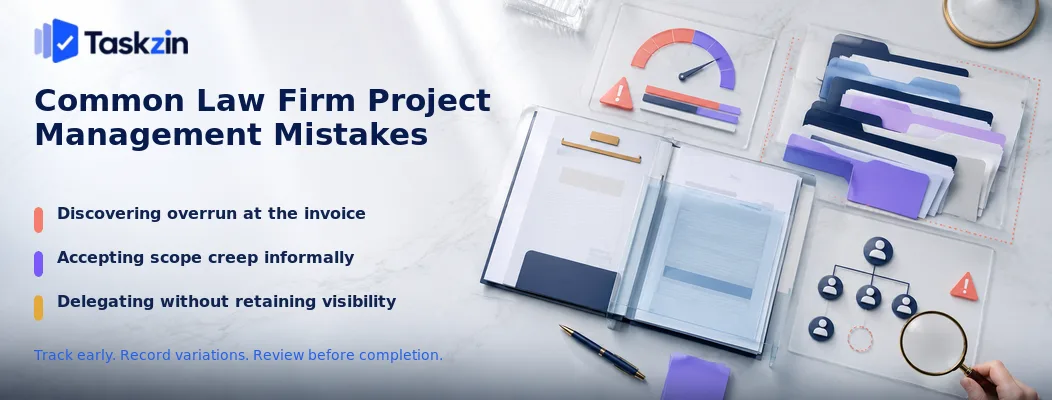
The three habits that cost most are discovering budget overrun at the invoice, accepting scope creep informally, and delegating without retaining visibility.
Discovering budget overrun at the invoice
By the time the bill is prepared, the choices are to write off the excess or to have a difficult conversation with a client who was never warned.
Phase-level budget tracking during the matter converts both of those into an earlier, easier conversation about scope.
Scope creep accepted informally
A client asks for something additional in a call. It seems minor and gets absorbed. Six of those consume a meaningful share of a fixed fee.
Record every additional request against the matter, with who asked and when. The record makes the eventual conversation about fees factual, and often the client agrees to the variation readily when it is raised at the time rather than in the bill.
Delegating without visibility
Work handed to a junior without a checkpoint either comes back late or comes back needing substantial partner time to correct — and the correction is often not billed.
Set a review point partway through delegated work rather than only at the end. This costs a few minutes and prevents the most common source of unrecoverable time.
It also develops people faster. Feedback at the midpoint, when the work can still be redirected, teaches considerably more than corrections applied after the fact by a partner working late — and the junior who was never shown the correction repeats the same approach next time.
Frequently asked
What is legal project management?
Applying project disciplines — scoping, phasing, budgeting, deadline tracking and delegation planning — to legal matters, so that overrun and scope changes are visible during the matter rather than at invoicing.
Why do law firms need project management?
Because fixed and capped fees transfer overrun risk to the firm. Under hourly billing inefficiency was billable; under a fixed fee it is absorbed, which makes in-matter visibility commercially significant.
How do you scope a legal matter?
Record what is included, what is excluded, the assumptions the fee depends on, and what happens if those assumptions fail. The exclusions and assumptions are what make later variation conversations straightforward.
How do you manage a fixed-fee matter profitably?
Plan the phases with intended owners at appropriate levels, track budget consumption by phase rather than in total, and raise scope variations at the time they arise rather than at billing.
How should firms track limitation dates?
Centrally, with visibility to more than one person, automated reminders, and review points well ahead of the date checking that the preparatory work is on track. Single-diary reliance is the main risk.
How do you handle confidentiality in a shared tool?
Structure each matter as its own space with deliberate membership rather than relying on per-item restrictions, so access is an explicit decision and information barriers can be maintained.
Do small law firms need project management software?
Smaller firms benefit particularly from matter templates and central deadline tracking, since they have less administrative support and a single missed date has proportionally greater consequences.
Sanju Shrestha is a SaaS content writer at Taskzin who explores smarter ways to manage work, organize priorities, and improve team performance. Her content covers productivity strategies, digital workflows, collaboration, and task management, with a focus on helping modern teams work more efficiently and stay aligned.
All posts by Sanju Shrestha


Comments