Project Management for Fully Remote Teams
A practical guide to project management for fully remote teams, covering what changes structurally without an office, the practices that matter most, designing around time zones, replacing informal office mechanisms, and common mistakes.

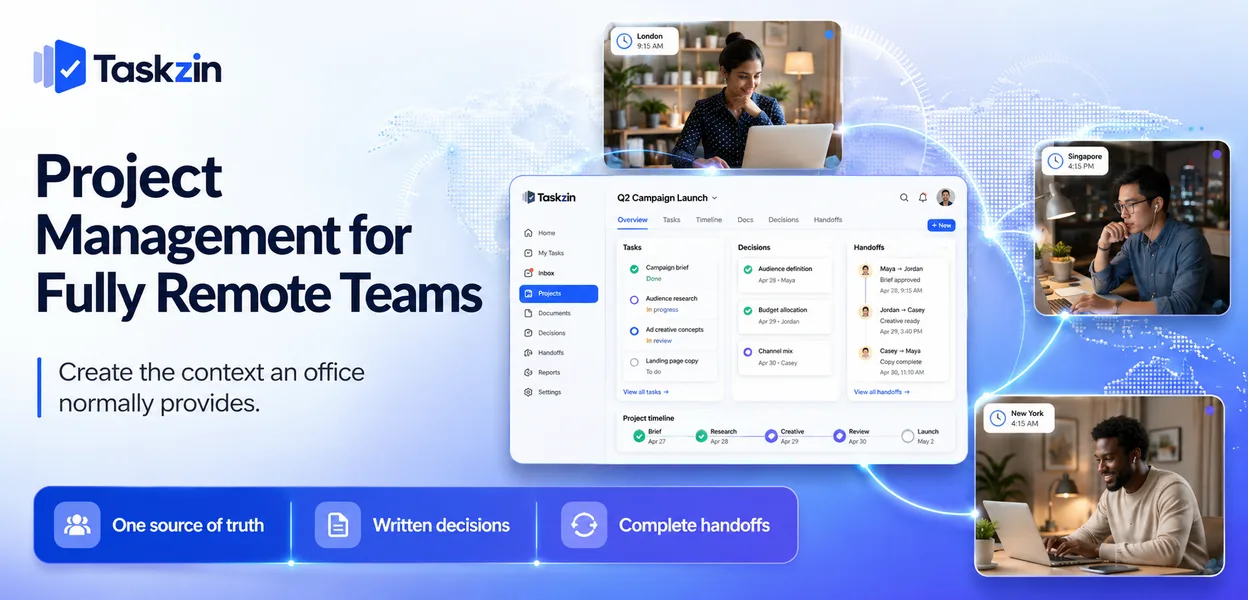
Hybrid teams can compensate for weak written practice with office days. Fully remote teams cannot, which is why the same habits matter considerably more here.
Quick answer: Fully remote teams have to produce deliberately the context that an office supplies for free. That means the project tool must be genuinely the source of truth, decisions must be written where the work lives, and handoffs between time zones must be complete enough that nobody has to ask a follow-up question. The cost of getting this wrong is not inconvenience — it is a day lost every time something is ambiguous.
What Fully Remote Changes
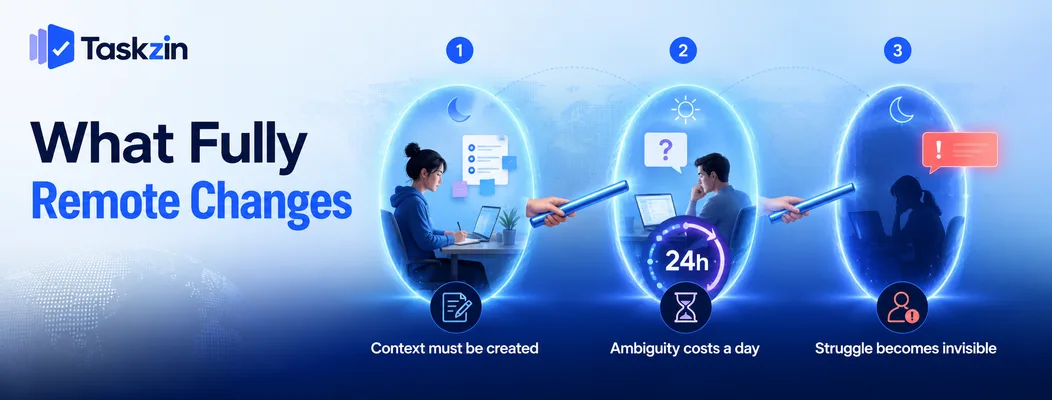
Three things change structurally: context must be created on purpose, ambiguity becomes expensive, and struggle becomes invisible.
Context has to be produced deliberately
In an office, people absorb enormous context passively — overheard conversations, a glance at a colleague's screen, noticing who is talking to whom.
Remove that and the context does not exist unless someone writes it. This is the single biggest adjustment, and teams that treat written communication as overhead rather than as the mechanism struggle regardless of what tooling they adopt.
Ambiguity costs a day, not a second
A vague task description in an office prompts a two-second question across a desk. The same ambiguity across a nine-hour time difference costs a full working day of blocked progress.
This asymmetry is why remote teams benefit disproportionately from writing things down properly — task descriptions with acceptance criteria, decisions with reasoning, handoffs with everything needed included.
Nobody sees that someone is stuck
In an office, a manager notices someone staring at the same screen for three hours, or looking frustrated, and asks.
Remotely, a person can be blocked for two days and nobody knows unless they say so. That places more weight on visible work status and on explicitly asking, since the ambient signal is gone.
The Practices That Matter Most
Practice Why it matters remotely Cost if missing Tool as single source of truth Nobody can ask across a desk Constant status questions Decisions written on the work Verbal agreement is invisible Decisions relitigated
Task descriptions with criteria Clarification costs a day Wrong work delivered
Structure handoffs to be self-contained
Receiver may be offline for hours A day lost per gap Written status updates Live standups exclude
Noticing someone is struggling
Meeting rota resentment Explicit availability No visual presence cue Interruption at bad times Notification control More written traffic Drowning or muting everything
Making the Tool the Source of Truth
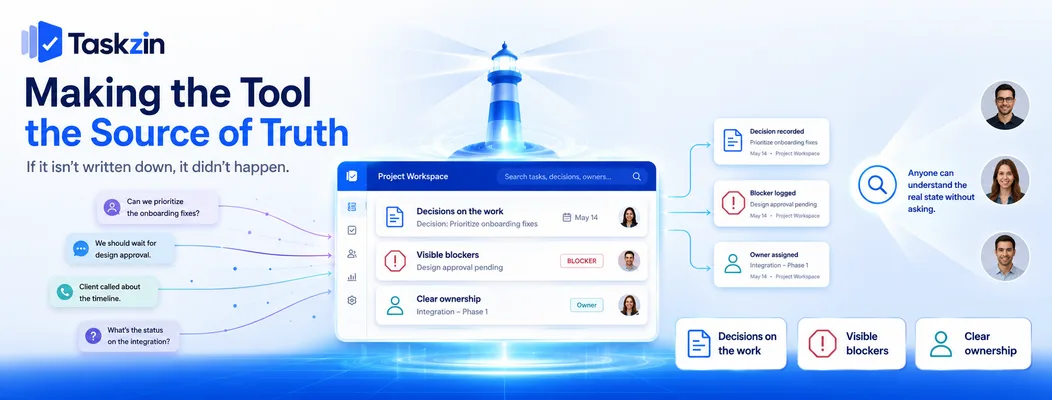
The project tool has to hold the real state of work, with decisions recorded on the items they concern and status current enough that nobody needs to ask.
If it is not written down, it did not happen
Agree this explicitly as a team rule. A decision reached on a call is not a decision until someone writes it into the relevant task.
It feels bureaucratic for about two weeks and then becomes invisible. It is the highest-return practice available to a distributed team, because it removes the dependency on having been present at the right moment.
Decisions live on the work
A decision recorded in chat scrolls away. A decision recorded on the task stays attached to the thing it concerns permanently.
Six months later, when someone asks why an approach was chosen, the answer is exactly where the work is. This single property is what makes a project tool more valuable than a chat tool for anything durable — and tools that link documents directly to tasks, as Taskzin does, keep the reasoning next to the work rather than in a separate wiki.
Status people can read without asking
The test is whether anyone can open a project and understand its true state without messaging a person.
That requires status to be current, blockers to be visible with an explanation, and ownership to be unambiguous. Where it is true, the volume of status questions drops noticeably, which is the clearest evidence the practice is working.
Designing Around Time Zones
Map your genuine overlap, make handoffs self-contained enough to start without questions, and rotate whichever meetings are unavoidably inconvenient.
Map your overlap honestly
Work out the hours your team genuinely shares, accounting for actual working patterns rather than nominal office hours.
Treat that window as scarce. Use it for decisions and unblocking — the things that genuinely benefit from live exchange — and push everything else to writing. A team with two hours of overlap that fills it with status meetings has spent its scarcest resource on the least valuable activity.
Structure handoffs to be self-contained Work passed between time zones should arrive with everything the receiver needs: the context, the decision that was made, the links, and what specifically is being asked.
A handoff arriving with an outstanding question costs a full day, and it costs it every single time.
Building a habit of re-reading a handoff and asking "could someone start this without me?"
prevents most of them.
Rotate the inconvenience
Where a live meeting is genuinely necessary across a wide spread, someone will be inconvenienced.
Rotate the time so it is not always the same region. This is a small thing with a disproportionate effect on how fairly the arrangement is perceived.
Replacing What the Office Provided
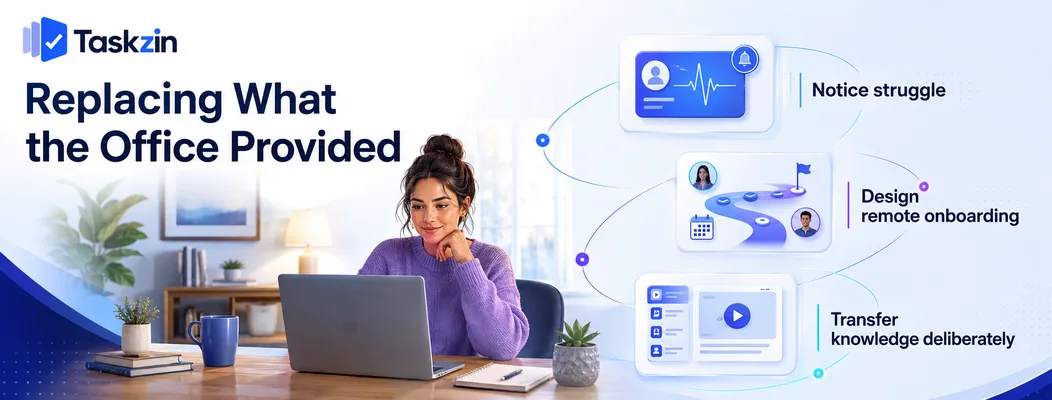
Three things an office supplied need deliberate replacement: noticing when someone is struggling, onboarding through proximity, and informal knowledge transfer.
Noticing someone is struggling Replace the ambient signal with two mechanisms: visible work status showing items that have not moved, and regular direct conversation where the question is actually asked.
A weekly one-to-one that includes "what is blocked, and what is harder than you expected" catches most of what proximity would have. The work-status signal catches the rest — an item unchanged for a week is worth a direct message.
Onboarding without proximity
New joiners in an office learn by absorption. Remotely, everything they would have absorbed must be written or scheduled.
That means a documented onboarding plan, written context about how the team works and why, a named person to ask questions of without hesitation, and deliberately scheduled introductions.
Remote onboarding takes longer and requires more preparation, and underestimating it is the most common remote management error.
Informal knowledge transfer
The knowledge that spreads by overhearing has to spread another way: written documentation, recorded walkthroughs, or deliberately pairing people who would not otherwise work together.
None of these is as efficient as proximity. Accepting that and investing accordingly is better than assuming the knowledge will find its way around.
Common Fully Remote Mistakes
The three failures are filling the day with video calls, measuring presence rather than outcomes, and allowing decisions to live in chat.
Recreating the office in video calls
Adding meetings to replace lost hallway conversation removes the main advantage of remote work — long stretches of uninterrupted focus — and punishes whoever lives furthest from the majority time zone.
Most of what those meetings carry can be written. Reserve live time for what genuinely needs it.
Measuring presence instead of outcomes
Monitoring software, mandatory online status and activity tracking measure presence and damage trust quickly.
Measure what shipped, what moved and what is blocked. That is both more useful and less corrosive, and it works identically whether the team is remote or not.
Letting decisions live in chat
Chat is excellent for quick coordination and poor at durable records. A decision made at 11pm in one region is effectively invisible to everyone else.
Write decisions where the work is, then link to it from chat. This is the same rule as making the tool the source of truth, and it is the one most often relaxed.
Frequently asked
How do fully remote teams manage projects?
By making the project tool the genuine source of truth, recording decisions on the work rather than in chat, writing task descriptions detailed enough to remove ambiguity, and structuring handoffs to be self-contained.
What is the difference between remote and hybrid project management?
The practices are the same but the tolerance for weak written communication is lower. Hybrid teams compensate on office days; fully remote teams cannot, so documentation quality matters considerably more.
How do you manage a team across many time zones?
Map the genuine overlap and reserve it for decisions and unblocking, make handoffs complete enough to start without questions, use written updates instead of live standups, and rotate any unavoidable meeting times.
How many meetings should a remote team have?
Most function well with one weekly team session plus regular one-to-ones. Anything more should justify itself against a written alternative that costs the reader under a minute.
How do you know if a remote team member is struggling?
Through visible work status — items that have not moved — and by asking directly in regular one-to-ones. The ambient signals an office provides do not exist, so both mechanisms need to be deliberate.
How do you onboard someone fully remotely?
With a documented plan, written context about how the team works, a named person to ask questions of, and scheduled introductions. It takes longer than in-person onboarding and requires more preparation.
Is async always better than synchronous?
No. Async by default, sync by exception. Reserve live time for decisions, difficult conversations and relationship building; use writing for status, updates and routine coordination.
Sanju Shrestha is a SaaS content writer at Taskzin who explores smarter ways to manage work, organize priorities, and improve team performance. Her content covers productivity strategies, digital workflows, collaboration, and task management, with a focus on helping modern teams work more efficiently and stay aligned.
All posts by Sanju Shrestha
Comments