A Practical Guide to Async Communication
A practical guide to asynchronous communication, covering what async actually means, what belongs async versus synchronous, writing messages people can act on, setting response time expectations, and making decisions asynchronously.

The practices below are what separate teams where async works from teams where it produces frustration in both directions.
Quick answer: Async communication means the sender and receiver do not need to be present at the same time — and it works only when the team has agreed what response time each channel implies. Without that agreement, async becomes a synonym for slow, and people revert to interrupting each other because it is the only reliable way to get an answer.
What Async Actually Means
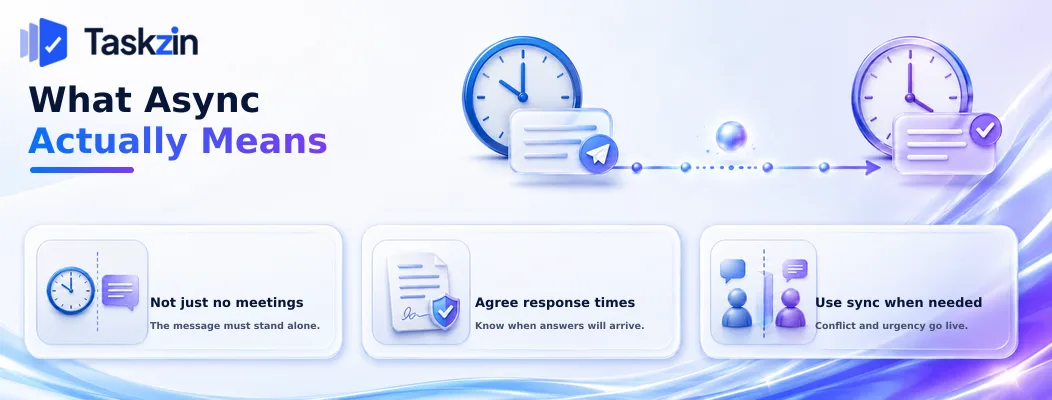
Async decouples sending from receiving, which requires a shared understanding of when a response is expected.
Not just "not a meeting"
Async is often defined negatively — anything that is not a live conversation. That framing misses what makes it work.
The defining characteristic is that the message contains everything needed to act, so the recipient can respond whenever they read it rather than needing a follow-up exchange. A message requiring three clarifying questions is not async; it is a slow synchronous conversation.
The response-time contract
Async depends entirely on knowing when to expect an answer. If a colleague does not know whether your message needs a response in an hour or a week, they either interrupt their work to answer immediately or leave it indefinitely.
Agreeing response times per channel is the single practice that makes everything else work.
Without it, async is guesswork.
What async is not
It is not the absence of live conversation. Difficult conversations, contentious decisions and early creative work all benefit from being synchronous.
It is not writing more. Long messages are worse than short ones. Async rewards precision, not volume.
Related: How Do You Write a Task Description People Actually Understand?
What Belongs Async and What Does Not
Situation Async or sync Why Status updates Async Reading is faster than listening Sharing information Async Recipients go at their own pace Routine decisions Async Options can be posted and considered
Feedback on work Async Reviewer needs time with the material Quick factual questions Async Answer takes seconds either way Contentious decisions Sync Tone and reaction matter Difficult personal conversations Sync Never async Early creative work Sync Unstructured exchange is the point Onboarding a new person Both Written context plus live contact Anything urgent and blocking Sync Async response times are too slow
Writing Async Messages People Can Act On
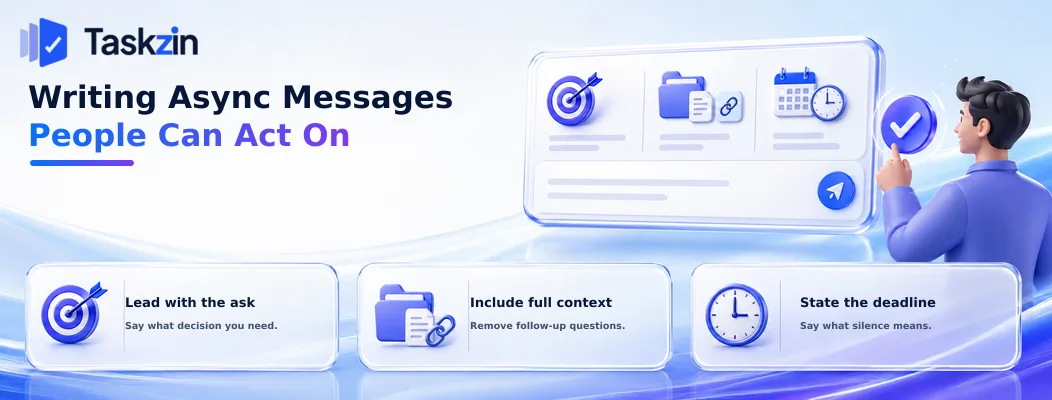
Put the ask first, include everything needed to respond, and state when you need an answer.
Lead with what you need
Start with the request or the decision required, then provide context. Not the other way round.
Most people write chronologically — background, then explanation, then finally the ask buried in paragraph four. Readers skim, miss the ask, and either respond to the wrong thing or defer it.
Leading with "I need a decision on X by Thursday" tells the reader immediately what this costs them.
Include everything required to respond
The test is whether the recipient can act without asking you anything.
That means the relevant links, the options considered, the constraint, and any information they would otherwise have to find. Every missing piece costs a round trip, and a round trip across time zones costs a day.
State the deadline
"When you get a chance" is not a deadline and will be treated accordingly.
Give a date and, where it matters, a time. Also state what happens if you do not hear back — "if I have not heard by Thursday I will proceed with option B" is enormously useful, because it converts silence into a valid answer.
Related: How to Reduce Cycle Time on Your Team
Setting Response Time Expectations
Agree what response time each channel implies, make urgency require deliberate effort, and publish availability honestly.
Define tiers by channel
A simple agreement covers most needs: a project tool comment within a working day, a chat message within a few hours during working hours, email within two days, phone or direct call for anything genuinely urgent.
Write it down and share it with new joiners. Most async friction comes from mismatched expectations rather than from slow responses.
Make urgency cost something
If marking something urgent is free, everything becomes urgent.
Make the urgent channel slightly effortful — a direct call rather than a message, or a specific tag that notifies someone properly. This is not bureaucracy; it is what preserves the meaning of urgency.
Publish availability honestly
Working hours, time zone, and any regular unavailability, visible to everyone.
For distributed teams this removes a surprising amount of friction. People stop wondering whether a lack of response means the person is ignoring them or asleep.
Making Decisions Asynchronously
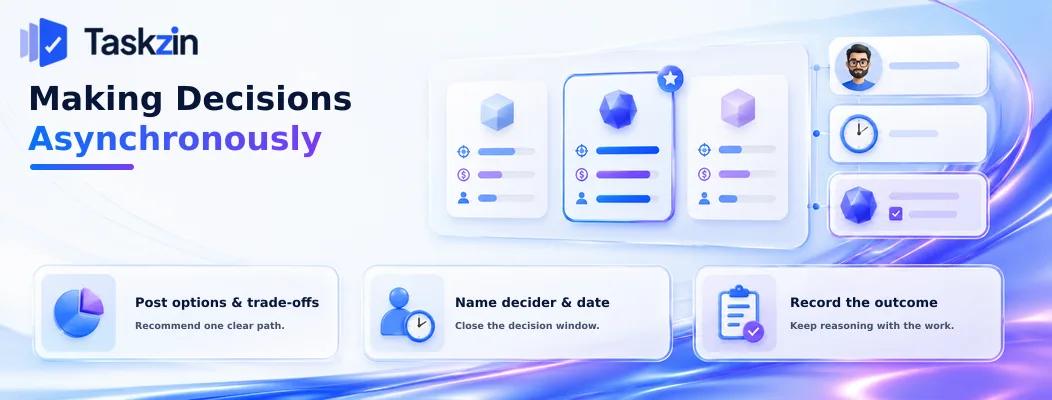
Post the options rather than only the question, name who decides and by when, and record the outcome where the work lives.
Post the options, not just the question
"What should we do about X?" produces either silence or unstructured opinion.
"Here is X. I see three options with these trade-offs. I recommend B. Any objections by Thursday?" produces a decision. The work of framing options is what makes async decision-making possible.
Name the decision-maker and the date
Async decisions fail when nobody knows who decides or when the window closes.
State both. Consensus-seeking without a named decider and a deadline drifts indefinitely, and drift is what makes people conclude that async does not work for decisions.
Record the outcome where the work lives
A decision made in a thread scrolls away. Record it on the task or document it affects, with the reasoning.
This is the difference between a decision that stays decided and one that gets relitigated in six weeks by someone who was not in the thread. Tools that let you attach a document to the relevant work keep the reasoning next to what it governs.
Common Async Mistakes
The three failures are treating async as an excuse for slowness, writing long messages with the ask buried, and expecting immediate replies to async messages.
Async as a synonym for slow
Async means not simultaneous. It does not mean whenever.
Teams without agreed response times drift into genuine slowness, then conclude the approach does not work. The response-time agreement is what prevents this, and it is the part most often skipped.
Long messages with the ask buried
A message requiring careful reading to find the request will be skimmed and deferred.
Lead with the ask. Keep the message as short as it can be while remaining self-contained — those two constraints together are the skill.
Expecting instant replies to async messages
Sending an async message and then following up within the hour defeats the purpose entirely, and it trains everyone to treat every message as interrupting.
If it needs an answer now, use the urgent channel. If it does not, wait for the agreed window.
Frequently asked
What is asynchronous communication?
Communication where the sender and receiver do not need to be present simultaneously, structured so the message contains everything needed to respond without a follow-up exchange.
What should be async and what should be a meeting?
Async for status, information sharing, routine decisions and feedback. Sync for contentious decisions, difficult personal conversations, early creative work, and anything urgent and blocking.
How do you write a good async message?
Lead with what you need, include everything required to respond without asking you anything, and state a deadline plus what will happen if you do not hear back.
What response times should a team agree?
Something like: project tool comments within a working day, chat within a few hours during working hours, email within two days, and a distinct channel for genuine urgency. Write it down and share it.
Can you make decisions asynchronously?
Yes, for most decisions. Post the options with trade-offs and a recommendation, name who decides and by when, and record the outcome where the work lives.
Is async communication slower?
Only when response times are undefined. Individual exchanges take longer; total time to resolution is often shorter because people are not waiting for a meeting slot.
Does async work for co-located teams?
Yes, and it benefits them by protecting focus. Co-located teams have the option of interrupting, which makes deliberate async practice harder to sustain but no less valuable.
Sujan Sharma is a content writer at Taskzin with a strong focus on productivity systems, task management, workflow optimization, team collaboration, and SaaS technology. He creates research-driven, practical content that helps professionals and growing teams improve operational efficiency, streamline processes, and make informed decisions about modern work management tools.
All posts by Sujan Sharma

Comments