Capacity vs Availability: What's the Difference?
An explainer on the difference between capacity and availability, covering why the gap matters, a worked capacity calculation for a sprint, how to use the distinction in planning, and the common mistakes that cause overcommitment.

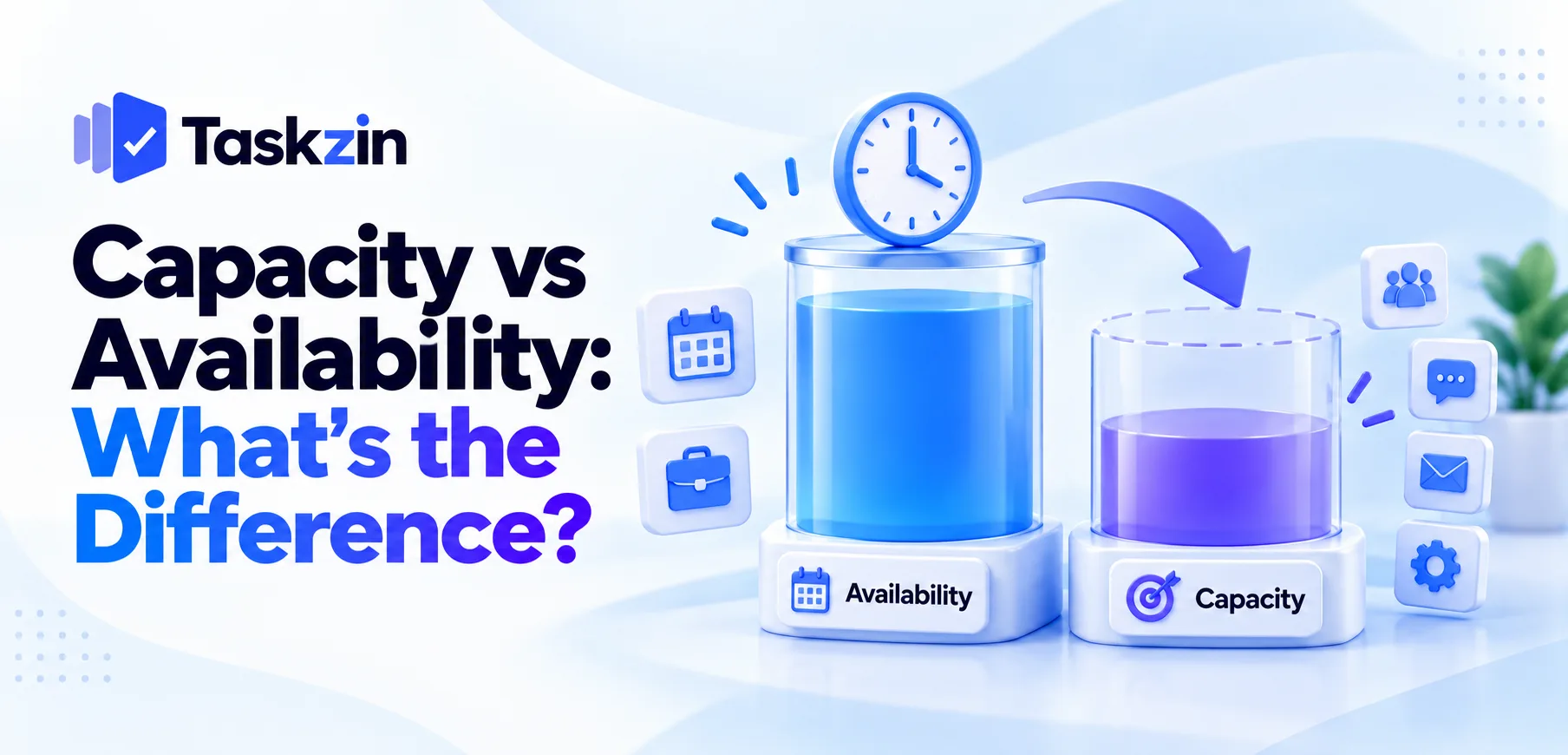
Most chronic overcommitment comes from one confusion: planning against the hours people are present rather than the work they can actually do.
Quick answer: Availability is the time someone is present and working — forty hours a week, less leave. Capacity is how much planned work they can actually complete in that time, after meetings, support duty, interruptions and admin. Capacity is always lower than availability, usually substantially, and it is what you should plan against.
Two Terms, Often Confused
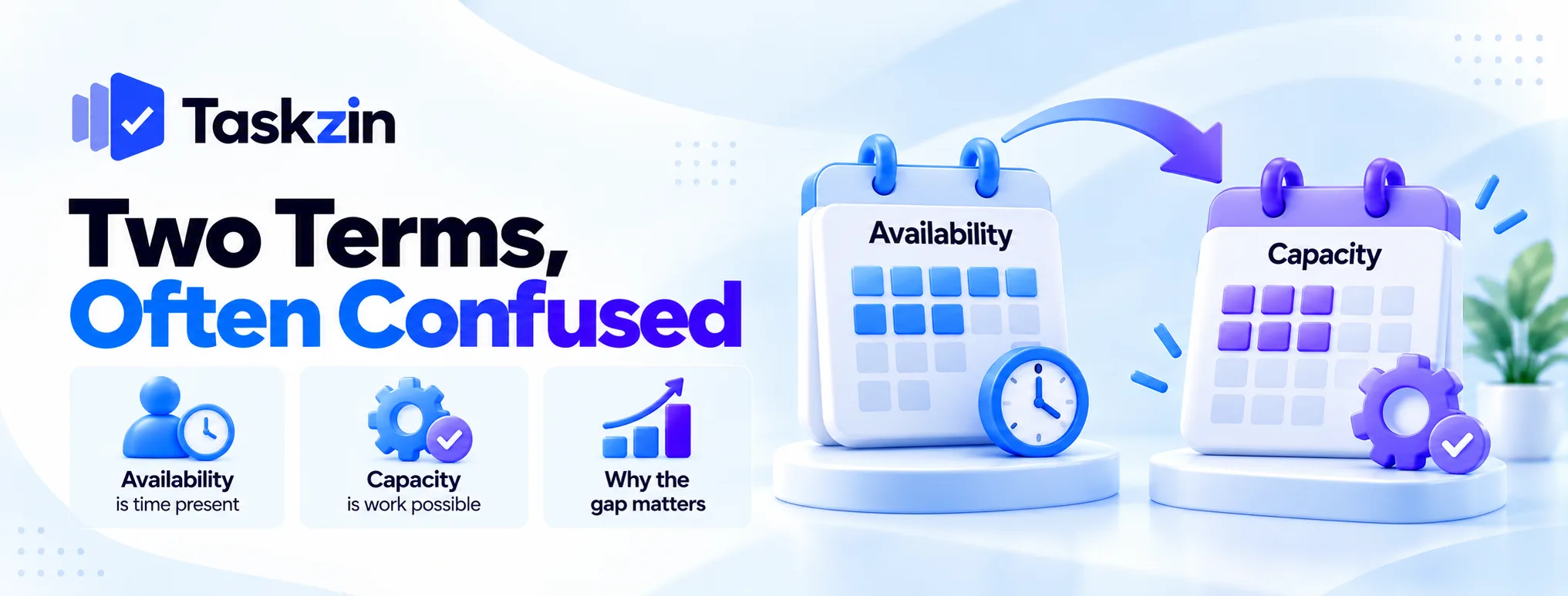
Availability measures presence; capacity measures what that presence can produce.
Availability is time present
Availability is contracted hours minus planned absence — leave, public holidays, training days.
A full-time person available for a two-week sprint with no leave has roughly eighty hours of availability. It is easy to calculate and straightforward to know.
Capacity is work possible
Capacity is the portion of available time that can go to planned project work. It subtracts meetings, email, support rotations, interviews, reviews, context switching and the unplanned work that arrives every week.
It is harder to calculate precisely and is the number that actually predicts what a team will finish.
Why the gap matters
Plans built on availability assume every available hour becomes project output. None do.
The result is plans that are wrong before they start — not because anyone estimated badly, but because the arithmetic began from the wrong number.
Related: How Do You Run a Sprint Planning Meeting?
Capacity and Availability Compared
Treating availability as capacity
Measures Time present Planned work achievable Deducts Leave, holidays, training Also meetings, support, admin, interruptions Typical level Close to contracted hours Commonly well below availability Easy to calculate? Yes Harder — best measured from history Plan against it? No Yes Changes with Absence Absence, meeting load, support duty, team practices
Calculating Real Capacity
A five-person team planning a two-week sprint of ten working days.
Step Calculation Result Contracted time 5 people × 10 days 50 person-days Minus planned leave One person out 3 days 47 person-days available Minus support rotation One person on support all sprint 37 person-days Minus meetings and ceremonies Roughly 1 day each for the 4 people not on support 33 person-days Minus admin, email, reviews Roughly 1 day each for the same 4 29 person-days Minus unplanned work allowance Based on team history, say 15% of 29 ~25 person-days Planning capacity
~25 of 50 person-days
The figures are illustrative — measure your own. The point is how much the deductions add up to before any project work is planned.
Using the Distinction in Planning
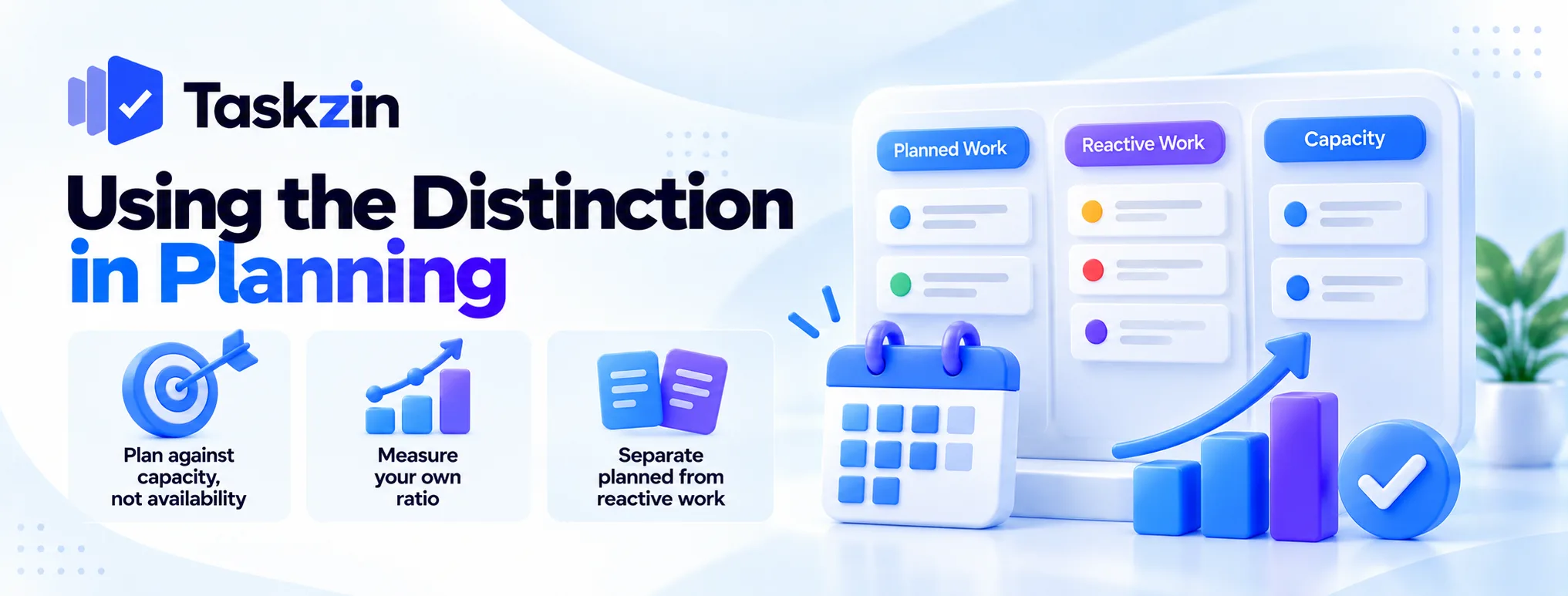
Plan against capacity, derive it from your own history, and treat reactive work as a known quantity.
Plan against capacity, not availability
Commit to work based on what the team can actually complete, not on how many people are nominally present.
This single change eliminates a large share of carry-over and missed commitments, because it removes the error that was built in before any estimating happened.
Measure your own ratio
The illustrative deductions above are a starting point. Your real ratio comes from comparing what your team planned against what it completed over several periods.
Most teams find they consistently deliver somewhere between half and three-quarters of nominal availability. Knowing your own figure is more useful than any industry rule of thumb.
Tracking time against work — which Taskzin supports with time tracking on its Business plan — turns that ratio from a guess into a measurement.
Separate planned from reactive work
Unplanned work is not a surprise if it happens every week. It is a predictable load.
Reserve capacity for it explicitly, based on history. A team that loses a fifth of every sprint to unplanned work and plans for none of it will miss every commitment.
Common Mistakes
Treating availability as capacity, assuming uniform capacity, and omitting recurring commitments.
Treating availability as capacity The root mistake. Every other planning error compounds it.
The fix is simple arithmetic, and it is resisted because the resulting number is uncomfortably low.
That discomfort is the honest version of the plan.
Assuming everyone is the same
A new joiner, a senior engineer with heavy review duties, and a lead who spends half their week in meetings have very different capacities despite identical availability.
Plan per person where the differences are large, especially for roles carrying significant non-project load.
Forgetting the recurring commitments
Standing meetings, on-call rotations, interviewing, mentoring, cross-team support.
These are easy to omit because they feel like background rather than work. They are work, and they consume capacity every week.
Frequently asked
What is the difference between capacity and availability?
Availability is the time someone is present and working. Capacity is how much planned work they can actually complete in that time after meetings, support, admin and interruptions.
How do you calculate team capacity?
Start from availability, subtract leave, support rotations, meetings, admin and an allowance for unplanned work based on history. Best of all, measure it from what the team has actually delivered.
What percentage of time is productive?
It varies substantially by role and team. Many teams find they deliver roughly half to three-quarters of nominal availability as planned work — measure your own rather than assuming.
Should you plan against availability?
No. Plan against capacity. Planning against availability builds overcommitment into the plan before anyone has estimated anything.
What is focus factor?
The ratio of capacity to availability — the proportion of available time that becomes planned project work. It is commonly used in agile capacity planning.
How does capacity relate to velocity?
Velocity is observed output per sprint. Capacity is the time available to produce it. Adjusting expected velocity for a sprint's capacity accounts for leave and other reductions.
How do you account for unplanned work?
Reserve a proportion of capacity for it, based on how much unplanned work your team has historically absorbed. Treat it as a predictable load rather than a surprise.
Sujan Sharma is a content writer at Taskzin with a strong focus on productivity systems, task management, workflow optimization, team collaboration, and SaaS technology. He creates research-driven, practical content that helps professionals and growing teams improve operational efficiency, streamline processes, and make informed decisions about modern work management tools.
All posts by Sujan Sharma


Comments