Epic vs Story vs Task: What's the Difference?
A clear explanation of the epic, story and task hierarchy, covering what each level means, three tests to classify work correctly, where themes and subtasks fit, how to split work between levels, and common mistakes.

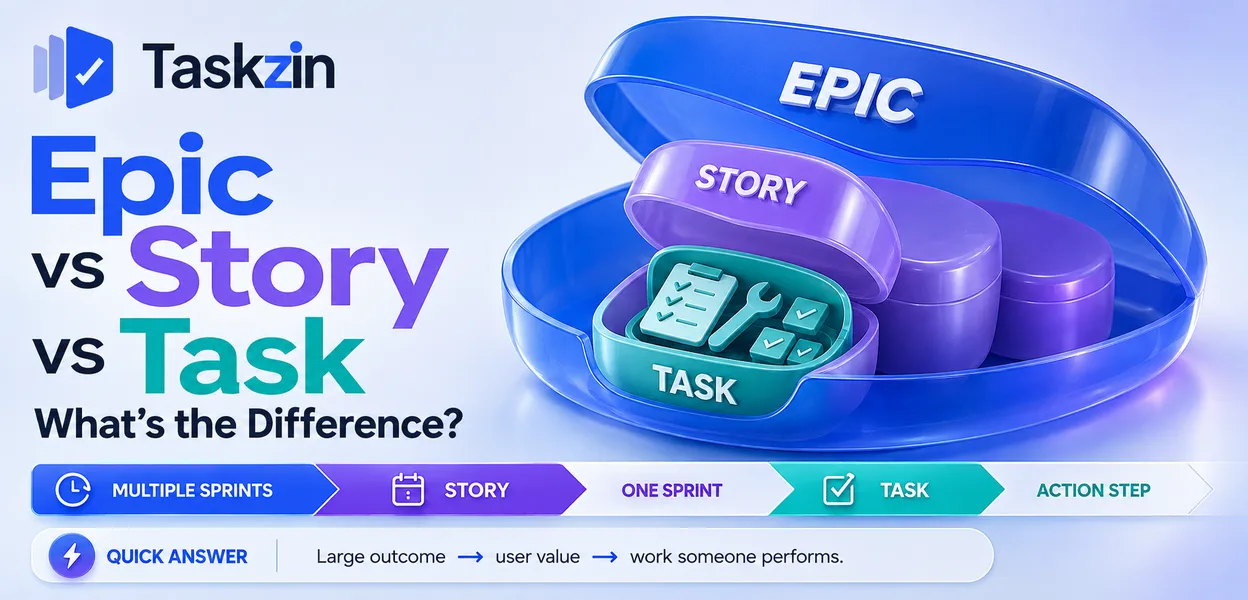
The distinction confuses teams because tools use these labels loosely and different organisations apply them differently. The underlying logic is consistent: each level is a smaller, more concrete piece of the level above.
This guide covers the three levels, how to tell them apart, where themes and subtasks fit, and how to split work between them.
Quick answer: An epic is a large body of work spanning multiple sprints, a story is a single piece of user-facing value that fits within one sprint, and a task is a step someone performs to complete a story. The hierarchy exists so large ambitions can be broken into pieces small enough to estimate, schedule and finish.
The Hierarchy in One Paragraph
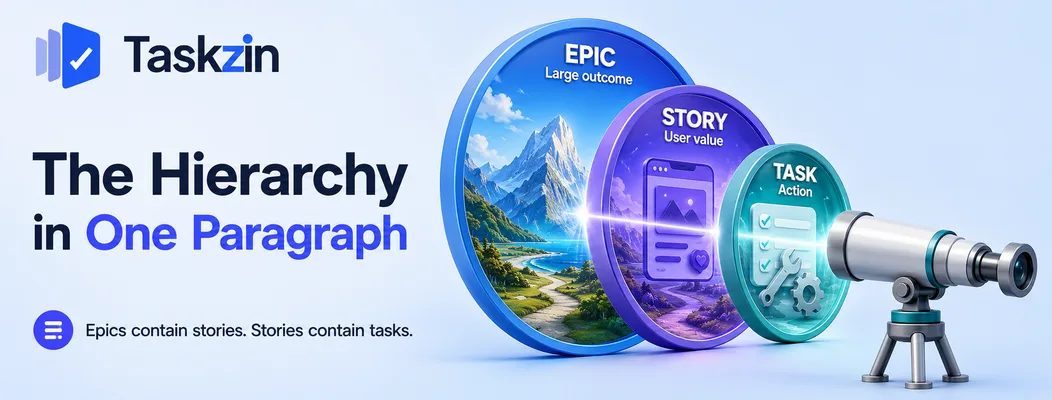
Epics contain stories; stories contain tasks. Each level answers a different question: an epic says what large outcome we are pursuing, a story says what a user will be able to do, and a task says what someone must actually perform.
Epic: a large body of work
An epic groups related stories toward one substantial outcome — "Self-service account management", "Migrate to the new payment provider".
It is too big for a single sprint and usually too big to estimate meaningfully. It exists to give related work a home and to let stakeholders see progress toward something they recognise.
Story: something a user gets
A story describes a piece of value from the user's perspective, small enough to complete within a sprint. "As a customer, I can reset my password without contacting support."
The defining property is that finishing it makes something possible that was not possible before.
If completing it changes nothing for anyone, it is probably a task.
Task: a step someone performs
A task is work required to deliver a story: update the schema, write the email template, add the validation.
Tasks are for the team's own coordination. A user does not care that the schema was updated; they care that password reset works. Tasks are how the story gets done.
Epic, Story and Task Compared
Epic Story Task Size Weeks to months Hours to days Hours
Fits in a sprint? No Yes Yes Delivers user value? Eventually Yes No Estimated? Roughly, if at all Yes Sometimes Written from Business outcome User perspective Team perspective Owner Product owner Product owner Team member Example Self-service account management Customer can reset password Add token expiry to auth service Closes when All child stories done Acceptance criteria met The step is complete
How to Tell Them Apart
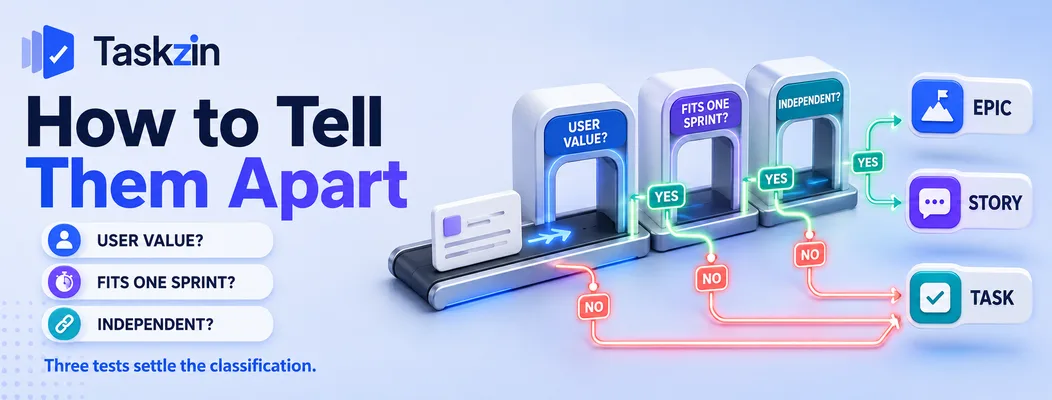
Three tests separate the levels: does it deliver user value, does it fit in a sprint, and could it be delivered independently?
The user value test
Ask whether a user would notice if this alone were delivered.
If yes, it is a story. If no, it is a task. This single question resolves most classification arguments, and it also improves the work — items that fail it are often technical steps that were written as though they were features.
The sprint test
If it cannot be finished within one sprint, it is an epic, regardless of what it is labelled.
Items that carry across sprints are the main reason velocity becomes unreliable. When something fails this test, split it rather than accepting that it will span sprints.
The independence test
A story should be deliverable without waiting for another story in the same sprint.
Dependencies between stories in the same sprint usually indicate a horizontal split — one story doing the backend and another the frontend. Neither delivers anything alone, which defeats the purpose of the level.
Where Themes, Initiatives and Subtasks Fit
Some organisations add levels above the epic and below the story, but most teams need only two or three levels total.
Levels above the epic
Themes and initiatives group epics toward strategic objectives — "Reduce support load" might contain several epics.
These are useful in larger organisations coordinating many teams. For a single team, they usually add hierarchy without adding information.
Subtasks below the story
Subtasks break a story into steps for the team's own coordination.
They are helpful when several people work on one story simultaneously, and unnecessary when one person owns it. Most tools support them — Taskzin's projects nest tasks and subtasks with individual owners and dates — but support is not a reason to use them by default.
How many levels you actually need
For most teams: epic, story, and optionally subtask. Three levels covers nearly everything.
Every additional level is structure someone must maintain. Add one only when you can name the question it answers that the existing levels cannot.
Splitting Work Between the Levels
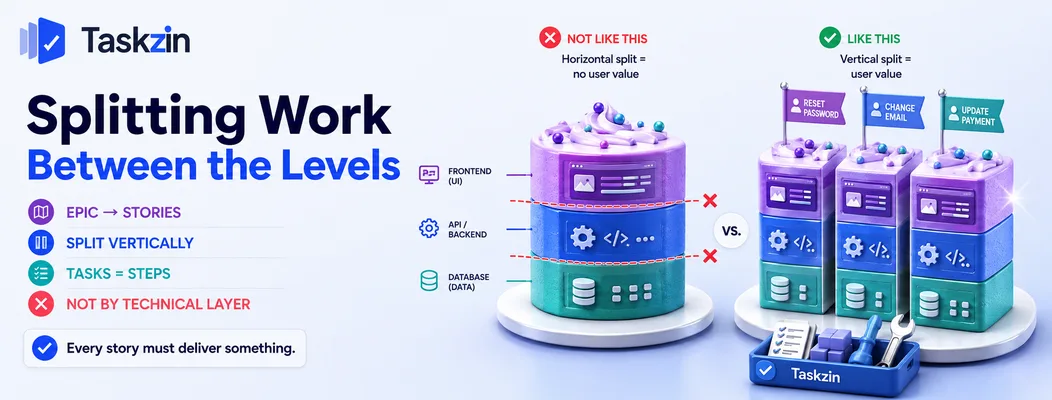
Break epics into stories that each deliver something, split oversized stories vertically rather than by technical layer, and use tasks for work with no user-facing outcome.
Breaking an epic into stories
Walk the user's journey through the epic and identify each point where something becomes possible.
For "self-service account management": reset password, change email, update payment details, close account. Each is independently valuable and independently releasable, which is what you want.
Splitting a story that is too large
Useful split lines: by workflow step, by data variation, by simple case first and edge cases later, by user role, or by happy path then error handling.
The rule is that each half must still deliver something. "Password reset for email accounts" then "password reset for SSO accounts" works. "Backend" and "frontend" does not.
When to use tasks instead of stories
Infrastructure work, refactoring, investigation and configuration often have no user-facing outcome. Forcing them into user story format produces awkward fiction.
Log them as tasks. Not everything needs to be phrased as user value, and pretending otherwise obscures what the work actually is.
Common Mistakes With the Hierarchy
The three recurring errors are epics that never close, splitting stories by technical layer, and using every level a tool offers.
Epics that never close
An epic that has been open for a year with items added continuously is not an epic — it is a category.
Epics should have a definition of done and an end. If work keeps arriving under the same heading indefinitely, that heading is a theme or a component label, and it should be treated as one.
Splitting by technical layer
Splitting a story into database, API and interface produces three items that individually deliver nothing and must all complete before anything works.
Split vertically — a thin slice through every layer that delivers something small but complete.
This is harder to plan and much better to deliver.
Using every level because it exists
Tools offer initiatives, epics, stories, tasks and subtasks. Using all five on a team of six produces a hierarchy that costs more to maintain than it clarifies.
Use the fewest levels that let you see what you need to see.
Frequently asked
What is the difference between an epic, a story and a task?
An epic is a large body of work spanning multiple sprints, a story is user-facing value that fits within one sprint, and a task is a step the team performs to complete a story.
How big should an epic be?
Large enough to need several stories, small enough to close within a quarter or two. Epics that stay open indefinitely have become categories rather than deliverable work.
Can a story exist without an epic?
Yes. Small, standalone improvements do not need a parent. Forcing every story into an epic creates artificial groupings that add no information.
What is a subtask?
A step within a story, used for team coordination when several people work on it simultaneously. Subtasks have no user-facing value and are unnecessary when one person owns the story.
Should bugs be stories or tasks?
Most teams use a separate bug type. If your tool does not have one, log significant bugs as stories where they affect user value, and minor fixes as tasks.
How do you split a story that is too big?
Vertically — by workflow step, data variation, user role, or happy path before edge cases. Each resulting piece must still deliver something on its own.
Do you need epics at all?
Not always. A small team with a short backlog can work from stories alone. Epics become useful when you need to show stakeholders progress toward an outcome larger than a single sprint.
Sanju Shrestha is a SaaS content writer at Taskzin who explores smarter ways to manage work, organize priorities, and improve team performance. Her content covers productivity strategies, digital workflows, collaboration, and task management, with a focus on helping modern teams work more efficiently and stay aligned.
All posts by Sanju Shrestha
Comments