What Are Story Points and How Do You Estimate Them?
A clear explanation of story points, covering what they represent, what each value on the scale means, how to estimate by comparison with reference stories, how to keep the scale stable, and when to stop using them.


The deliberate imprecision is the point. Story points cannot be read as a schedule, which protects the team from a conversation that estimation cannot honestly support.
This guide covers what a point represents, how the scale works, how to estimate, and when points stop being worth the effort.
Quick answer: A story point is a unit expressing how large a piece of work is relative to other work the team has done, combining complexity, effort and uncertainty into a single number. You estimate by comparing against reference stories the team already knows, usually on a modified Fibonacci scale, with the whole team estimating together rather than individually.
What a Story Point Represents
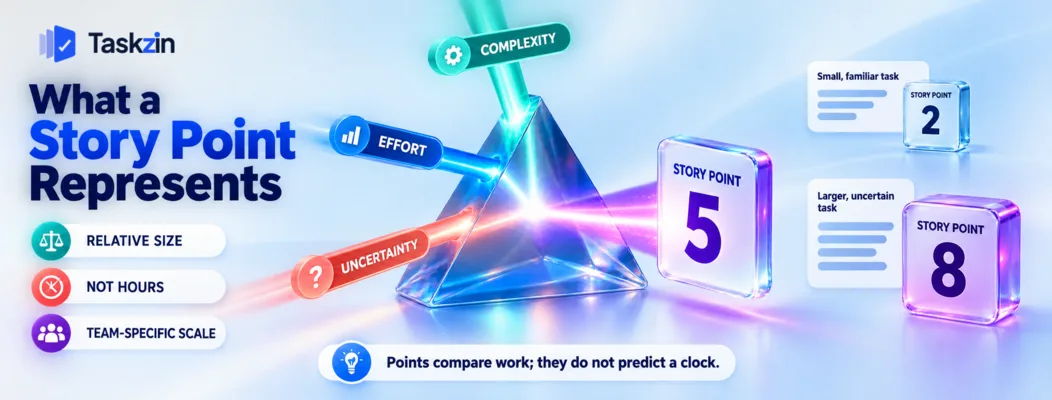
A story point combines three things into one number — how complicated the work is, how much of it there is, and how much is unknown.
Three things combined into one number
Complexity is how difficult the work is intellectually. Effort is the sheer volume. Uncertainty is how much you do not yet know.
A simple change across two hundred files is high effort and low complexity. A subtle algorithm in one function is the reverse. Both might be a 5, for different reasons — and that is fine, because what you are forecasting is how long things take, and all three factors affect that.
Relative, not absolute
Points have no fixed meaning. A 5 means "about the size of that other thing we called a 5".
This is why they are not comparable between teams, and why a team's scale must be anchored to something concrete. Relative comparison works because humans are much better at judging bigger-or-smaller than at estimating absolute duration.
Why not just use hours
Hour estimates carry two problems. They are read as commitments, so people pad them defensively. And they are systematically optimistic, because the unknowns in software work all point one direction.
Relative sizing sidesteps both. Nobody argues about whether a 5 will be finished by Thursday, and the conversion into time happens through velocity, which is based on what actually happened rather than what someone hoped.
The Point Scale and What Each Value Means
Points Typical meaning Rough guidance 1 Trivial, fully understood Change a label, small config 2 Small, no unknowns Simple form field, clear fix
3 Straightforward, some work Standard CRUD screen 5 Moderate, one or two unknowns Feature touching two areas 8 Large, several unknowns Multi-step flow, new integration 13 Very large — consider splitting At the limit of one sprint 20+ Too big to estimate Split it before planning
Values are relative to your team's own reference stories, not to any external standard.
How to Estimate in Story Points
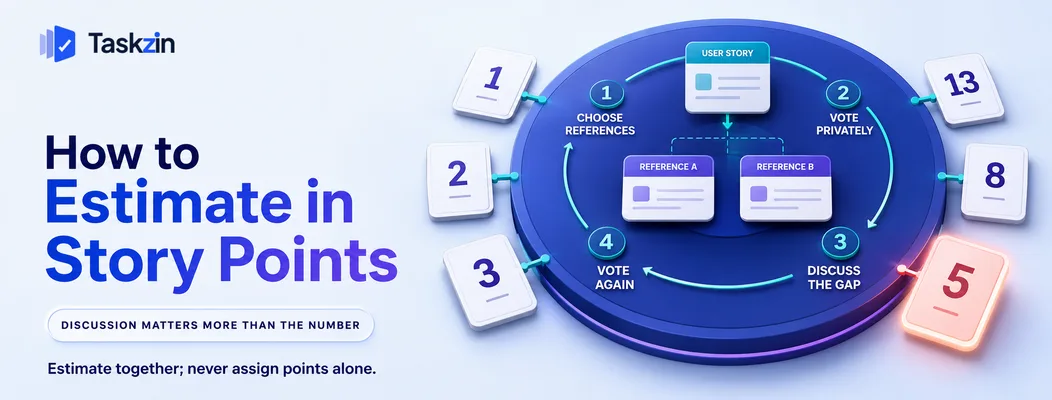
Set reference stories before you start, estimate by comparison rather than calculation, and have the whole team estimate together.
Establish reference stories first
Choose two or three completed items everyone remembers and agree their sizes — commonly a 2, a 5 and an 8.
Without shared references, the first few estimates are arbitrary and everything afterwards inherits that arbitrariness. Ten minutes spent on references at the start is the highest-value part of any estimation session.
Keep them written down and visible. Teams that rely on memory drift over months, and a drifting scale makes velocity history useless for forecasting.
Compare, don't calculate
The question is never "how long will this take". It is "is this bigger or smaller than our reference 5, and by roughly how much".
If someone starts breaking work into hours and adding up, the team has reverted to absolute estimation with a points label attached. Redirect to comparison.
Estimate as a team, not individually
Planning poker exists for one reason: to stop the most senior or loudest voice anchoring everyone else. Each person selects privately, all reveal simultaneously.
The valuable moment is when estimates diverge widely. Someone saying 2 and someone saying 13 almost always means they understand the story differently, and surfacing that before work starts is worth more than the number itself. Ask both to explain, then re-vote.
Calibrating and Keeping the Scale Stable
Anchor the scale to a memorable baseline, recalibrate when the team changes, and split anything above your agreed ceiling.
Choosing your baseline
Pick a completed story of unambiguous middling size and call it your 3 or 5. Every new estimate is a comparison to it.
Choose something recent and well remembered by everyone. An abstract definition of a point is far less useful than one concrete example.
Recalibrating after team changes
Points are specific to a team's capability. When several people join or leave, the scale genuinely shifts — work that was hard for the old team may be routine now.
Re-establish references after significant change and expect two or three unstable sprints. This is normal, not a performance problem.
Setting a ceiling
Agree a maximum, commonly 13 or 20. Anything above it must be split before it enters a sprint.
Treat a high estimate as information rather than a result: it means the story is not yet understood well enough. This single rule improves both estimation accuracy and delivery predictability more than any technique choice.
When Story Points Stop Being Useful
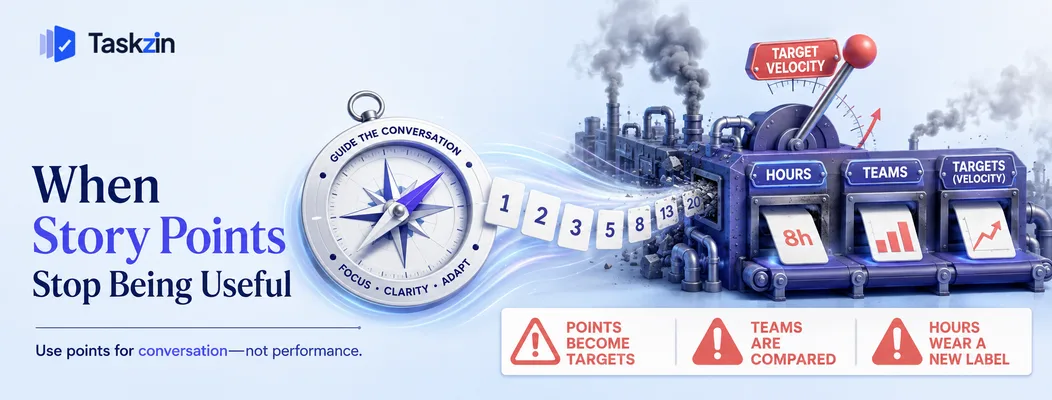
Points lose value when they become a target, when stories are already uniform in size, and when the estimation overhead exceeds the forecasting benefit.
When they become a target
If anyone is asked to increase points delivered, estimates inflate within a sprint or two. The number rises and delivery does not.
At that point the metric is dead. The only reliable protection is never using velocity for evaluation.
When stories are already uniform
Teams that break work down consistently often find their stories cluster around similar sizes.
When that happens, counting items — throughput — forecasts as well as points do, without the estimation meetings. Many mature teams reach this point and drop estimation deliberately.
When the overhead exceeds the value
If estimation consumes a substantial part of every sprint and forecasts are no better than counting items, it is not paying for itself.
Estimation is a means to forecasting, not an obligation. If you have eight to ten sprints of throughput history, you already have what you need.
Common Story Point Mistakes
The three habits that undermine points are publishing a conversion to hours, estimating individually, and re-estimating work after it is done.
Publishing a points-to-hours conversion
Announcing that a point equals a day converts points back into hours with extra steps, restoring every drawback relative estimation was meant to avoid.
If your organisation genuinely needs hours, estimate in hours openly. Mixing the two produces false precision nobody trusts.
Estimating individually
Handing stories to one person to size removes the discussion that makes estimation valuable.
The divergence between estimates is the signal; a single estimate has no signal in it.
Re-estimating completed work
Adjusting a story's points after delivery because it turned out harder corrupts velocity, which depends on estimates reflecting what was known at planning time.
Leave the original estimate. The variance is information about your estimation accuracy, and erasing it removes the only feedback the practice generates.
Frequently asked
What are story points?
A unit of relative size combining complexity, effort and uncertainty. Work is sized by comparison against reference stories the team has already completed, rather than estimated in hours.
How many hours is a story point?
There is no conversion, and publishing one defeats the purpose. Duration emerges from velocity over several sprints rather than from a fixed exchange rate.
Why use Fibonacci numbers for story points?
The widening gaps reflect how uncertainty grows with size. Distinguishing a 1 from a 2 is meaningful; distinguishing a 20 from a 21 is not, and the scale prevents false precision.
Who estimates story points?
The people who will do the work, estimating together. The product owner clarifies scope but does not set the estimate, since they are not the ones delivering it.
What is a reference story?
A completed item of known size used as an anchor for comparison. Teams typically keep two or three — a small, a medium and a large — written down and visible during estimation.
Should you estimate bugs in story points?
Teams differ. What matters is consistency, so velocity stays comparable sprint to sprint. Many teams timebox investigation work rather than estimating it.
Can agile teams work without story points?
Yes. Teams that break work into similarly sized items can forecast from throughput — items completed per sprint — which needs eight to ten sprints of history and no estimation meetings.
Binita Ray is a content writer at Taskzin, creating insightful and practical content on task management, team collaboration, productivity, workflow optimization, and SaaS solutions. She focuses on helping businesses, teams, and professionals simplify their work processes, improve efficiency, and make better use of modern productivity tools.
All posts by Binita Ray
Comments