What Is a RACI Matrix? Definition and Examples
A plain-English explanation of the RACI matrix, covering what the four roles mean, a worked project example, how to build one step by step, how to read a completed matrix for organisational problems, the main variants, and when it is unnecessary.

Most project confusion is not about what needs doing. It is about who decides, who does it, and who should have been asked first. A RACI matrix is a simple grid that settles those questions before they become arguments.
It takes about an hour to build and resolves a category of problem that otherwise recurs throughout a project.
This guide explains what the four letters mean, gives worked examples, shows how to build one, and covers when it is worth the effort.
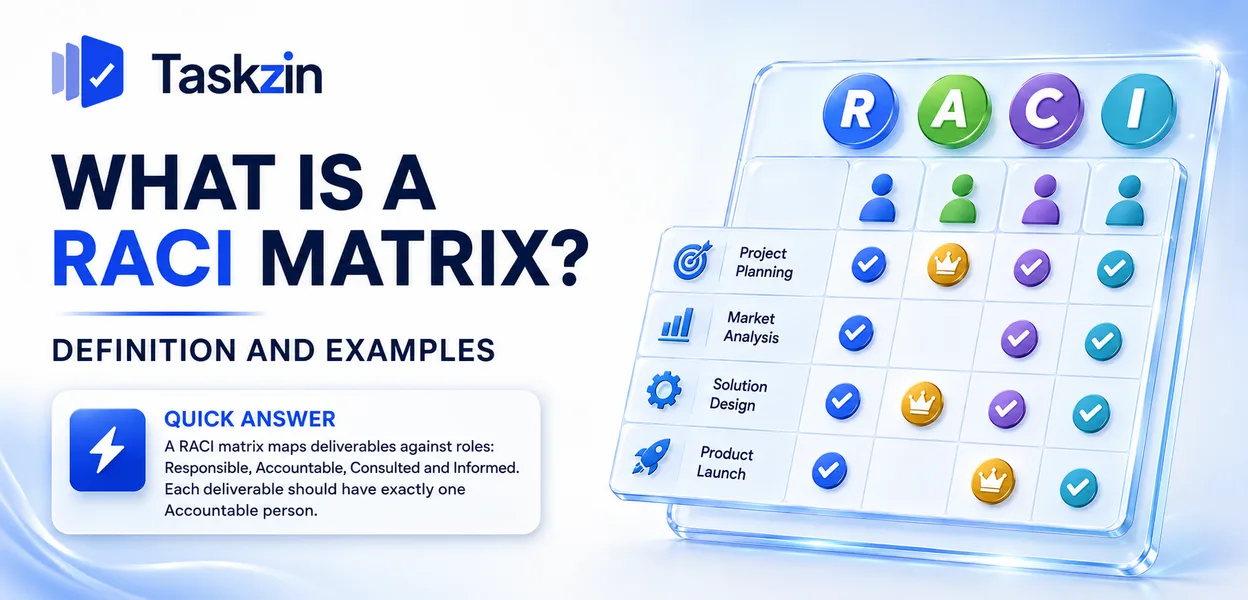
Quick answer: Quick answer: A RACI matrix is a grid mapping deliverables against roles, where each cell records whether that role is Responsible for doing the work, Accountable for the outcome, Consulted before decisions, or Informed afterwards. Each deliverable should have exactly one Accountable person, which is the rule that gives the tool most of its value.
What RACI Stands For
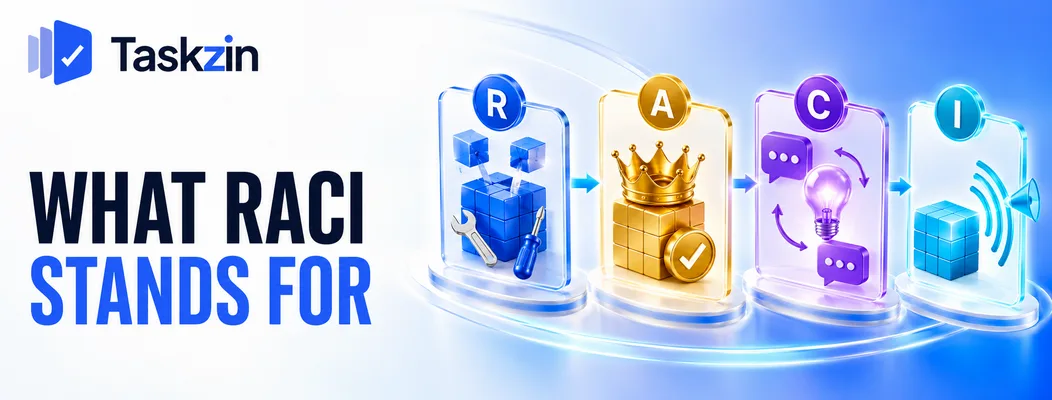
RACI assigns four distinct relationships to each piece of work: Responsible does it, Accountable owns whether it happened properly, Consulted contributes input beforehand, and Informed is told afterwards.
Responsible: who does the work
The person or people who actually perform the task. Several people can be Responsible for the same deliverable.
This is the least contentious of the four, because it usually matches how people already think about work.
Accountable: who owns the outcome
The single person answerable for whether the deliverable was completed properly. They approve the work and carry the consequence if it fails.
Exactly one person per deliverable. This constraint is the whole point of the framework, and it is where the difficult conversation usually happens — because shared accountability feels collaborative and functions as nobody being accountable.
Consulted: whose input is needed
People whose expertise or interest means they should be asked before the work is finalised.
This is two-way: they contribute, and their input is expected to affect the outcome.
Consulted is where matrices become bloated. Every additional consultee adds real elapsed time, and being generous here is how a two-day task becomes a two-week one.
Informed: who needs to know
People told about the outcome after the fact. One-way communication, no input expected.
Distinguishing Informed from Consulted is one of the most useful things the exercise achieves.
Many people believed to require consultation are perfectly content to be informed, and moving them removes a delay from the process.
RACI Matrix Examples
A website redesign project:
Deliverable Project lead Designer Developer Marketing head Legal CEO Requirements brief A C C R I I Wireframes A R C C — I Visual design A R I C — C Content C I — A/R C I Build A C R I — — Legal review I — — C A/R I Launch approval R I I C I A
Note that the CEO is Accountable only for launch approval and Informed elsewhere — which is usually the right pattern, and considerably better than a senior person being Consulted on everything.
How to Build a RACI Matrix

List deliverables rather than every task, use roles rather than names, assign exactly one Accountable per row, and review the finished grid with the people in it.
List the deliverables, not every task
Rows should be significant deliverables or decisions — ten to twenty for most projects, not two hundred tasks.
A matrix at task level is unmaintainable and nobody reads it. The purpose is resolving ambiguity about ownership, and that ambiguity exists at deliverable level.
List the roles, not the people
Columns should be roles or functions. This keeps the matrix valid when people change, which they will.
Names can be mapped to roles separately. Building the grid around individuals means rebuilding it every time someone moves.
Assign one Accountable per row
Work across each row and assign exactly one A. If you cannot decide between two people, you have found the exact ambiguity the matrix exists to resolve — resolve it now rather than during a dispute.
Then add R, C and I. Not every cell needs a letter; blank means no involvement, which is a legitimate and underused answer.
Review it with the people in it
Circulate the draft. People will discover they are Accountable for something they did not know about, or Consulted on something they have no interest in.
Both are useful discoveries, and both are cheaper now than mid-project.
Reading a RACI Matrix for Problems

A completed matrix diagnoses organisational problems: rows with no Accountable, rows with two, excessive consultation, and individuals carrying too much.
A row with no Accountable
Nobody owns this deliverable. It will drift, and when it fails everyone will reasonably believe someone else had it.
Every row needs an A before the matrix is finished.
A row with two Accountables
Shared accountability is no accountability. When two people are answerable, each assumes the other is handling the difficult part.
Pick one. If that feels impossible, the underlying organisational ambiguity is worth surfacing explicitly rather than papering over with a second A.
Too many Consulted
A row with six consultees will take weeks. Each one adds a round of feedback and a wait for a response.
Ask which of them genuinely need to influence the outcome and which would be satisfied with being Informed. Usually most can move.
A person who is Responsible for everything
Scan the columns. If one person carries R on most rows, they are the project's bottleneck and the schedule is fictional.
This is one of the most valuable outputs of the exercise, and it is invisible until the grid is laid out.
RACI Variants
Several variants add roles — RASCI adds Support, RACI-VS adds Verify and Sign-off, DACI reframes around decisions — but each addition costs simplicity.
RASCI, RACI-VS and DACI
RASCI adds Support: people who help the Responsible party without owning delivery. RACI-VS separates Verify and Sign-off from Accountable, useful in regulated environments with formal approval gates. DACI is decision-focused, using Driver, Approver, Contributor and Informed.
Which variant is worth the added complexity
For most teams, standard RACI. Its value comes from being simple enough that people actually complete and read it.
Add a variant only where a specific gap causes real problems — formal sign-off requirements in regulated work justify RACI-VS; a decision-heavy environment may suit DACI. Adding letters because the framework seems incomplete produces a grid nobody maintains.
When RACI Helps and When It Does Not
RACI resolves genuine ambiguity on cross-functional work; it adds pure overhead on small teams where everyone already knows who does what.
Where it genuinely resolves confusion
Cross-functional projects with several departments. Work involving external parties. Situations where a previous project failed because nobody owned something.
It is also valuable when a specific recurring argument keeps happening — building the matrix forces the decision that has been avoided.
When it becomes bureaucracy
A team of four working closely does not need one. They know who does what, and formalising it adds a document to maintain with no corresponding gain.
The honest test: can you name, right now, who is accountable for each major deliverable? If yes, you do not need the matrix. If you hesitate on any of them, you probably do.
Frequently asked
What is a RACI matrix?
A grid mapping deliverables against roles, recording for each whether the role is Responsible for the work, Accountable for the outcome, Consulted for input, or Informed afterwards.
What does RACI stand for?
Responsible, Accountable, Consulted, Informed. Responsible does the work, Accountable owns the outcome, Consulted provides input before decisions, and Informed is told after.
What is the difference between responsible and accountable?
Responsible people perform the work and there can be several. Accountable is the single person answerable for whether it was done properly, who approves it and carries the consequence.
Can two people be accountable for the same task?
No — that is the one rule the framework depends on. Shared accountability means each person assumes the other has the difficult part, and the deliverable drifts.
How detailed should a RACI matrix be?
Deliverable level, typically ten to twenty rows. A matrix listing every task becomes unmaintainable and nobody reads it, which defeats the purpose.
What are the alternatives to RACI?
RASCI adds a Support role, RACI-VS separates Verify and Sign-off for regulated work, and DACI reframes around decisions. Standard RACI suits most teams because it stays simple enough to use.
When should you not use a RACI matrix?
On small teams where everyone already knows who owns what. The test is whether you can name the accountable person for each major deliverable without hesitating.
Sanju Shrestha is a SaaS content writer at Taskzin who explores smarter ways to manage work, organize priorities, and improve team performance. Her content covers productivity strategies, digital workflows, collaboration, and task management, with a focus on helping modern teams work more efficiently and stay aligned.
All posts by Sanju Shrestha

Comments