Project Management for Customer Support Teams
A practical guide to project management for customer support teams, covering why support resists sprints, separating ticket work from project work, managing the knowledge base, metrics that balance speed with improvement, and common mistakes.


The pattern is universal. Everyone agrees the help centre needs updating, the recurring issue needs a proper fix, and the onboarding guide is out of date. None of it gets done, because there are always tickets waiting and tickets feel more urgent.
This guide covers why support resists standard planning, how to separate ticket work from project work, how to run the knowledge base properly, and which metrics balance speed against improvement.
Quick answer: Support teams cannot plan work in sprints because demand arrives rather than being scheduled, so the workable approach is to run tickets as continuous flow while protecting a fixed share of capacity for the project work — knowledge base, process improvement, escalation follow-up — that otherwise never happens. Without that protection, improvement work loses to the queue every single day.
Why Support Work Doesn't Fit a Sprint
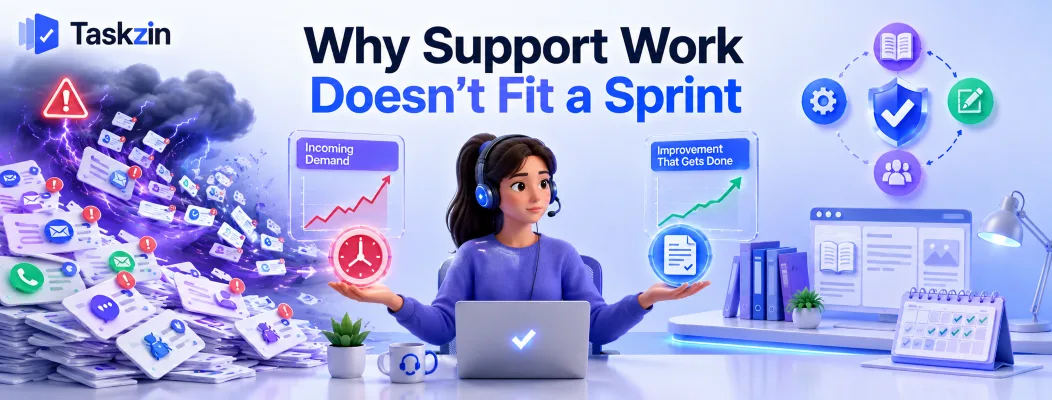
Support demand is externally generated and unpredictable, the team handles two fundamentally different kinds of work, and the urgent kind always displaces the important kind.
Each of these breaks a core assumption of sprint-based planning.
Demand arrives, it isn't planned
A product team decides what to work on. A support team finds out when the queue fills. A release goes badly, a competitor has an outage, a payment provider changes something, and volume triples without warning.
Committing to two weeks of planned work under those conditions is unrealistic, and a team that commits anyway simply fails its commitment most sprints. That failure is corrosive: after a few cycles nobody takes the plan seriously, including the people who made it.
Two kinds of work, one team
Ticket work is reactive, interrupt-driven and measured in hours. Project work — writing documentation, fixing a recurring process problem, building a macro library — is proactive and measured in days.
They need different management. Trying to run both through one queue means the project work sits permanently at the bottom, because a customer waiting always outranks an article that could be written tomorrow.
Improvement work always loses to the queue
This is the central problem in support management, and it is not a discipline failure. The incentives point entirely one direction: response times are measured and visible, while the article you did not write costs nothing today.
The only reliable fix is structural — capacity reserved in advance, protected from the queue, rather than time found when things are quiet. Things are never quiet. Support volume expands
to fill available capacity, because faster responses generate more contacts and a growing customer base generates more still.
Ticket Work Versus Project Work
Ticket work Project work Origin Customer-initiated Team-initiated Predictability Unpredictable volume Plannable Duration Minutes to hours Days to weeks Measured by Response and resolution time Completion and impact Managed as Continuous flow with WIP limits Small projects with owners Fails when Volume exceeds capacity Capacity is never protected Examples Queries, bugs, account issues Help articles, macros, process fixes
Setting Up Support Project Management
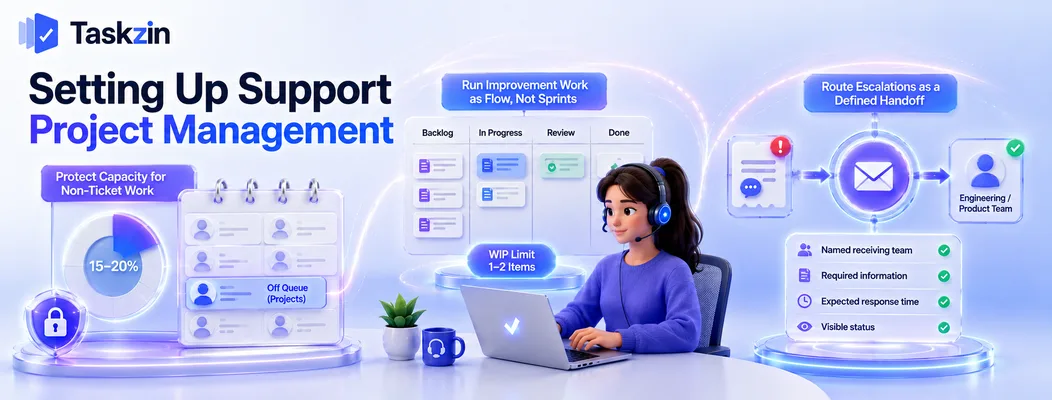
Reserve a fixed share of capacity for non-ticket work, manage tickets as continuous flow rather than sprints, and define escalation as a real handoff with an owner on the other side.
Protect capacity for non-ticket work
Decide a figure — commonly 15 to 20 percent — and protect it structurally rather than by intention. The usual mechanism is a rotation: one agent per week is off the queue entirely and works on improvement projects.
A rotation works where "spend Friday afternoons on documentation" does not, because Friday afternoon always has tickets in it. Taking someone out of the queue completely makes the capacity real, and it distributes the improvement work rather than concentrating it on whoever volunteers.
Run improvement work as flow, not sprints
The reserved capacity is small and irregular, so a two-week sprint commitment does not fit. Use a simple board with a strict work-in-progress limit instead.
One or two improvement items in progress at a time. Finish them before starting more. A support team's improvement backlog fails far more often from having eight things half-done than from lack of ideas.
Route escalations as a defined handoff
Escalation to engineering or product is where support work most often disappears. The agent sends the issue onward and has no visibility of what happens next, and the customer keeps asking.
Define it as a real handoff: a named receiving team, a required set of information, an expected response time, and a way for the agent to see status. An escalation with no owner on the receiving end is not an escalation — it is the ticket being moved somewhere the customer cannot see.
Managing the Knowledge Base as a Project

Write help content from actual ticket data rather than assumption, give every article an owner and a review date, and measure deflection honestly rather than by page views.
Write from ticket data, not guesswork
The highest-value articles are the ones answering questions people actually ask. Run a monthly review of the most frequent ticket subjects and write for the top handful.
This sounds obvious and is regularly skipped in favour of documenting what the team thinks is confusing. The ticket data is the only reliable evidence of what customers actually struggle with, and it usually contains a surprise.
Assign owners and review dates
An unowned help centre decays quietly. Articles describe features that changed, screenshots show an old interface, and trust in the whole thing erodes.
Give every article a named owner and a review date — commonly six or twelve months.
Reviews then appear as scheduled tasks rather than depending on someone noticing an article is wrong, which usually happens only when a customer complains.
Measure deflection honestly
Page views tell you an article was opened, not that it prevented a ticket. Someone can read an article, fail to find the answer, and contact support anyway.
Better signals: a thumbs-up on the article, a drop in tickets on that specific subject after publication, or a search-then-no-contact pattern if your tooling supports it. Honest deflection measurement is what justifies the reserved capacity when someone questions it.
Metrics That Balance Speed With Improvement
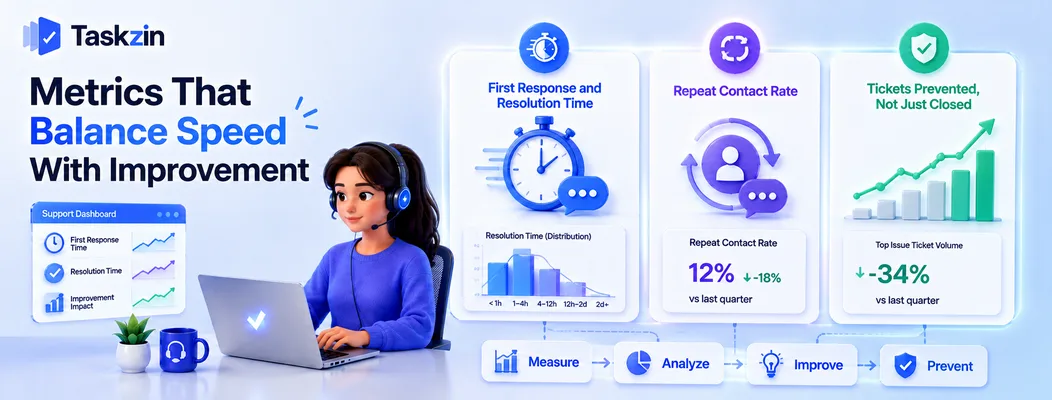
Measure first response and resolution time for service quality, repeat contact rate for whether answers actually work, and tickets prevented for whether improvement work is paying off.
First response and resolution time
The standard pair, and both matter — but resolution time is the one customers actually feel. A fast first response followed by four days of silence is worse than a slower, complete answer.
Watch the distribution rather than the average. Averages hide the small number of tickets that took two weeks, and those are the ones generating complaints and churn.
Repeat contact rate
How often does the same customer contact you again about the same issue within a short window? This measures whether your answers actually resolve things.
It is a better quality signal than customer satisfaction scores, which are heavily influenced by tone and by whether the customer got the outcome they wanted rather than whether the issue was solved.
Tickets prevented, not just closed
Track ticket volume by subject over time. If the top subject last quarter has dropped substantially after documentation or a product fix, that is the improvement work demonstrating value.
This is the metric that protects the reserved capacity. Without it, improvement time looks like time not spent on tickets, and it gets cut the first time volume spikes.
Common Support Project Management Mistakes
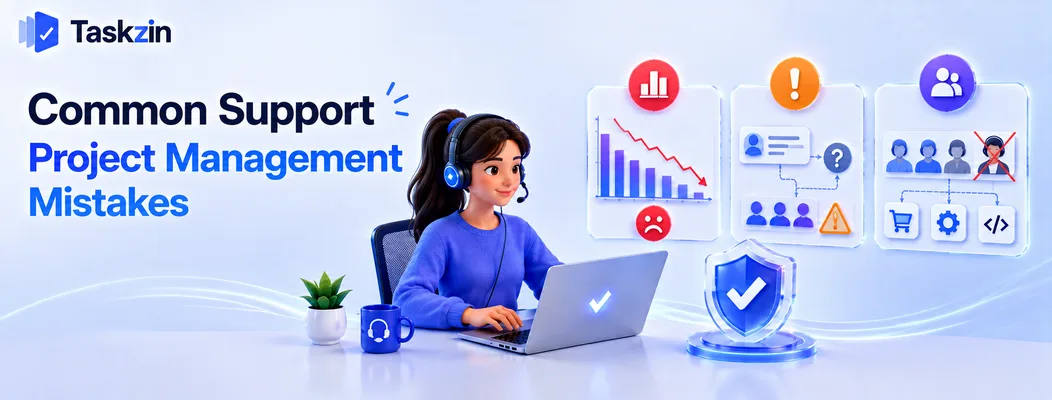
The three habits that hurt support most are measuring only volume, escalating without a receiving owner, and excluding support from tooling decisions that affect them.
Measuring only ticket volume
Tickets closed per agent measures activity, not value. It rewards fast superficial answers over thorough ones, and it actively penalises the improvement work that reduces future volume.
An agent who writes an article preventing two hundred tickets has a bad week by that metric.
Balance volume with repeat contact rate and prevented tickets, or the measurement will drive exactly the wrong behaviour.
Escalating into a void
An escalation with no named owner and no response commitment leaves the agent unable to update the customer and unable to chase. The ticket stays open, the customer grows frustrated, and the agent absorbs it.
Agree the escalation path formally, including what happens when nobody responds within the expected window.
Treating support as a cost centre in tooling decisions
Support generates the clearest signal in the business about what customers find difficult.
Excluding them from product and process decisions wastes that, and it means the same issues keep arriving.
A standing route for support to feed recurring problems into the product backlog is one of the cheapest sources of product insight available. It needs to be a real route with a named receiver and a response, not an invitation to add tickets to a backlog nobody reads — support teams stop submitting after a few submissions disappear, and the channel closes permanently.
Frequently asked
How do customer support teams manage projects?
By separating reactive ticket work, run as continuous flow with WIP limits, from proactive project work such as documentation and process improvement, which needs capacity reserved in advance to happen at all.
Should support teams use agile?
Kanban rather than Scrum. Sprint commitments do not survive unpredictable demand, whereas continuous flow with work-in-progress limits matches how support work actually arrives.
How much capacity should support reserve for improvement work?
Commonly 15 to 20 percent, protected structurally — usually by rotating one agent off the queue each week rather than hoping time appears during quiet periods.
What is the difference between a helpdesk and project management software?
A helpdesk manages customer conversations and tickets. Project management software manages the team's own initiatives — documentation, process improvement, escalation follow-up. Most support teams need both.
How should support escalate issues to engineering?
Through a defined handoff with a named receiving owner, a required information set, an expected response time, and visibility of status so the agent can update the customer without chasing.
How do you keep a knowledge base up to date?
Give every article a named owner and a scheduled review date, and write new content from the most frequent ticket subjects rather than from assumptions about what customers find confusing.
What support metrics actually matter?
Resolution time distribution, repeat contact rate, and tickets prevented by subject over time. Volume closed per agent measures activity and penalises the work that reduces future volume.
Binita Ray is a content writer at Taskzin, creating insightful and practical content on task management, team collaboration, productivity, workflow optimization, and SaaS solutions. She focuses on helping businesses, teams, and professionals simplify their work processes, improve efficiency, and make better use of modern productivity tools.
All posts by Binita Ray


Comments