Project Management in Healthcare
A practical guide to project management in healthcare settings, covering what makes healthcare projects different, planning around clinical availability, clinical engagement, governance and risk documentation, and common mistakes.

The most common failure is a project that is technically sound and clinically rejected. The system works, the process is more efficient on paper, and the ward does not use it — because the people who would use it were consulted after the design was fixed.
This guide covers what makes healthcare different, planning around clinical availability, engaging clinicians so change holds, and handling governance.
*This article covers operational and organisational project management in healthcare settings. It does not address clinical decision-making or provide medical guidance.* Quick answer: Healthcare projects operate under three constraints most industries do not face:
the people whose input the project needs are delivering patient care and cannot simply attend workshops, changes carry patient safety implications, and governance approval is mandatory rather than advisory. Managing them well means planning around clinical availability from the start rather than treating it as a scheduling difficulty.
What Makes Healthcare Projects Different

Clinical staff cannot be released from patient care for project work, changes to clinical process carry safety consequences, and formal governance approval is a requirement rather than a courtesy.
Each of these reshapes the plan rather than simply making it harder.
Clinical staff cannot be taken off the floor
In most industries, a project needing four hours from a subject matter expert schedules four hours. In healthcare, that person is on a shift with patients, and their absence has to be covered by someone else.
This is the constraint that most often derails healthcare project plans built by people from other sectors. Clinical input is not a scheduling preference — it requires either backfill, which costs money, or genuinely short sessions fitted around shift patterns.
Change affects patient safety
A process change in a factory affects output. A process change on a ward can affect a patient outcome.
This justifies the additional caution that outsiders sometimes read as resistance. It also means risk assessment is not paperwork: identifying how a change could cause harm, and how that will be mitigated, is a core project activity that must happen before go-live rather than as documentation afterwards.
Governance and approval are non-negotiable
Clinical governance, information governance, ethics where relevant, and departmental sign-off are mandatory steps with their own committee schedules.
A committee meeting monthly is a fixed feature of your timeline. A project plan that assumes approval happens when the work is ready will slip by weeks the first time a submission deadline is missed, and those weeks are not recoverable.
Common Healthcare Project Types
Project type Typical duration Main constraint Frequent failure EHR or clinical system rollout 6–24 months Clinical training time
Training as the entire change management plan
whole change plan Service redesign 3–12 months Clinical engagement Designed without frontline input Facility or ward change 3–18 months Maintaining service during works Underestimated decant planning Quality improvement 3–6 months Staff time for measurement No sustained measurement after Compliance programme 3–12 months Evidence gathering Documentation gaps found late Equipment procurement 3–12 months Procurement and training Training scheduled after go-live Pathway change 6–18 months Multi-department agreement One department not consulted
Planning Around Clinical Availability
Build the plan around shift patterns and realistic release time, budget for backfill explicitly, and prefer many short sessions over few long ones.
Design the project around shift patterns
Find out the actual shift pattern, handover times and quieter periods before scheduling anything.
A session at handover is a session nobody attends.
Repeating the same short session across shifts — including nights and weekends — reaches staff a single daytime workshop never will. It is more work for the project team and it is the difference between reaching a third of the staff and reaching most of them.
Backfill is part of the budget
If clinical staff are required for design sessions, testing or training, someone has to cover their clinical duties. That cost is real and belongs in the business case.
Projects that omit it either fail to secure clinical time at all, or secure it by asking people to attend outside their working hours — which produces resentment and poor attendance, and undermines the engagement the project depends on.
Short sessions beat long workshops
A ninety-minute workshop requiring six clinicians is difficult to arrange. Six fifteen-minute conversations at convenient moments are achievable and frequently produce better input.
Structure engagement around what is realistically obtainable. A project designed to need one large workshop will wait weeks for it; a project designed around short focused sessions keeps moving.
Engaging Clinicians So Change Actually Sticks
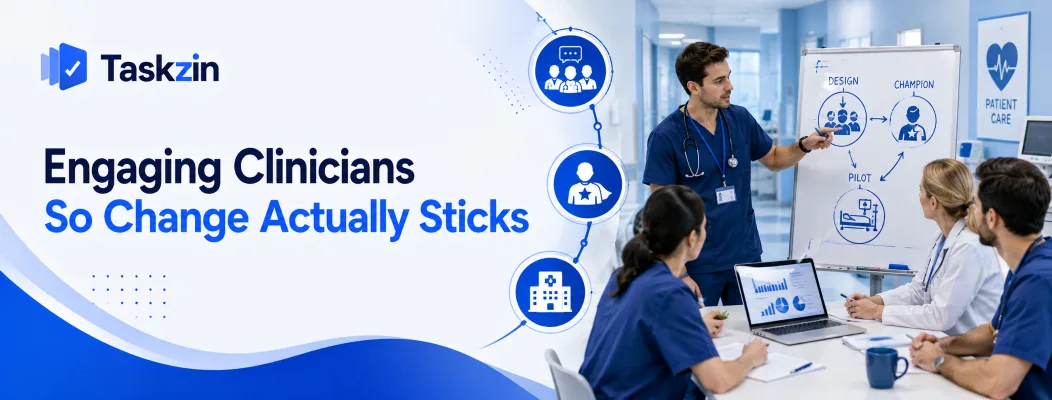
Involve clinical staff in designing the change rather than only in training on it, identify a respected clinical champion, and pilot on one ward or department before wider rollout.
Involve them in design, not just training
The most common cause of rejected healthcare change is that clinicians first encountered it as a finished decision.
Involving them during design produces a better solution — they know the workarounds, the edge cases and the reasons the last attempt failed — and produces ownership. A change designed with a ward is defended by that ward; a change delivered to it is endured or bypassed.
Find the clinical champion
Every department has someone whose opinion carries disproportionate weight — often not the most senior person. Identify them early and involve them genuinely.
A credible clinical champion advocating for a change achieves more than any amount of communication from a project team. Equally, a respected clinician who thinks the change is unsafe will stop it, and if that is their view it is usually worth understanding why rather than working around them.
Pilot on one ward or department first
A pilot surfaces the practical problems that no design process catches: the workflow that does not fit, the step that takes too long at three in the morning, the equipment that is not where it needs to be.
It also produces internal evidence. "It worked on ward six and here is what they said" is far more persuasive to ward seven than any presentation from the project team.
Governance, Risk and Documentation
Map the approval path and committee dates before planning the schedule, keep the risk assessment live rather than filing it, and gather evidence throughout rather than before an inspection.
Map the approval path before you start
List every approval required, which committee grants it, when that committee meets, and what the submission deadline is.
Committee cycles are fixed points around which everything else must fit. Discovering in month four that a particular approval needs eight weeks' notice, and the next meeting is in three, is entirely avoidable and entirely common.
Treat risk assessment as a live document
Identify how the change could cause harm, what mitigates each risk, and who owns each mitigation. Then review it as the project evolves, because the risks change as the design does.
A risk assessment completed once for approval and never revisited is documentation. One reviewed at each phase is a working control, and it is also the thing that demonstrates diligence if something does go wrong.
Keep the evidence trail as you go
Decisions, approvals, training records, testing results and risk reviews will all be asked for — at inspection, at audit, or if there is an incident.
Recording them as the project runs is substantially cheaper than reconstructing them afterwards, and considerably more credible. A project management system that timestamps decisions and approvals produces most of this automatically.
Common Healthcare Project Management Mistakes
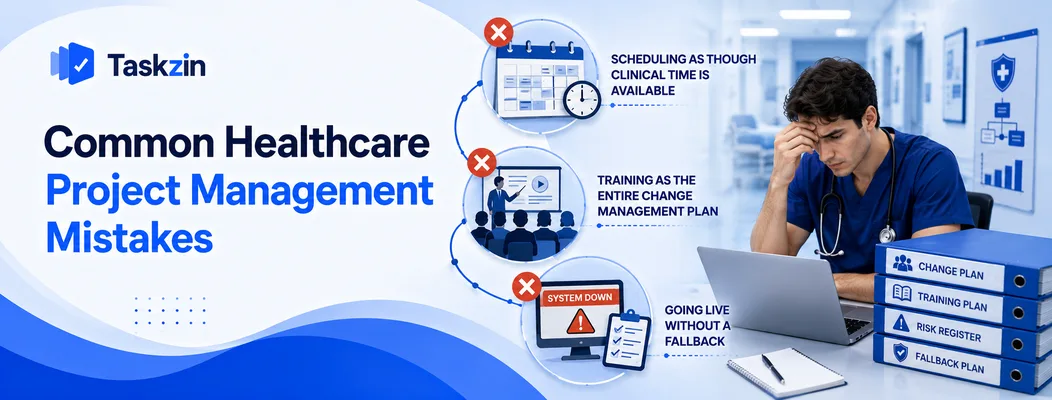
The three most damaging errors are scheduling as though clinical time is freely available, treating training as the entire change plan, and going live without a fallback.
Scheduling as though clinical time is available
A plan showing clinical staff in workshops on consecutive afternoons was written by someone who has not tried to arrange it. The plan is wrong from day one and the project is behind before it starts.
Confirm realistic availability with a ward manager before committing to dates.
Training as the entire change management plan Training teaches people how to use something. It does not address whether the change fits their workflow, whether they believe it improves anything, or what they will do when it does not work at two in the morning.
Change management is engagement during design, a credible champion, a pilot, support during go-live and a route to report problems. Training is one component of that, not a substitute for it.
Going live without a fallback
In healthcare, a failed go-live is not an inconvenience. If a system is unavailable and there is no downtime procedure, patient care is affected.
Every go-live needs a documented fallback: what staff do if the system is down, how information is recorded, how it is reconciled afterwards. Test it before go-live rather than writing it as a contingency nobody has rehearsed. The reconciliation step is the one most often missing — staff know to record on paper, and nobody has decided who enters those records afterwards or by when.
Frequently asked
What does project management in healthcare involve?
Managing organisational and operational change — clinical systems, service redesign, facility changes, quality improvement — under constraints of clinical availability, patient safety and mandatory governance approval.
Why do healthcare IT projects often fail?
Most commonly because clinical staff were involved only at training stage rather than during design, so the system does not fit real workflow and is bypassed or used minimally.
How do you plan projects around clinical staff availability?
Build the plan around shift patterns, budget explicitly for backfill, and use many short sessions repeated across shifts rather than a small number of long workshops that few can attend.
What is a clinical champion?
A respected clinician — often not the most senior — who advocates for a change within their department. Their endorsement carries more weight with colleagues than communication from a project team.
How should healthcare projects handle governance approval?
Map every required approval, the responsible committee, its meeting dates and submission deadlines before building the schedule, then plan around those fixed points rather than assuming approval fits the work.
Should healthcare projects use agile?
Iterative approaches work well for service improvement and internal tooling. Where patient safety and formal validation are involved, a stage-gated approach with defined approval points is usually more appropriate.
How do you roll out a change across multiple wards?
Pilot on one, gather evidence and fix what surfaced, then roll out in phases with the pilot ward's experience as the case. Simultaneous rollout removes your ability to learn before the change is everywhere.
Binita Ray is a content writer at Taskzin, creating insightful and practical content on task management, team collaboration, productivity, workflow optimization, and SaaS solutions. She focuses on helping businesses, teams, and professionals simplify their work processes, improve efficiency, and make better use of modern productivity tools.
All posts by Binita Ray
Comments