Project Management for Sales Teams
A practical guide to project management for sales teams, covering the boundary between CRM and project work, running complex deals as projects, managing RFP responses, handover to delivery, and common mistakes.

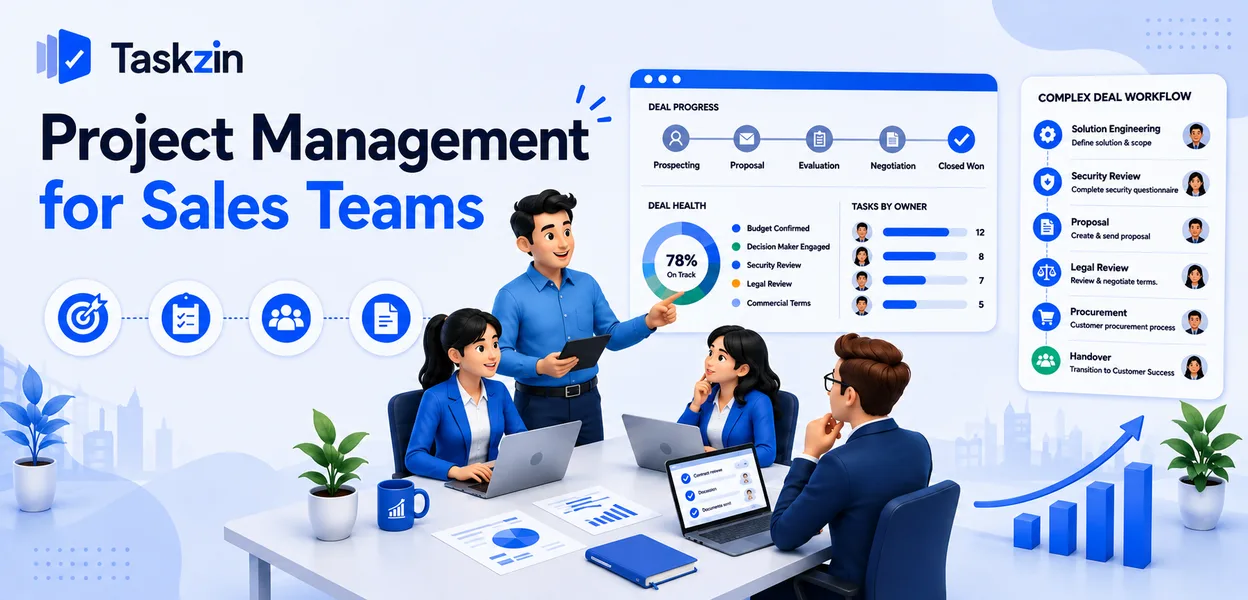
For transactional sales, a CRM is sufficient. For deals involving a solution engineer, a legal review, a security questionnaire and a procurement process, the CRM shows a stage while the actual work happens invisibly across email threads and Slack messages.
This guide covers where the boundary sits, how to run a complex deal as a project, how to manage RFPs, and how to fix the handover to delivery.
Quick answer: Sales teams need project management alongside a CRM because the CRM tracks the deal's state while the work required to advance it — proposals, security reviews, pilots, legal negotiation, handover — involves people and tasks the CRM was never designed to coordinate. The larger your average deal, the more true this becomes.
Where a CRM Stops and Project Management Starts

A CRM records the deal — contact, value, stage, forecast. A project tool coordinates the work that moves it forward, particularly when that work involves people outside the sales team.
Confusing the two leads either to a CRM stuffed with tasks nobody outside sales can see, or to critical pre-sales work happening entirely in email.
The CRM tracks the deal, not the work
A CRM tells you a deal is in "Proposal" stage, worth a certain amount, closing next month.
It does not tell you that the security questionnaire has been with the engineering team for six days, that legal has flagged two clauses, or that the pilot environment has not been provisioned.
Those are tasks with owners and deadlines, several of them belonging to people who do not use the CRM and never will.
Complex deals are projects
An enterprise deal has stakeholders, dependencies, a deadline and a cross-functional team.
That is a project by any reasonable definition.
Treating it as a CRM record with notes attached means the coordination happens in someone's head and their inbox. When that person is on leave, the deal stalls, and nobody can say why without reading three months of email.
Post-sale handover is where revenue leaks
The deal closes, the account executive moves to the next opportunity, and the delivery team receives a signed contract and a short email.
What was promised during the sales process — the integration, the timeline, the specific configuration — exists in call notes and the salesperson's memory. The gap between what was
sold and what gets delivered is one of the most common causes of early churn, and it is entirely a coordination problem.
Sales Work That Belongs in a Project Tool
Work type Stays in CRM Belongs in project tool Why Contact and account records Yes No Core CRM function Pipeline and forecast Yes No Core CRM function Call logging Yes No Core CRM function Proposal and RFP production No Yes Multi-person, deadline-driven Security questionnaire No Yes Owned outside sales Pilot or POC delivery No Yes Cross-functional project Legal and procurement No Yes External dependencies Sales-to-delivery handover No Yes Handoff between teams Territory and quota planning Partly Yes Periodic project work
Running a Complex Deal as a Project

For any deal involving several people outside sales, create a project with the stages that require other teams, assign real owners to each, and track blockers explicitly rather than inferring them from the deal stage.
Map the stages that involve other people
Not every deal needs this. Apply it above a threshold — deal size, cycle length, or any deal requiring a security review or pilot.
For those, map what actually has to happen: discovery, solution design, proposal, security review, pilot, legal, procurement. Each becomes a task with an owner and a target date, and the sequence makes dependencies visible before they bite.
Assign owners outside the sales team
The security questionnaire is owned by engineering. The commercial terms are owned by finance. The pilot environment is owned by solutions.
Assigning these to the account executive because they own the deal is how they get delayed — the AE can chase but cannot complete them. Naming the real owner creates accountability with the person who can actually act.
Track blockers, not just stage
Deal stage tells you where a deal is. It does not tell you why it has not moved for eleven days.
Recording blockers explicitly — waiting on customer legal, waiting on our security team, waiting on budget approval — turns pipeline review from a status recital into a working session. The most useful question in any pipeline meeting is which deals have not moved and what is holding each one, and only explicit blocker tracking answers it.
Over a quarter the blocker data also shows a pattern. If a third of your late-stage deals stall on the same security questionnaire, that is not a sales problem to be solved deal by deal — it is a
reason to pre-complete the questionnaire and publish the answers, which removes the delay from every future deal at once.
Managing RFPs and Bid Responses

RFPs have fixed external deadlines and require input from several people, so plan backwards from submission, use a response template, and maintain an answer library.
Work backwards from the submission deadline
The submission date is immovable. Everything else derives from it.
Set the internal deadline several days before submission, then work backwards: final review, compilation, section deadlines, kickoff. Sections should be due well before compilation, because someone always submits late and the compilation step is where lateness becomes fatal.
Build a reusable response template
Most RFPs ask similar things: company background, security posture, implementation approach, references, pricing, support model.
A template with these sections, each with a default owner, turns each new RFP from a fresh scramble into an assignment exercise. It also means nothing is forgotten under time pressure, which is when omissions happen.
Maintain an answer library
Keep approved answers to recurring questions — security certifications, data residency, uptime commitments, implementation timelines — in one searchable place with a review date on each.
This is the highest-return investment in bid management. It cuts response time substantially and, more importantly, ensures consistency: two different answers to the same security question across two bids is the kind of inconsistency procurement teams notice.
Handover From Sales to Delivery

Define what a complete handover contains, make it a tracked task with an owner rather than an email, and keep the salesperson involved through the first weeks of onboarding.
Define what a complete handover contains
Agree the list once: what was promised, what was explicitly excluded, key stakeholders and their concerns, timeline commitments, technical requirements discussed, commercial terms affecting delivery, and known risks.
Without a defined list, handovers vary by salesperson and by how busy they were that week.
With one, incomplete handovers are visible immediately rather than discovered in week three.
Make it a task, not an email
A handover email is read once and lost. A handover task in the delivery project, with a checklist and an owner, persists and can be referenced when a question arises months later.
Make it a required step before the delivery project starts. This is a small piece of process that prevents a disproportionate amount of early-relationship damage.
Keep the salesperson involved through onboarding
The customer built a relationship during the sales process. Disappearing at signature is jarring, and it removes the person who best understands what was promised at exactly the point that understanding matters most.
A defined involvement — attending kickoff, available for the first month — costs little and reduces both churn risk and the number of "but we were told" conversations.
Common Sales Project Management Mistakes

The three habits that cost most are running everything in the CRM, treating proposal work as invisible, and disappearing after handover.
Trying to run everything in the CRM
CRMs handle deal records well and cross-functional coordination poorly. People outside sales generally do not have licences, do not use it, and will not check it.
Keep deal data in the CRM and coordinate the work where the other teams already are.
Treating proposal work as invisible
A significant RFP consumes days from several people. Because it does not appear on any project board, that time is unplanned and lands on people already committed elsewhere.
Make bid work visible so it competes honestly for capacity. This also produces the data for the more important conversation — whether the bids you pursue are worth what they cost.
Handing over and disappearing
The gap between what was sold and what gets delivered starts at handover. A defined handover and continued involvement through onboarding close it cheaply, and the alternative is an expensive conversation with a disappointed customer in month two.
Compensation structures often work against this, since commission typically pays at signature and the salesperson's incentive moves to the next deal immediately. If handover quality matters to your renewal rate, that is worth addressing directly rather than expecting process alone to fix it.
Frequently asked
Do sales teams need project management software?
For transactional sales, a CRM is enough. For complex deals involving solution engineers, security reviews, pilots or legal negotiation, a project tool is needed to coordinate work owned outside the sales team.
What is the difference between a CRM and project management software?
A CRM records the deal — contacts, value, stage, forecast. Project management software coordinates the tasks required to advance it, especially those owned by people outside sales who do not use the CRM.
How do you manage an RFP response?
Plan backwards from the submission deadline with section-level deadlines well before compilation, use a reusable response template with default owners, and maintain a library of approved answers to recurring questions.
How should sales hand over to delivery?
Through a defined checklist covering what was promised, what was excluded, stakeholders, timelines and known risks — recorded as a tracked task in the delivery project rather than sent as an email.
How do you track complex enterprise deals?
Keep deal data in the CRM and run the work as a project: map the stages requiring other teams, assign real owners outside sales, and record blockers explicitly rather than inferring them from deal stage.
Should sales and marketing share a project tool?
Usually yes. Campaign work, content requests and event planning cross both functions, and a shared tool removes the handoff friction that separate systems create.
How do you stop deals stalling in late stages?
Track blockers explicitly and measure time in stage. Late-stage stalls are almost always security review, legal or procurement, and naming the specific blocker with an owner is what allows anyone to act on it.
Binita Ray is a content writer at Taskzin, creating insightful and practical content on task management, team collaboration, productivity, workflow optimization, and SaaS solutions. She focuses on helping businesses, teams, and professionals simplify their work processes, improve efficiency, and make better use of modern productivity tools.
All posts by Binita Ray

Comments