Project Management for Nonprofits and NGOs
A practical guide to project management for nonprofits and NGOs, covering how funding agreements shape projects, running a grant-funded programme, volunteer coordination, managing multiple funders, and common mistakes.

The familiar difficulty is a programme that delivered good work and struggles to prove it. The activities happened, beneficiaries were helped, and at reporting time nobody can produce the participant numbers, the attendance records or the before-and-after measures the funder asked for.
This guide covers what shapes nonprofit projects, how to run a grant-funded programme, coordinating volunteers, and managing several funders at once.
Quick answer: Nonprofit project work is shaped by the funding agreement rather than by internal priorities, delivered substantially by volunteers or short-term staff, and judged on outcome reporting that must be evidenced rather than described. Managing it well means planning directly from the grant agreement, capturing outcome data as delivery happens, and building processes that survive constant turnover.
What Shapes Nonprofit Project Work [IMG]
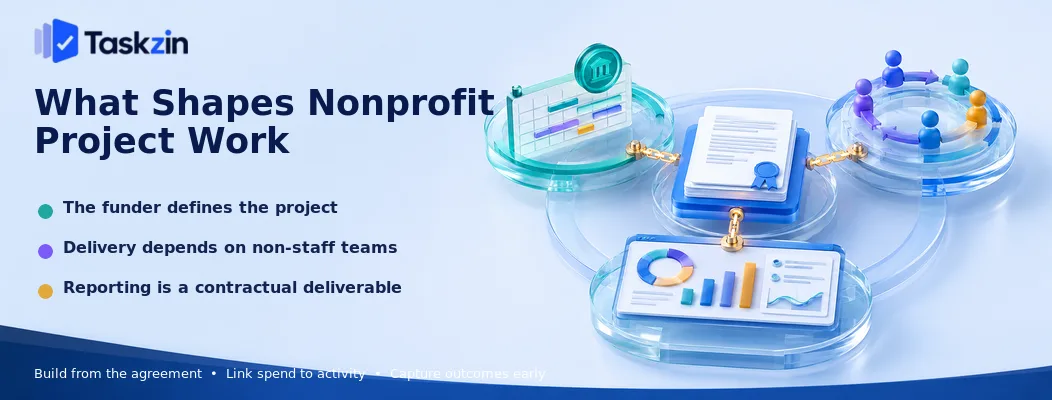
The funder defines scope, timescale and success measures; delivery relies heavily on people who are not permanent staff; and reporting is a contractual deliverable rather than administrative overhead.
These three together explain most of what distinguishes nonprofit delivery from commercial project work.
The funder defines the project, not you
A commercial team decides its own scope. A grant-funded programme has its objectives, activities, timescale, budget lines and success indicators written into an agreement before work starts.
That agreement is effectively the project charter. Every plan should derive from it directly, because delivering something excellent that differs from what was funded creates a serious problem at reporting time, however good the work was.
Delivery depends on people who are not staff
Volunteers, sessional workers and short-term funded posts do much of the actual delivery. They join, contribute for a period, and move on.
This makes documented process a survival requirement rather than good practice. A programme where the method exists only in the coordinator's head loses that method every time the coordinator changes, which in this sector is often. Grant-funded posts compound it: the role itself may end when the funding does, so the organisation loses the person precisely when the programme moves into its evaluation and continuation phase.
Reporting is a deliverable, not overhead
Funders require evidence: participant numbers, demographic breakdowns, outcome measures, financial reconciliation against budget lines.
Treating this as something done at the end is where most difficulty originates. The data has to be captured during delivery, because attendance and outcome information cannot be reconstructed six months later, and a report that cannot be evidenced puts future funding at risk.
The Grant Cycle as a Project Lifecycle
Phase Duration Main task Common failure Identify and apply 1–3 months Match programme to funder priorities Reshaping mission to fit funding Award and set-up 2–6 weeks Convert agreement into a plan Plan drifts from agreement Mobilise 1–2 months Recruit, train, publicise Underestimated recruitment time Deliver 6–36 months Run activities, capture data Data captured retrospectively Monitor and report Ongoing Interim reports to funder
Leaving reporting until the deadline
Evaluate 1–2 months Outcome analysis No baseline to compare against Close and transition 1–3 months Final report, continuity plan Funding gap unplanned
Running a Grant-Funded Programme
Build the delivery plan directly from the funding agreement, track spend against activity rather than only against budget, and capture outcome evidence as delivery happens.
Build the plan from the funding agreement
Take the agreement and convert each committed activity, output and outcome into tasks with owners and dates. Include the reporting deadlines as tasks in their own right.
This sounds mechanical and prevents the most common problem in the sector: a programme that gradually drifts from what was funded because the agreement was read once and filed. If the plan and the agreement are the same document, drift becomes visible immediately.
A shared workspace helps here. Holding the plan in a tool such as Taskzin — with reporting deadlines, activity milestones and evidence tasks all in one place — means a new coordinator can see the whole commitment rather than inheriting fragments.
Track spend against activity, not just budget
Restricted funding means money is allocated to specific budget lines. Knowing you have spent 60 percent of the budget is not sufficient; you need to know whether that matches 60 percent of the delivery.
Spending ahead of delivery signals a problem at final reconciliation. Spending behind it usually means activities are running late, and both are far easier to correct at month four than at month eleven.
Collect outcome data as delivery happens
Attendance registers, participant feedback, baseline and follow-up measures. Each is trivial to capture at the session and close to impossible to reconstruct afterwards.
Build the capture into the delivery task itself, so the session is not complete until the register and feedback are recorded. Programmes that treat data collection as a separate later activity consistently find the data missing when the report is due.
Coordinating Volunteers Without Burning Them Out [IMG]
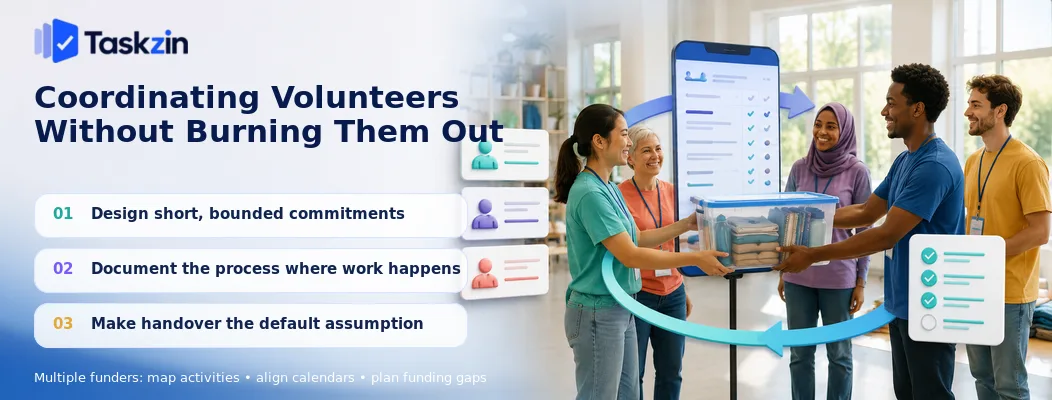
Design volunteer roles as short, clearly bounded commitments, document the process where the work happens, and assume every role will change hands.
Design roles around short, bounded commitments
A volunteer offering two hours a week cannot own an open-ended responsibility. Roles defined as "help with the programme" produce either overcommitment or disengagement.
Define discrete tasks with clear boundaries and an end point. This makes it easy to say yes, easy to hand over, and easy to recognise when the commitment is complete.
Document the process where the work happens
Written instructions attached to the task, not stored in a folder someone has to be told about.
The test is whether a new volunteer could complete the task correctly using only what is recorded. If they need to ask, the documentation is incomplete — and that gap becomes a crisis when the person who knows is unavailable.
Make handover the default assumption
Plan for every role to change hands. Keep the documentation current, keep contact lists in the shared workspace rather than in someone's phone, and record decisions where the next person will find them.
Turnover is not a problem to be minimised in this sector; it is the normal operating condition, and processes should be built for it.
Managing Multiple Funders at Once
Map which activities each grant pays for, keep all reporting calendars visible in one view, and plan deliberately for the gaps between funding periods.
Map which activities each grant pays for
When three grants fund overlapping work, you need to know which activity and which staff time is attributable to which agreement.
Tagging activities by funding source at the point of planning makes reporting straightforward and prevents the awkward situation of two funders being told they paid for the same session.
Retrofitting that attribution afterwards is difficult and error-prone.
Keep reporting calendars visible together
Each funder has its own reporting dates and formats. Held separately, they collide unpredictably, and a small team can find three reports due in the same fortnight.
One combined view of every reporting deadline lets you see the collisions in advance and start earlier where needed.
Watch for gaps between funding periods
A grant ending in March with the next starting in June is a three-month gap in which staff may need to be retained, beneficiaries may lose service, and momentum is lost.
Track funding end dates as project milestones and start the continuation conversation early.
This is a project management responsibility as much as a fundraising one, because the delivery consequences land on the programme.
Common Nonprofit Project Management Mistakes [IMG]
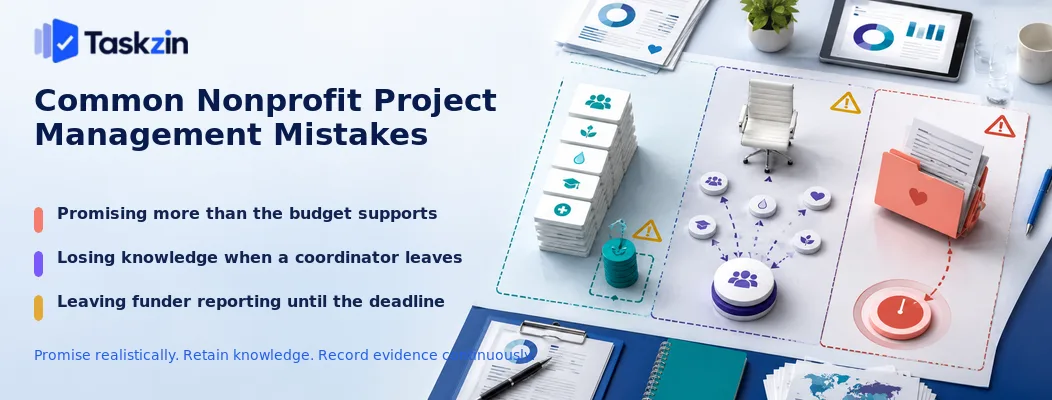
The three most damaging habits are promising outputs the budget cannot support, losing institutional knowledge with staff turnover, and leaving reporting until the deadline.
Promising outputs the budget cannot deliver
Competitive applications create pressure to promise ambitious numbers. Those numbers become contractual, and underdelivery is reported to the funder.
Model the delivery honestly before submitting. Reaching 80 participants against a promise of 200 is a worse outcome than promising 100 and reaching 110, both for the report and for the relationship.
Losing everything when a coordinator leaves
The programme ran for two years and the method, the contacts and the reasoning existed in one person's head and inbox.
Documentation inside the shared workspace, templates for recurring activities, and contact records held centrally address this at almost no cost.
Leaving reporting until the deadline
Retrospective reporting produces weak evidence and consumes disproportionate time. The register that was not kept cannot be recreated.
Make evidence capture part of delivery, and draft interim reports as the period progresses rather than in the fortnight before submission. There is a funding dimension too: the quality of your reporting is one of the few direct signals a funder receives about how well the organisation is run, and a strong report supports the next application in a way that good delivery alone does not.
Frequently asked
How do nonprofits manage projects?
By converting the funding agreement directly into a delivery plan with owners, dates and reporting deadlines, capturing outcome evidence during delivery, and documenting processes so they survive volunteer and staff turnover.
How do you plan a grant-funded programme?
Take each committed activity, output and outcome from the agreement and turn it into tasks with owners and dates, including the reporting deadlines. Keeping the plan aligned to the agreement prevents scope drift.
How do you track outcomes for funders?
Capture the data at the point of delivery — attendance, baseline and follow-up measures, feedback — as part of the activity task rather than as a separate exercise afterwards, when it cannot be reconstructed.
How should nonprofits coordinate volunteers?
Define short, bounded roles with a clear end point, document the process where the work happens so a newcomer can follow it unaided, and assume every role will change hands.
How do you manage projects funded by several grants?
Tag each activity with its funding source at planning time, keep all reporting deadlines in one combined calendar, and check for collisions and gaps between funding periods well in advance.
What happens between funding periods?
Gaps create staffing and service continuity problems. Track funding end dates as milestones and begin continuation planning several months ahead rather than treating it purely as a fundraising matter.
Do small charities need project management processes?
Yes, though not necessarily complex ones. Templates for recurring activities, documented process and consistent evidence capture matter more at small scale, because turnover has a proportionally larger effect.
Binita Ray is a content writer at Taskzin, creating insightful and practical content on task management, team collaboration, productivity, workflow optimization, and SaaS solutions. She focuses on helping businesses, teams, and professionals simplify their work processes, improve efficiency, and make better use of modern productivity tools.
All posts by Binita Ray

Comments