Project Management for Marketing Teams
A practical guide to project management for marketing teams, covering how marketing work actually flows, a stage-by-stage workflow, how to control intake and standardise briefs, the metrics worth tracking, and common mistakes.


The common experience is a team that feels permanently busy and permanently behind. Six campaigns are live, each waiting on a different person, and nobody can say confidently what will actually ship this month. That is rarely a capacity problem — it is a queueing problem.
This guide covers how marketing work actually flows, how to set up a workflow that holds, how to write briefs that prevent rework, and what to measure.
Quick answer: Marketing project management works differently from product delivery because campaigns run in parallel rather than in sequence, approval cycles consume more elapsed time than production does, and requests arrive continuously from across the business. Managing it well means controlling intake, standardising briefs, and making approval steps visible rather than assumed.
How Marketing Work Actually Flows
Marketing work is characterised by parallel campaigns competing for the same specialists, long approval queues that dominate the timeline, and requests arriving through informal channels.
Recognising these three patterns explains most of what goes wrong, and each has a specific fix.
Everything runs in parallel
A product team ships one thing at a time. A marketing team has a launch, a nurture sequence, an event, a website update and three pieces of content in flight simultaneously, all competing for one designer.
The practical consequence is that per-campaign views are close to useless on their own. What a marketing lead needs is the cross-campaign picture: what is in progress everywhere, what is blocked, and who is overloaded. Without it, work is committed to without knowing whether anyone has room.
The bottleneck is almost always approval
Writing takes two days. Getting it approved takes nine. That ratio holds across most marketing teams and is the single biggest determinant of delivery speed.
Approval delay is invisible in most workflows because a piece sitting in review looks identical whether it arrived an hour ago or last week. Until you measure waiting time explicitly, every conversation about speed will focus on the people producing work rather than the people holding it.
Requests arrive from everywhere
Sales asks in Slack. The CEO mentions something in a corridor. A product manager emails.
Each request is reasonable; collectively they are unmanaged intake.
The cost is not just the work itself. It is the interruption, the clarification round, and the fact that nobody — including the marketing lead — has a complete picture of what has been promised. A team in this position cannot negotiate priorities, because it cannot describe what it is already committed to.
The Marketing Workflow, Stage by Stage
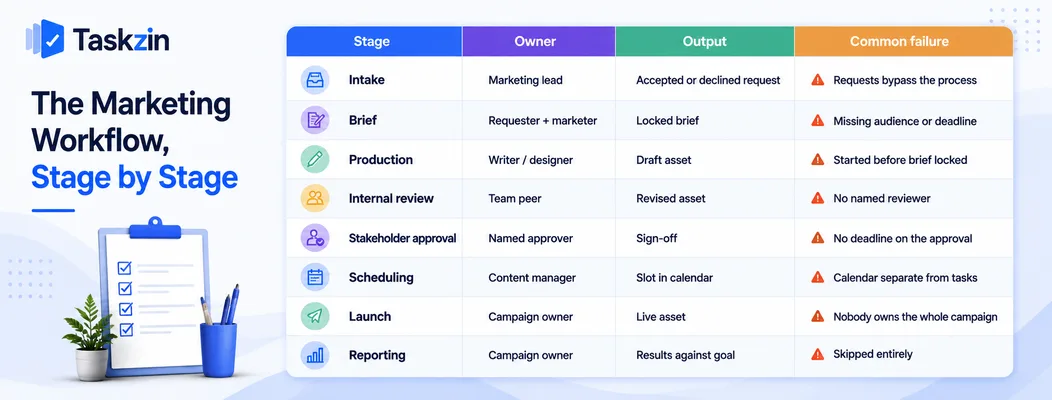
Stage Owner Output Common failure Intake Marketing lead Accepted or declined request Requests bypass the process Brief Requester + marketer Locked brief Missing audience or deadline Production Writer / designer Draft asset Started before brief locked Internal review Team peer Revised asset No named reviewer Stakeholder
Approval turnaround by reviewer
Named approver Sign-off No deadline on the approval Scheduling Content manager Slot in calendar Calendar separate from tasks Launch Campaign owner Live asset Nobody owns the whole campaign Reporting Campaign owner Results against goal Skipped entirely
Setting Up Marketing Project Management

Create one intake route and refuse work outside it, build a campaign template you reuse every time, and turn every approval into a named task with a due date.
Build one intake route and close the others
A single form that creates a task with required fields is the highest-return change most marketing teams can make. Audience, objective, deadline, channel, approver — all mandatory.
Then enforce it politely but consistently. When a request arrives in Slack, reply with the form link rather than accepting it. This feels bureaucratic for about three weeks and then becomes normal, and it eliminates both the clarification round and the invisible commitment problem in one move.
Create a campaign template you reuse
Campaigns vary less than they feel. Brief, asset production, internal review, stakeholder approval, scheduling, launch, reporting — most follow that shape regardless of channel.
Build it once with standard tasks, owners and relative dates. Every new campaign then starts complete rather than being assembled from memory, which removes setup time and the things people forget under deadline pressure. It also makes campaigns comparable, so you can see whether delivery is improving.
Make every approval a named task with a date
"Send it to legal" is not a task. "Legal review — owner: named person — due Thursday" is.
Every approval needs a named individual, a due date, and an agreed default for what happens if the date passes. An approval step without those is a queue with no exit condition, and work will sit in it for as long as everyone tolerates.
Writing Briefs That Prevent Rework
Most marketing rework traces back to a brief that never specified something — so use a required-fields template, lock the brief before production starts, and treat post-lock changes as new scope.
The fields a brief must contain
At minimum: the audience, the single objective, the key message, the format and channel, the deadline, the named approver, and any mandatory inclusions such as legal disclaimers or brand constraints.
If any of these is missing, the person producing the work will guess. Their guess will be reasonable and sometimes wrong, and the correction happens after the work exists, which is the most expensive point to discover it.
Locking the brief before production starts
Once the brief is agreed, mark it locked and start work. This is a small ceremony with a large effect: it establishes a shared reference point that both sides can return to.
Without a lock, the brief is a living document, and "that's not what I asked for" becomes an unresolvable disagreement because both parties remember it differently.
Handling changes after the lock
Changes will happen and should be accommodated — but visibly. Log each one as a change against the campaign, noting who requested it and when.
This is not bureaucracy for its own sake. It converts an awkward conversation about slipping deadlines into a factual one: here are the six changes requested after the brief was locked, which is why the date moved. Without the record, the delay looks like a delivery failure.
Metrics Marketing Teams Should Track
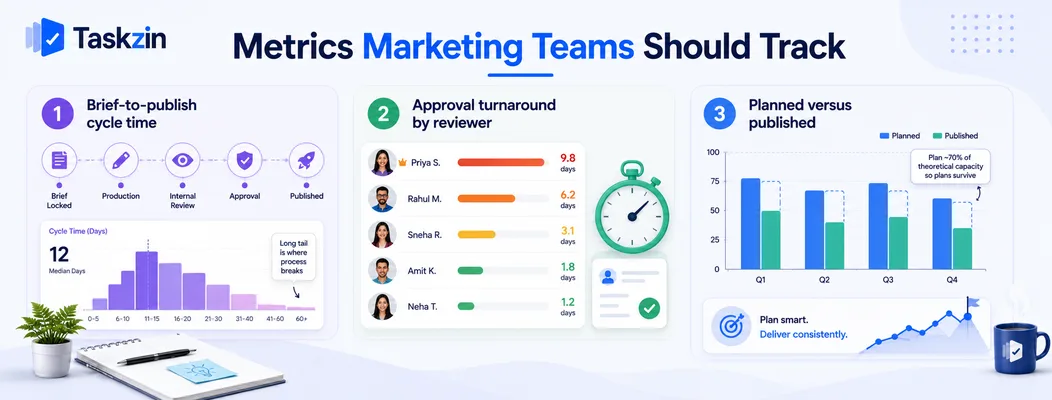
Track brief-to-publish cycle time, approval turnaround by individual reviewer, and planned versus published volume — these three explain almost every delivery complaint a marketing team receives.
Brief-to-publish cycle time
Measure elapsed days from brief lock to publication. This is what stakeholders experience, and it is usually far longer than anyone estimates.
Examine the distribution rather than the average. If most pieces take twelve days and a few take fifty, the long tail is where your process actually breaks, and those cases repay individual investigation.
Approval turnaround by reviewer Measure how long work sits with each approver. This is the most valuable metric available to a marketing team, because it turns "everything takes too long" into a specific, evidenced conversation.
The data almost always shows that one or two reviewers account for most of the delay. That is a solvable problem once visible, and nearly impossible to raise credibly without numbers.
Planned versus published
Compare what was committed to at the start of the quarter against what actually shipped. A persistent shortfall usually means planning is optimistic rather than the team slow.
Most marketing teams plan at full theoretical capacity, leaving nothing for the urgent request that arrives every month. Planning at around seventy percent produces plans that survive.
Common Marketing Project Management Mistakes
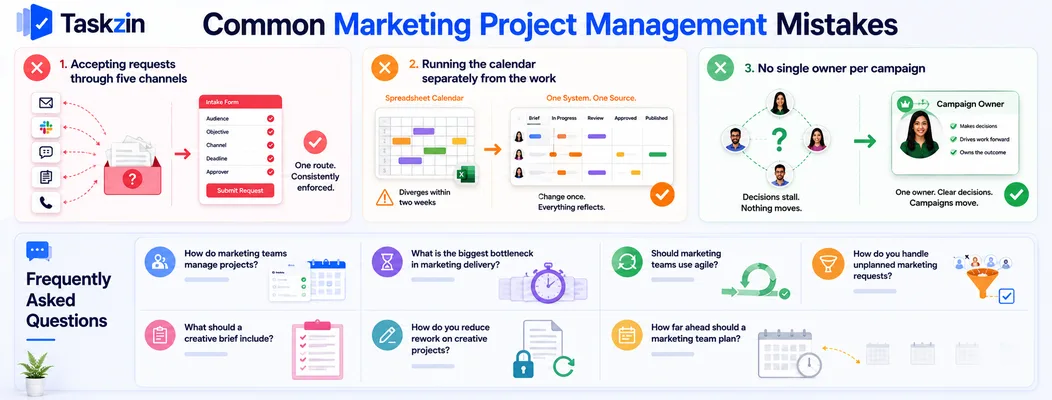
The three habits that cause most marketing delivery problems are accepting requests through multiple channels, running the content calendar separately from the work, and having no single owner per campaign.
Accepting requests through five channels
Every accepted channel is a place work can enter unrecorded. The marketing lead then cannot see total commitment, and capacity conversations become guesswork.
One route, consistently enforced. This is the change that makes every other improvement possible.
Running the calendar separately from the work
A content calendar in a spreadsheet and the work in a project tool will diverge within two weeks.
Someone reconciles them weekly, and between reconciliations both are wrong.
Use one system where the calendar is a view of the same tasks. Change a publication date once and everything reflects it.
No single owner per campaign
Campaigns with several contributors and no named owner stall at every decision point, because nobody has authority to resolve them.
Name one owner per campaign even when contribution is equal. Their job is not to do the most work but to make the small decisions — which headline, whether to slip a date — that would otherwise wait for consensus.
The absence of an owner is difficult to spot because nothing visibly fails. The campaign simply arrives two weeks later than it should have, and afterwards nobody can point to where the time went. If you cannot name the owner of a campaign in one word, that is the problem.
Frequently asked
How do marketing teams manage projects?
Most effectively with a single intake route, a reusable campaign template, named approvers with deadlines on every review step, and a calendar that is a view of the same tasks rather than a separate spreadsheet.
What is the biggest bottleneck in marketing delivery?
Approval. Production typically takes a fraction of the elapsed time; work sitting in review queues accounts for most of it, which is why measuring approval turnaround matters more than measuring production speed.
Should marketing teams use agile?
Borrow the useful parts — short cycles, visible work, regular retrospectives. Story points, sprints and velocity generally fit content and campaign work poorly, since deadlines are externally fixed rather than negotiated.
How do you handle unplanned marketing requests?
Route them through the same intake form, and reserve around a quarter of capacity for them in planning. Unplanned work is predictable in aggregate even though the specifics are not.
What should a creative brief include?
Audience, single objective, key message, format and channel, deadline, named approver, and any mandatory legal or brand inclusions. Missing fields are where rework originates.
How do you reduce rework on creative projects?
Use a required-fields brief template, lock the brief before production starts, and log post-lock changes as new scope. Most rework traces back to something the brief never specified.
How far ahead should a marketing team plan?
Detailed planning one quarter ahead, with themes at a higher level beyond that. Detailed plans further out get invalidated by market changes and campaign results before they are executed.
Sanju Shrestha is a SaaS content writer at Taskzin who explores smarter ways to manage work, organize priorities, and improve team performance. Her content covers productivity strategies, digital workflows, collaboration, and task management, with a focus on helping modern teams work more efficiently and stay aligned.
All posts by Sanju Shrestha


Comments