How to Measure Productivity Without
A practical guide to measuring team productivity without surveillance, covering what monitoring actually costs, better alternatives to each surveillance metric, flow metrics worth tracking, and how to handle genuine performance concerns.

Measure the system, not the person. Cycle time, throughput and predictability at team level tell you far more about whether work is flowing than any count of keystrokes, active hours or messages sent — and they do it without the cost that surveillance carries.
Activity metrics fail for a structural reason: they measure what is easy to count rather than what matters, and people adjust to whatever is counted.
This is not only an ethical argument. Surveillance metrics produce worse information than the alternatives, which is why the case against them holds even for managers who are unmoved by the ethics.
What Surveillance Actually Costs
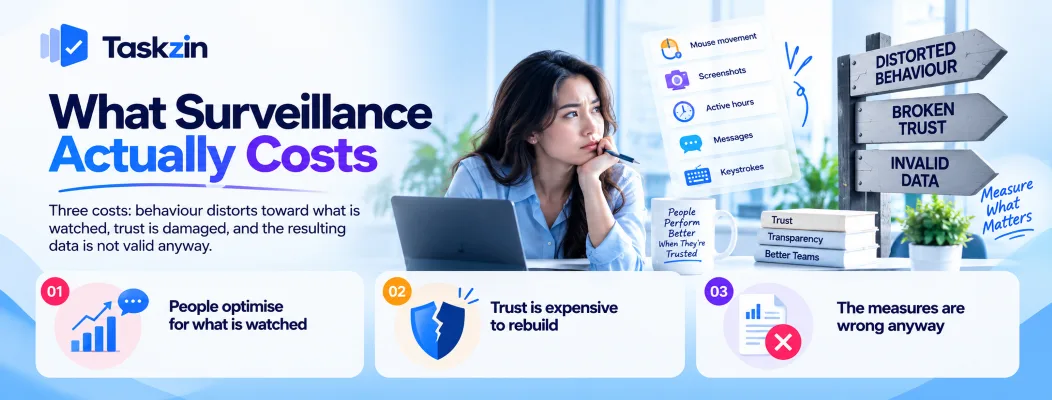
Three costs: behaviour distorts toward what is watched, trust is damaged in ways that are slow to repair, and the resulting data is not valid anyway.
People optimise for what is watched
Count messages and people send more messages. Track active hours and mouse movement and people keep sessions alive. Count commits and commits become smaller and more frequent without more being built.
None of this is dishonesty. It is a rational response to being measured on something, and it happens reliably enough to be treated as a law rather than a tendency.
Trust is expensive to rebuild
Introducing monitoring communicates a belief about your team that is difficult to walk back.
People remember being watched long after the software is removed.
The practical effects are concrete: less willingness to raise problems early, less discretionary effort, and the best people leaving first because they have options. That cost does not appear in any dashboard.
The measures are wrong anyway
A developer thinking through a design problem shows as idle. Someone deleting 400 lines of unnecessary code shows as negative output. A person helping three colleagues unblock shows nothing at all.
Activity metrics systematically undervalue the highest-value work. Even setting ethics aside, they mislead.
Surveillance Metrics and Their Alternatives
What each surveillance metric is trying to learn, and a better way to learn it.
Surveillance metric What it is trying to answer Better alternative
Active hours, mouse movement Are people working?
Cycle time — is work moving through the system?
Keystroke or screenshot
Where monitoring is legitimate
Are people doing the right work?
Throughput of completed items against commitment Messages sent, meetings attended Are people engaged?
Do commitments get met, and do problems surface early?
Lines of code, commit count Is the developer productive?
Cycle time from start to merged, and change failure rate Time-at-desk for remote workers Are remote people slacking?
Same delivery metrics as everyone else Individual task counts Who is pulling their weight?
Team throughput plus one-to-one conversations
Measure the System, Not the Person
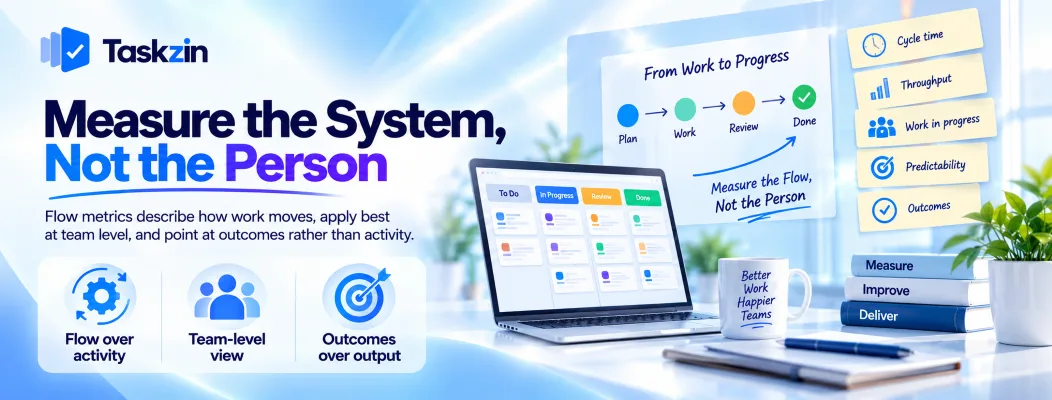
Flow metrics describe how work moves, apply best at team level, and point at outcomes rather than activity.
Flow metrics over activity metrics
Flow metrics describe the movement of work: how long items take from start to finish, how many complete per period, how much is in progress at once, and where things wait.
They are useful precisely because they are hard to game individually. A person cannot improve team cycle time by looking busy — it improves when handoffs get faster, batches get smaller and blockers get cleared.
Team-level rather than individual
Individual metrics almost always mislead, because work is interdependent. A developer whose numbers look poor may be the person unblocking everyone else.
Team-level measurement asks the right question — is our system working — and does not create competition between people whose collaboration you depend on.
Outcomes rather than output
Output is what you produced. Outcome is what changed as a result.
Twelve features shipped is output. Support tickets falling by 40 percent is an outcome. Teams measured on output ship more things; teams measured on outcomes ship the things that matter, and occasionally ship less.
Metrics Worth Tracking
Metrics that inform without surveilling, and what each one tells you.
Metric What it measures What it tells you Cycle time Start to done, per item Where work waits; usually reveals review or handoff delays Throughput Items completed per period Capacity, and whether it is stable
Work in progress Items open at once Whether the team is starting more than it finishes Predictability Committed versus completed Whether planning is realistic Blocked time How long items sit blocked, and on whom Dependencies that need fixing Escaped defects Bugs reaching production Whether quality practices are holding Rework rate Items reopened or returned Whether requirements are clear enough Outcome measures The business result the work targets Whether the work is worth doing
All of these come from data the work generates as it moves. Where the tool records when items change state, they are a report rather than an additional reporting burden on anyone.
Handling Genuine Performance Concerns
Individual concerns are real and are addressed by conversation, not by monitoring.
Individual concerns need conversations, not dashboards
If you believe someone is underperforming, the response is a direct conversation about specific work and specific expectations.
Installing monitoring to build a case does not solve the problem — it delays a conversation you will have to have anyway, damages your relationship with everyone else on the team, and produces evidence about activity when the concern is about outcomes.
What to look at when someone is struggling
Concrete, specific things: is the work they complete of the expected standard, do they meet commitments they make, do problems surface from them early or late.
Then ask why, directly. Frequently the answer is something you can fix — unclear expectations, a missing skill, an obstacle they have not raised, or something outside work entirely. None of those is visible in activity data.
Where monitoring is legitimate Some monitoring is necessary and defensible: security logging, access audit trails, compliance requirements in regulated industries, and safety-critical contexts.
The distinguishing features are that it is disclosed, proportionate, applied to systems rather than individuals, and used for the stated purpose only. Audit logs recording who accessed what are a security control; screen recording to assess diligence is not the same thing, and conflating them is how surveillance gets introduced under a compliance justification.
Common Measurement Mistakes
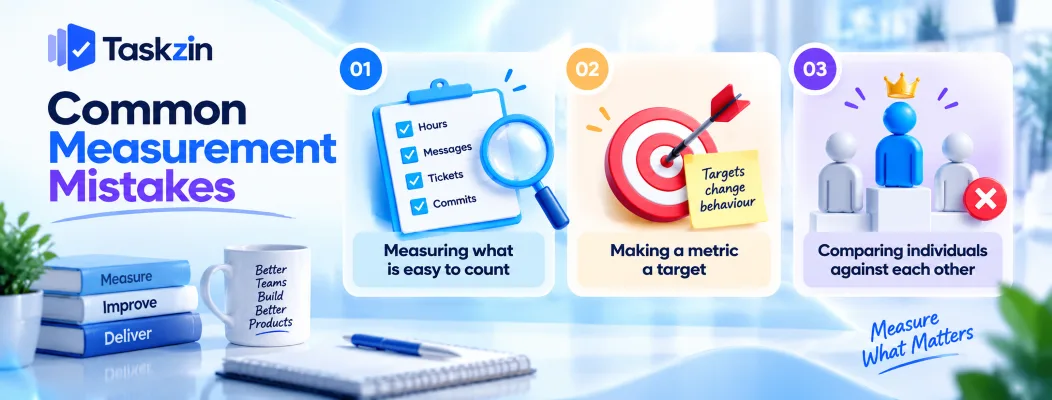
Three failures: measuring what is countable, turning metrics into targets, and ranking individuals.
Measuring what is easy to count
Hours, messages, tickets and commits are easy to count, which is why they get measured.
Ease of counting has no relationship to usefulness.
Ask what question you actually need answered before choosing a metric. Frequently the honest answer is "I want to know if my team is doing well", and cycle time and predictability answer that better than any activity count.
Making a metric a target
Once a measure becomes a target, it stops measuring what it did — a pattern general enough that it is worth assuming rather than testing.
Use metrics to prompt questions, not to set goals. "Cycle time doubled last month — what changed?" is useful. "Reduce cycle time by 20 percent" produces smaller tickets rather than faster delivery.
Comparing individuals against each other
Ranking people on any productivity metric damages collaboration immediately and permanently, because helping a colleague now costs you relative position.
Compare the team to its own past. That comparison is meaningful and creates no incentive to withhold help.
Frequently asked
How do you measure productivity fairly?
Measure the system at team level — cycle time, throughput, predictability and outcome measures — rather than individual activity. These reflect whether work is flowing and cannot be gamed by looking busy.
Is employee monitoring software effective?
It reliably changes behaviour toward whatever it measures, which is not the same as improving performance. It also undervalues the highest-value work, since thinking, deleting code and helping others all register as inactivity.
What are flow metrics?
Measures of how work moves through a system — cycle time, throughput, work in progress and blocked time. They describe the process rather than the people, and improve when handoffs and blockers improve.
Should you measure individual developer productivity?
Generally no. Work is interdependent, so individual numbers mislead — the person with weak numbers may be the one unblocking everyone else. Use team metrics plus direct conversations.
What is Goodhart's law?
The observation that once a measure becomes a target, it ceases to be a good measure. It is the reason metrics should prompt questions rather than being set as goals.
How do you handle someone who is underperforming?
Directly, with a conversation about specific work and specific expectations, then ask why. The cause is usually something addressable that no activity data would reveal.
Is any monitoring acceptable?
Yes — security logging, access audit trails and compliance requirements in regulated industries. The distinction is that it is disclosed, proportionate, applied to systems, and used only for its stated purpose.
Sujan Sharma is a content writer at Taskzin with a strong focus on productivity systems, task management, workflow optimization, team collaboration, and SaaS technology. He creates research-driven, practical content that helps professionals and growing teams improve operational efficiency, streamline processes, and make informed decisions about modern work management tools.
All posts by Sujan Sharma
Comments