How to Run Half as Many Meetings
A practical guide to reducing meeting load, covering why meetings accumulate, how to audit their real cost, what each meeting type should become instead, how to improve the ones that remain, and how to stop the load creeping back.


The reduction is not achieved by asking people to have fewer meetings. It is achieved by giving each recurring meeting a specific test and cancelling the ones that fail.
Quick answer: Most teams can remove between a third and a half of their meetings by auditing what each one actually produces, converting status meetings to written updates, and cutting attendance on the rest. The reason meeting load grows is structural: creating a meeting costs one person two minutes, and attending costs everyone invited an hour, so the incentive points one direction.
Why Meeting Load Grows
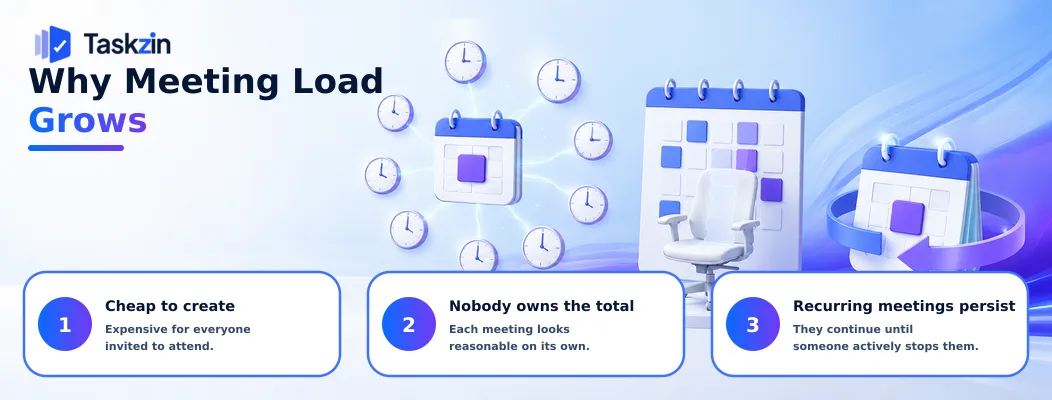
Meetings accumulate because they are cheap to create and expensive to attend, because nobody is accountable for the total, and because recurring meetings have no natural end.
Meetings are cheap to create and expensive to attend
Scheduling takes a minute. A one-hour meeting with eight people costs a full working day of collective time.
Nobody sees that cost. The organiser sees a calendar entry; the organisation loses a day. This asymmetry alone explains most of the growth.
Nobody owns the total
Individual meetings have organisers. The total meeting load on a person or team has no owner.
Each addition is defensible in isolation. The aggregate — a calendar with no space for actual work — is nobody's responsibility, so it is never addressed until someone deliberately looks.
Recurring meetings never end
A weekly meeting set up for a specific reason continues long after that reason has passed, because cancelling requires someone to actively decide.
The default is continuation. A recurring meeting created three years ago is still running unless somebody stopped it, and nobody is checking.
What Each Meeting Type Should Become
Meeting type What it usually is Better alternative Keep it?
Weekly status Round-robin updates Written update, read async
Cancel the bottom third
Information sharing One person presenting Document or short recording Cancel Decision meeting Discussion, sometimes a decision Keep, with the decision stated in the agenda Keep
Brainstorm Idea generation Keep, but with async pre-work Keep, shorter One-to-one Manager and report Keep Keep Retrospective Team improvement Keep Keep Standup Daily coordination Written for distributed teams Depends Recurring project sync Habit Cancel; use the board Cancel All-hands Company update Keep, but less frequent Keep, reduce
The Audit That Starts Everything
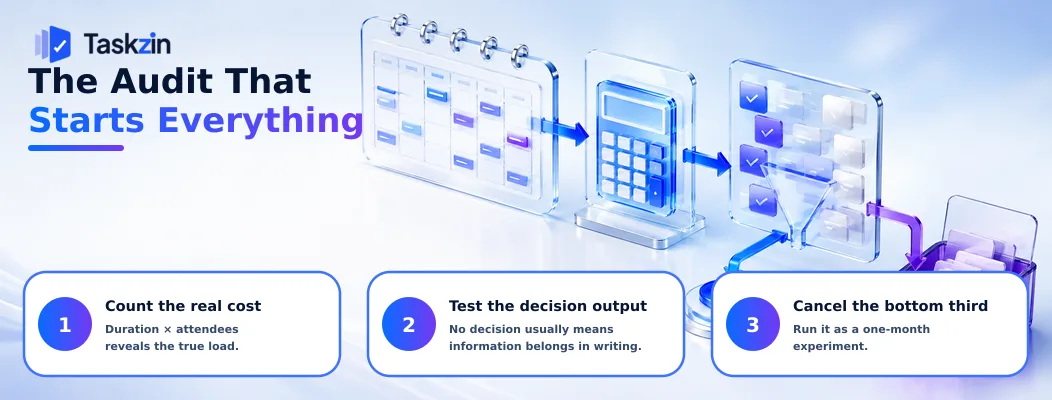
Calculate what your meetings actually cost, test each one against the decisions it produces, and cancel the weakest third.
Count the real cost
Export a month of calendar data for the team. Multiply each meeting's duration by attendee count.
The total is usually startling — commonly a quarter to a third of the team's available hours. That number is the argument. Nobody responds to "we have too many meetings"; people respond to "we spend 340 hours a month in meetings".
Ask what decision each one produces
For every recurring meeting, ask what decision it produced in the last month. Not what was discussed — what was decided that would not otherwise have been.
Meetings that produce no decisions are information transfer, and information transfers better in writing. This single question identifies most of what can be cancelled.
Cancel the bottom third Rank recurring meetings by value and cancel the bottom third outright, as an experiment, for a month.
Framing it as a trial removes the political difficulty. Some will be genuinely missed and can return; most will not, and the absence of complaints is your evidence.
Replacing Meetings With Something Better
Status becomes a written update, information sharing becomes a document, and open discussion becomes a thread with a deadline.
Status becomes written
A weekly status meeting where six people each speak for five minutes costs three person-hours and delivers information that could be read in four minutes.
Replace it with written updates posted in one place: what moved, what is blocked, what needs a decision. If the project tool holds current status, much of the update writes itself and people can read the board rather than being told about it.
Information sharing becomes a document
A meeting where one person presents and others listen is a document being read aloud.
Write it instead. Readers go at their own pace, skip what is irrelevant, and can return to it later.
Add a short window for questions, in writing or in a brief optional call.
Discussion becomes a thread with a deadline
Some genuine discussion can happen asynchronously, provided it has a deadline and a decision-maker.
Post the question, the context and the options, ask for input by a stated date, and name who decides. This works for most decisions that are not contentious, and it converts a scheduled hour into fifteen minutes of scattered reading.
Making the Remaining Meetings Worth Attending
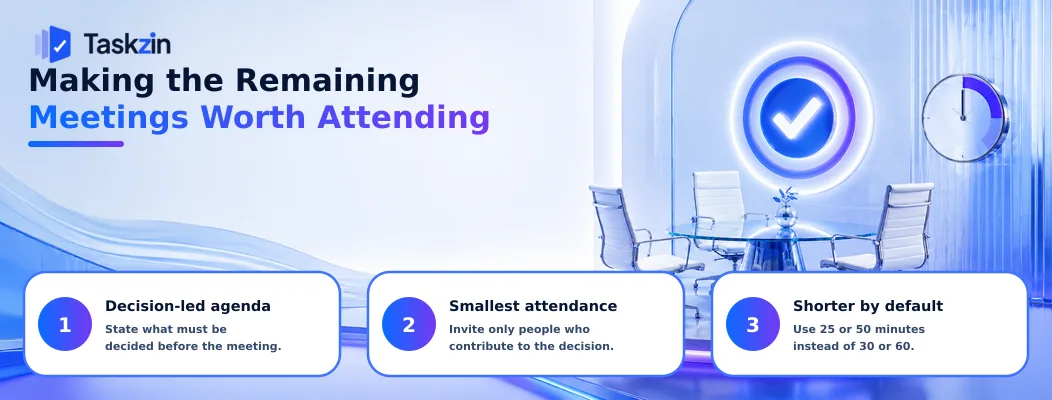
Every remaining meeting needs an agenda stating the decision required, the smallest possible attendance, and a default length shorter than an hour.
An agenda that states the decision required
Not a list of topics. A statement: "We need to decide X by the end of this meeting."
Meetings without a stated decision expand to fill the time and end without conclusion. Requiring the organiser to write the decision also causes some meetings to be cancelled during the writing, when the organiser realises there is not one.
The smallest possible attendance
Every additional attendee multiplies the cost and reduces the chance of a decision.
Invite people who will contribute to the decision. Everyone else receives the notes. Make it explicitly acceptable to decline an invitation where attendance is not needed — without that permission, people attend defensively.
A default of 25 or 50 minutes
Meetings expand to their allotted time. Setting the default to 25 or 50 minutes rather than 30 or 60 recovers a meaningful amount of time and gives people a gap between commitments.
Most calendar tools support changing the default. It is a one-off setting change with a permanent effect.
Common Mistakes When Cutting Meetings
The three failures are cancelling without providing a replacement, cutting the wrong meetings, and allowing the load to creep back.
Cancelling without replacing
Cancelling a status meeting without establishing written updates does not remove the need for coordination — it removes the mechanism.
The information finds another route, usually a proliferation of individual messages, which is worse. Replace first, then cancel.
Cutting the wrong ones
One-to-ones and retrospectives are frequently the first to go because they feel less operationally urgent.
They are among the most valuable. One-to-ones are where problems surface early, and retrospectives are the only structured opportunity to improve. Cut status meetings and recurring syncs instead.
Letting them creep back
Six months after a successful reduction, the calendar is full again.
Schedule a recurring audit — quarterly is enough. Reviewing recurring meetings on a fixed cadence prevents the slow accumulation that got you here the first time.
Frequently asked
How do you reduce the number of meetings?
Audit the real cost, test each recurring meeting by what decision it produced last month, cancel the weakest third as a trial, and replace status meetings with written updates before cancelling them.
Which meetings should you cancel first?
Recurring status meetings and project syncs that produce no decisions. Keep one-to-ones, retrospectives and genuine decision meetings — these are frequently cut first and are the most valuable.
What can replace a status meeting?
A written update in one shared place covering what moved, what is blocked and what needs a decision. Where the project tool holds current status, much of it is already visible without writing.
How long should a meeting be?
Set the default to 25 or 50 minutes rather than 30 or 60. Meetings expand to fill their allocation, and the shorter default recovers real time while giving people gaps.
Who should attend a meeting?
Only people contributing to the decision. Everyone else gets the notes. Make declining an invitation explicitly acceptable, or people attend defensively.
Do no-meeting days work?
Reasonably well, provided they are genuinely protected. They work best combined with a reduction in total load — a no-meeting Wednesday with the same meetings compressed into four days helps less than it appears.
How do you stop meetings creeping back?
Review recurring meetings quarterly on a fixed schedule. Without a scheduled review, the default is continuation and the load rebuilds within about six months.
Binita Ray is a content writer at Taskzin, creating insightful and practical content on task management, team collaboration, productivity, workflow optimization, and SaaS solutions. She focuses on helping businesses, teams, and professionals simplify their work processes, improve efficiency, and make better use of modern productivity tools.
All posts by Binita Ray


Comments