Getting Things Done (GTD) Explained for Teams
An explanation of Getting Things Done adapted for teams, covering the five steps, which GTD concepts transfer to shared work and which do not, how to run a practical team version, and common mistakes.


Teams that adopt GTD wholesale usually end up with the vocabulary and none of the habits.
Teams that borrow the three transferable ideas frequently see real improvement.
Quick answer: GTD is a five-step personal productivity method: capture everything, clarify what each item means, organise it, reflect regularly, and engage. Three of its ideas transfer well to teams — universal capture, defining a concrete next action, and the weekly review — while its contexts and personal trusted-system model do not. The method was designed for one person's head, and adapting it requires knowing which parts depend on that.
What GTD Actually Prescribes
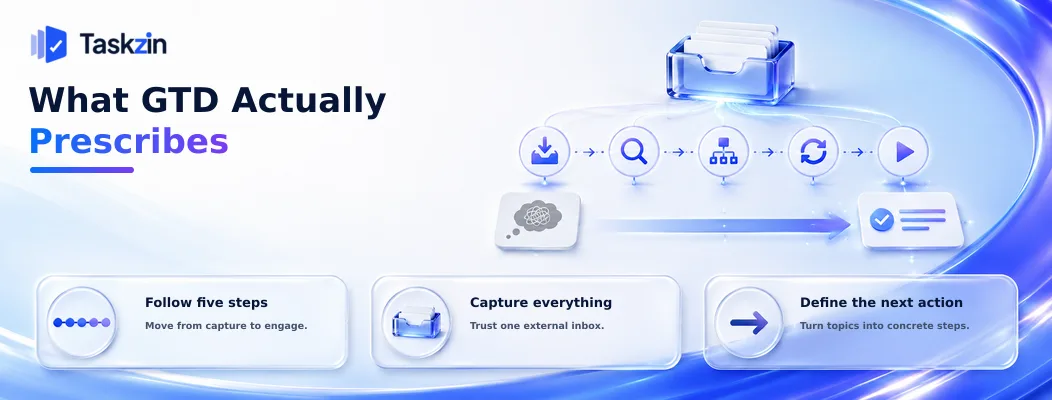
GTD's core insight is that commitments held in your head generate anxiety without producing progress, so everything should be captured externally and converted into concrete next actions.
The five steps
Capture everything that has your attention into a trusted inbox. Clarify what each item is and whether it is actionable. Organise it into the right place. Reflect through regular review. Engage by choosing what to do with confidence.
The steps are sequential and each depends on the one before. Skipping clarification is the most common failure, and it produces an inbox full of unprocessed items that becomes another source of anxiety rather than a relief from it.
Why capture comes first
The argument is that your mind is poor at storing commitments and good at processing them.
Anything held mentally is both unreliable and quietly consuming attention.
Capture removes that load, but only if the capture location is genuinely trusted. If you suspect things go into the inbox and never come out, you keep holding them mentally anyway, and the system provides no benefit.
The next action rule
The most transferable idea in the method. Every actionable item must be expressed as the specific physical next step, not as a topic.
"Website" is a topic. "Draft three homepage headline options" is a next action. The difference matters because a topic requires a decision before any work can start, and that decision is exactly what people avoid when tired.
Related: How to Onboard a New Team Member Remotely
GTD Concepts Translated to Team Work
Running a Team Version
Capture everything, decide later
Everything into one inbox Single intake route for requests Well Next action Concrete physical step Task with a clear verb and owner Well
The weekly review
Team review, 15–30 min Well Projects list Anything needing more than one step Project list with owners Reasonably
Contexts have largely dissolved
@phone, @computer, @errands Largely obsolete Poorly Trusted system Personal, private Cannot be personal if shared Poorly Someday/maybe Personal parking list Becomes backlog rot Poorly Two-minute rule Do it now if under 2 min Works, but beware interruption cost Partially
What Transfers to a Team Well
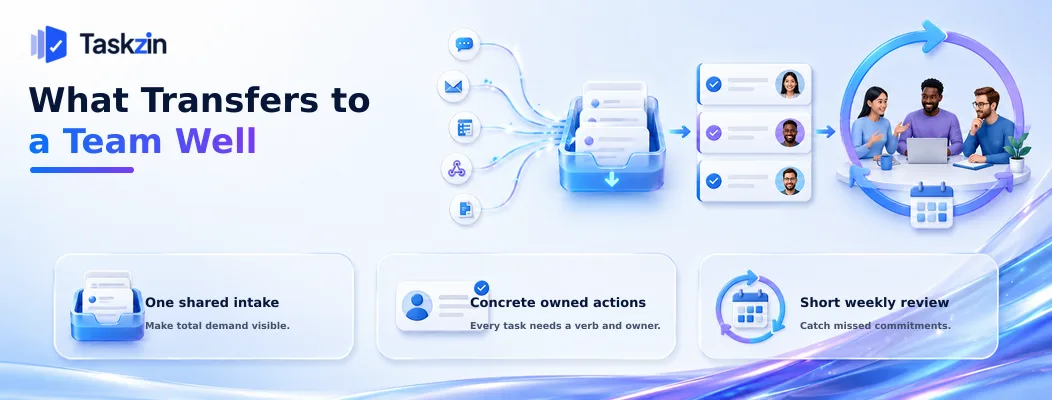
Three GTD ideas work at team level: capturing everything into one place, expressing work as concrete next actions, and holding a regular review.
Capture everything, decide later The team equivalent of universal capture is a single intake route. Requests arrive through one form or channel rather than through five, and they are triaged afterwards rather than assessed on arrival.
This solves the same problem GTD solves for individuals: things stop being held informally in people's heads and in scattered messages. It also makes total demand visible, which no individual can see when requests arrive privately.
Next actions instead of topics
Teams suffer from topic-shaped work items even more than individuals do, because a vague item passed between people accumulates ambiguity at every step.
Requiring every task to state a concrete action with an owner removes an entire category of stalled work. Items that cannot be expressed as a next action usually need a conversation rather than a task, which is itself useful information.
What is the GTD weekly review?
GTD's weekly review is the practice its own advocates identify as most often skipped and most essential.
The team version is shorter: what did not move this week, what did we agree that never got recorded, what is due next week. Fifteen to thirty minutes. It catches the things that fall between systems, which is precisely what no tool does automatically.
What Does Not Transfer
GTD's contexts, its personal trusted-system model, and its someday/maybe list all depend on assumptions that do not hold for a team.
Contexts have largely dissolved GTD's contexts — @phone, @computer, @errands — assumed that where you were determined what you could do.
For most knowledge work that is no longer true; everything is @computer. The idea survives in a limited form as filters by tool or by mode of work, but the original framing does not apply.
Personal trusted systems do not aggregate
GTD assumes one person maintaining one system they trust completely. A team has several people, and trust in a shared system depends on everyone maintaining it.
This is why individual GTD practice does not sum to team GTD practice. Five people each with an excellent personal system still have no shared view, and the coordination problem is untouched.
Someday-maybe becomes backlog rot
A personal someday/maybe list is harmless — you review it occasionally and mostly delete things.
The team equivalent is a backlog that grows indefinitely with items nobody intends to do. Unlike a personal list, it is visible to stakeholders who believe their request is coming. Teams need active pruning rather than a parking area.
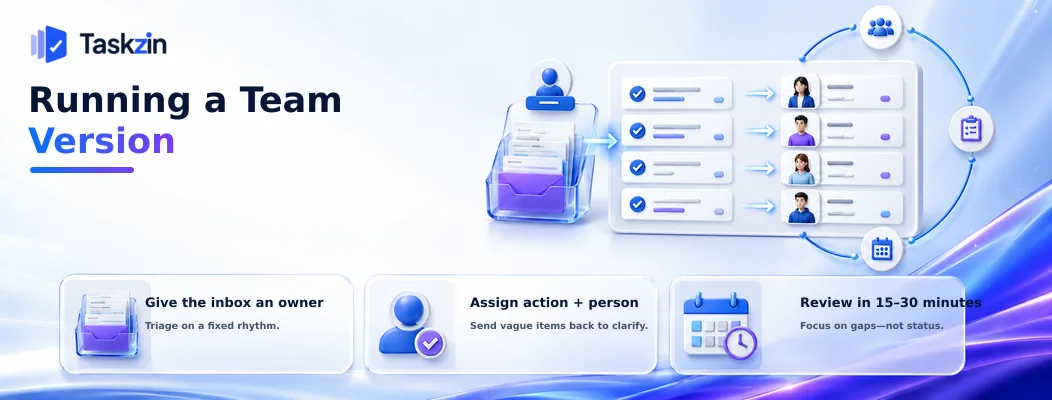
Running a Team Version A workable team adaptation has one shared inbox with an owner, a rule that every item has a next action and a person, and a short weekly review.
One shared inbox with an owner
Requests land in one place. One named person triages them on a defined rhythm — daily or every other day.
An unowned inbox is not a capture system; it is a pile. The owner does not decide priority, they decide what each item is and where it goes, which is GTD's clarify step applied to a team.
Every item gets a next action and a person
Nothing leaves triage without a concrete action and an owner. Items too vague to express that way go back for clarification rather than into the backlog.
This single rule prevents most of what makes backlogs unusable. Where the tool requires an assignee before an item can move out of intake, the rule enforces itself rather than depending on discipline.
A team weekly review that is short
Fifteen to thirty minutes, fixed slot. Look at what did not move, what was agreed verbally and never recorded, and what is due next week.
Keep it separate from status reporting. The purpose is catching what the system missed, not narrating what it already shows.
Common GTD Mistakes on Teams
The three failures are adopting the vocabulary without the habits, capturing without processing, and letting the review turn into a status meeting.
Adopting the vocabulary without the habits
Teams start saying "next action" and "someday-maybe" without changing how work is captured or reviewed.
The vocabulary is the least valuable part. If the weekly review is not happening and items are still written as topics, nothing has changed except the words.
Capture without processing
An inbox that fills and is never triaged becomes worse than no inbox, because people believe their request was received and it is sitting unread.
Capture and clarify are two steps. Doing the first without the second is the most common way GTD implementations fail, individually and collectively.
Reviews that become status meetings
The review is for catching what fell through, not for each person reporting what they did.
If it turns into a round-robin update, it will grow to an hour and then be cancelled. Keep it focused on gaps and it stays short enough to survive.
Frequently asked
What is Getting Things Done?
A personal productivity method based on capturing all commitments externally, clarifying each into a concrete next action, organising them, reviewing regularly, and choosing work with confidence.
What are the five steps of GTD?
Capture, clarify, organise, reflect and engage. Each depends on the one before, and skipping clarification is the most common reason implementations fail.
Can GTD be used by a team?
Partially. Universal capture, next actions and the weekly review transfer well. Contexts, personal trusted systems and someday/maybe lists do not, because they assume one person's system.
What is a next action?
The specific physical step required to move something forward — "draft three headline options" rather than "website". Topics require a decision before work can start; next actions do not.
What is the GTD weekly review?
A regular session reviewing all lists and commitments to keep the system trusted. The team version is shorter: what did not move, what was agreed but never recorded, what is due next.
Are GTD contexts still useful?
Largely not in their original form, since most knowledge work can be done anywhere. A limited version survives as filtering by tool or mode of work.
What is the difference between GTD and a project management system?
GTD is a personal method for managing your own commitments. A project management system coordinates work across people. They are complementary — GTD habits improve how individuals use a shared system.
Sujan Sharma is a content writer at Taskzin with a strong focus on productivity systems, task management, workflow optimization, team collaboration, and SaaS technology. He creates research-driven, practical content that helps professionals and growing teams improve operational efficiency, streamline processes, and make informed decisions about modern work management tools.
All posts by Sujan Sharma

Comments