The Pomodoro Technique, Honestly Evaluated
An honest evaluation of the Pomodoro Technique, covering what the method actually is, where it genuinely helps, where it gets in the way of deep or reactive work, how to adapt it rather than abandon it, and common mistakes.


Most honest assessment of it comes down to one question: is your problem starting, or is your problem sustaining? Pomodoro is excellent at the first and frequently unhelpful for the second.
Quick answer: Pomodoro means working in fixed intervals — traditionally 25 minutes — separated by short breaks, with a longer break after four. It is genuinely effective for starting work you are avoiding and for building an accurate sense of how long things take. It is often counterproductive for work requiring long ramp-up. The technique is neither the productivity breakthrough its advocates claim nor the gimmick its critics suggest.
What the Technique Actually Is
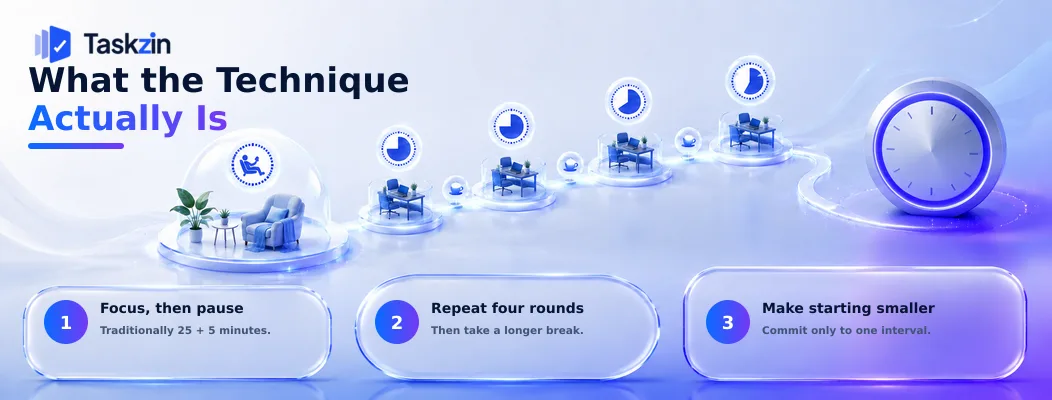
A timer-driven method of alternating focused intervals with short breaks, designed originally to make starting easier and to measure how work actually consumes time.
The original method
Choose a task. Set a timer for 25 minutes. Work only on that task until it rings. Take a five-minute break. After four intervals, take a longer break of 15 to 30 minutes.
The rules include that an interrupted interval does not count, and that you record completed intervals. Both matter more than people assume.
What it was designed to solve
The method was developed to address procrastination and to make time consumption visible — how many intervals a task actually took, rather than how long it felt.
That second purpose is largely forgotten. Most people use Pomodoro purely as a focus timer and skip the recording, which discards half of what it was for.
Why the timer is the point
The timer creates a commitment small enough to accept. Twenty-five minutes is short enough that "I do not want to do this" loses its force — anyone can do anything for 25 minutes.
It also creates a hard stop, which prevents the common pattern of working until exhausted and then avoiding the task for two days.
What It Does Well and Badly
Where Pomodoro Genuinely Helps
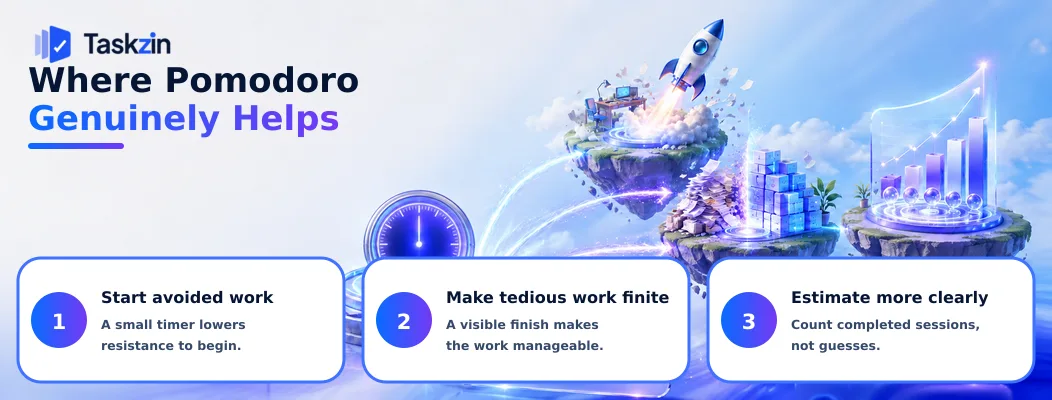
Starting a task you are avoiding Strongly — Tedious or unpleasant work Strongly — Estimating how long work takes Strongly — Preventing overwork in one sitting Yes —
Reactive or interrupt-driven
Work you find unpleasant
— Intervals constantly broken
Deep work with long ramp-up
Timer interrupts at the wrong point Collaborative work — Others do not run on your timer Creative work in flow Sometimes Breaking flow is costly
Where Pomodoro Genuinely Helps The technique is strongest at overcoming resistance to starting, at making tedious work tolerable, and at producing an honest estimate of task duration.
Starting when you do not want to
This is its best use, and the one supported most clearly by experience.
The barrier to a task you are avoiding is rarely the whole task — it is beginning it. Committing to 25 minutes rather than to completion removes the reason to defer, and in practice most people continue past the timer once started.
Work you find unpleasant Expenses, documentation, data cleanup, the report nobody wants to write.
A defined interval with a guaranteed end makes unpleasant work finite. Three intervals with breaks is materially easier than an open-ended session of the same length.
Building an estimate of your own capacity
Recording completed intervals per task produces something genuinely useful: an evidence-based sense of how long your work actually takes.
Most people are surprised. The task they thought took an hour took five intervals across two days. That calibration improves planning far more than any estimation technique, and it is the part of Pomodoro most often skipped. Where your tasks live in a system that tracks time against them, the record accumulates without extra effort.
Where It Gets in the Way
Pomodoro struggles with work requiring long ramp-up, with collaborative and reactive work, and whenever the interval count becomes the objective.
Deep work with long ramp-up Complex analysis, debugging, architectural design and long-form writing all require assembling a mental model that takes time to build.
Twenty-five minutes may be barely enough to load the context. A timer that interrupts at that point actively destroys value, because the reassembly cost is paid again after the break. For this work, longer intervals or no timer at all is better.
Collaborative and reactive work
Other people do not run on your timer. Meetings, pairing, support duty and anything where response time matters cannot be intervalled.
Attempting it produces constant broken intervals, which the method treats as failures — and a technique that labels a normal working day as failure will be abandoned.
When the timer becomes the goal
Counting pomodoros as a productivity measure is the classic corruption. The number rises and the work does not improve.
An interval spent on a low-value task counts identically to one spent on the most important thing you could be doing. The count says nothing about value.
Adapting It Rather Than Abandoning It
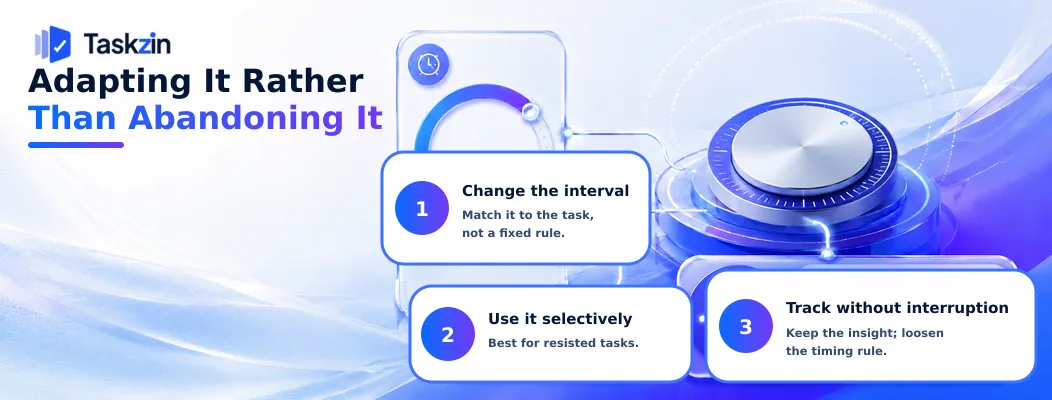
Most people who benefit from Pomodoro use a modified version: different intervals, selective application, or the tracking without the strict timing.
Change the interval
Twenty-five minutes is not sacred. It was one person's choice, not a research finding.
Many people find 45 to 90 minutes better for substantial work, with proportionally longer breaks.
Experiment for a week at different lengths and use what actually holds your attention.
Use it selectively
Rather than structuring the whole day around intervals, deploy the technique for specific situations: the task you have deferred three times, the tedious block of admin, the thing you cannot make yourself start.
This is how most long-term users end up working, and it captures the genuine benefit without the friction.
Keep the tracking, drop the timer
If the timer interrupts you unhelpfully but you want the calibration benefit, record how long tasks actually take without enforcing intervals.
You lose the starting mechanism and keep the estimation improvement, which for some people is the more valuable half.
Common Pomodoro Mistakes
The three errors are treating the interval length as fixed, counting intervals as output, and applying it to work that does not need it.
Treating 25 minutes as sacred
The specific number is arbitrary. Rigid adherence to an interval that does not suit your work is following a rule rather than getting a benefit.
Counting pomodoros as productivity
Intervals measure time spent, not value delivered. A day of twelve intervals on the wrong work is a bad day with good metrics.
If you track anything, track what got finished.
Using it for work that does not need it
Applying intervals to work you are happy to do and already focus on well adds structure with nothing to gain, and the timer becomes an irritation.
Reserve it for resistance and tedium, which is where it genuinely earns its place.
Frequently asked
What is the Pomodoro Technique?
Working in fixed intervals — traditionally 25 minutes — separated by short breaks, with a longer break after four, recording completed intervals to see how long tasks actually take.
Does the Pomodoro Technique actually work?
For overcoming resistance to starting and making tedious work tolerable, yes, reliably. For deep work requiring long ramp-up or for reactive roles, it frequently gets in the way.
Why 25 minutes?
It was the interval the method's originator settled on, not a research-derived optimum. Many people work better with 45 to 90 minute intervals for substantial work.
Can you change the interval length?
Yes, and most long-term users do. Experiment with different lengths for a week and use what holds your attention, scaling break length proportionally.
Is Pomodoro good for deep work?
Often not. Work requiring a complex mental model may take 25 minutes just to load the context, so a timer interrupting at that point destroys the value it was building.
What do you do if you are interrupted mid-pomodoro?
The original method says the interval does not count and you restart. In practice, note the interruption source — if it happens constantly, your work is too reactive for the technique.
Is Pomodoro suitable for team work?
Poorly, since collaborative work depends on other people's availability rather than your timer. Some teams run synchronised focus blocks instead, which achieves a similar effect collectively.
Sujan Sharma is a content writer at Taskzin with a strong focus on productivity systems, task management, workflow optimization, team collaboration, and SaaS technology. He creates research-driven, practical content that helps professionals and growing teams improve operational efficiency, streamline processes, and make informed decisions about modern work management tools.
All posts by Sujan Sharma


Comments