Spotting and Preventing Burnout on Your Team
A manager's guide to spotting and preventing burnout, covering what burnout is as an occupational phenomenon, early signals worth noticing, the workplace conditions that cause it, what managers can actually change, and how to have the conversation.

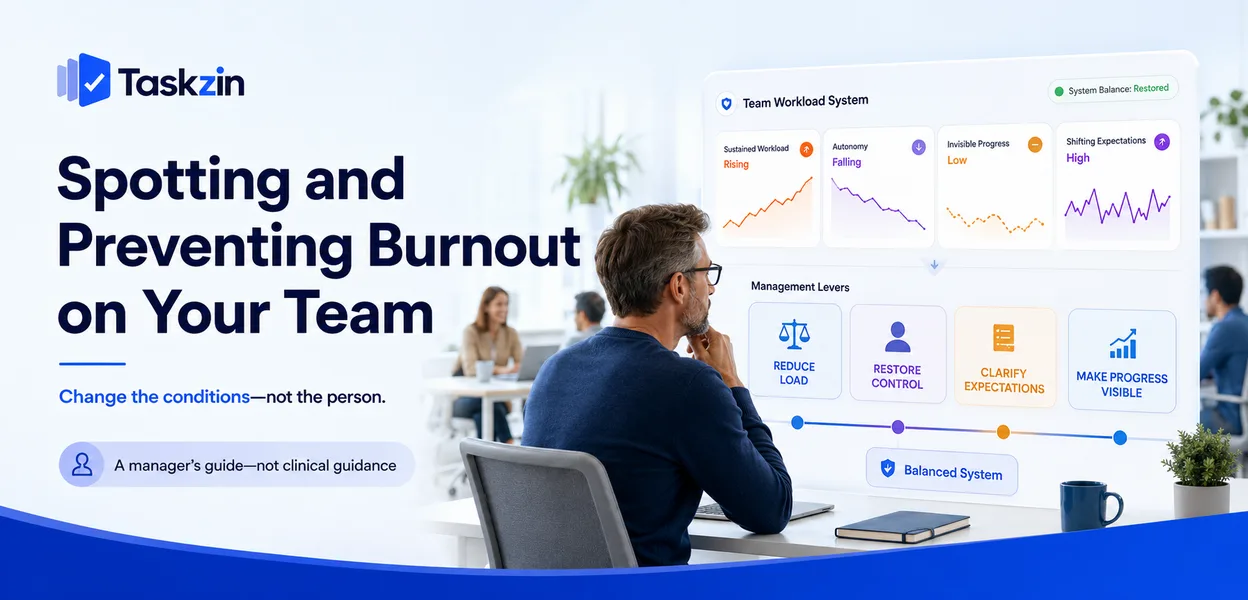
This article covers what managers can observe and change. It is not clinical guidance — if you or someone on your team is struggling, a GP, occupational health service or employee assistance programme is the right route, and encouraging that is part of the job.
Quick answer: Burnout is recognised as an occupational phenomenon resulting from chronic workplace stress that has not been successfully managed — which means it is primarily a management problem rather than an individual resilience problem. The conditions that produce it are largely under a manager's control: sustained overload, low autonomy, effort that produces no visible result, and unclear expectations.
What Burnout Is, and What It Is Not
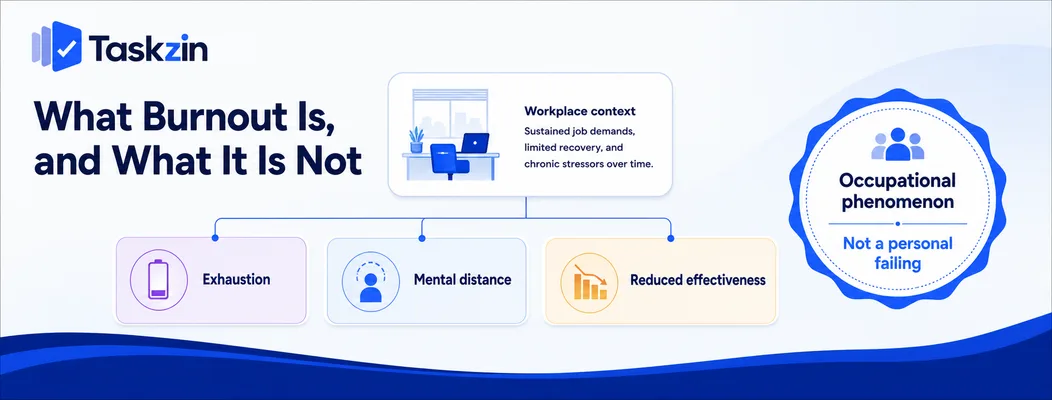
Burnout describes a syndrome arising from chronic workplace stress, characterised by exhaustion, mental distance from the job, and reduced sense of effectiveness.
An occupational phenomenon, not a personal failing
The World Health Organization classifies burnout as an occupational phenomenon — something arising from the work context — rather than as a medical condition or a characteristic of the person.
That framing matters practically. If burnout is a resilience problem, the intervention is training the individual. If it arises from workplace conditions, the intervention is changing the conditions. The evidence supports the second, and it puts the responsibility somewhere it can actually be acted on.
The three recognised dimensions
Exhaustion — depleted energy that rest does not resolve. Mental distance from the job, often expressed as cynicism about work that previously mattered. Reduced professional efficacy — the sense of being ineffective regardless of effort.
The second is the one managers most often miss, because it can look like a bad attitude rather than a warning sign.
Why it is a management problem
The conditions that produce burnout are workload, control, reward, community, fairness and values alignment. A manager influences most of these directly.
None of them is fixed by resilience training or a wellbeing app, which is why those interventions produce so little effect on their own.
Early Signals Worth Noticing
Signal What it can indicate What it is not
Withdrawal from optional interaction Depleted capacity Necessarily disengagement Cynicism about work that used to matter Mental distance A bad attitude Quality slipping in a reliable person Reduced efficacy Carelessness Working consistently late or at weekends
Sustained overload
Reluctance to take leave Feeling indispensable or behind Dedication Increased irritability in a normally patient person Exhaustion A personality issue Presence without output Struggling to engage Laziness
These are patterns to notice and ask about, not a diagnostic checklist. Any one of them has many possible explanations.
The Workplace Conditions That Cause It
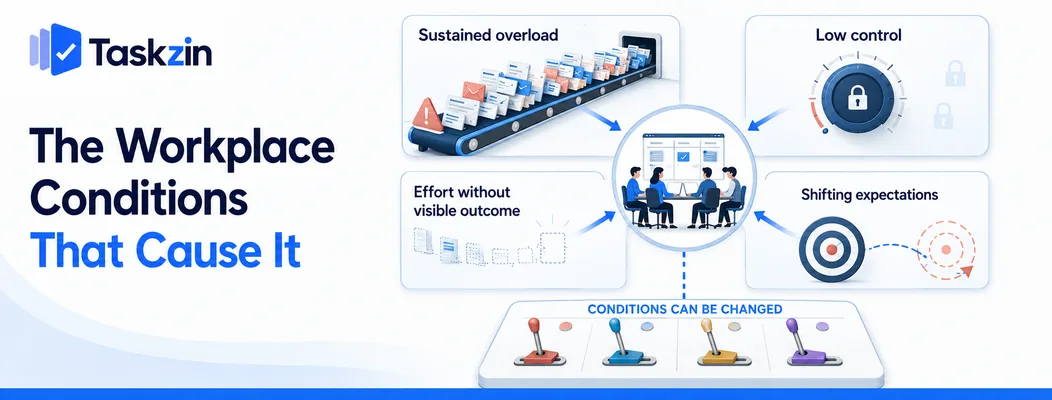
Four conditions do most of the work: sustained overload, lack of control, effort that produces nothing visible, and expectations that keep changing.
Sustained overload Not a busy fortnight — months without a period of normal load. Occasional intensity is manageable and sometimes energising. Continuous intensity with no end date is not.
The distinction is whether people can see the far side of it. A team told "this is heavy until the March release" copes considerably better than one that has been busy indefinitely with no stated end.
Lack of control
Being unable to influence what you work on, how you do it, or when. Low autonomy is one of the most consistent contributors, and it is often invisible to the person setting the constraints.
Control does not require full freedom. Being consulted, being able to choose the order of your own work, or being able to say no to something all substantially change the experience.
Effort without visible outcome
Working hard on something that never ships, or that ships and disappears without acknowledgement, is corrosive in a way that hard work with a visible result is not.
This is why projects that are cancelled late, or repeatedly reprioritised, take a disproportionate toll. The effort was real and produced nothing anyone can point to.
Unclear or shifting expectations
Not knowing what good looks like, or being measured against standards that change, produces a permanent low-level anxiety.
This one is cheap to fix and frequently overlooked. Clear expectations, stated once and held to, remove a stressor that costs nothing to remove.
What Managers Can Actually Change
Reduce load in a way that is real rather than nominal, return control where possible, and make progress visible.
Reduce the load, genuinely
The most direct lever and the one most often avoided, because it means telling someone else that something will not happen.
Nominal reductions — "deprioritise where you can" — move the decision back to the person who is already overloaded. Real reduction means you decide what gets dropped, tell the stakeholders, and take the consequence. That is the job.
Plan against measured capacity rather than headcount. Most teams deliver 60 to 75 percent of nominal availability, and committing against the higher figure builds overload into the plan before anyone starts.
Give back control where you can
Even small increases in autonomy help: choosing the order of work, choosing how to approach something, having a genuine say in what enters the sprint.
Being consulted about a decision that affects you, even when the outcome is unchanged, measurably changes how the constraint feels.
Make progress visible
Where work is long and outcomes are distant, people lose the sense that effort produces anything.
A shared board showing what has actually been completed provides that visibility at almost no cost, and it also makes overload legible — a person carrying eight open items is visible to everyone, including to them.
Having the Conversation

Ask rather than diagnose, listen before problem-solving, and be clear about where your role ends.
Ask, do not diagnose
You are not qualified to tell someone they are burnt out, and doing so is likely to be received badly regardless of accuracy.
Describe what you have noticed and ask an open question. "You've seemed quite flat the last few weeks and you're working later than usual — how are you finding things at the moment?"
That invites a conversation. A conclusion invites defensiveness.
Listen without immediately problem-solving
The instinct is to fix. Frequently the more useful first response is to understand.
Let the person describe their experience before offering anything. Some of what emerges will be things you can change; some will not; and the distinction is often not what you assumed before asking.
Know where your role ends
You can change workload, expectations, autonomy and recognition. You cannot provide clinical support, and attempting to is unhelpful to both of you.
If someone describes symptoms that go beyond work strain, encourage them toward proper support — a GP, occupational health, or an employee assistance programme if your organisation has one. Saying "I'd encourage you to speak to someone properly qualified, and I'll support the time to do that" is appropriate and useful.
Common Mistakes Managers Make
The three errors are offering perks instead of reducing load, framing burnout as an individual resilience issue, and only acting once someone is visibly unwell.
Offering perks instead of reducing load
Wellbeing apps, yoga sessions and mental health days do not address workload, control or unclear expectations.
They are not harmful, and they are not a substitute. Offering them while the underlying conditions continue reads as an attempt to be seen doing something, and teams recognise that.
Treating it as an individual resilience problem
Resilience training for a team under sustained overload places the problem with the people experiencing it rather than with the conditions producing it.
If several people on a team are showing the same signals, the common factor is the team's conditions, not their individual coping.
Acting only when someone is already unwell
By the time someone takes leave, recovery takes considerably longer than prevention would have.
The signals above appear weeks or months earlier. Acting on them costs a conversation and a workload adjustment; not acting costs a person's health and, frequently, their employment.
Frequently asked
What is burnout?
An occupational phenomenon resulting from chronic workplace stress that has not been successfully managed, characterised by exhaustion, mental distance from the job, and a reduced sense of effectiveness.
What are the early signs of burnout in a team?
Withdrawal from optional interaction, cynicism about work that previously mattered, quality slipping in a reliable person, consistent late working, reluctance to take leave, and uncharacteristic irritability.
What causes burnout at work?
Primarily workplace conditions: sustained overload with no visible end, low control over your own work, effort that produces no visible outcome, and unclear or shifting expectations.
How do you talk to someone you think is burning out?
Describe what you have noticed and ask an open question rather than offering a conclusion. Listen before problem-solving, and encourage professional support if what they describe goes beyond work strain.
Can wellbeing perks prevent burnout?
Not on their own. Apps, sessions and wellbeing days do not address workload, autonomy or unclear expectations, which are the conditions that produce burnout.
What should a manager do if someone is struggling?
Reduce their load in a real rather than nominal way, restore control where possible, clarify expectations, and encourage proper support — a GP, occupational health, or an employee assistance programme.
How do you prevent burnout on a team?
Plan against measured capacity rather than headcount, give periods of intensity a visible end, preserve autonomy, make progress visible, and act on early signals rather than waiting for someone to become unwell.
Binita Ray is a content writer at Taskzin, creating insightful and practical content on task management, team collaboration, productivity, workflow optimization, and SaaS solutions. She focuses on helping businesses, teams, and professionals simplify their work processes, improve efficiency, and make better use of modern productivity tools.
All posts by Binita Ray

Comments