The Real Cost of Context Switching: Research Roundup
An evidence-based roundup of context switching research, covering the findings that hold up, the widely circulated figures that do not, why switching costs more than the time it appears to take, and how to measure the effect in your own team.


This matters because context switching is real and expensive, and the case for taking it seriously is weakened by citing figures that fall apart under scrutiny. This roundup separates what the research supports from what has been repeated into apparent fact.
Quick answer: The research reliably establishes three things: knowledge workers switch tasks every few minutes, they rarely return to an interrupted task directly, and interruptions raise stress and perceived workload even when output is maintained. Beyond that, many of the numbers circulating online — including the widely repeated $450 billion economic cost — cannot be traced to a primary source.
What the Research Actually Establishes
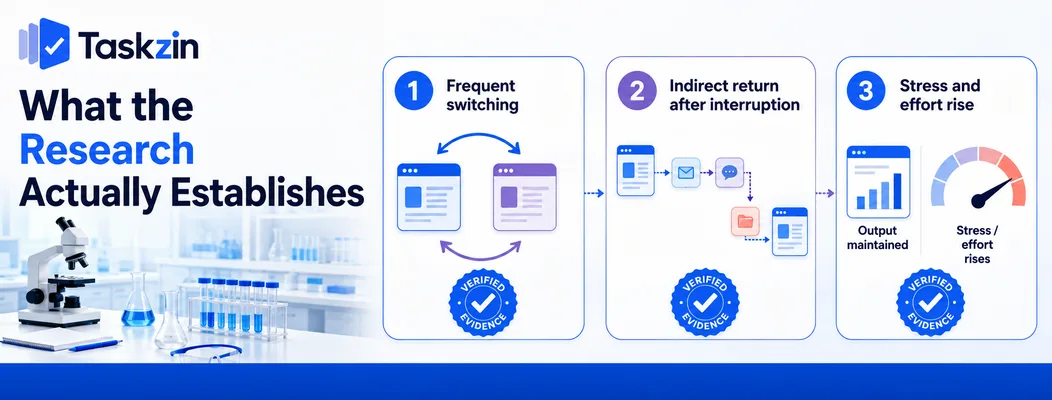
The best-supported findings concern switching frequency, what happens after an interruption, and the effect on stress rather than raw output.
How often people switch
Research by Gloria Mark and colleagues at UC Irvine tracked knowledge workers switching tasks every three minutes on average, spending roughly 11 to 12 minutes in a working sphere before switching or being interrupted.
Application-level data points the same way. A 2022 study published by Harvard Business Review found that the average digital worker toggles between applications and websites nearly 1,200 times per day. Microsoft researchers similarly found that the typical knowledge worker spends less than three minutes on a digital screen before switching to something else.
These figures are consistent across independent methods, which is what gives them weight.
What happens after an interruption
The most cited figure in this field is the average time before someone returns to an interrupted task. Mark's research found it takes an average of 23 minutes and 15 seconds to fully return to the original task — but the number is often misunderstood, because workers rarely return to the original task directly, switching to an average of 2.26 other tasks first.
That distinction is the single most important correction in this whole subject, and the next section covers why.
The stress finding people forget
The same body of work found something less quoted and arguably more useful. Interruptions made people work faster but with more stress, frustration, time pressure and effort.
In other words, the immediate cost may not appear as reduced output at all. People compensate — and the compensation shows up as strain rather than as a visible productivity dip, which is precisely why organisations underestimate it.
The Key Studies at a Glance
Source Finding Strength Mark et al., UC Irvine Task switching roughly every 3 minutes Strong — observational studies Mark et al., "The Cost of Interrupted Work" ~23 min elapsed before returning to an interrupted task Strong, but widely misread Same study Interruptions raise stress, frustration and effort Strong Harvard Business Review, 2022 ~1,200 application toggles per day Strong Microsoft workplace research Under 3 minutes per screen before switching Strong
Attention residue
Attention persists on the previous task Strong "$450 billion annual cost" Circulated widely Weak — no traceable primary source "40% productivity loss" Circulated widely Weak — attribution inconsistent
Widely Quoted Numbers That Do Not Hold Up
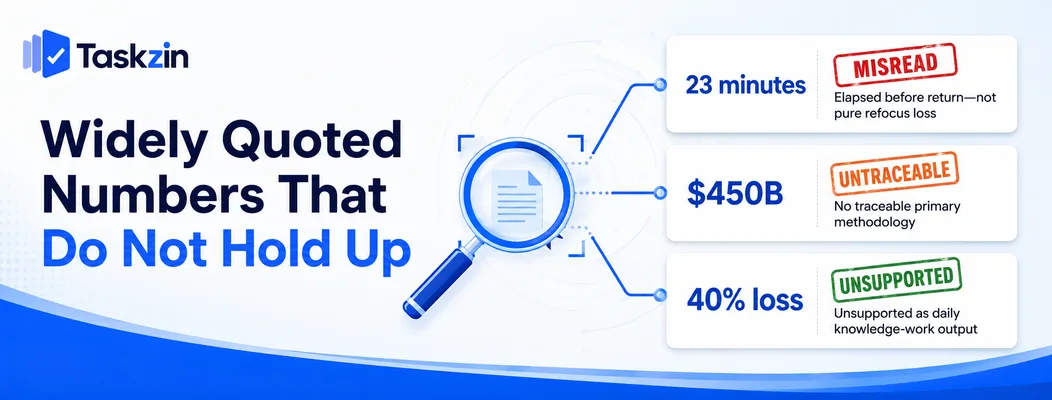
Three figures dominate online discussion of context switching, and all three are either misread or untraceable.
The 23-minute refocus penalty, misread
The finding is that roughly 23 minutes elapse before a person returns to the interrupted task. It is repeatedly reported as though every interruption costs 23 minutes of lost focus.
The widely cited 23 minutes and 15 seconds figure is the average elapsed time before people return to an interrupted task; it is not a pure refocus penalty that applies to every distraction.
During most of that time the person is doing other real work. Multiplying 23 minutes by daily interruption count produces figures exceeding the working day, which should have been the clue.
The $450 billion figure
This number appears across dozens of articles. Tracing it back, it is presented as an extrapolation rather than a measurement — described by one source as extrapolated from Mark's UC Irvine research and Microsoft's workforce studies, with no published methodology behind the arithmetic.
An extrapolation is not a finding. Treat it as an illustration at best.
The "40 percent productivity loss" claim
Sometimes attributed to the American Psychological Association, sometimes to unnamed 2025 research, and stated with varying scope — sometimes as multitasking cost, sometimes as total daily productivity.
The underlying laboratory research on task-switching costs is real, but it measures switching penalties on controlled tasks in seconds, not a 40 percent reduction in a knowledge worker's daily output. The leap between the two is not supported.
Why Context Switching Costs More Than the Clock Suggests
The measurable time is only part of it: switching also forces you to reload working memory, leaves attention residue on the previous task, and penalises complex work disproportionately.
Reloading working memory
Resuming a task means rebuilding the mental model you had constructed. For simple work that is trivial. For work holding several interacting elements in mind, it is substantial.
This is why the cost cannot be expressed as a fixed number of minutes. It scales with how much context the task required.
Attention residue Sophie Leroy's research describes attention residue: when you switch tasks, part of your attention remains on the previous one, particularly when it was left incomplete.
The practical implication is that the cost is not only at the moment of switching. Performance on the new task is degraded while the residue persists, which the stopwatch does not capture.
Compounding for complex work
Developers pay a steeper price not because they switch more often, but because each interruption breaks a complex mental representation of the system.
The same logic applies to any work requiring an assembled mental model — analysis, writing, design. The switching frequency may be identical to a colleague's; the cost is not.
Measuring the Cost in Your Own Team
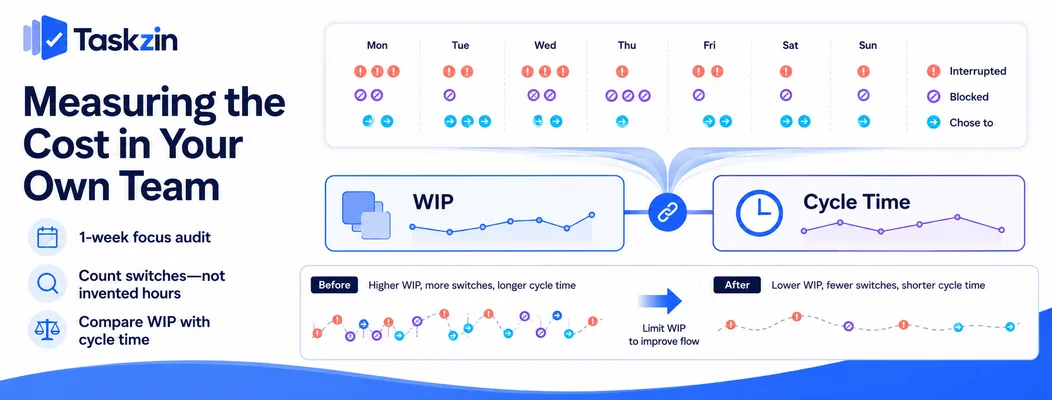
Rather than importing a statistic, measure your own switching directly: count switches for a week, look at how many things people have open, and compare against cycle time.
Run a one-week focus audit
Ask everyone to note, for one week, each time they switch tasks and roughly why — interrupted, blocked, chose to.
Rough data is sufficient. What you are looking for is the pattern: how many switches are externally imposed, how many are self-initiated, and which sources dominate. That answer is specific to your team and is more actionable than any published average.
Count switches, not hours lost
Resist converting switches into hours using a published multiplier. That is exactly the arithmetic that produced the unreliable figures above.
Count switches per person per day, and track whether it falls when you change something. A relative measure you trust beats an absolute one you invented.
Compare against cycle time
Switching shows up in delivery data. Teams with high work in progress have longer cycle times, and high WIP is the structural cause of most switching.
If your tool reports cycle time and open items per person — Taskzin's board and dashboard views do — you can watch both move together when you limit WIP, which is stronger evidence than any survey.
What Actually Reduces Switching
The three interventions with the clearest effect are limiting work in progress, batching interruptions instead of trying to eliminate them, and reducing the number of places work lives.
Reduce work in progress
Someone with seven open items switches because they have seven things to switch between.
WIP limits address the cause rather than the symptom.
This is the highest-return change available and requires no new tooling — only the discipline to finish before starting.
Batch interruptions rather than eliminating them
Attempting to remove all interruptions fails, because much of the work genuinely requires responsiveness.
Batching works better: agreed focus blocks, a rota where one person handles interrupts while others stay heads-down, and response-time expectations that do not require instant replies.
Cut the number of places work lives
In one survey, 45 percent of workers said toggling between too many apps makes them less productive, and 43 percent reported it is mentally exhausting.
Consolidating where work is tracked reduces the toggling that generates a large share of switches. This is one of the few cases where a tooling decision genuinely addresses the underlying problem rather than relabelling it.
Frequently asked
What is the real cost of context switching?
The research reliably shows frequent switching, indirect return to interrupted tasks, and increased stress. Precise economic figures circulating online are extrapolations rather than measurements, so measure your own team rather than importing a number.
Does it really take 23 minutes to refocus?
Not as usually stated. The finding is that around 23 minutes elapse before returning to the interrupted task, during which people do other real work. It is not a pure refocus penalty applied to every interruption.
How often do knowledge workers switch tasks?
Observational research puts task switching at roughly every three minutes, with around 11 to 12 minutes spent in a working sphere before switching, and application-level studies find close to 1,200 toggles a day.
Is context switching worse for developers?
The evidence suggests the cost is higher for work requiring a complex mental model, because each interruption breaks a larger assembled context. That includes development, analysis, design and long-form writing.
How do you measure context switching on a team?
Run a one-week audit counting switches and their causes, then track work in progress and cycle time. Relative movement in your own numbers is more reliable than published averages.
What is attention residue?
The finding that part of your attention remains on a previous task after switching, particularly if it was left incomplete, degrading performance on the new task until the residue fades.
What reduces context switching most effectively?
Limiting work in progress, since fewer open items means fewer things to switch between. Batching interruptions and consolidating where work is tracked also help materially.
Sanju Shrestha is a SaaS content writer at Taskzin who explores smarter ways to manage work, organize priorities, and improve team performance. Her content covers productivity strategies, digital workflows, collaboration, and task management, with a focus on helping modern teams work more efficiently and stay aligned.
All posts by Sanju Shrestha

Comments