Project Management Trends Worth Paying Attention To
An evidence-filtered look at project management trends, covering how to tell a real shift from marketing, the structural and practice changes worth planning for, what AI has genuinely delivered, and which trends can safely be ignored.

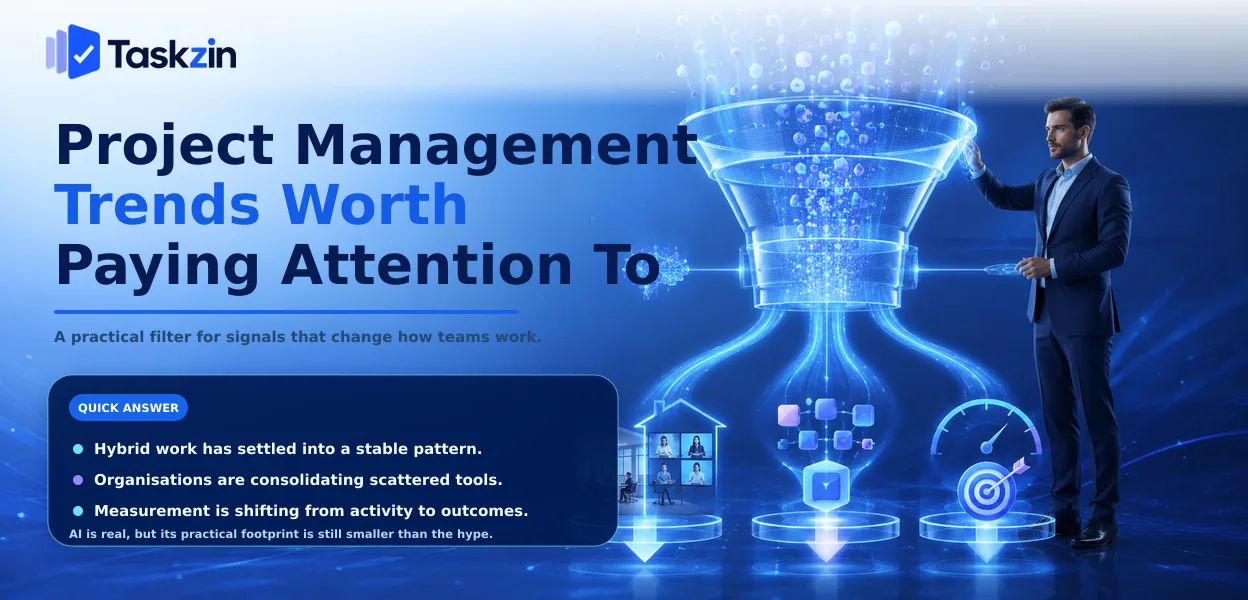
Trends lists are unusually low-value in this field because most repeat the same predictions annually. The useful filter is whether a trend has a mechanism — something specific that changes what a team does on a Tuesday.
This guide applies that filter, covers what has genuinely shifted, and names what can safely be ignored.
Quick answer: The trends that will actually affect how you work are structural rather than technological: hybrid working has settled into a stable pattern, organisations are consolidating tools after years of sprawl, and measurement is shifting from activity to outcomes. AI is real but its practical footprint is currently smaller than the announcements suggest.
How to Read a Trends List
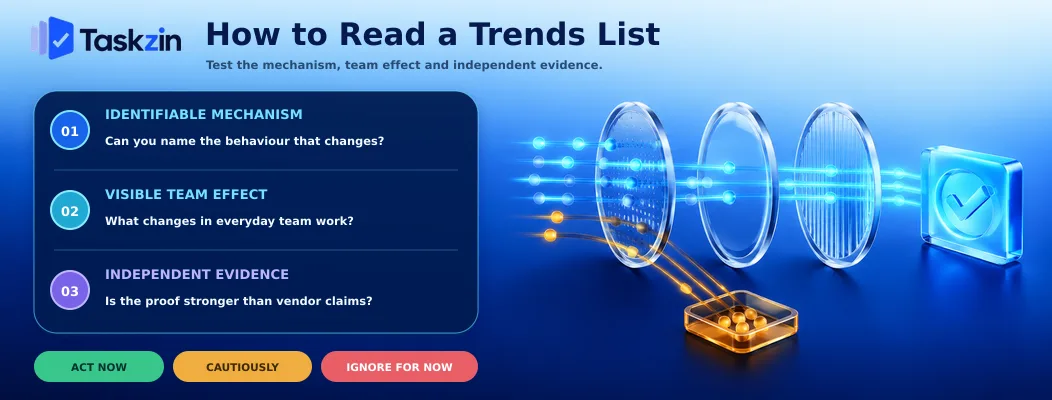
A trend is worth attention when it has an identifiable mechanism, a visible effect on how teams work, and evidence beyond vendor claims.
Separating shifts from marketing
Many announced trends originate with vendors describing a category they sell into. That does not make them false, but it means the evidence deserves checking.
The test: can you name a specific behaviour that changes, and is there evidence from somewhere with no commercial interest in the answer?
What makes a trend actionable
An actionable trend implies a decision. Hybrid working settling at roughly two office days implies decisions about meeting scheduling, documentation and onboarding.
"AI will transform project management" implies nothing. It cannot be acted on because it does not say what to do differently.
Trends that keep being announced
Some items appear on these lists every year without ever arriving. Perennial candidates include the imminent disappearance of the project manager role, universal adoption of a particular framework, and the year that everything becomes fully autonomous.
Repeated annual prediction without arrival is itself evidence.
The Trends and What They Actually Mean
Trend Evidence quality What it changes Act now?
Hybrid working has settled, not reversed
stabilised Strong (Gallup, Stanford) Meeting design, documentation, onboarding Yes
Tool consolidation after years of sprawl
Fewer subscriptions, one source of truth Yes
Outcome measurement replacing activity measurement
measurement Moderate What you report and reward Yes
Flow metrics over velocity
velocity Moderate How teams forecast Yes
Meeting load reduction Moderate Calendar policy Yes
Hybrid delivery approaches becoming normal
approaches Strong Methodology choice per team Yes AI for administrative work Moderate Summaries, task extraction Cautiously AI for forecasting and decisions Weak Little, currently No Autonomous project management Very weak Nothing No
Structural Shifts Worth Planning For
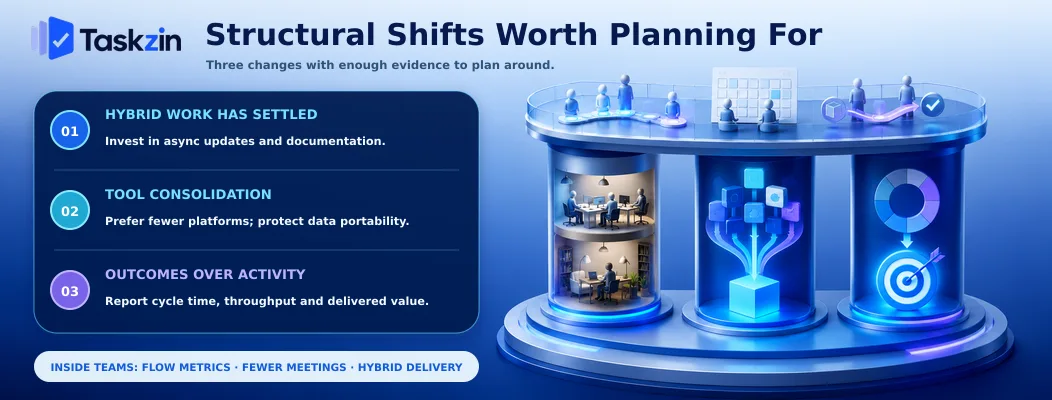
Three structural changes have enough evidence behind them to plan around: hybrid working has settled, tool sprawl is reversing, and measurement is shifting toward outcomes.
What has not
Despite prominent return-to-office announcements, the aggregate data shows stability rather than reversal. Around half of remote-capable employees work hybrid, roughly a quarter fully remote, and the global average of working-from-home days has been broadly flat for two years.
The implication for project work is that distributed coordination is the permanent default, not a transitional state. That justifies investing properly in written status, asynchronous updates and documentation, rather than treating them as temporary accommodations.
Tool consolidation after years of sprawl After a decade of adopting specialised tools, organisations are reducing count — driven by cost scrutiny, integration overhead, and the recognition that data spread across six systems produces no reliable picture.
The practical effect is a preference for platforms covering several needs adequately over best-in-class tools requiring integration. It also raises the value of data portability: check that you can export before committing, since consolidation cycles reverse periodically.
Outcome measurement replacing activity measurement Hours logged, tasks closed and utilisation are being displaced by cycle time, throughput and delivered outcomes.
This is partly a consequence of distributed work — presence stopped being observable, so organisations had to measure something else. The shift is uneven and contested, but the direction is consistent and it changes what teams are asked to report.
Practice Shifts Inside Teams
Within teams, three practice changes are visible: flow metrics displacing velocity, deliberate reduction of meeting load, and hybrid delivery approaches becoming normal rather than embarrassing.
Flow metrics over velocity Teams are moving toward cycle time, throughput and work in progress, which require no estimation and cannot be inflated by adjusting estimates.
The driver is credibility. Velocity was too easily corrupted by being used as a target, and flow metrics measure elapsed reality instead. Tools increasingly report these natively — Taskzin's dashboards include cycle time and throughput — which removes the manual calculation that previously made them impractical.
Fewer, better meetings
Meeting load is now widely recognised as a delivery constraint rather than an inevitability, with organisations trialling no-meeting blocks, default-shorter durations and written updates replacing status meetings.
Evidence on interruption frequency supports the concern: telemetry studies find knowledge workers interrupted by a meeting, message or notification every few minutes, which makes sustained focus structurally difficult.
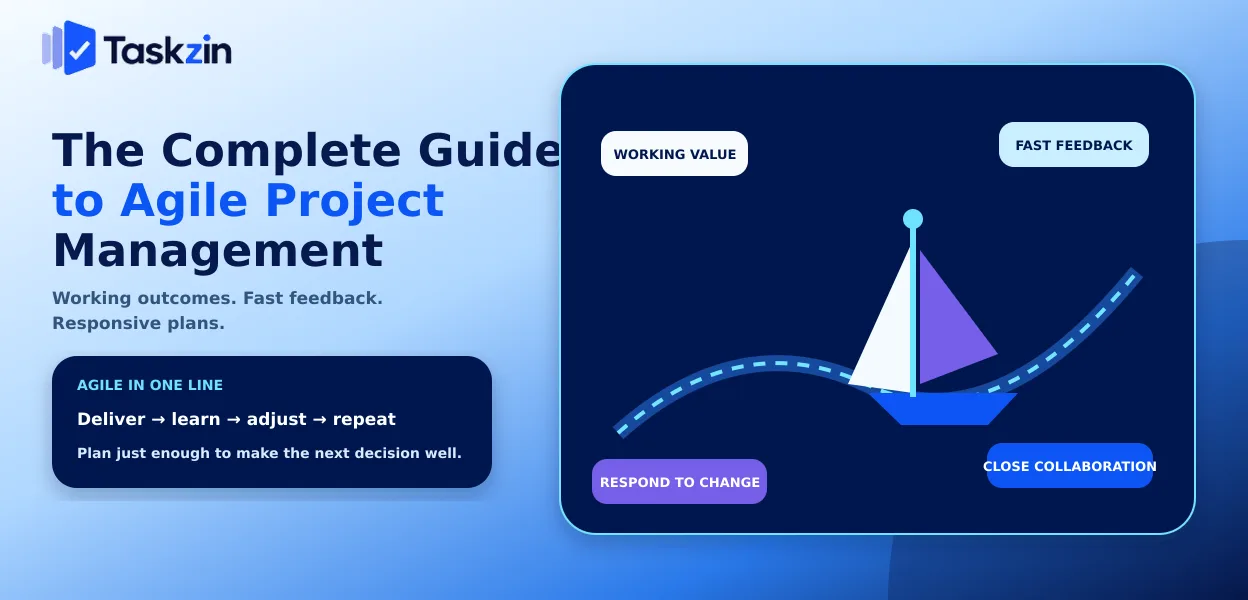
Hybrid delivery approaches becoming normal The methodology debate has largely settled into pragmatism. Teams use waterfall where constraints are fixed, agile where uncertainty is high, and a deliberate blend where both apply.
The change is that admitting to a hybrid approach is no longer treated as a failure of commitment, which allows organisations to design the seam properly rather than pretending it does not exist.
AI: Separating the Real From the Announced
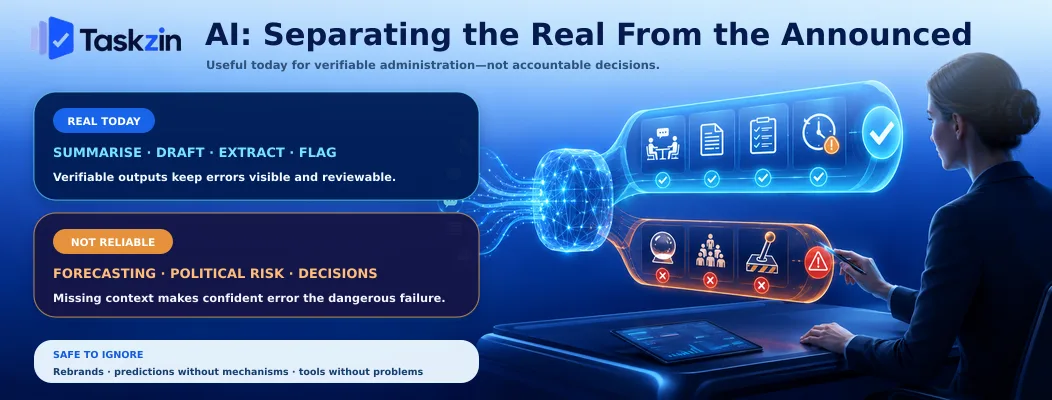
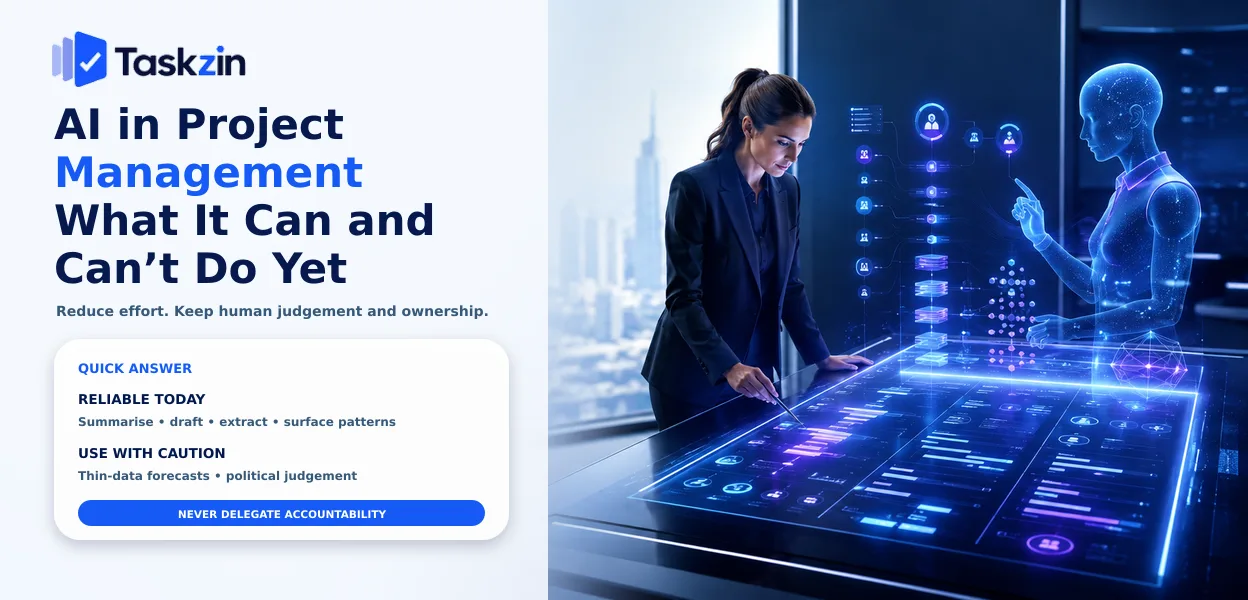
AI's genuine footprint in project management today is administrative — summarising, drafting and extracting — while forecasting and decision support remain unreliable.
What has actually landed
Meeting transcription turned into tasks. Status summaries generated from project data.
Extraction of action items from unstructured text. Flagging of stalled or ageing work.
These share a property: the output is immediately verifiable, so errors are visible and the failure mode is acceptable. That is why they work.
What has not
Reliable date forecasting on projects without substantial history. Assessment of stakeholder or political risk. Anything requiring accountability for a decision.
These fail for structural reasons rather than because the technology is immature — the information required is not in the project data, and responsibility cannot be delegated to a system.
How to evaluate the next wave
Ask what data the feature uses, test it on a project you know well, and check whether it is confident when wrong. Confident error is the dangerous failure mode.
Measure time saved including review time. A feature saving fifteen minutes weekly is worthwhile; describing that as transformation is where the credibility gap comes from.
Trends You Can Safely Ignore
Ignore anything requiring you to rebrand your process, predictions with no stated mechanism, and tool categories that arrive without a problem attached.
Anything requiring a rebrand of your process
Periodically a new name appears for practices teams already follow. Adopting the vocabulary changes nothing except how you describe yourself.
If the substance is what you already do, the trend is a naming exercise.
Predictions with no mechanism
"The project manager role will disappear within five years" has been predicted repeatedly for two decades. It specifies no mechanism, so it cannot be evaluated or acted on.
Ask what would have to become true. If nobody can answer, the prediction is decorative.
Tool categories with no problem attached
New categories appear regularly, described by capability rather than by the problem they solve.
The question is always what specific failure in your current process it addresses. If you cannot name one, the answer is not yet.
Frequently asked
What are the main project management trends right now?
Hybrid working settling into a stable pattern, tool consolidation after years of sprawl, measurement shifting from activity to outcomes, flow metrics replacing velocity, and AI adopted for administrative rather than decision-making work.
Is agile still growing?
Adoption is broad and the debate has largely moved on to pragmatic blending. The notable shift is that hybrid approaches — traditional planning for fixed constraints, iterative delivery for uncertain work — are now openly acknowledged rather than treated as a compromise.
Are companies consolidating project tools?
Yes, driven by cost scrutiny, integration overhead and the recognition that data across many systems produces no reliable picture. This favours platforms covering several needs over best-in-class tools requiring integration.
How is AI changing project management?
Currently through administrative reduction: summarising meetings into tasks, drafting status updates from real data, extracting action items and flagging stalled work. Forecasting and decision support remain unreliable.
Is remote work still shaping how projects run?
Yes. Aggregate data shows hybrid work has stabilised rather than reversed, which makes distributed coordination the permanent default and justifies real investment in written status and documentation.
What project management trends are overhyped?
Autonomous project management, the imminent disappearance of the project manager role, and any trend that amounts to renaming practices teams already follow.
How should teams decide which trends to act on?
Ask whether the trend has an identifiable mechanism that changes a specific behaviour, and whether evidence exists from a source with no commercial interest in the answer.
Binita Ray is a content writer at Taskzin, creating insightful and practical content on task management, team collaboration, productivity, workflow optimization, and SaaS solutions. She focuses on helping businesses, teams, and professionals simplify their work processes, improve efficiency, and make better use of modern productivity tools.
All posts by Binita Ray
Comments