The Complete Guide to Scrum
A comprehensive guide to Scrum, covering what the framework is and deliberately leaves out, its roles, events and artefacts, how a sprint runs from planning to retrospective, the practices that make it work, and common failures.

That incompleteness is the most misunderstood aspect. Teams expecting Scrum to tell them how to build things find it silent on the question, and organisations expecting it to guarantee predictability find that it only makes reality visible sooner.
This guide covers what Scrum is, its structure, how a sprint runs, and where implementations typically fail.
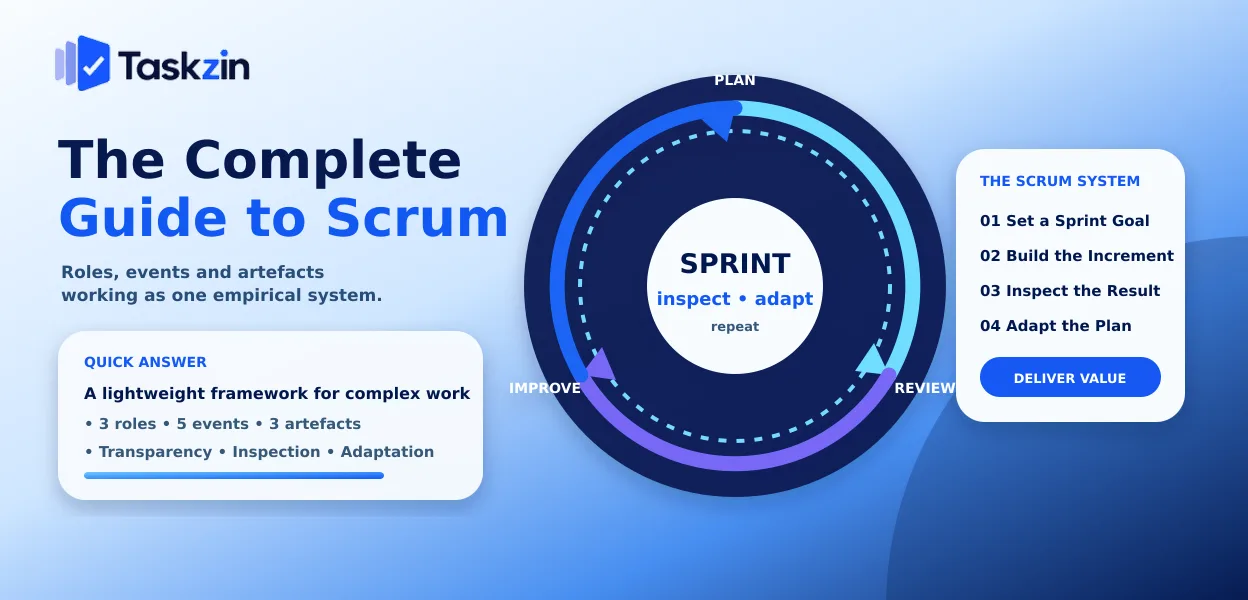
Quick answer: Scrum is a lightweight framework built on three roles, five events and three artefacts, in which a team delivers a usable increment of work in a fixed-length sprint and inspects both the product and its own process at the end. It is deliberately incomplete — it tells you when to inspect and adapt, not how to do the work.
What Scrum Is
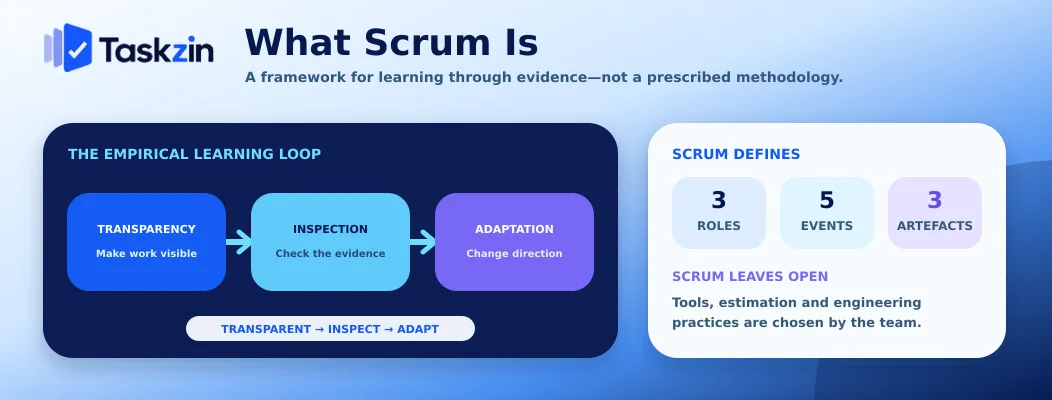
Scrum provides a structure for inspecting and adapting at regular intervals, and leaves the actual working practices to the team.
A framework, not a methodology
A methodology tells you how to do the work. Scrum does not — it defines when you plan, when you inspect, who is accountable for what, and leaves everything else open.
This is why two Scrum teams can look completely different. The framework is a container, and the practices inside it are chosen by the team. Teams wanting prescribed engineering practices need something like Extreme Programming alongside it.
The empirical foundation
Scrum rests on three pillars: transparency, inspection and adaptation. Make the work visible, examine it regularly, and change based on what you see.
All three are required. Transparency without adaptation produces visible dysfunction that persists. Adaptation without transparency produces changes based on assumption.
What Scrum deliberately leaves out
No technical practices, no estimation method, no tooling requirement, no guidance on architecture or design.
The omissions are intentional, but they mean Scrum alone is insufficient. A team adopting Scrum without also improving how it works will inspect the same problems repeatedly and adapt slowly, because it lacks the practices that would let it change.
The Three Roles, Five Events and Three Artefacts
Element Name Purpose Role Product owner Maximises value; owns and
Product backlog and the product goal
The scrum master as administrator
Accountable for team effectiveness and the process Role Developers Decide how to build; own the
Sprint backlog and the sprint goal
The sprint itself
A fixed-length container, one to four weeks Event Sprint planning Agrees the sprint goal and sprint backlog Event Daily scrum 15-minute daily coordination Event Sprint review Inspects the increment with stakeholders Event Sprint retrospective Inspects the process, team only Artefact Product backlog Ordered list of everything that might be done
Can the sprint backlog change mid-sprint?
Selected items plus the plan for delivering them Artefact Increment The sum of completed work, in a usable state
How a Sprint Actually Runs
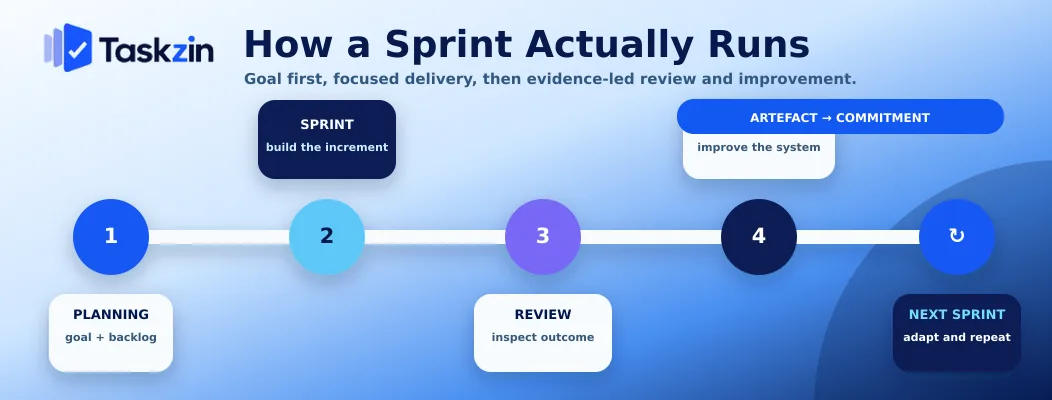
A sprint opens with planning that agrees a goal before selecting work, proceeds with daily coordination, and closes with a review of the product followed by a retrospective on the process.
Planning: goal then backlog
The product owner proposes what the sprint should achieve. The team assesses whether it is realistic given capacity, then pulls items until capacity is reached.
Setting the goal first shapes the selection. Without it, the team takes the top items by priority and ends up with unrelated work that cannot be traded off when disruption arrives.
Planning should take under two hours for a two-week sprint. If it runs longer, the backlog was not refined beforehand.
The sprint itself Work proceeds, with the daily scrum providing a fifteen-minute coordination point. The sprint backlog is the team's own — they adjust it as they learn, provided the sprint goal remains intact.
Scope may be renegotiated with the product owner as understanding grows. What does not change is the sprint length or the goal.
Review then retrospective
The review demonstrates the increment to stakeholders and updates the product backlog based on their response. The retrospective examines how the team worked and commits to one or two changes.
The order matters: what happens in the review is useful input to the retrospective. Running them in the reverse order means discussing the sprint without knowing how the work landed.
The Artefacts and Their Commitments
Each artefact has an associated commitment: the product backlog has the product goal, the sprint backlog has the sprint goal, and the increment has the definition of done.
Product backlog and the product goal The backlog is the single ordered source of work. The product goal describes the longer-term objective the backlog is working toward.
Without a product goal, a backlog becomes a list of requests with no coherent direction, and prioritisation degrades into responding to whoever asked most recently.
Sprint backlog and the sprint goal The sprint backlog is the selected items plus the plan. The sprint goal is the one sentence describing what the sprint should achieve.
The goal is what gives the team autonomy mid-sprint. When something slips, they can decide what to drop without escalating, because the goal tells them what matters.
Increment and the definition of done
The increment is everything completed, in a usable state. The definition of done is the shared standard determining whether an item counts.
An item not meeting the definition is not part of the increment, regardless of how nearly finished it is. Holding this line under deadline pressure is what separates teams whose "done" means something from teams accumulating invisible debt.
Making Scrum Work in Practice
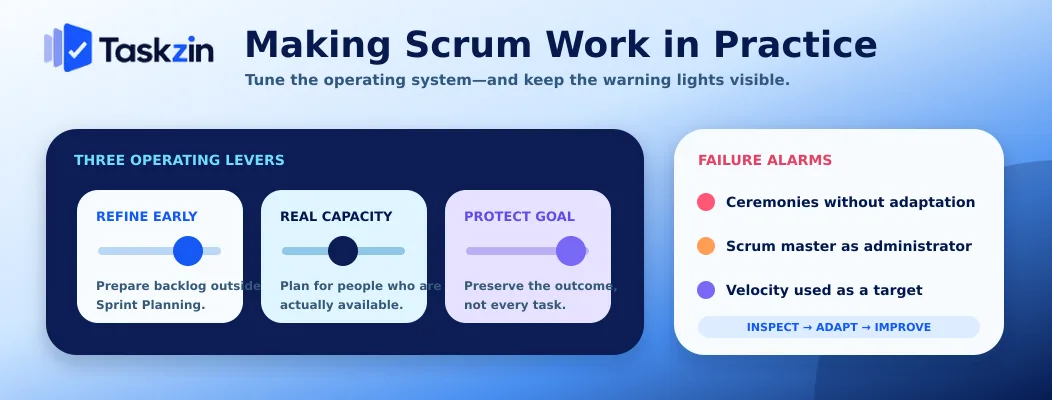
Three practical habits determine whether Scrum delivers: refining outside planning, planning against measured capacity, and protecting the goal rather than the task list.
Refine outside planning
Hold a separate refinement session mid-sprint where upcoming items are clarified, sized and split.
This single change is usually the difference between a three-hour planning meeting and a one-hour one. Planning becomes selection from ready items rather than discovery.
Plan against real capacity
Count available days, subtract leave and known commitments, then apply a focus factor — commonly 60 to 75 percent of nominal time.
Teams that plan against headcount rather than capacity overcommit every sprint and misread the resulting carryover as a delivery problem. Tools that show sprint capacity alongside velocity history — Taskzin's sprint view includes both — make this arithmetic visible rather than optional.
Protect the sprint goal, not the task list
When something goes wrong mid-sprint, the team drops whatever least threatens the goal.
Teams without a goal drop whatever is easiest, which is rarely the right choice and usually requires escalation. The goal is the mechanism that lets the team decide.
Where Scrum Goes Wrong
The three most common failures are performing the ceremonies without adapting, treating the scrum master as an administrator, and using velocity as a target.
Ceremonies without adaptation
A team holding all five events while nothing changes has the overhead of Scrum and none of the benefit.
The test is simple: in the last three sprints, what changed as a result of a retrospective, and what changed in the backlog as a result of a review? If the answer is nothing, the events are theatre.
The scrum master as administrator A scrum master booking meetings, updating the board and chasing status is doing secretarial work, and a team needing that is not self-managing.
The role is about removing impediments and improving how the team works, which requires influence and uncomfortable conversations rather than administration.
Velocity used as a target
The moment velocity becomes something to increase, estimates inflate and the number stops describing anything.
Velocity is a forecasting aid for one team over time. Used for evaluation or comparison, it corrupts within a couple of sprints and takes the team's honesty about estimates with it.
Frequently asked
What is Scrum?
A lightweight framework with three roles, five events and three artefacts, in which teams deliver a usable increment in fixed-length sprints and inspect both the product and their process at the end of each one.
What are the three roles in Scrum?
The product owner, who owns and orders the backlog; the scrum master, accountable for team effectiveness and process; and the developers, who decide how the work is done and own quality.
How long should a sprint be?
One to four weeks, with two weeks most common. Shorter sprints give faster feedback; longer ones reduce ceremony overhead but delay learning. The length should stay consistent.
What are the five Scrum events?
The sprint itself, sprint planning, the daily scrum, the sprint review and the sprint retrospective. Each has a defined purpose and a maximum duration.
Can the sprint backlog change mid-sprint?
Yes — the team adjusts it as they learn, and scope can be renegotiated with the product owner. What does not change is the sprint length or the sprint goal.
Does Scrum work for non-software teams?
It can, though some elements fit awkwardly. Marketing and operations teams often find Kanban a better fit because their work is more interrupt-driven and less suited to a fixed sprint commitment.
What is the difference between Scrum and agile?
Agile is the set of values and principles. Scrum is one framework implementing them. You can be agile without Scrum, and it is entirely possible to run Scrum without being agile.
Sujan Sharma is a content writer at Taskzin with a strong focus on productivity systems, task management, workflow optimization, team collaboration, and SaaS technology. He creates research-driven, practical content that helps professionals and growing teams improve operational efficiency, streamline processes, and make informed decisions about modern work management tools.
All posts by Sujan Sharma

Comments