The Complete Guide to Agile Project Management
A comprehensive guide to agile project management, covering the underlying values, how Scrum, Kanban, XP and scaling frameworks differ, how delivery works in practice, honest adoption, useful metrics, and where agile genuinely does not fit.

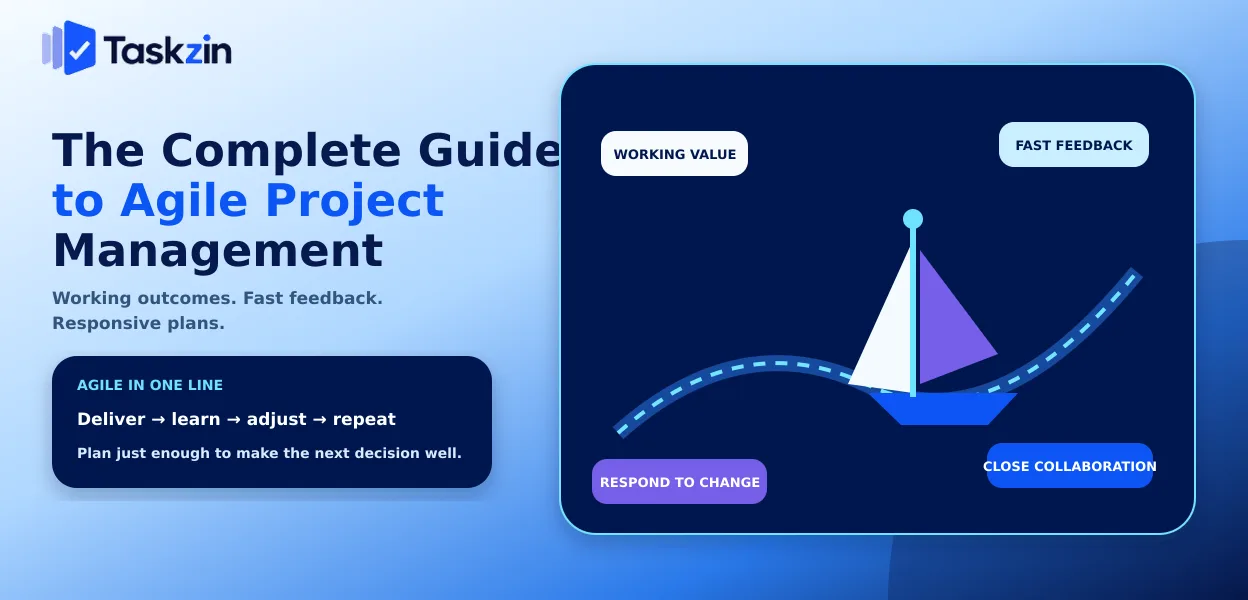
Most agile failures are not failures of the approach. They are organisations adopting the ceremonies without the underlying commitment, which produces the overhead of agile with none of the adaptability.
This guide covers what agile actually is, how the frameworks differ, how delivery works in practice, how to adopt it honestly, and where it genuinely does not fit.
Quick answer: Agile project management delivers work in short iterations with frequent feedback, adapting plans as understanding improves rather than following a fixed long-range schedule. It is a set of values and principles, not a specific process — Scrum, Kanban and XP are frameworks that implement those values differently. The core commitment is that plans should change when evidence changes.
What Agile Actually Is
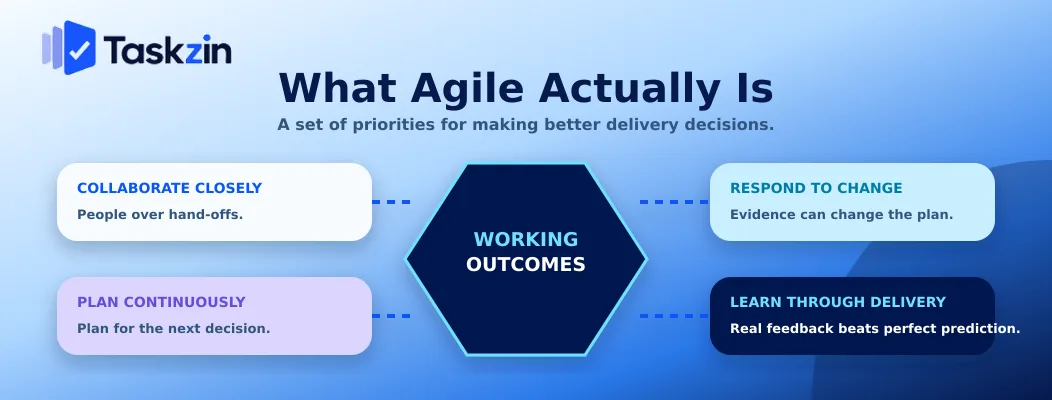
Agile prioritises working outcomes, close collaboration with those who need the work, and responsiveness to change over comprehensive documentation and fixed plans.
The four values in plain terms
The original values favour individuals and interactions over processes and tools; working software over comprehensive documentation; customer collaboration over contract negotiation; and responding to change over following a plan.
The crucial phrasing is "over" rather than "instead of". Documentation, process and plans still exist. The statement is about what wins when they conflict, which is a far more modest and more workable claim than it is often presented as.
What agile is not
It is not the absence of planning — agile teams plan continuously rather than once. It is not a licence to change requirements without consequence. It is not synonymous with Scrum, and it is not a set of meetings.
Teams that adopt the meetings without changing how decisions are made end up with more overhead than they had before, which is why "we tried agile and it didn't work" is usually accurate about what they tried.
Why it emerged
It emerged from repeated observation that large up-front specifications for software were frequently wrong, and that the wrongness was only discovered at the end when correction was most expensive.
The response was to shorten the loop: build a small piece, show it to someone who will use it, learn, adjust. Everything else in agile follows from that single move.
The Agile Frameworks Compared
Framework Structure Cadence Best for Main risk Scrum Roles, events, artefacts Fixed sprints Teams needing rhythm and predictability Ceremony without substance Kanban Visualise, limit WIP, manage
Iterations and continuous flow
Continuous Interrupt-driven work Board without WIP limits Extreme Programming Engineering practices Continuous Teams improving code quality Practices need discipline Scrumban Scrum structure, Kanban flow Flexible Teams outgrowing strict sprints Ambiguity about which rules apply SAFe Programme layer above teams Quarterly increments Many teams, one product Heavy at small scale LeSS Minimal scaling of Scrum Fixed sprints Scaling with least addition Requires real organisational change
How Agile Delivery Works in Practice
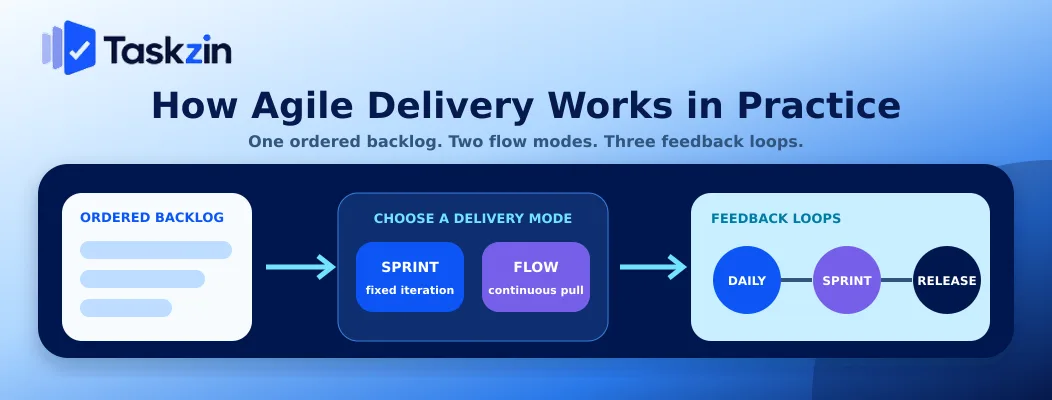
Delivery runs from a single ordered backlog, through either fixed iterations or continuous flow, with feedback loops operating at the daily, iteration and release level.
The backlog as the single ordered list
Everything the team might do sits in one list, ordered by priority, owned by one person.
The ordering is the mechanism. Because there is no tie for first place, prioritisation happens explicitly rather than being deferred through priority labels. Items near the top are refined and ready; items further down are deliberately vague.
Iterations and continuous flow Scrum-style teams pull a batch of work into a fixed-length sprint and commit to a goal.
Kanban-style teams pull items one at a time as capacity frees up, with WIP limits controlling load.
Neither is superior. Sprints suit predictable work and stakeholders who need a rhythm; continuous flow suits high-interrupt environments where a two-week commitment is unrealistic.
A team abandoning its sprint commitment most sprints should be running flow.
Modern tools support both over the same data — Taskzin's board and sprint views operate on one dataset — which means the choice is a process decision rather than a tooling migration.
Feedback loops at three levels
Daily: the standup surfaces blockers within a day rather than a week. Iteration: the review puts working output in front of stakeholders. Process: the retrospective changes how the team works.
If any of the three is skipped, adaptation slows at that level. Teams that hold reviews but skip retrospectives adapt the product and never the process, which is why the same friction persists for years.
Adopting Agile Without the Theatre
Adopt agile by identifying a specific problem, introducing one practice that addresses it, and confirming the practice actually changes what it was meant to.
Start from a problem, not a framework
"We should be agile" is not a reason. "We find out too late that we built the wrong thing" is, and it points at shorter feedback loops.
Naming the problem determines which practices matter. A team with a discovery problem needs reviews and stakeholder contact; a team with a coordination problem needs visible work and WIP limits. Adopting the full framework regardless of the problem is how ceremonies become theatre.
Add one practice at a time
Introduce a practice, run it for a month, and assess whether the problem improved.
Adopting eight practices simultaneously means you cannot tell which helped, and the aggregate overhead arrives before any of the benefit. Sequential adoption is slower to describe and faster in effect.
Change what the practices are meant to change
A retrospective that produces no change is not a retrospective. A review with no stakeholders is a demo. A backlog nobody reorders is a list.
The test for every practice is whether the thing it exists to change actually changes. If not, either fix the practice or stop performing it — continuing produces cost without benefit and teaches the team that process is decoration.
Measuring Whether It Is Working
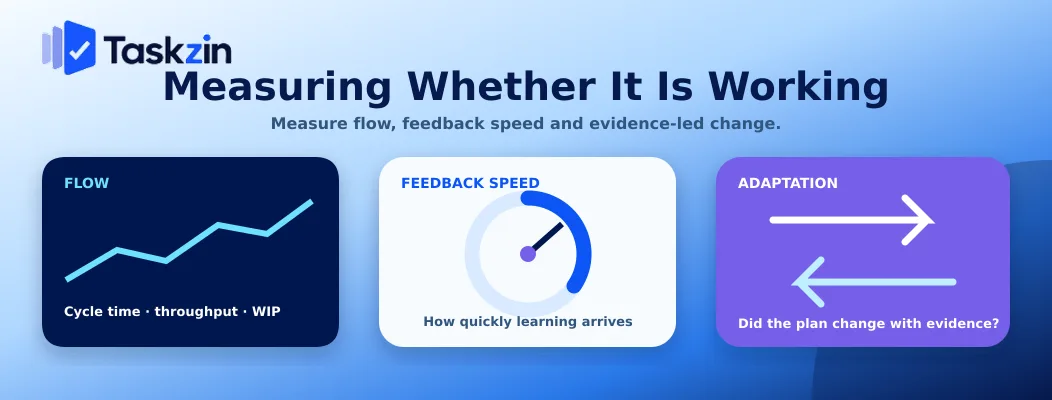
Measure flow rather than activity, how quickly feedback arrives, and whether plans actually change when evidence contradicts them.
Flow metrics over activity metrics
Cycle time, throughput, work in progress and carryover describe delivery. Velocity is a forecasting aid, not a performance measure. Hours and activity measure neither.
Flow metrics have the advantage of being difficult to game, because they measure elapsed reality rather than estimated intent.
Feedback speed
How long between building something and someone who will use it responding to it?
This is the metric closest to agile's actual purpose. A team running perfect ceremonies with a six-month gap between build and feedback has not shortened the loop that agile exists to shorten.
Whether plans change when evidence does
The clearest indicator of genuine agility: when the team learns something that contradicts the plan, does the plan change?
Organisations where the quarterly roadmap is fixed regardless of what the last quarter revealed are not agile, whatever their ceremonies look like.
Where Agile Struggles
Agile fits poorly with fixed-scope fixed-price contracts, work dominated by long lead-time physical dependencies, and organisations that cannot actually change direction.
Fixed-scope contracts
If the contract specifies exactly what will be delivered for a fixed price, adapting scope in response to learning is a contractual variation rather than a normal event.
Agile can still help within the fixed scope — iterative delivery, early feedback on quality — but the central benefit is constrained by the commercial arrangement.
Long lead-time dependencies
Where a decision commits you to a twelve-week manufacturing lead time or a fixed regulatory submission, the option to change direction cheaply does not exist.
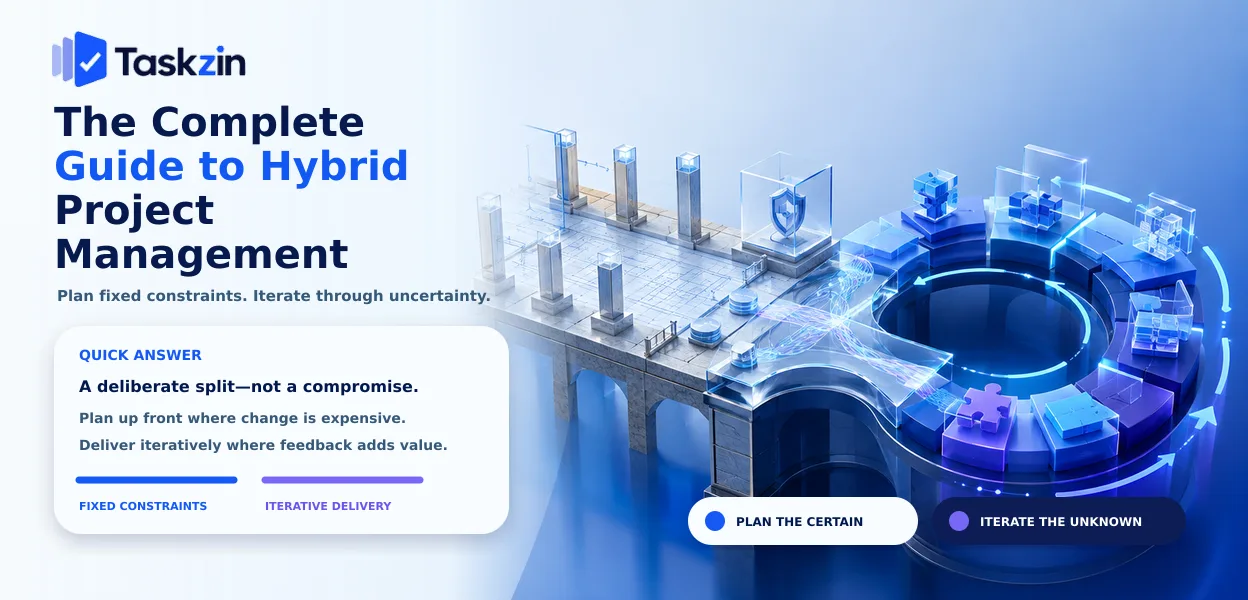
Hybrid approaches usually fit better: plan the constrained elements traditionally and run the adaptable elements iteratively.
Organisations that cannot change direction
Agile assumes someone can decide to do something different next month. If priorities are fixed annually by a committee that meets twice a year, the team's ability to adapt is theoretical.
This is the most common structural blocker, and no amount of team-level practice overcomes it.
It requires a change above the team, which is why agile adoptions confined to delivery teams frequently stall.
Frequently asked
What is agile project management?
An approach delivering work in short iterations with frequent feedback, adapting plans as understanding improves rather than following a fixed long-range schedule. It is a set of values implemented differently by various frameworks.
What is the difference between agile and Scrum?
Agile is the set of values and principles. Scrum is one specific framework implementing them, with defined roles, events and artefacts. Kanban and XP are alternative implementations.
Is agile only for software teams?
No. Marketing, operations, HR and product teams all use iterative delivery successfully. Some practices — story points, sprints — fit software better, but short feedback loops and visible work are general.
Does agile mean no planning?
No. Agile teams plan continuously rather than once at the start. The difference is that plans are expected to change as evidence arrives, not that plans are absent.
How long does agile adoption take?
A small team can work in a lightweight agile way within weeks. Genuine organisational change — where priorities actually shift in response to evidence — typically takes a year or more.
What are the main agile frameworks?
Scrum, Kanban, Extreme Programming and Scrumban at team level; SAFe and LeSS for scaling across multiple teams. Most organisations use Scrum, Kanban or a blend of the two.
When is agile the wrong choice?
Where scope is contractually fixed, where long lead-time physical dependencies remove the option to change cheaply, or where the organisation cannot actually redirect priorities between annual planning cycles.
Binita Ray is a content writer at Taskzin, creating insightful and practical content on task management, team collaboration, productivity, workflow optimization, and SaaS solutions. She focuses on helping businesses, teams, and professionals simplify their work processes, improve efficiency, and make better use of modern productivity tools.
All posts by Binita Ray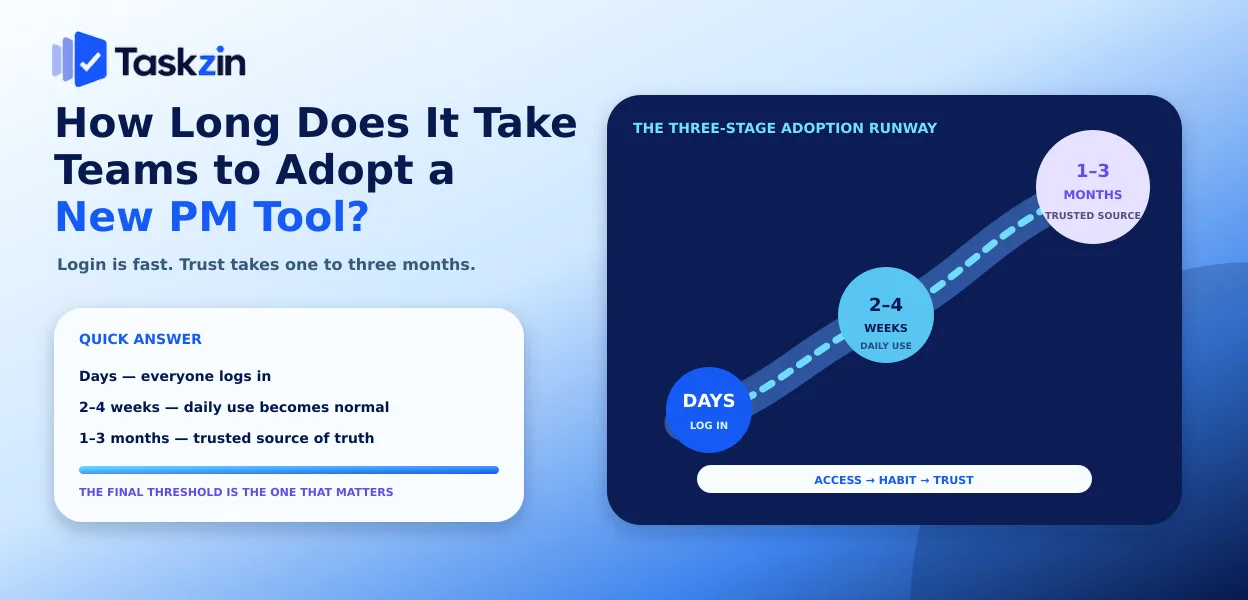

Comments