The Complete Guide to Hybrid Project Management
A comprehensive guide to hybrid project management, covering what hybrid genuinely means, three common patterns, how to split work by uncertainty rather than by team, designing the interface between approaches, governance, and common mistakes.

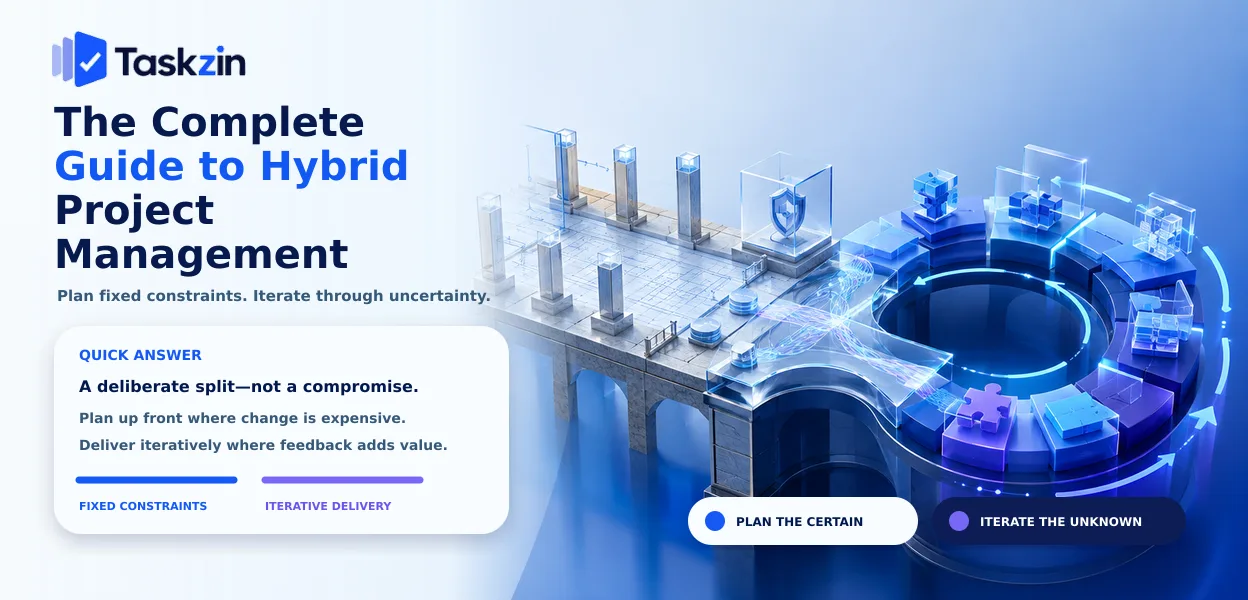
Most organisations arrive at hybrid rather than choosing it. Delivery teams adopt agile practices while procurement, budgeting and governance remain unchanged, and the result is either a workable blend or an incoherent mess depending on whether anyone designed the seam between them.
This guide covers what hybrid means, the common patterns, how to decide what goes where, and how to make the boundary work.
Quick answer: Hybrid project management deliberately applies traditional planning to the parts of a project with fixed constraints and iterative delivery to the parts with genuine uncertainty.
Done well, it is a considered split rather than a compromise — the elements that cannot change cheaply get planned up front, and the elements that benefit from feedback get delivered iteratively.
What Hybrid Actually Means
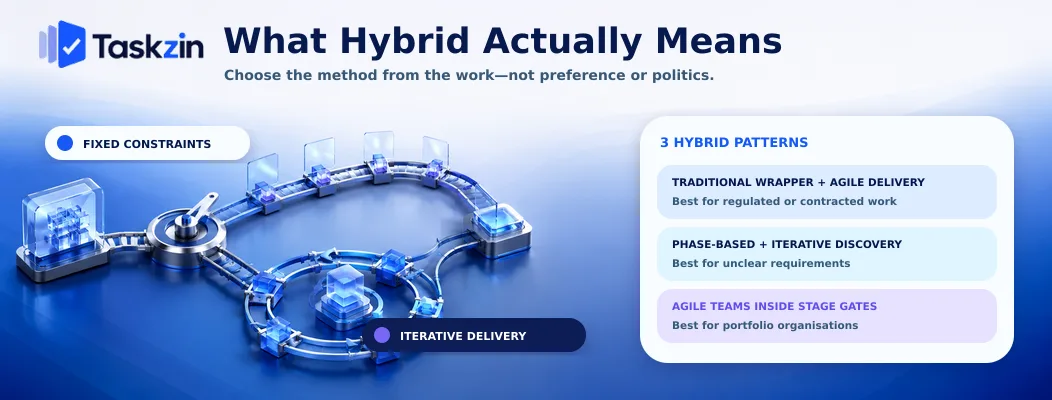
Hybrid means using each approach where it fits, based on the characteristics of the work rather than on preference or politics.
Not a compromise, a deliberate split
The negative framing treats hybrid as agile diluted by bureaucracy. That describes bad hybrid.
Good hybrid recognises that a single project can contain genuinely different types of work.
Building a data centre and building the software running in it have different uncertainty profiles, different costs of change, and different appropriate approaches. Forcing one method across both is the actual compromise.
Why organisations end up here
Regulatory obligations require documented traceability. Contracts fix scope and price. Hardware carries lead times. Finance approves budgets annually. Boards expect roadmaps.
None of these disappear because a delivery team adopts Scrum. Hybrid is what happens when an organisation is honest about which constraints it cannot remove.
The difference between hybrid and confused
A hybrid model is designed: someone decided which elements follow which approach, and how the two interact.
Confusion is undesigned: teams run sprints while a project manager maintains a Gantt chart that nobody updates from the sprint results, and both artefacts diverge. The distinguishing question is whether anyone can explain the split and the interface between the halves.
Three Common Hybrid Patterns
Pattern Structure Best for Main risk Traditional wrapper, agile delivery Fixed phases and milestones; iterative build inside Regulated or contracted work Governance overhead crowding delivery Phase-based with
Discovery work stays iterative
Traditional throughout; iterative discovery phase Projects with unclear requirements Learning stops when discovery ends
Agile teams inside
Stage gates around iterative delivery
Continuous delivery; gates for funding decisions Portfolio-managed organisations Gates becoming approval bottlenecks
Deciding What Goes Where
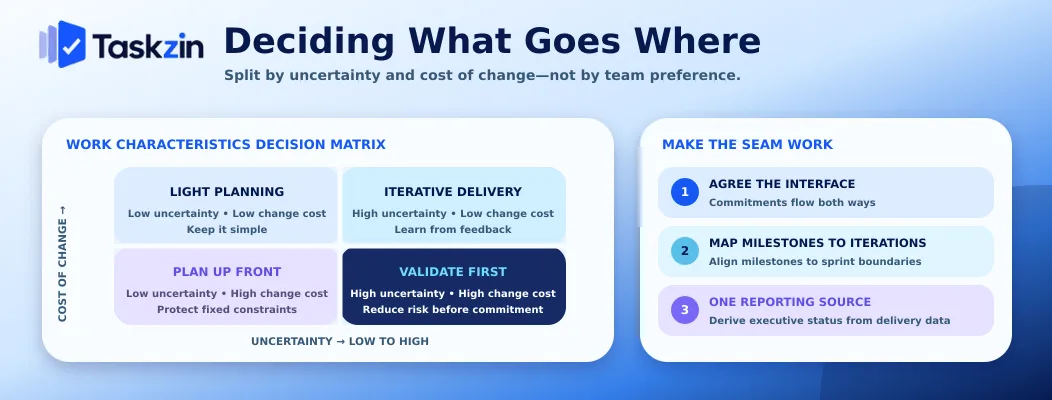
Split by how uncertain the work is and how expensive change would be — not by which team is doing it or which approach people prefer.
Split by uncertainty, not by team
The right question for any element is how confident you are in the requirement and how expensive it would be to change later.
High confidence and expensive change means plan it up front. Low confidence and cheap change means deliver it iteratively and learn. This produces a split that follows the work rather than the org chart, which is what makes it defensible when someone objects.
Fixed constraints stay traditional
Regulatory submissions, contractual milestones, physical procurement, venue bookings and integration dates with external parties all have fixed dates and expensive change.
Plan these traditionally with dependencies, critical path and buffer. Iterating on a submission deadline is not possible, and pretending otherwise creates risk rather than agility.
Discovery work stays iterative Anything where the requirement is genuinely uncertain — user-facing features, process design, anything where you will learn from feedback — belongs in iterative delivery.
The failure to avoid is specifying this work in detail up front. That produces a specification that will be wrong, discovered at the point where correction is most expensive.
Making the Seam Work
The boundary between the two halves needs an explicit interface: what each side commits to the other, how iterations map to milestones, and what the organisation receives as reporting.
Agree the interface between the two halves
Write down what the iterative side must deliver by each fixed milestone, and what the traditional side guarantees the iterative side — access, decisions, dependencies delivered.
This is the single most important artefact in a hybrid model, and it is usually missing. Without it, each side assumes the other will accommodate them, and the assumption fails at the first milestone.
Translate between milestones and iterations
Milestones are points; iterations are periods. Someone must translate between them.
The practical approach is to tie milestones to iteration boundaries rather than arbitrary dates, so a milestone falls at the end of a sprint rather than mid-way through one. This removes an entire category of awkward partial-progress reporting.
Decide which reporting the organisation gets
Executives generally want milestone status, risks and decisions required. Delivery teams need flow and iteration detail.
Produce one and derive the other rather than maintaining two. A single system holding both the timeline and the iteration data — Taskzin's Gantt and sprint views operate over the same tasks — means milestone status reflects actual delivery rather than a separately maintained impression of it.
Governance in a Hybrid Model
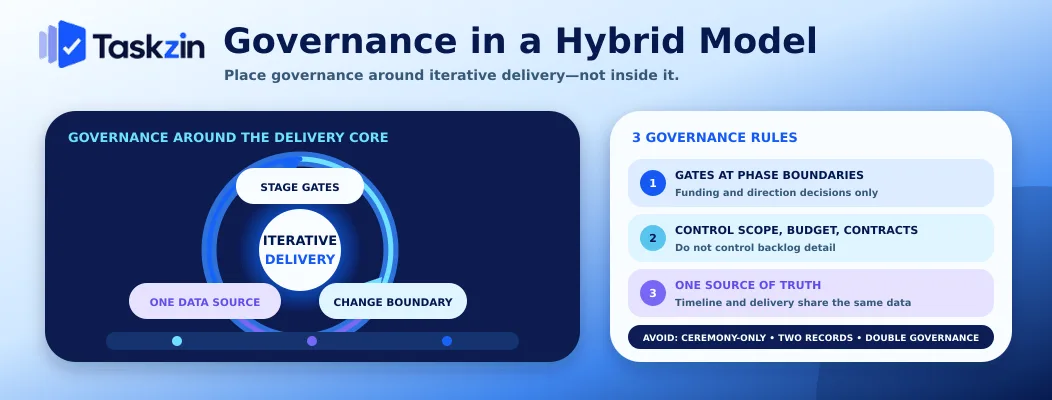
Hybrid governance places gates around iterative delivery rather than inside it, keeps change control for scope and budget rather than for detail, and maintains one source of truth.
Stage gates around iterative delivery Gates work well as funding and direction decisions: is this still worth continuing, has the situation changed, should we proceed to the next phase.
They work badly as detailed approvals of work already completed iteratively, which reintroduces the delay that iteration removed. Place the gate at the boundary, not in the middle.
Change control that does not block adaptation
Apply formal change control to scope, budget and contractual commitments. Do not apply it to how the team implements something within agreed scope.
Organisations that require a change request to reorder a backlog have eliminated adaptability while keeping the ceremony that was supposed to enable it.
One source of truth across both
The commonest hybrid failure is two systems: a plan for governance and a board for the team, updated separately.
They diverge within weeks, and the reporting becomes fiction. Whichever tool you choose, the milestone view and the delivery view must be derived from the same underlying data.
Common Hybrid Mistakes
The three failures are running waterfall with agile ceremonies attached, maintaining two systems of record, and applying both governance models simultaneously.
Waterfall with standups
A fully specified plan, fixed scope, no ability to change direction — plus daily standups and a board.
This is the most common thing people mean when they complain about hybrid. It adds ceremony without adding adaptability, and it gives agile a bad name inside the organisation.
Two systems of record
A project plan maintained by the PM and a board maintained by the team, diverging steadily.
Someone reconciles them weekly, badly. Pick one system and derive both views from it.
Applying both sets of governance
Requiring sprint ceremonies and full change control and stage gates and detailed status reports means the team spends more time on process than on work.
Hybrid should reduce total governance by applying each mechanism only where it is needed, not accumulate both sets. If your hybrid model has more overhead than either pure approach, it has been assembled rather than designed.
Frequently asked
What is hybrid project management?
An approach that applies traditional planning to elements with fixed constraints and iterative delivery to elements with genuine uncertainty, within a single project or programme.
When should you use a hybrid approach?
When a project contains genuinely different types of work — fixed regulatory or contractual elements alongside uncertain discovery work — or when organisational constraints such as annual budgeting cannot be removed.
What is the most common hybrid model?
A traditional wrapper with agile delivery inside: fixed phases, milestones and governance at the project level, with iterative delivery within the build phase.
Is hybrid just a compromise?
Only when undesigned. A deliberate split based on uncertainty and cost of change is a considered choice; agile ceremonies bolted onto an unchanged waterfall process is the compromise people criticise.
How do you report on a hybrid project?
Produce milestone-level status for stakeholders derived from the same data the team uses for delivery, rather than maintaining separate plan and board artefacts that inevitably diverge.
Can you run agile inside a stage-gate process?
Yes, provided the gates sit at phase boundaries as funding and direction decisions rather than as detailed approvals of iterative work, which reintroduces the delay iteration removed.
What tools suit hybrid project management?
Anything providing both timeline and iteration views over the same dataset, so milestone reporting reflects actual delivery rather than a separately maintained plan.
Sujan Sharma is a content writer at Taskzin with a strong focus on productivity systems, task management, workflow optimization, team collaboration, and SaaS technology. He creates research-driven, practical content that helps professionals and growing teams improve operational efficiency, streamline processes, and make informed decisions about modern work management tools.
All posts by Sujan Sharma
Comments