PMP vs CSM vs PRINCE2 vs SAFe: Certifications Compared
A comparison of the major project management certifications, covering what PMP, CSM, PRINCE2 and SAFe each signal to employers, their prerequisites and geographic recognition, how to choose for your market, and common mistakes.

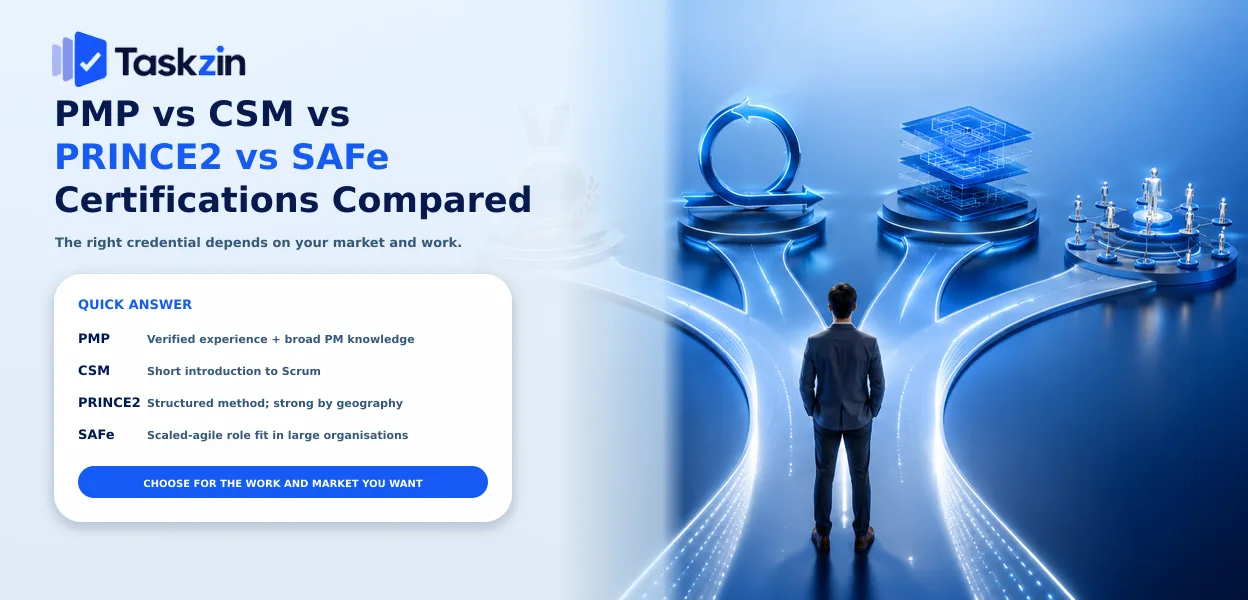
The common question — which is best — has no answer without knowing where you work and what you do. A PMP carries substantial weight in North America and in engineering and construction; a CSM carries almost none by comparison but takes two days rather than years of documented experience.
This guide compares what each actually signals and how to choose.
*Verify current costs, prerequisites and renewal terms directly with each certifying body — these change regularly.* Quick answer: PMP validates documented project management experience against a broad body of knowledge. CSM is a short introductory course in Scrum. PRINCE2 certifies knowledge of a specific structured method, strongest in the UK, Europe and Australia. SAFe certifications cover scaled agile roles in large organisations. They signal genuinely different things, so the right choice depends on your market and the work you want.
What Each Certification Actually Signals
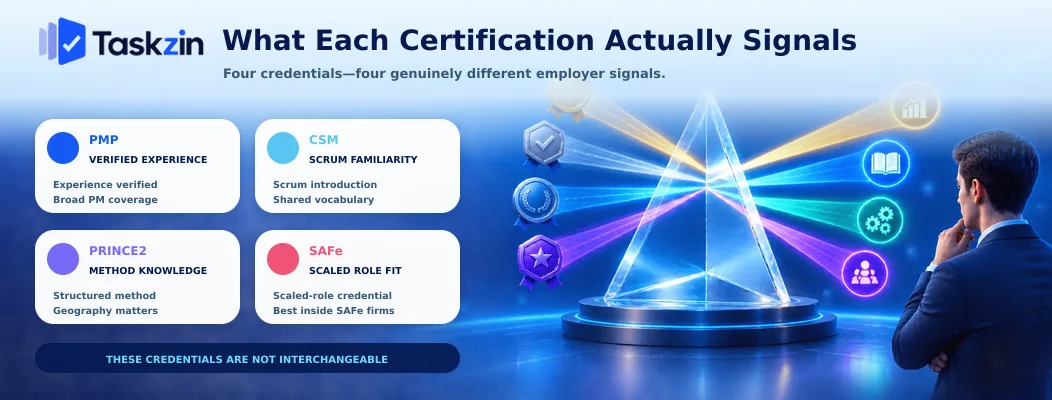
Certifications differ in whether they verify experience, teach a framework, or grant access to a role — and conflating these is the main source of confusion.
They are not interchangeable
PMP requires documented project experience and a substantial exam. CSM requires attending a course and passing a straightforward assessment.
Treating them as comparable credentials misreads both. One is an experience gate; the other is an introduction. Neither is better — they answer different questions for an employer.
Signal versus skill
A certification tells an employer something about you before they meet you. It does not, on its own, make you good at the work.
This is worth stating plainly because expectations are frequently mismatched. People complete a certification and find their day-to-day capability unchanged, which is not a failure of the certification — it was never the mechanism for that.
Who each one is aimed at
PMP: practising project managers with years of experience, often in North America or in traditional delivery environments.
CSM: people entering agile ways of working, or team members wanting shared vocabulary.
PRINCE2: project managers working in the UK, Europe, Australia and public sector or government-adjacent contracts.
SAFe: people working in large organisations running scaled agile, frequently because the organisation adopted it.
The Four Certifications Side by Side
PMP CSM PRINCE2 SAFe Agilist Body PMI Scrum Alliance Axelos / PeopleCert
SAFe: scaled agile roles
Focus Broad PM body of knowledge Scrum framework Structured project method Scaled agile at programme level Prerequisites Documented experience + education Course attendance Foundation before Practitioner Recommended experience Typical effort Months of study Two-day course Days to weeks Two-day course Exam Long, substantial Short assessment Foundation + Practitioner exams Assessment after course Renewal Continuing education units Periodic renewal Periodic re-registration Annual renewal Strongest in North America, engineering, construction Software, product teams UK, Europe, Australia, public sector Large enterprises running SAFe Signals Verified experience Familiarity with Scrum Knowledge of a method Fit for a scaled role
PMP: The Experience-Gated Standard
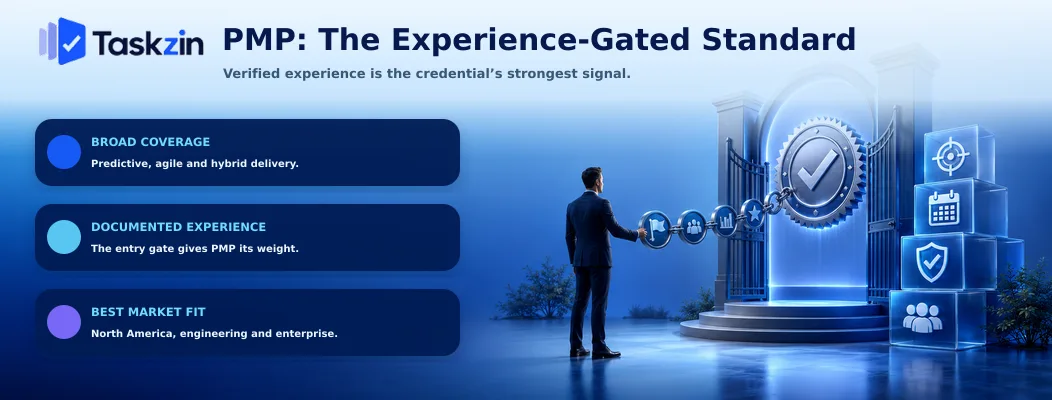
PMP is the most widely recognised project management certification globally, and its main value comes from the experience requirement rather than the exam.
What it covers
A broad body of knowledge spanning predictive, agile and hybrid approaches — scope, schedule, cost, quality, risk, procurement, stakeholders and the people side of delivery.
Recent versions have incorporated agile content substantially, so the older perception of PMP as purely waterfall is out of date.
Entry requirements
Documented project management experience plus formal education in project management, with the specific hours depending on your degree level.
This gate is what gives the credential its weight. An employer seeing PMP knows you have run projects for years and someone verified it, which is a genuinely useful signal that a course-attendance certificate cannot provide.
Who benefits most
Practising project managers in markets where PMP appears in job specifications — most commonly North America, and in engineering, construction, defence and large corporate environments.
If PMP appears in the job adverts you are applying to, it is worth the investment. If it does not appear in your market, the return is much weaker.
CSM, PRINCE2 and SAFe Compared
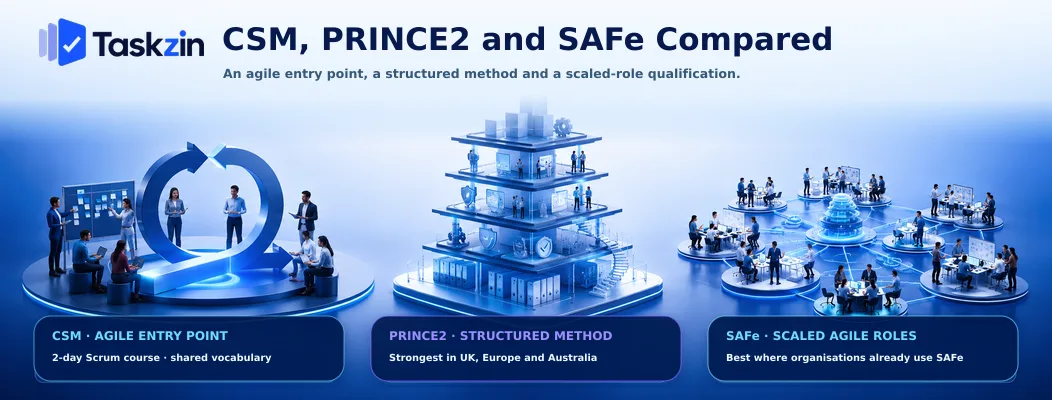
These three serve different purposes: an agile entry point, a structured method credential, and a scaled-framework role qualification.
CSM: agile entry point
A two-day course covering Scrum's roles, events and artefacts, followed by a short assessment.
Its value is as an introduction and a shared vocabulary, not as evidence of capability. Employers generally read it as "has been introduced to Scrum" rather than "can run a team", and expecting more from it leads to disappointment. Practitioner-level agile certifications exist for those wanting a stronger signal.
PRINCE2: structured method, strong in the UK and Europe
PRINCE2 certifies knowledge of a specific method with defined principles, themes and processes, split into Foundation and Practitioner levels.
Its recognition is strongly geographic. In the UK, parts of Europe, Australia and public sector procurement it appears frequently in requirements; in North America it is much less common.
That geography should largely determine whether it is worth your time.
SAFe: scaled agile roles SAFe certifications map to roles within the framework — Agilist, Scrum Master, Product Owner, Release Train Engineer and others.
They are most valuable when your organisation has adopted SAFe or you are targeting employers who have. Outside that context the signal is limited, because the framework itself is not universally used.
Choosing Based on Your Situation
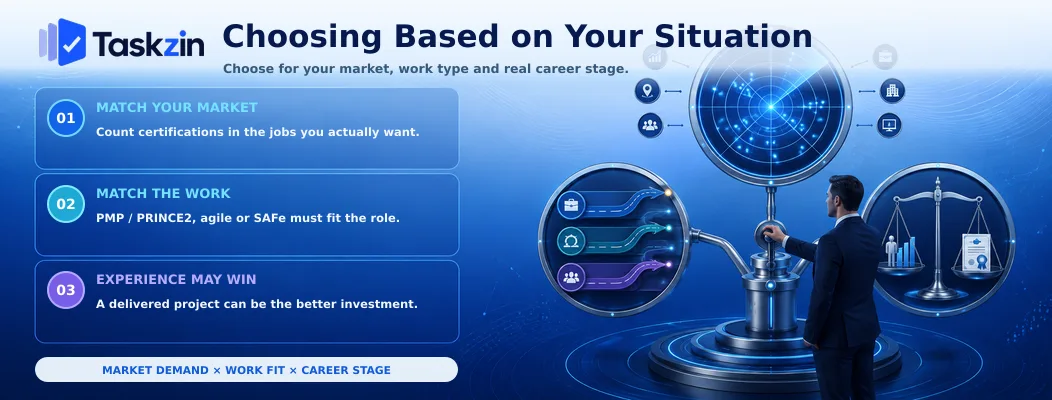
Choose by looking at what appears in job adverts in your market, what kind of work you want to do, and whether experience would serve you better than a credential.
Match the certification to your market
Search fifty job adverts for the roles you want and count which certifications appear.
This takes an hour and is more reliable than any general advice, including this article.
Certification value is heavily geographic and sector-specific, and your local job market is the only relevant evidence.
Match it to the work you want
Traditional or hybrid delivery in a large organisation points to PMP or PRINCE2. Product and software teams point to agile certifications. Large enterprises running scaled frameworks point to SAFe.
Certifying in a framework you will not use is a common and expensive mistake.
When none of them is the right investment
If you are early in your career, delivering a project well and being able to describe it specifically is worth more than a certificate.
If you are experienced and your market does not ask for certification, the money is better spent elsewhere. Certifications are useful where they open doors, and neutral where they do not.
Common Mistakes When Choosing a Certification
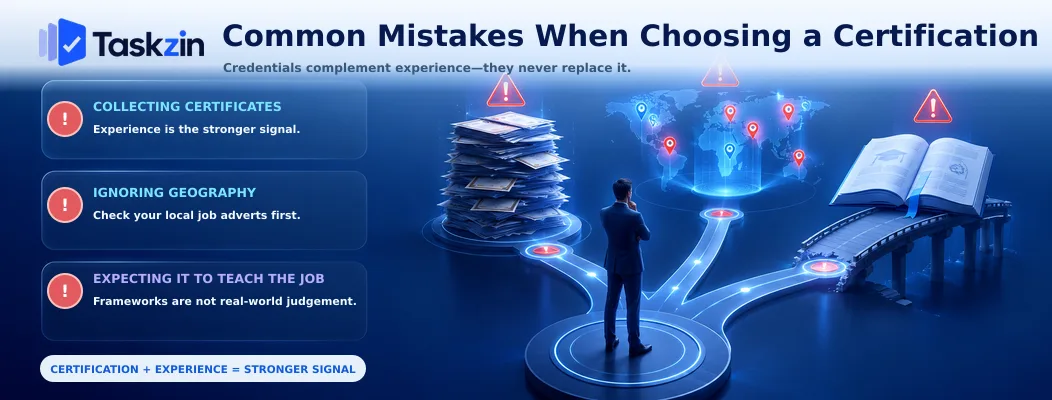
The three errors are collecting certificates instead of building experience, ignoring geography, and expecting a certification to teach you the job.
Collecting certificates instead of experience
Four certifications and two years of experience reads worse to an experienced hiring manager than one certification and six years.
Certifications complement experience. They do not substitute for it, and a long list can suggest someone optimising for signals rather than capability.
Ignoring where you work
Studying for PRINCE2 in a market where nobody asks for it, or PMP in one where PRINCE2 dominates, is a common and avoidable waste.
Check the job adverts first. Recognition varies more by geography than most guidance acknowledges.
Expecting it to teach you the job
Certifications teach vocabulary, frameworks and standard approaches. They do not teach how to have a difficult conversation with a sponsor, how to notice that a project is quietly failing, or how to say no politely.
Those are the skills that determine whether someone is good at this work, and they are learned by doing it — which is why the experience requirement is the most valuable part of PMP.
Frequently asked
What is the difference between PMP, CSM, PRINCE2 and SAFe?
PMP validates documented experience against a broad body of knowledge. CSM introduces Scrum via a short course. PRINCE2 certifies knowledge of a structured method. SAFe certifies fit for roles within a scaled agile framework.
Which project management certification is most valuable?
It depends entirely on your market and work type. PMP has the widest global recognition; PRINCE2 is strong in the UK, Europe and Australia; agile certifications suit product and software contexts.
Is PMP worth it?
Where it appears in job specifications in your market, generally yes — the experience requirement gives it real signalling value. Where it does not appear locally, the return is much weaker.
Is a Scrum Master certification enough to get a job?
Rarely on its own. Employers typically read CSM as evidence of familiarity rather than capability. Combined with real delivery experience it helps; without experience it is a limited signal.
Is PRINCE2 recognised outside the UK?
It is recognised across Europe, Australia and parts of Asia, and in public sector procurement in those regions. Recognition in North America is considerably lower than PMP.
Do you need certification to be a project manager?
No. Many effective project managers hold none. Certification helps mainly with getting past screening in markets and sectors where it is expected.
Which certification should a beginner start with?
Usually an agile certification such as CSM, since it has no experience prerequisite. PMP requires documented experience, so it is a mid-career step rather than an entry point.
Sanju Shrestha is a SaaS content writer at Taskzin who explores smarter ways to manage work, organize priorities, and improve team performance. Her content covers productivity strategies, digital workflows, collaboration, and task management, with a focus on helping modern teams work more efficiently and stay aligned.
All posts by Sanju Shrestha
Comments