AI in Project Management: What It Can and Can't Do Yet
An honest assessment of AI in project management, covering where it genuinely helps today, where it falls short and why, the practical applications worth adopting now, how to evaluate AI features, and common mistakes.

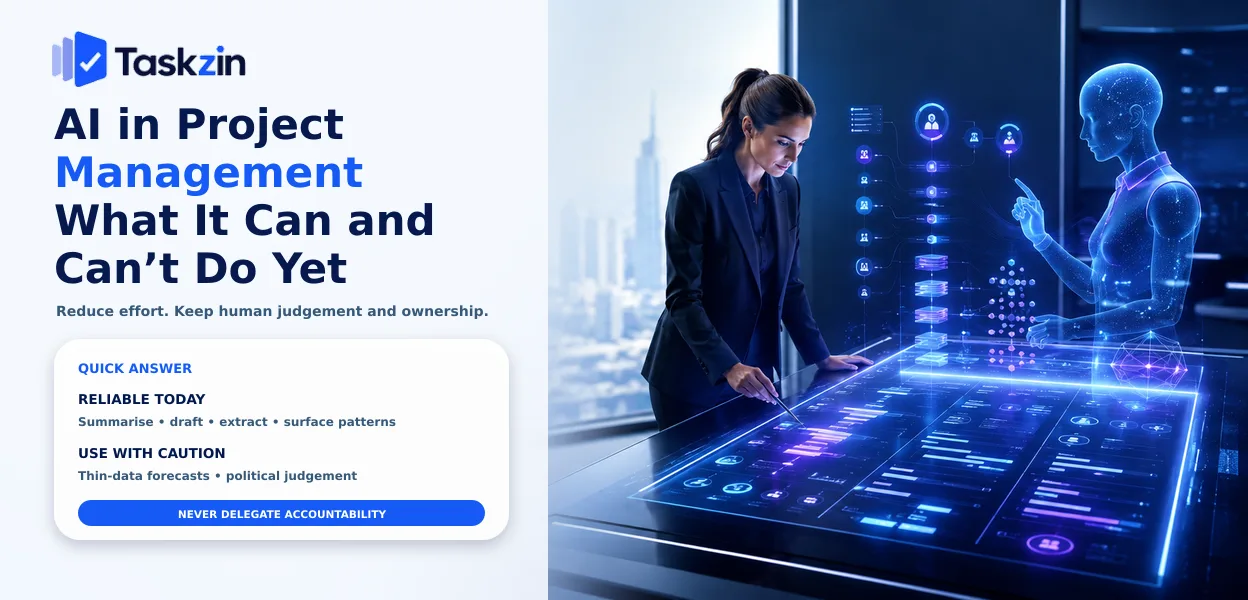
The gap between marketing claims and practical value is unusually wide in this category. Most tools advertise prediction; most of the actual value is in typing less.
This guide covers where AI genuinely helps today, where it falls short, what to adopt now, and how to evaluate a feature honestly.
Quick answer: AI is genuinely useful for the administrative layer of project management — summarising, drafting, extracting tasks from unstructured text, and surfacing patterns in data you already have. It is unreliable for estimation on thin data, for judgement calls with political weight, and for anything requiring accountability. The distinction is roughly between reducing effort and making decisions.
Where AI Genuinely Helps Today
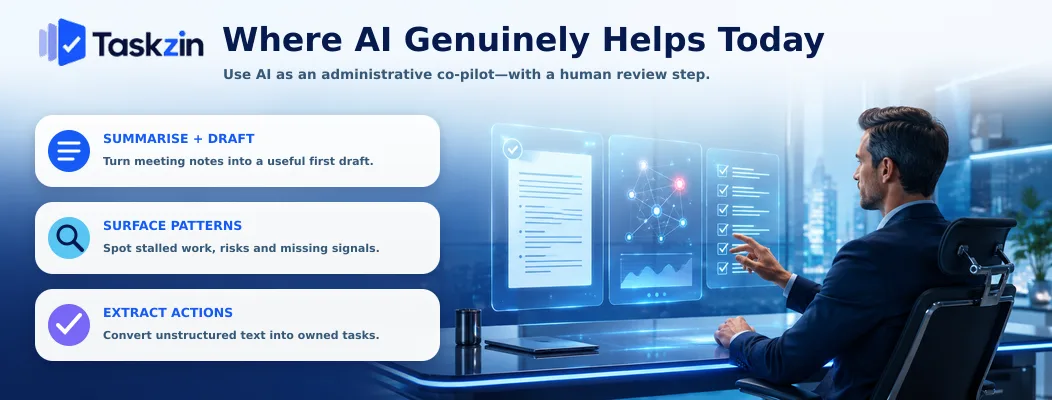
The reliable gains are in summarisation, drafting and pattern surfacing — tasks where a good-enough output that a human reviews is genuinely valuable.
Summarising and drafting
Turning a meeting transcript into a list of decisions and actions. Drafting a status update from project data. Writing a first version of a task description or a risk entry.
These work because the failure mode is acceptable: a human reads the output before it matters, errors are visible, and the alternative is someone spending twenty minutes writing it themselves.
The time saved is real and repeats daily.
Surfacing what you would have missed
Flagging that an item has not moved in eleven days. Noting that three tasks depend on the same person next week. Spotting that a project's cycle time has drifted upward over two months.
None of this is sophisticated inference — it is querying data nobody had time to query. That is precisely why it works: the AI is not predicting anything, it is noticing.
Reducing administrative friction
Extracting tasks from an email thread, suggesting an assignee based on past patterns, proposing which items to pull into a sprint given capacity.
Each saves a small amount of effort many times a day. This is unglamorous and it is where most of the genuine value currently sits.
What AI Can and Cannot Do
Capability Current reliability Why Summarise meetings into actions Good Human reviews output; errors visible Draft status updates from data Good Grounded in real project data Extract tasks from text Good Verifiable immediately Flag stalled or ageing items Very good Simple querying, not prediction
Suggest assignees or priorities Moderate Depends on data quality Predict project completion dates Poor to moderate Needs substantial history to be meaningful Estimate unfamiliar work Poor No basis for comparison Judge stakeholder or political
Risk and blocker detection
Poor Not in the data Decide scope trade-offs Not appropriate Requires accountability
Where AI Falls Short
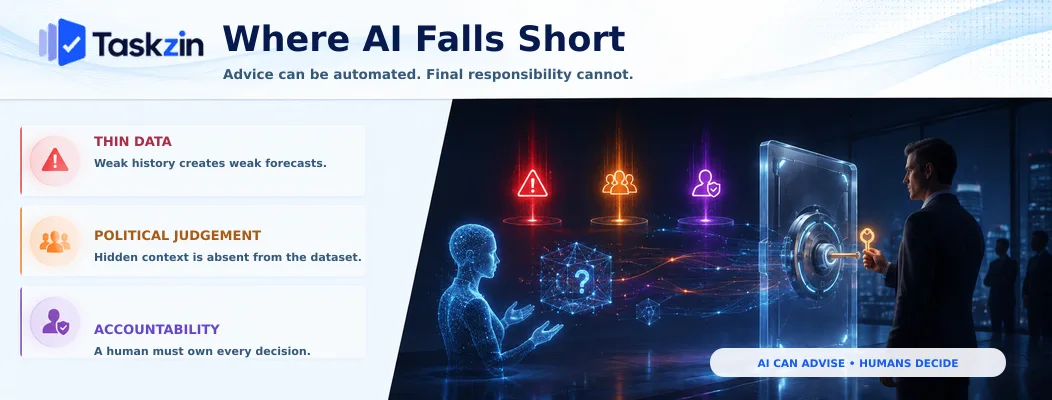
AI struggles wherever there is little historical data, where the relevant information is not written down, and where a decision needs someone accountable for it.
Estimation from thin data
Forecasting requires history. A team with three months of consistent data can support a statistical forecast; a new team or a novel project cannot.
Tools that present a confident completion date regardless of data volume are producing output, not insight. The honest version presents a range with a stated confidence, and says when there is insufficient history — which few products do, because a range is a worse demo than a date.
Judgement calls with political weight
Whether to tell a client the date is slipping. Whether a stakeholder's objection is substantive or positional. Whether to push back on a request from someone senior.
These depend on context that exists in relationships and conversations rather than in project data. AI has no access to the relevant information, and its confident-sounding answer is a guess dressed as analysis.
Anything requiring accountability
If a decision goes wrong, someone must own it. "The system recommended it" is not accountability, and organisations discover this the first time it matters.
Use AI to inform decisions and keep the decision with a person. This is not a temporary limitation of the technology — it is a structural point about responsibility.
Practical Uses Worth Adopting Now
Three applications deliver value reliably today: converting meeting notes into tasks, generating status summaries from project data, and detecting stalled work.
Meeting notes into tasks
The gap between "we agreed this in the call" and "it exists as a task with an owner" is where a large share of commitments disappear.
Automating that conversion, with a human confirming, closes it cheaply. This is probably the highest-return AI application in project management today, and it requires no forecasting at all.
Status summaries from real data
A summary generated from actual task status, movement and blockers is accurate by construction, because it describes data rather than predicting.
The value is that it happens weekly without anyone spending an hour on it. Keep a person reviewing before it goes to stakeholders — not because the summary is likely wrong, but because emphasis and framing are judgement calls.
Risk and blocker detection Rules-based flagging — items older than twice your typical cycle time, dependencies converging on one person, sprints where committed work exceeds historical velocity — catches problems earlier than human review does.
Most of this is not really AI, and that is fine. The value is in the noticing, not the sophistication.
Evaluating AI Features Honestly
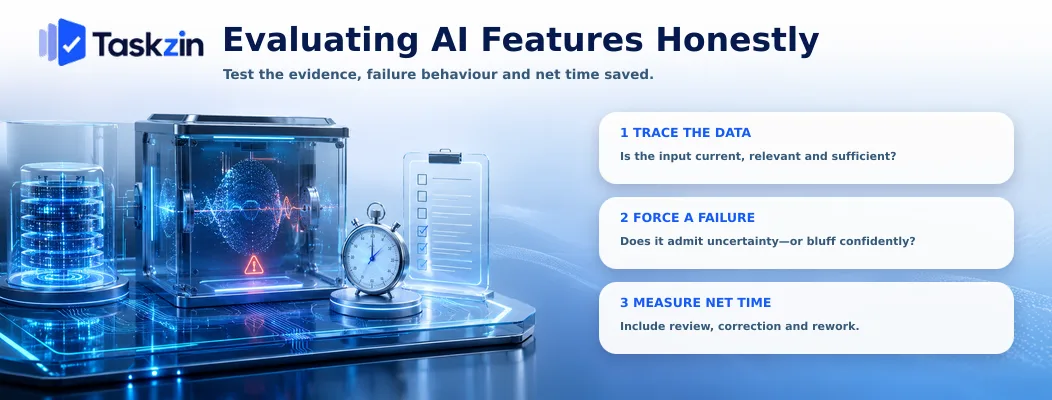
Ask what data the feature uses, check how it behaves when it is wrong, and measure the time it actually saves rather than the time it claims to.
Ask what data it is using
A forecast built on your team's twelve sprints of history is different from one built on general patterns across other companies.
If a vendor cannot explain what data drives the output, treat the feature as decorative. This question separates genuinely useful capabilities from demo features very quickly.
Check whether it is confident when wrong
The dangerous failure mode is not error — it is confident error. A tool that presents a wrong date with the same certainty as a right one will be trusted until it causes a problem.
Test it deliberately on a project you know well. If it produces plausible-sounding output for a situation it could not possibly have information about, that tells you what its other outputs are worth.
Measure the time actually saved
Time the task before and after. Include the review time, which is often omitted from vendor claims and is a real part of the cost.
A feature saving fifteen minutes a week is genuinely worthwhile and should be described as such. Features described as transformative usually save fifteen minutes a week.
Common Mistakes With AI in Project Management
The three errors are trusting forecasts built on insufficient history, automating judgement rather than administration, and applying AI to a process that does not work.
Trusting forecasts built on little history
A completion date generated from six weeks of data on a novel project is a number with the appearance of analysis.
Ask how much history underpins any prediction. If the answer is thin, treat the output as a conversation starter rather than a forecast.
Automating the judgement, not the admin
The instinct is to automate the interesting part — prioritisation, resource allocation, risk assessment. Those are exactly the parts requiring context AI does not have and accountability it cannot hold.
Automate the typing. Keep the deciding.
Adding AI to a process that does not work
If your project data is stale because nobody updates the board, AI summarisation produces confident summaries of inaccurate data — which is worse than no summary, because it looks authoritative.
Fix the data first. AI applied to a well-maintained system is useful; applied to a neglected one it amplifies the neglect. This is the same principle that applies to automation generally: making a broken process faster does not fix it.
Frequently asked
What can AI do in project management today?
Reliably: summarise meetings into tasks, draft status updates from project data, extract action items from text, and flag stalled or ageing work. These reduce administrative effort rather than making decisions.
Can AI estimate project timelines?
Only where substantial consistent history exists. With twelve or more sprints of data a statistical forecast is meaningful; on a new team or novel project, a confident date is not supported by anything.
Will AI replace project managers?
Not on current evidence. Most of the role is chasing, communicating, negotiating scope and anticipating problems — work requiring context that is not in the data and accountability that AI cannot hold.
Is AI good at writing status reports?
Yes, when generated from real task data rather than free text, because the output describes rather than predicts. Keep a person reviewing before it goes to stakeholders, since emphasis is a judgement call.
How accurate are AI project risk predictions?
Rules-based detection of stalled items and converging dependencies is reliable. Predictions of stakeholder, political or commercial risk are not, because the relevant information is not in the project data.
What should you not use AI for in project management?
Scope trade-offs, stakeholder judgement, decisions requiring accountability, and forecasting on projects without meaningful historical data.
How do you evaluate an AI feature in a PM tool?
Ask what data drives it, test it on a project you know well to see whether it is confident when wrong, and measure the time it saves including review time.
Binita Ray is a content writer at Taskzin, creating insightful and practical content on task management, team collaboration, productivity, workflow optimization, and SaaS solutions. She focuses on helping businesses, teams, and professionals simplify their work processes, improve efficiency, and make better use of modern productivity tools.
All posts by Binita Ray

Comments