How Do You Estimate Project Timelines Accurately?
A practical guide to estimating project timelines, covering why estimates are systematically optimistic, five estimation approaches compared, a working method including the work people forget, converting effort into dates, and communicating estimates honestly.

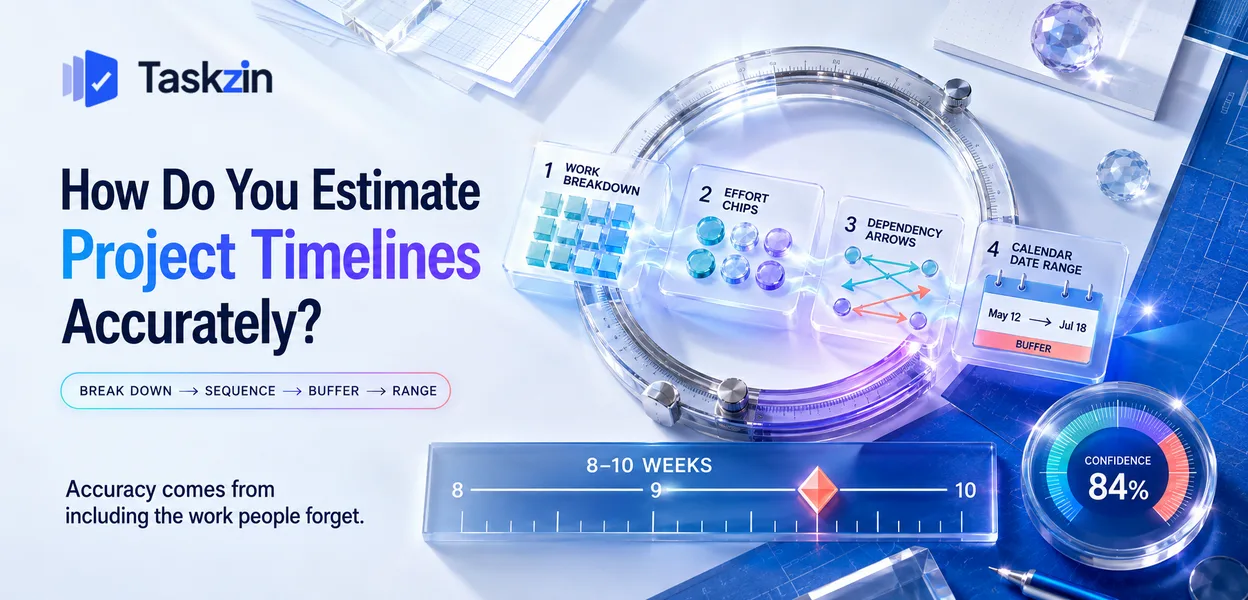
How do you estimate project timelines accurately?
Estimates fail in a consistent direction. They are optimistic, and the optimism is systematic rather than random — which means it can be corrected once you know the pattern.
This guide covers why estimates go wrong, five approaches, a practical method, and how to communicate an estimate without setting yourself up to fail.
Quick answer: Break the work down before estimating anything, estimate effort rather than duration, convert to a date using a realistic focus factor and the actual sequence of work, add the tasks nobody lists, and present the result as a range with its assumptions stated. Accuracy comes mostly from including work you would otherwise forget, not from estimating known work more precisely.
Why Timeline Estimates Are Usually Wrong
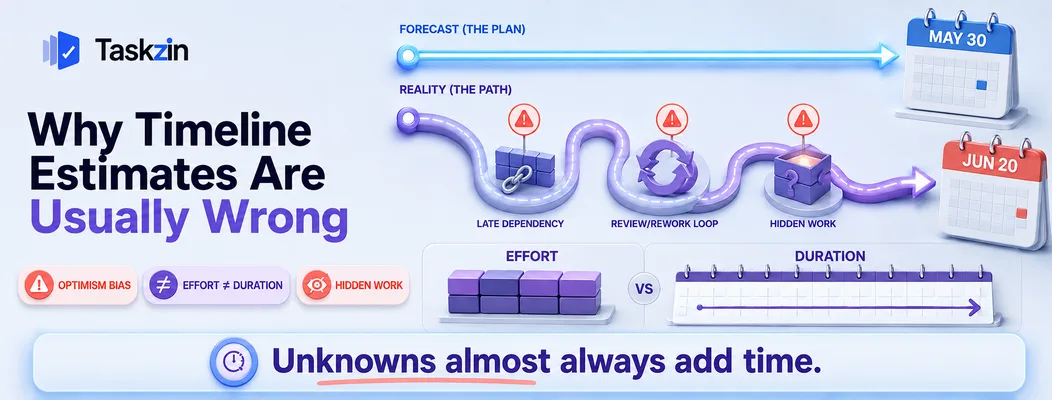
Estimates skew optimistic because unknowns only add work, because effort is confused with duration, and because a substantial share of real work never appears on the plan.
Estimates are optimistic in one direction
When you estimate a task, you imagine it going normally. You rarely imagine the dependency arriving late, the requirement changing, or the edge case nobody discussed.
The unknowns are almost all additive. That is why estimates are not symmetrically wrong — they miss low far more often than high, and adding a flat percentage to everything is a crude but partially effective correction.
Effort is not duration
Five days of effort does not mean five days of elapsed time. The person doing it also has meetings, other work, and time waiting for someone else.
Confusing the two is one of the largest single sources of estimation error. A plan built from effort estimates without conversion routinely comes out at half the real duration.
The work you did not think of
Review, rework, handover, testing, deployment, documentation, fixing what the review found, answering questions.
These are real and predictable and are consistently absent from estimates because they are not the interesting part of the work. Adding them explicitly is the single highest-return correction available.
Five Estimation Approaches
Method How it works Accuracy Effort Best for Analogous Compare to a similar past project Low–medium Very low Early ballpark figures Bottom-up Estimate each task, roll up High High Well-understood work
Three-point Optimistic, likely, pessimistic weighted Medium–high Medium Uncertain work
What is reference class forecasting?
Use actuals from similar past projects High Low Any project with history Parametric Cost or time per unit × quantity Medium–high Low Repetitive work
A Practical Estimation Method
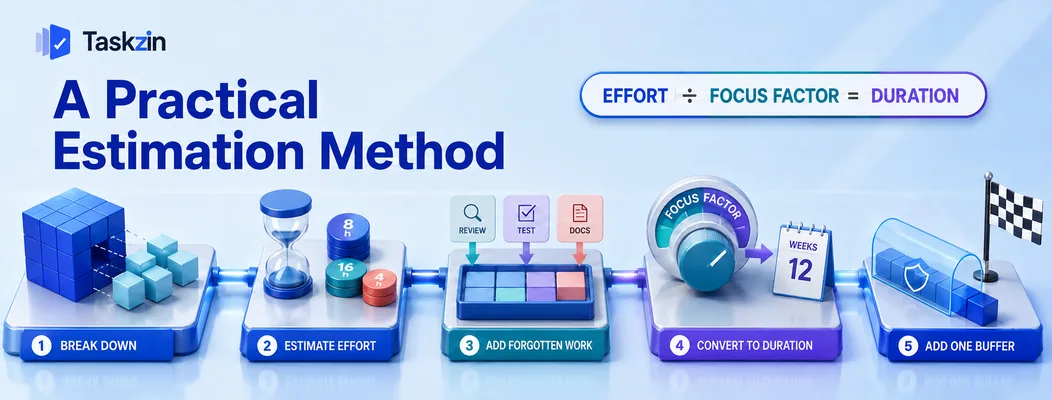
Decompose first, estimate effort per piece, explicitly add the work people forget, then sanity-check the total against what similar past projects actually took.
Break the work down first
Estimating a whole project as one number produces a guess. Decompose it until each piece represents roughly one day to two weeks of work, then estimate the pieces.
This works because errors partially offset — some pieces come in over, some under — and because the act of decomposing reveals work you had not considered. That discovery is worth more than the arithmetic.
Estimate effort, then convert to duration
Estimate how much work each piece is, in person-days, ignoring calendars entirely at this stage.
Keeping effort and duration separate prevents the most common error. Convert afterwards, deliberately, using capacity and sequence.
Add the work nobody lists
Go through the breakdown and add: review time, rework after review, testing, deployment, handover and documentation.
For most knowledge work this adds 30 to 50 percent to the raw build estimate. If that feels excessive, compare it against a past project's actuals — it usually turns out conservative.
Apply a reference-class check
Take the total and ask how long similar projects actually took. Not how long they were estimated to take.
This is the most effective single check available. If your bottom-up total is six weeks and the last three comparable projects each took ten, your estimate is wrong regardless of how carefully it was built. Historical data from your own tracked projects makes this straightforward; even rough records of past durations are enough to catch a serious underestimate.
Turning Effort Into a Date
Convert effort to duration by applying a realistic focus factor, respecting the sequence of dependent work, and holding buffer at the project level.
Apply a realistic focus factor
A full-time person contributes perhaps 60 to 75 percent of their week to project work once meetings, support, review and interruptions are accounted for.
Measure your own rather than assuming. Divide effort by the focus factor to get elapsed working time — sixty person-days at 70 percent is roughly eighty-five working days of one person's calendar.
Account for sequence, not just totals
Total effort divided by team size gives a floor, not a date. If work is sequentially dependent, adding people does not compress it.
The critical path determines the minimum duration. Two hundred person-days of work with a strict sequence may take longer than the same effort in parallel streams, and only the dependency network reveals which you have. Tools that recalculate this — a Gantt view with dependencies, as in Taskzin's timeline — make the difference visible immediately when something moves.
Hold buffer at the project level
Add contingency once, immediately before the delivery date, rather than padding every task.
Padded tasks consume their padding invisibly — work expands to fill the time available — and you arrive at the end with no protection left. A single visible buffer lets you watch it deplete, which is genuine information about whether the project is in trouble.
Communicating an Estimate Honestly
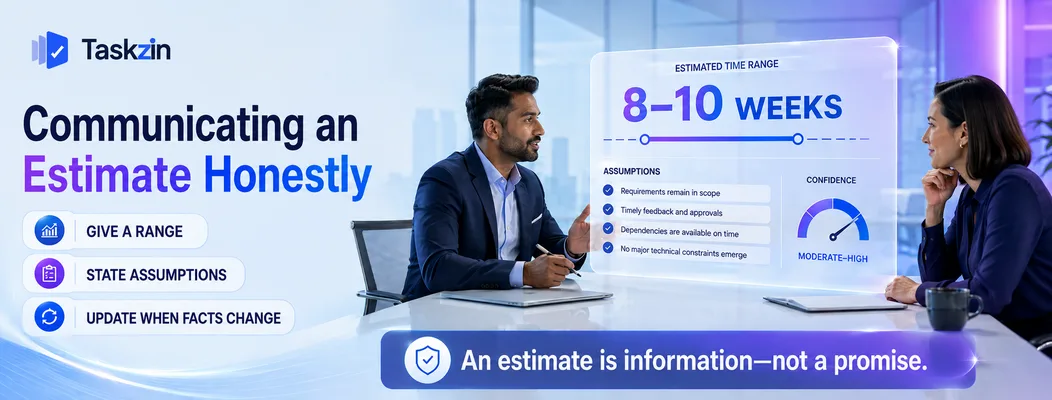
Present a range rather than a single date, state the assumptions the estimate depends on, and re-forecast when things change rather than defending the original number.
Give a range, not a single date
"Ten to thirteen weeks" is more honest and more useful than "eleven weeks".
A single date is heard as a commitment. A range is heard as an estimate, which is what it is. If pressed for one number, give the top of the range — the cost of being late is almost always higher than the cost of finishing early.
State the assumptions it depends on
"Assumes the data migration can use the existing export" and "assumes design sign-off within one week" are the sentences that later explain a three-week variance.
Assumptions written down convert a missed date from a failure into a known cause.
Assumptions held in someone's head convert it into an argument.
Re-forecast rather than defend
When new information arrives, update the estimate. An estimate is a forecast, not a promise, and defending an outdated one helps nobody.
Re-forecasting early and often builds more trust than holding a date until the week before it is missed. Stakeholders can act on early bad news; they cannot act on late bad news.
Common Estimation Mistakes
The three habits that most damage accuracy are estimating only the happy path, letting a desired deadline shape the estimate, and never comparing estimates to actuals.
Estimating the happy path only
Estimating as though everything goes as intended produces a best case presented as an expectation.
Ask explicitly what could make each significant piece take longer, and reflect it. Three-point estimation formalises this, but even asking the question informally improves the result.
Letting the deadline set the estimate
When a date is announced before estimation, estimates tend to fit it. This is not dishonesty; it is a strong and largely unconscious pull.
Estimate before hearing the target where possible. Where that is impossible, produce the estimate independently and then discuss the gap explicitly, rather than quietly closing it.
Never comparing estimates to actuals
Teams that do not compare what they estimated against what happened cannot improve, because they have no feedback.
Record both. Most teams discover a consistent bias — commonly underestimating by a stable percentage — which is trivially correctable once measured and invisible until then.
Frequently asked
How Do You Estimate Project Timelines Accurately?
Break the work down, estimate effort per piece, add the review, rework and deployment work people forget, convert to duration using a realistic focus factor and the dependency sequence, then check the total against what similar past projects actually took.
Why are project estimates always too optimistic?
Because unknowns only add work, never remove it, and because people estimate the version of the task where everything goes as intended. The bias is systematic, which means it can be corrected with historical data.
What is the difference between effort and duration?
Effort is how much work something takes in person-days. Duration is how much calendar time elapses, which is longer because nobody spends their entire week on one project. Confusing the two is a major source of error.
How much buffer should you add?
Commonly 10 to 20 percent of total duration, held once at the project level before delivery rather than distributed across individual tasks where it gets consumed invisibly.
What is reference class forecasting?
Estimating by looking at what similar past projects actually took rather than building up from task estimates. It corrects for optimism bias because it uses outcomes rather than intentions.
Should you give a single date or a range?
A range. Single dates are heard as commitments; ranges are heard as estimates. If forced to give one number, give the top of the range.
How do you improve estimation over time?
Record estimates and actuals for every project, then compare. Most teams find a consistent percentage bias, which is straightforward to correct once measured and invisible until it is.
Sujan Sharma is a content writer at Taskzin with a strong focus on productivity systems, task management, workflow optimization, team collaboration, and SaaS technology. He creates research-driven, practical content that helps professionals and growing teams improve operational efficiency, streamline processes, and make informed decisions about modern work management tools.
All posts by Sujan Sharma
Comments