What Is Task Management? Definition, Examples and Tools
A plain-English explanation of task management, covering the definition, the five-stage lifecycle, worked examples for individuals and teams, how it differs from project management, how to write good tasks, and the main methods and tools.

Everybody manages tasks, whether or not they call it that. The difference between people who feel on top of their work and people who do not is rarely capacity — it is usually whether their system for tracking commitments is trustworthy.
Task management is the practice that makes it trustworthy. It has a small number of moving parts and they are worth understanding properly.
This guide defines it, gives worked examples, distinguishes it from project management, and covers the methods and tools that support it.
Quick answer: Quick answer: Task management is the process of capturing, organising, prioritising and completing individual units of work. A task is a discrete item with a clear outcome, usually an owner and often a due date. It differs from project management in that tasks are tracked individually, whereas projects coordinate related tasks with dependencies, timelines and reporting.
Task Management Defined
Task management is the practice of tracking discrete units of work from the moment they are identified through to completion, so that nothing is forgotten and the right thing is worked on next.
What counts as a task
A task is something with a clear finishing point that one person can complete. "Send the invoice to Acme" is a task. "Improve cash flow" is not — it is an objective with many possible tasks underneath it.
The test is whether you could tell, unambiguously, that it is done. If two people might disagree about whether it is complete, it needs breaking down further.
The five stages every task passes through
Capture: record it the moment it appears, before it is forgotten. Clarify: decide what it actually requires. Organise: put it where it belongs, with a date or a priority. Do: complete it. Review:
check the list regularly and remove, update or reschedule.
Most systems fail at capture or review. Capture fails because recording felt slower than remembering; review fails because it is never scheduled. Both are habits rather than features.
Personal versus shared task management
Personal task management optimises for speed of capture and a calm view of your own commitments. Shared task management optimises for visible ownership and coordination between people.
They pull in different directions. An app optimised for one is usually mediocre at the other, which is why many people run a fast personal list alongside a shared team system rather than forcing one to do both.
Task Management Examples
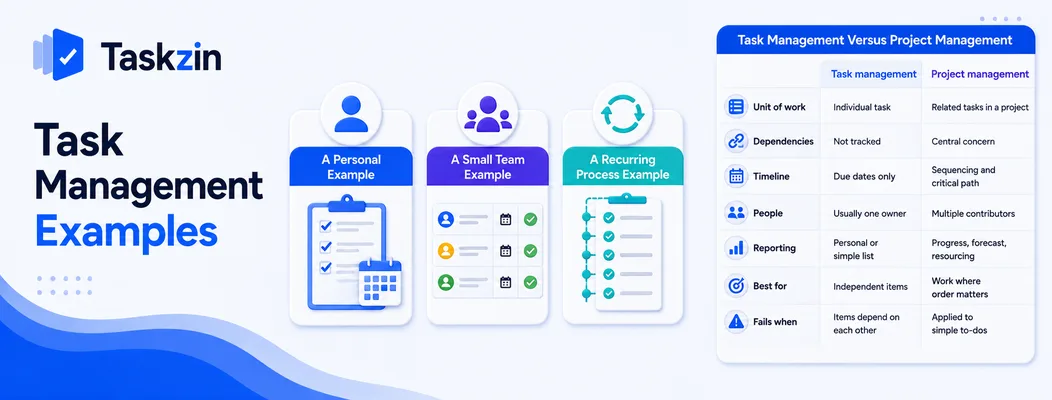
Task management looks different at three common scales: an individual tracking personal commitments, a small team dividing work, and a recurring process run repeatedly.
A personal example
Someone finishes a meeting with four commitments. They record each one before leaving the room, add a date to the two that are time-sensitive, and see them in their list the following morning.
The value is not organisation for its own sake. It is that none of the four depends on being remembered later, which frees attention for the work rather than for holding a list in your head.
A small team example
A three-person team runs a shared list of client deliverables. Each item has one owner and a due date. In a short weekly review they look at what is overdue and what is coming.
Nothing here is sophisticated. The gain comes from a single shared list replacing three private ones, which removes both duplicated work and the assumption that someone else was handling something.
A recurring process example
An onboarding checklist runs every time someone joins: create accounts, order equipment, book the induction, assign a buddy, schedule the thirty-day check-in.
Recurring processes are where task management pays back most reliably. The list captures institutional knowledge, so the process survives the person who designed it and improves each time it runs.
Task Management Versus Project Management
Task Management Methods
Unit of work Individual task Related tasks in a project Dependencies Not tracked Central concern Timeline Due dates only Sequencing and critical path People Usually one owner Multiple contributors Reporting Personal or simple list Progress, forecast, resourcing Best for Independent items Work where order matters Fails when Items depend on each other Applied to simple to-dos
How to Write a Task Properly
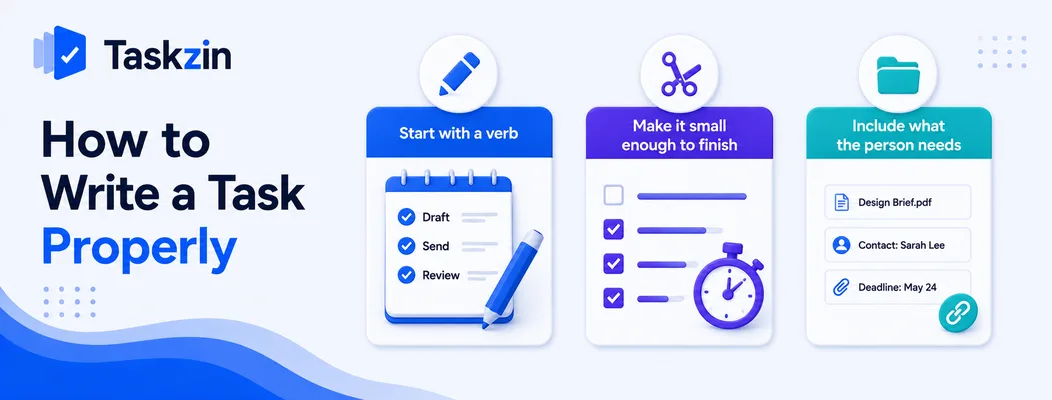
A well-written task starts with a verb, is small enough to complete in one sitting, and contains what the person needs to begin without hunting for context.
Start with a verb
"Website" is a topic. "Draft three homepage headline options" is a task.
Topics create hesitation because a decision is required before any work can start. Verbs remove that decision. This single change is the most reliable improvement most people can make to their lists, and it is why lists full of nouns tend to stall.
Make it small enough to finish
A task that takes three days is a project wearing a task's clothing. It sits on the list looking undone for days, which is demoralising and hides how much progress is actually happening.
Break it into pieces that finish. Completion is what keeps a system trusted.
Include what the person needs
Link the document, note the contact, record the constraint. A task that requires ten minutes of searching before work can start will be skipped in favour of something easier.
This matters most for shared tasks, where the person completing it is not the person who wrote it and has none of the context.
Task Management Tools
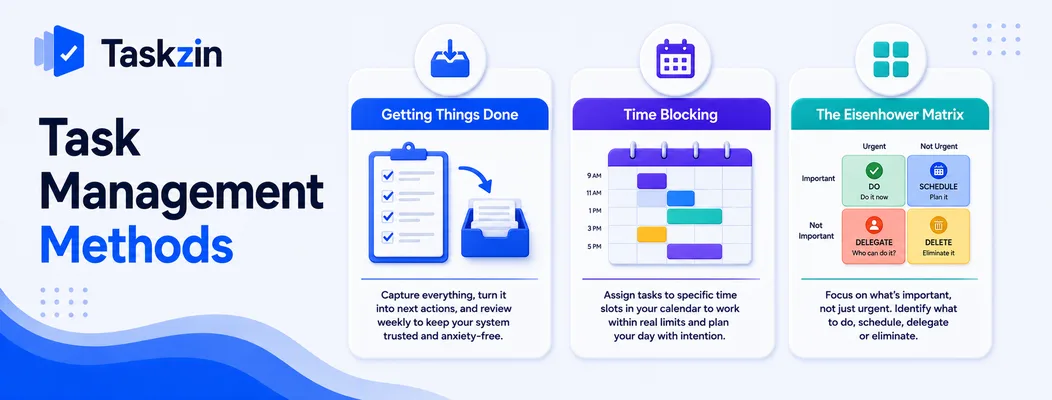
Three widely used methods solve different problems: Getting Things Done addresses forgetting, time blocking addresses over-commitment, and the Eisenhower matrix addresses confusing urgency with importance.
Getting Things Done
GTD's core idea is capturing everything into a trusted system, then converting each item into a concrete next action. The point is removing commitments from your head, where they generate background anxiety without producing progress.
Its essential practice is the weekly review — a scheduled pass through every list. Systems that skip it decay, because the list stops reflecting reality and stops being trusted.
Time blocking
Time blocking assigns tasks to slots in your calendar rather than leaving them on an open list. It confronts you with a real limit: a list holds thirty items, a day does not.
It works well for people whose lists grow faster than their capacity, because it forces the choice at planning time rather than at the end of a disappointing day.
The Eisenhower matrix
Sorting tasks by urgency and importance separates what feels pressing from what actually matters. The most useful output is the urgent-but-not-important quadrant, which is where delegable and deletable work hides.
Task Management Tools
Tools fall into personal apps optimised for capture speed, shared team tools optimised for ownership and visibility, and project software for when tasks start depending on each other.
Personal task apps
These prioritise speed. Natural language entry, keyboard shortcuts, and a clean daily view. They suit individuals managing a large volume of independent commitments.
Shared team tools
These prioritise clarity of ownership: who has what, when it is due, and what the current status is. Comments live on the task, so context stays attached to the work.
When a list stops being enough
Three signals indicate you have outgrown task management: tasks depend on each other and you are tracking the order mentally, several people need to see the same work, and someone has started asking for a status summary.
At that point a list needs manual coordination to stay accurate, which is precisely what project software exists to remove.
Frequently asked
What is task management?
The process of capturing, organising, prioritising and completing individual units of work, so nothing is forgotten and the right thing is worked on next.
What is an example of task management?
Recording four commitments after a meeting, adding dates to the time-sensitive ones, and reviewing the list each morning. At team level, a shared list of deliverables with one owner and a due date each.
What is the difference between task management and project management?
Task management tracks independent items. Project management coordinates related tasks with dependencies, timelines and reporting. The test is whether the order of the work matters.
What are the five stages of task management?
Capture, clarify, organise, do and review. Most systems fail at capture, because recording felt slower than remembering, or at review, because it was never scheduled.
What makes a good task description?
It starts with a verb, is small enough to complete in one sitting, and contains the context or links needed to start without searching for anything.
What is the best task management method?
It depends on the problem. GTD suits people who forget commitments, time blocking suits those who over-commit, and the Eisenhower matrix suits those confusing urgency with importance.
Do you need software for task management?
No — paper works for a small personal list. Software becomes valuable when tasks are shared, when you need reminders, or when the volume exceeds what you can review comfortably by hand.
Binita Ray is a content writer at Taskzin, creating insightful and practical content on task management, team collaboration, productivity, workflow optimization, and SaaS solutions. She focuses on helping businesses, teams, and professionals simplify their work processes, improve efficiency, and make better use of modern productivity tools.
All posts by Binita Ray
Comments