What Is the Critical Path Method?
A plain-English explanation of the critical path method, covering what the critical path is and what float means, the four-step calculation, a worked example, what the path tells you, how it compares to critical chain, and its limitations.


What is the critical path method?
The critical path method is one of the few genuinely mathematical techniques in project management. It takes a list of tasks with durations and dependencies and tells you, unambiguously, which of them determine your completion date.
That output is more useful than it first sounds. On most projects, a minority of tasks control the end date and everything else has slack — and managers routinely spend attention on the wrong ones.
This guide explains what the critical path is, how to calculate it, what it tells you, and where it breaks down.
Quick answer: Quick answer: The critical path method identifies the longest chain of dependent tasks through a project, which determines the shortest possible completion time. Any delay to a task on the critical path delays the whole project directly. Tasks not on it have float — spare time in which they can slip without affecting the end date.
What the Critical Path Actually Is
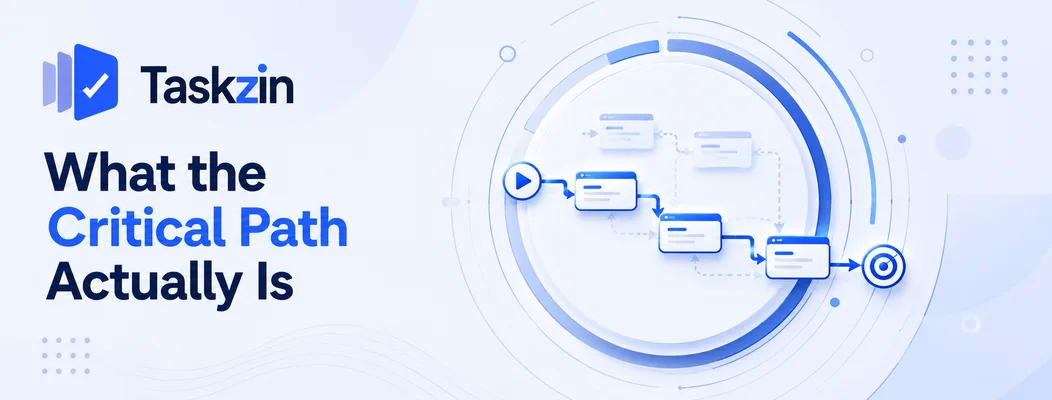
The critical path is the longest sequence of dependent activities from start to finish; because it is the longest, it sets the earliest possible completion date, and every task on it has zero float.
The longest path, not the most important tasks
"Critical" here is a technical term, not a judgement of importance. A task can be commercially vital and not on the critical path, and a trivial task can sit squarely on it.
This is the most common misunderstanding of the method. The critical path is about schedule mechanics, not about which work matters most to the customer.
Float: the slack that hides in a schedule
Float — also called slack — is how long a task can be delayed without pushing the project end date.
Tasks on the critical path have zero float by definition. Everything else has some, and knowing how much changes how you respond to a delay. A three-day slip on a task with eight days of float is genuinely fine; the same slip on a critical task costs three days of the project.
Why one path determines the end date
If two chains of work run in parallel and one takes twelve weeks while the other takes eight, the project cannot finish before twelve weeks regardless of how quickly the shorter chain completes.
That longer chain is the constraint. Accelerating anything else changes nothing, which is precisely the insight the method exists to provide.
How to Calculate It
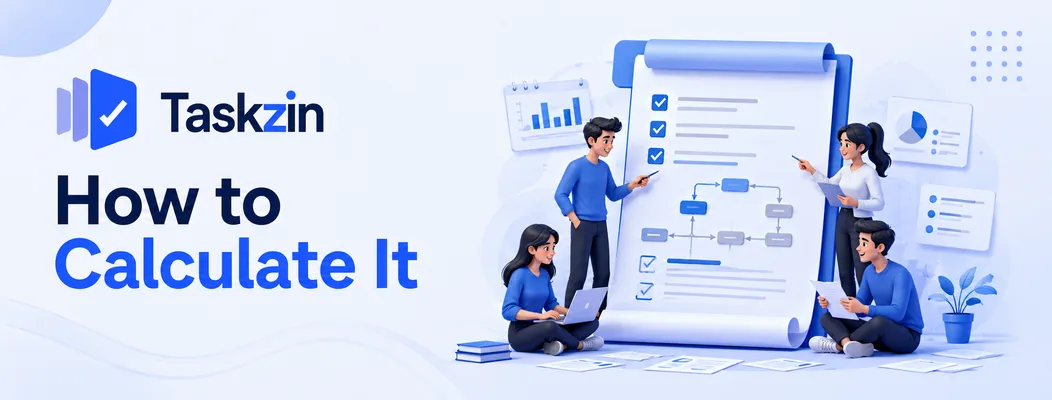
Calculating the critical path takes four steps: list activities with durations and dependencies, work forward for earliest dates, work backward for latest dates, then subtract to find float.
Step 1: List activities, durations and dependencies
Write down every activity, how long each takes, and which must finish before it can start. This produces a network of connected tasks.
The quality of this step determines everything after it. False dependencies make the schedule more rigid than reality, and missing ones make it optimistic.
Step 2: The forward pass — earliest dates
Starting at the beginning, calculate the earliest each activity can start and finish. An activity's earliest start is the latest earliest-finish among all its predecessors.
Working through to the end gives you the project's earliest completion date.
Step 3: The backward pass — latest dates
Starting from that completion date, work backwards to find the latest each activity can start and finish without delaying the project.
An activity's latest finish is the earliest latest-start among its successors.
Step 4: Float equals latest minus earliest
Subtract earliest start from latest start for each activity. The result is total float. Activities with zero float form the critical path.
Software does this automatically, but understanding the arithmetic matters — it is what lets you sanity-check a schedule that produces a surprising result.
A Worked Example
Five activities in a simple project:
Activity Duration Depends on Earliest start Latest start Float Critical?
A — Requirements 5 days — Day 0 Day 0 0 Yes B — Design 8 days A Day 5 Day 5 0 Yes C — Content 4 days A Day 5 Day 9 4 No D — Build 10 days B, C Day 13 Day 13 0 Yes E — Testing 3 days D Day 23 Day 23 0 Yes
The critical path is A → B → D → E, totalling 26 days. Content has four days of float, so it can start late or overrun by up to four days without affecting delivery.
What the Critical Path Tells You

Knowing the critical path tells you where to concentrate attention, which delays genuinely matter, and where to apply effort if you need to finish sooner.
Where to spend your attention
On a fifty-task project, perhaps twelve sit on the critical path. Those are the ones worth checking daily.
The remainder need monitoring rather than management. This is a substantial reduction in what a project manager has to hold in mind, and it is the method's most practical everyday benefit.
Which delays actually matter
When something slips, the first question is whether it was on the critical path. If not, check whether the slip exceeded its float. If it did not, no action is required.
This prevents both kinds of error: panicking about delays that do not matter, and ignoring small slips on critical tasks that do.
How to compress a schedule
If you must finish sooner, there are only two levers and both apply to the critical path.
Crashing means adding resources to critical tasks to shorten them, which costs money and has diminishing returns. Fast tracking means running critical tasks in parallel that were planned sequentially, which adds risk. Applying either to a non-critical task achieves nothing at all.
Critical Path Versus Critical Chain
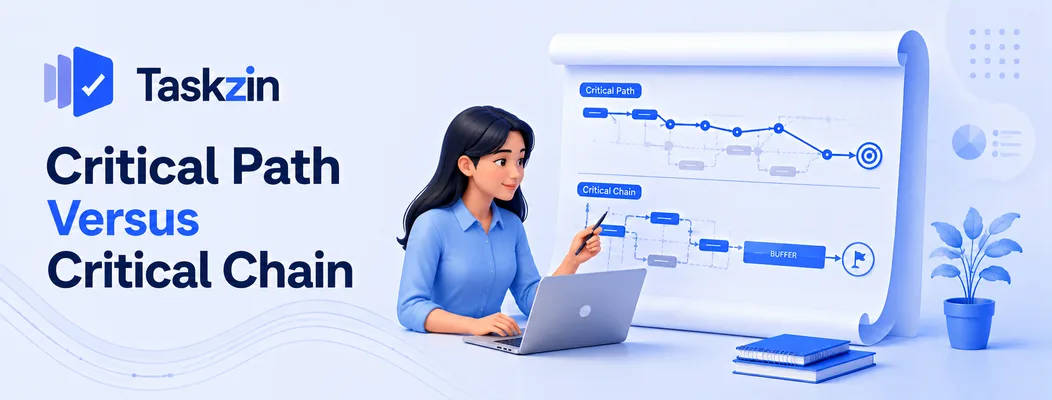
Critical chain extends the method by accounting for resource availability and by handling contingency differently — pooling buffer at the end rather than padding each task.
What critical chain adds
Critical path assumes resources are available whenever a task is ready. Critical chain accounts for the fact that the same person may be needed on two parallel tasks simultaneously.
It also changes how buffer works. Instead of padding each estimate, critical chain strips tasks to realistic durations and places a single visible buffer before the completion date, so you can see contingency being consumed.
When the difference matters
On projects where a few specialists are needed across many tasks, resource conflicts often constrain delivery more than dependencies do, and critical chain models that better.
For most projects the standard critical path method is sufficient, provided you check resource conflicts separately rather than assuming the schedule has handled them.
Limits of the Critical Path Method
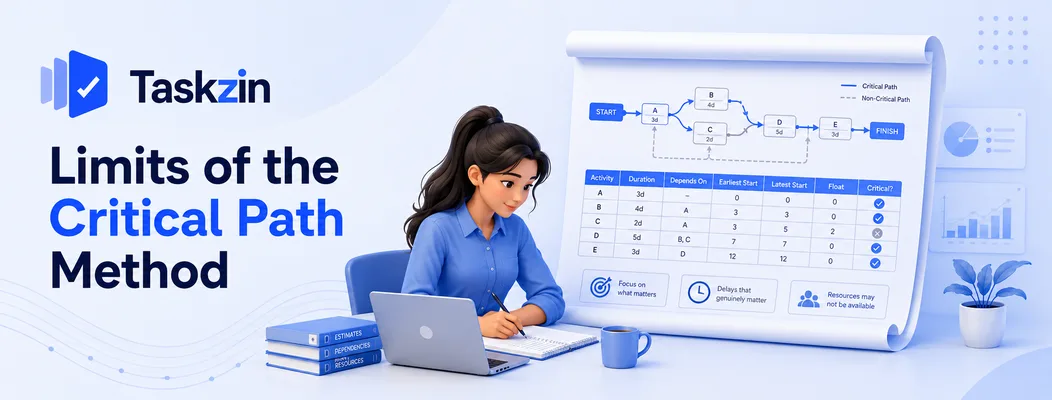
The method is only as good as your estimates, the path shifts as the project progresses, and it takes no account of whether the assigned people are actually available.
It assumes your estimates are right
The calculation is exact; the inputs are not. Durations are estimates, and estimates skew optimistic.
A precisely calculated critical path built on optimistic durations produces false confidence. The arithmetic cannot compensate for the guesses feeding it.
The path moves as the project changes
The critical path is not fixed. A task with five days of float that slips six days becomes critical, and the original path may no longer be.
Recalculate with every schedule update. Identifying the critical path once at kickoff and managing to it for six months is a common and costly error.
It ignores resource conflicts
Two parallel critical tasks both requiring the same engineer will not run in parallel, whatever the network diagram says.
Check resource allocation alongside the schedule. This is precisely the gap critical chain was developed to address.
Frequently asked
What Is the Critical Path Method?
A scheduling technique that identifies the longest chain of dependent tasks through a project. That chain determines the shortest possible completion time, and any delay on it delays the whole project.
How do you calculate the critical path?
List activities with durations and dependencies, perform a forward pass for earliest dates, a backward pass for latest dates, then subtract to find float. Activities with zero float form the critical path.
What is float in project management?
The amount of time a task can be delayed without pushing the project completion date. Critical path tasks have zero float; everything else has some, and knowing how much determines how you respond to a slip.
Can a project have more than one critical path?
Yes. When two or more chains have identical length, all are critical. This makes a schedule more fragile, since a delay anywhere on either path affects the end date.
What is the difference between critical path and critical chain?
Critical path considers dependencies only. Critical chain also accounts for resource availability and pools contingency into a single visible buffer rather than padding individual task estimates.
Does the critical path change during a project?
Yes, frequently. A non-critical task that slips beyond its float becomes critical. The path should be recalculated with every schedule update rather than identified once at the start.
Do you need software to find the critical path?
Not for a small project — the arithmetic is manageable by hand. Beyond about twenty activities, or when the schedule changes often, software recalculation becomes necessary in practice.
Binita Ray is a content writer at Taskzin, creating insightful and practical content on task management, team collaboration, productivity, workflow optimization, and SaaS solutions. She focuses on helping businesses, teams, and professionals simplify their work processes, improve efficiency, and make better use of modern productivity tools.
All posts by Binita Ray


Comments