How Do You Create a Project Plan? A 7-Step Guide
A step-by-step guide to creating a project plan, covering what a plan must answer, defining the work, building the schedule with dependencies and owners, adding risk buffer correctly, and keeping the plan current.

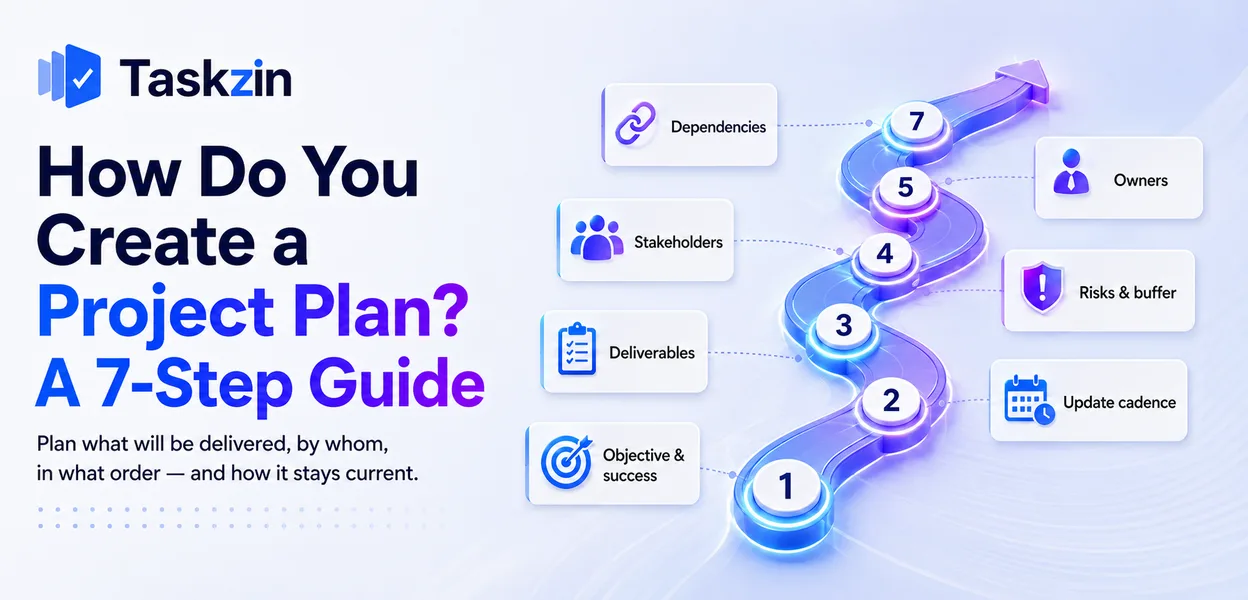
A project plan is not a list of dates. It is a set of decisions about what will be delivered, by whom, in what order, and what happens when reality intervenes.
This guide walks through each step and the mistakes that make plans unusable.
Quick answer: Create a project plan in seven steps: agree the objective and success criteria,
Step 2: Identify deliverables and break them down
sequence the work and find dependencies, estimate and assign owners, identify risks and place buffer at the project level, and agree how the plan will be maintained. The final step is the one most often skipped and the reason most plans become fiction within a month.
What a Project Plan Needs to Answer
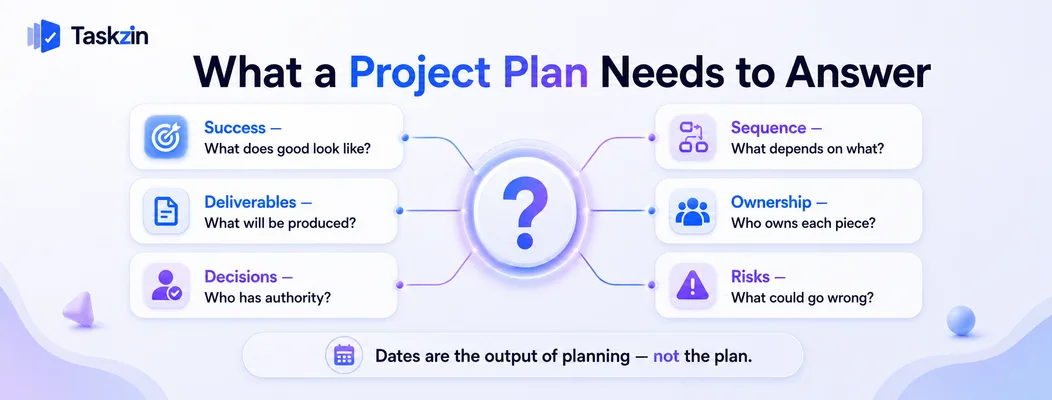
A plan must settle what success looks like, what will be produced, who decides, what order the work happens in, and how the plan itself will be kept honest.
More than a list of dates
A schedule with dates but no ownership, dependencies or success criteria cannot tell you anything useful when something slips.
The plan's value is in the relationships between items — what depends on what, what happens if this moves. Dates alone are the output of planning, not the plan.
The questions it must settle
What are we delivering. How will we know it worked. Who decides when there is a disagreement. What must happen before what. Who owns each piece. What could go wrong.
If your plan cannot answer these, it will not survive the first difficult week.
How detailed to make it
Detailed enough that each item can be estimated with confidence, and no more.
Over-planning is a real cost. A plan with three hundred items on a three-month project takes longer to maintain than it saves, and detail beyond about two months out is usually invalidated before it is used.
The Seven Steps at a Glance
Step What you produce Time (medium project) 1. Objective and success criteria Agreed measurable outcome Half a day 2. Deliverables and breakdown Work breakdown structure 1 day 3. Stakeholders and decisions Stakeholder and RACI map Half a day
4. Sequence and dependencies Ordered network, critical path Half a day 5. Estimates and owners Sized tasks with named owners 1 day 6. Risks and buffer Risk list, project-level buffer Half a day 7. Update cadence Agreed review rhythm 1 hour
Steps 1 to 3: Defining the Work
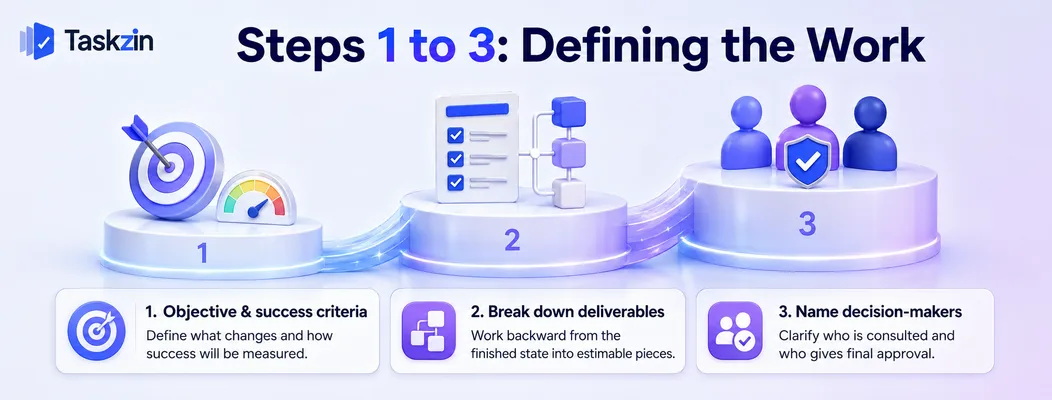
The first three steps establish what the project is delivering, what it consists of, and who has authority over it.
Step 1: Agree the objective and success criteria
Write one sentence describing what will be different when the project is done, then three to five measurable criteria proving it.
"Improve onboarding" is an objective without criteria. "Reduce time from signup to first project from four days to one" can be assessed. Projects without measurable criteria are judged on impressions at the end, which satisfies nobody.
Get this agreed with the sponsor before anything else. Every later decision refers back to it.
Step 2: Identify deliverables and break them down List everything the project must produce, then decompose each until you can estimate it — typically pieces representing one day to two weeks of work.
Work from the finished state backwards rather than from what you plan to do first. Forward planning produces a detailed beginning and a vague end, which is precisely the wrong shape.
The check is completeness: does everything under a heading add up to that heading fully? The moment it does not, you have found work you had not planned for.
Step 3: Name stakeholders and decision-makers
List who is affected, who must be consulted, and — critically — who decides when there is disagreement.
Ambiguity here causes delay throughout delivery. Knowing in advance who approves what avoids the common situation where work is finished and nobody is certain who signs it off.
Steps 4 to 5: Building the Schedule
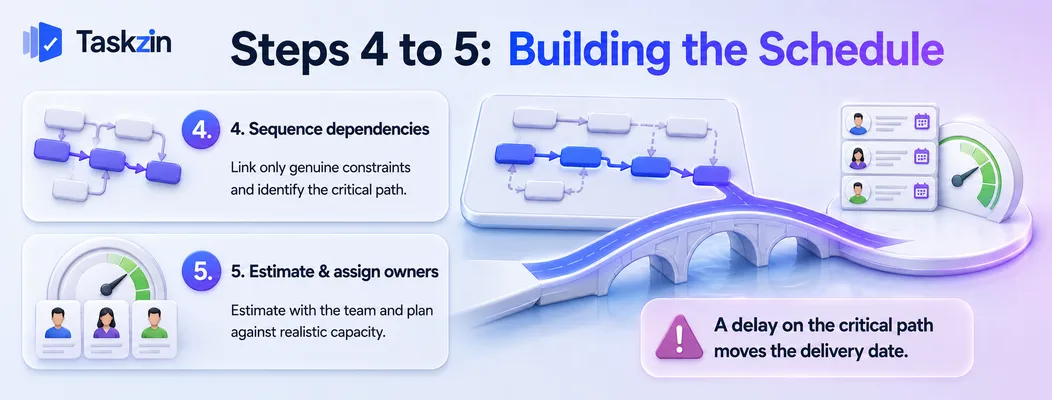
Sequencing reveals the critical path, and estimating with named owners turns a list of work into a plan someone has committed to.
Step 4: Sequence the work and find dependencies
Link items by what genuinely constrains what. Resist linking things that merely happen in a customary order — false dependencies make the plan more rigid than reality.
Once linked, the critical path emerges: the longest chain of dependent work, where any delay moves the end date directly. This is the most useful output of the whole exercise, because it tells you which few items deserve close attention.
Tools that recalculate this automatically are worth using here. A Gantt view with dependencies — Taskzin's timeline recalculates the critical path when dates change — means you can see immediately whether a slip is absorbed by float or moves delivery.
Step 5: Estimate and assign owners
Estimate each package with the people who will do the work, and give each one a named owner.
Estimates produced by the team are more accurate and, more importantly, owned. Estimates handed to people are neither.
Plan against realistic capacity rather than nominal hours. A full-time person delivers perhaps 60 to 75 percent of their week to project work once meetings, support and interruptions are accounted for.
Steps 6 to 7: Making It Survive Contact
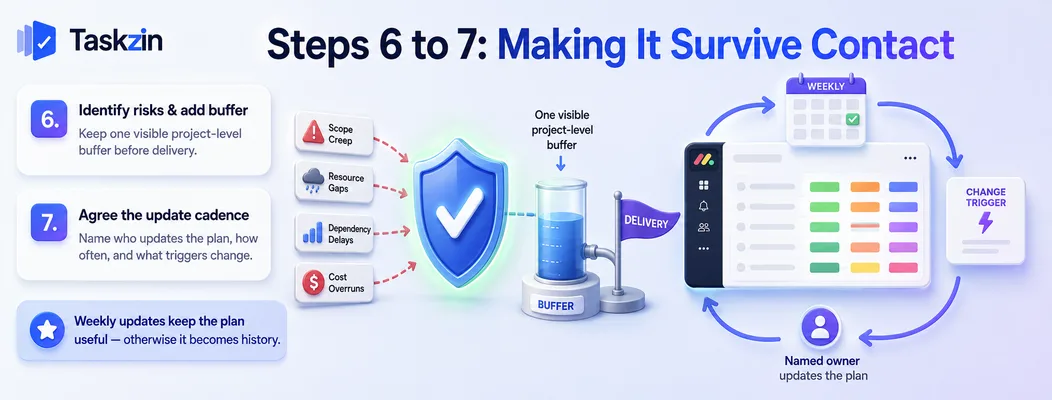
Identify what could derail the project and place buffer where it can be seen, then agree explicitly how the plan will be kept current.
Step 6: Identify risks and add buffer where it belongs
List the significant things that could go wrong, how likely each is, and what you would do.
Then add buffer — but at the project level, immediately before the delivery milestone, not spread across every task. Padding individual tasks hides your contingency and guarantees it gets consumed, because work expands to fill the time available. A single visible buffer lets you watch it deplete, which is information a padded schedule never gives you.
Step 7: Agree how the plan will be updated
Decide who updates the plan, how often, and what triggers a formal change.
Weekly progress recording is the minimum for most projects. Without an agreed cadence, the plan describes an increasingly historical version of the project and quietly stops being consulted.
This step takes an hour and determines whether the previous six were worth doing.
Common Project Planning Mistakes
The three errors that make plans fail are planning at full capacity, padding every task, and never updating after kickoff.
Planning at full capacity
Five people times twenty working days is one hundred person-days on paper and roughly sixty-five in practice.
Plans built on nominal capacity overrun from the first week. Use your team's measured focus factor.
Padding every task instead of the project
Adding 20 percent to every estimate produces a plan that is both too long and has no visible contingency. Each task consumes its padding, and you arrive at the end with nothing left.
Estimate honestly and hold one buffer where everyone can see it.
Never updating after kickoff
A plan is a model, and a model not fed actual data becomes fiction within weeks.
Thirty minutes weekly — mark real progress, adjust what moved, re-check the critical path — keeps it worth consulting. Without that, the plan becomes a document produced for the sponsor rather than a tool for running the project.
Frequently asked
How do you create a project plan?
In seven steps: agree the objective and success criteria, break down the deliverables, identify stakeholders and decision-makers, sequence the work and find dependencies, estimate and assign owners, identify risks and add buffer, and agree the update cadence.
What should a project plan include?
Objectives and measurable success criteria, a breakdown of deliverables, stakeholders and decision rights, sequenced tasks with dependencies, estimates and owners, milestones, risks, buffer, and an agreed review rhythm.
How long should project planning take?
Roughly 5 to 10 percent of the project duration. A three-month project warrants three to five days of planning. Substantially more usually indicates over-planning; substantially less produces plans that fail early.
What is the difference between a project plan and a schedule?
The schedule is the timeline — tasks and dates. The plan includes the schedule plus scope, success criteria, ownership, risks and how change will be handled.
How much buffer should a project plan have?
Commonly 10 to 20 percent of the total duration, held at the project level before the delivery milestone rather than distributed across individual tasks where it becomes invisible.
How often should a project plan be updated?
Weekly for most projects — record actual progress, adjust what moved, re-check the critical path. A plan updated monthly identifies problems about a month after they could have been fixed cheaply.
Do agile projects need a project plan?
They need a lighter one: objective, success criteria, high-level milestones and known constraints. The detailed schedule is replaced by a prioritised backlog and forecasting from velocity or throughput.
Binita Ray is a content writer at Taskzin, creating insightful and practical content on task management, team collaboration, productivity, workflow optimization, and SaaS solutions. She focuses on helping businesses, teams, and professionals simplify their work processes, improve efficiency, and make better use of modern productivity tools.
All posts by Binita Ray

Comments